History

President Roosevelt
President Roosevelt, also known as Franklin D. Roosevelt, was the 32nd President of the United States, serving from 1933 to 1945. He is best known for his leadership during the Great Depression and World War II, implementing the New Deal to address economic challenges and leading the country through a period of significant global conflict. His presidency had a lasting impact on American politics and society.
Written by Perlego with AI-assistance
Related key terms
1 of 5
12 Key excerpts on "President Roosevelt"
 eBook - ePub
A Companion to U.S. Foreign Relations
Colonial Era to the Present
- Christopher R. W. Dietrich(Author)
- 2020(Publication Date)
- Wiley-Blackwell(Publisher)
Chapter Eighteen Insulation : The Presidency of Franklin D. Roosevelt During the Years 1933–1941Kiran Klaus PatelThe presidency of Franklin D. Roosevelt (1933–1945) is often seen as a pivotal and transformative period in the history of American foreign relations. The United States played a crucial role in World War II and emerged from the conflict as one of the world's two superpowers, wielding global influence as never before. Roosevelt himself is often associated with a particularly internationalist brand of foreign policy, even if his approach was not canonized in a neologism, as in the case of his Democratic predecessor, Woodrow Wilson – there is no “Rooseveltism” to match “Wilsonianism.” Interestingly, the term most closely associated with FDR's presidency – the New Deal – is normally reserved for his pre‐war domestic policies. And while some of the defenders of the 32nd president praise his foreign policy and describe him as a capable and farsighted statesman, others have been much more critical, accusing him either of a lack of vision and a politics of procrastination or of leading the country into a needless war. To this day, Roosevelt's foreign policies remain highly controversial and evade easy categorization.This chapter examines the foreign relations of the Roosevelt presidency until 1941, when the United States joined World War II. It advances in three steps. In the first, it provides a succinct summary of the main historiographical trends and interpretations. The second summarizes my own arguments in this context, before the third points to new avenues of research. In sum, the chapter seeks to demonstrate that the pre‐1941 Roosevelt presidency deserves more attention that it has experienced to date. Research has to go further in overcoming old categories and dichotomies, such as isolationism versus internationalism, and in challenging established but too‐narrow differentiations between foreign affairs and domestic politics. Finally, the chapter argues for a more global approach to the history of U.S. foreign relations by bringing in transnational and comparative perspectives. eBook - ePub
The Presidential Difference
Leadership Style from FDR to Barack Obama - Third Edition
- Fred I. Greenstein(Author)
- 2012(Publication Date)
- Princeton University Press(Publisher)
Very often when some matter was being fought out with his advisers, he would bring up the question at dinner and bait me into giving an opinion by stating as his own a point of view with which he knew I would disagree. He would give me all the arguments which had been advanced to him, and I would try vociferously and with heat to refute them. I remember one occasion … when I became extremely vehement and irritated. My husband smiled indulgently and repeated all the things that everyone else had said to him. The next day he asked Miss Thompson if she could have tea in the West Hall in the White House for him and Robert Bingham, who was then our Ambassador to London and about to return to his post.I dutifully served them with tea, fully expecting to sit and listen in silence to a discussion of questions with which I probably would not be in agreement. Instead, to my complete surprise, I heard Franklin telling Ambassador Bingham to act, not according to the arguments that he had given me, but according to the arguments that I had given him! Without giving me the satisfaction of batting an eyelash in my direction, he calmly stated as his own the policies and beliefs he had argued against the night before! To this day I have no idea whether he had simply used me as a sounding board, as he so often did, with the idea of getting the reaction of the person on the outside, or whether my arguments had been needed to fortify his decision and to clarify his own mind.– ELEANOR ROOSEVELT ,This I Remember , 1949T he force of nature known as Franklin Delano Roosevelt swept into the presidency on March 4, 1933, and remained there until his death on April 12, 1945, three months into his fourth term. By then the United States had become a world power and a nascent welfare state, and the presidency itself had undergone a fundamental transformation, replacing Congress as the principal energy source of the political system. Roosevelt was not solely responsible for these changes, but without him American history would have been different, not just in its details but in its larger contours.A RARIFIED UPBRINGING
It is difficult to imagine a more unlikely candidate for the leader of a powerful coalition of blue-collar workers, labor unions, and ethnic minorities than Franklin Roosevelt. He was born on January 30, 1882, and raised on the Hudson River Valley estate of his family in Hyde Park, New York. He was the only child of James Roosevelt, a wealthy landowner who traced his ancestry to seventeenth-century New Amsterdam, and Sara Delano Roosevelt, who came from a moneyed family that went back to the founding of Plymouth Colony in 1621. eBook - PDF
My Fellow Americans
Presidential Addresses That Shaped History
- James C. Humes(Author)
- 1992(Publication Date)
- Praeger(Publisher)
11 Franklin Roosevelt's First Inaugural: The Rhetoric of Recovery Let me again assert my firm belief that the only thing we have to fear is fear itself. Franklin Delano Roosevelt was more than a president—he was a presence. In the 1930s his reassuring patrician tones were a familiar voice in American homes. He was the first president to project his personality into the family living room. If radio in that decade became the focal centerpiece of furniture, Roosevelt, more than any commentator or entertainer, commanded its air waves. His intimate chats were models of conversational intimacy. They invited a credibility lacking in the frenetic cant and histrionic excesses of the typical politician heard at a local courthouse rally. Roosevelt seemed more real to them, and his presence, still attested today by a yellowing photograph of that regal profile in countless Appalachian and African- American homes more than a half-century later, represented a source of hope. When President Franklin Roosevelt took his inaugural oath in March 1933, America was stricken with its worst economic crisis in history. If, as historians suggest, the recovery by the United States during his adminis- tration was accomplished more by the mobilization for World War II than by his New Deal programs, he did permanently restructure government foundations and reshape the presidency as an institution. The agency for this political revolution were the rapidly expanding powers of the federal government. The catalyst for that expansion was the charisma of Franklin Roosevelt, whose voice radiated his innate buoyancy and self-confidence. The president became more than just chief of state or chief executive. The 146 My Fellow Americans president emerged as "chief guarantor" of economic hopes and opportu- nities. Franklin Roosevelt, who marshalled the war against depression, had little in his childhood that suggested darkness and despair. eBook - PDF
- Stephen Hess, James P. Pfiffner(Authors)
- 2002(Publication Date)
- Brookings Institution Press(Publisher)
The government Roosevelt inherited had neither the structure nor the personnel to deal with the most serious economic crisis in the nations history. The new president would change that forever, not simply by enlarging the government but by fundamentally redefining its goals and the way it achieved them. He would, in effect, be the first person to be the presiding officer of the modern presidency. But he certainly had no coherent plan. Despite having been governor of the most populous state, he was not much interested in the traditional forms of administration. The Presidency is not merely an administrative office, he told Anne O'Hare McCormick in 1932. That's the least of it. It is more than an engineering job, efficient or inefficient. It is pre-eminently a place of moral leadership. 3 He was to stay in office long enough to give special weight to his view. His administrative predilections were to be flexible, to work informally, often outside the nor-mal chain of command, to give competing assignments, to keep shifting the composition of his inner circle, to marshal support through adroit appeals to the public, and to maintain himself at the center of the action. A gener-ation of political scientists would make of this style a virtue by which to measure subsequent presidents. In staffing the administration Roosevelt generally relied on five (often overlapping) sources of talent: —The friends and colleagues of his young years, contemporaries in Washington such as Daniel Roper, William Phillips, Breckinridge Long, and William Bullitt when Roosevelt was assistant secretary of the navy under Woodrow Wilson, and more important, a small band of supporters (Louis McHenry Howe, Stephen Early, Marvin Mclntyre) who had rec-ognized his political potential, in some cases as early as during his pre-World War I tenure in the New York state legislature. —Those who had been in his state administration (Frances Perkins, Henry Morgenthau Jr., Harry Hopkins, Samuel Rosenman).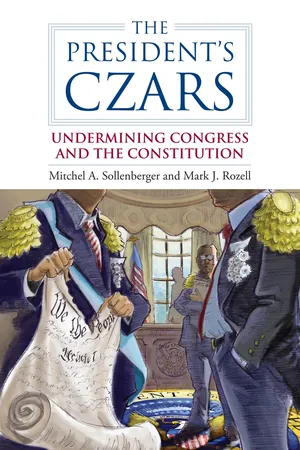 eBook - PDF
The President's Czars
Undermining Congress and the Constitution
- Mitchel A. Sollenberger, Mark J. Rozell(Authors)
- 2015(Publication Date)
- University Press of Kansas(Publisher)
FDR himself had precedents from which he could draw. Franklin D. Roosevelt’s admiration of both Woodrow Wilson’s and Theodore Roosevelt’s style of governing is well documented. Even though the two had in-frequent contact, Roosevelt learned much from working in Wilson’s administra-tion. One scholar of the period explained: “A veteran of the Wilson era, Franklin Roosevelt clearly cherished his progressive roots.” An often-used example of FDR’s view of the presidency comes from his 1942 speech demanding that Congress act to repeal a provision of the Emergency Price Control Act. He stated that inaction by Congress “will leave me with inescapable responsibility to the people of this country to see to it that the war effort is no lon-ger imperiled by threat of economic chaos.” Continuing, he declared: “In the event that Congress should fail to act, and act adequately, I shall accept the responsibil-ity, and I will act.” Edward S. Corwin found Roosevelt’s remarks to be alarming and wrote that they could “only be interpreted as a claim of power on the part of the President to 54 chapter three suspend the Constitution in a situation deemed by him to make such a step nec-essary.” Roosevelt’s claim to such power to nullify the law at will had never been asserted so boldly by a president. Even English monarchs had been unable to ex-ercise such authority since before the Glorious Revolution. The framers were well aware of British history and rejected the ability of chief executives to ignore law. Instead, they placed within the Constitution a duty on presidents to “take care that the laws be faithfully executed.” Asserting the right to dispense with duly enacted laws thus goes well beyond even the most expansive views of the presidency that Theodore Roosevelt and Woodrow Wilson asserted. FDR’s tenure in office thus represents the last significant step to what is now considered to be the model for the modern presidency. eBook - PDF
U.S. Foreign Policy
A Documentary and Reference Guide
- Akis Kalaitzidis, Gregory W. Streich(Authors)
- 2011(Publication Date)
- Greenwood(Publisher)
Roosevelt 105 President Franklin D. Roosevelt delivers one of his popular fireside chats, a series of evening radio talks to the American public. Roosevelt used these chats to explain New Deal programs during the Great Depression and war policies during World War II. (Library of Congress) American independence, and all of the things that American independence means to you and to me and to ours. Tonight, in the presence of a world crisis, my mind goes back eight years to a night in the midst of a domestic crisis. It was a time when the wheels of American industry were grinding to a full stop, when the whole banking system of our country had ceased to function. I well remember that while I sat in my study in the White House, preparing to talk with the people of the United States, I had before my eyes the picture of all those Americans with whom I was talking. I saw the workmen in the mills, the mines, the factories, the girl behind the counter, the small shopkeeper, the farmer doing his spring plowing, the widows and the old men wondering about their life’s savings. I tried to convey to the great mass of American people what the banking crisis meant to them in their daily lives. Tonight, I want to do the same thing, with the same people, in this new crisis which faces America. We met the issue of 1933 with courage and realism. We face this new crisis, this new threat to the security of our nation, with the same courage and realism. Never before since Jamestown and Plymouth Rock has our American civilization been in such danger as now. For on September 27th, 1940—this year—by an agreement signed in Berlin, three powerful nations, two in Europe and one in Asia, joined them- selves together in the threat that if the United States of America interfered with or blocked the expansion program of these three nations—a program aimed at world control—they would unite in ultimate action against the United States. eBook - ePub
U.S. Foreign Policy
A Documentary and Reference Guide
- Akis Kalaitzidis, Gregory W. Streich(Authors)
- 2011(Publication Date)
- Greenwood(Publisher)
President Roosevelt was an astute politician, and he used his powers to evade the Neutrality Acts in order to gently mobilize his country toward eventual entry into the war, in 1941. He used his persuasive powers in a series of “fireside chats” broadcast by radio to argue that the United States, even though neutral, could not avoid seeing the moral imperatives in the war being waged in Europe. He called for America to be the “arsenal of democracy” against fascism and, even though bound by law, he found ways to help Britain in its battle against Germany. He gave Britain destroyers from the U.S. Navy in exchange for military bases, he expanded the U.S. Navy’s control of the western Atlantic all the way to Iceland, and he invented a further way of helping the financially devastated British government through a “lend/ lease” program. He argued that the executive branch should be uninhibited in its duties as the primary foreign policymaker in the United States and used his powers to punish Japanese aggression in China by imposing trade sanctions on Japan. This last move, however, backfired when the military-dominated government of Japan responded not by pursuing a negotiated settlement with the United States but by initiating a war with the United States when it attacked the U.S. naval base in Pearl Harbor, Hawaii, on December 7, 1941, an attack that killed thousands of U.S. sailors and destroyed several ships. American neutrality was no more, and within days, the United States entered World War II on two fronts.During FDR’s presidency, the United States improved its domestic economy by establishing new regulatory agencies and laws governing the workplace, emerged victorious from World War II, firmly established itself in Latin America, and, finally, acquired new interests in the Middle East, Southeast Asia, and elsewhere around the globe. FDR’s foreign policy achievements cannot be overstated; he was not only an effective manager of the war and its contingencies but a great leader with the foresight to set a long-term agenda for the United States. He also helped create the United Nations, carrying forward the Wilsonian notion that an international body could potentially prevent future conflicts from blossoming into full-scale wars. At the end of World War II, the future for the United States was bright: It emerged as a global superpower, taking over from the British, who had to adjust to their new status as a second-class global power. World War II saw the beginning of the dismantling of the British and French empires and the emergence of the United States as a preeminent economic, military, and political power on the world stage.On the other hand, FDR’s policies in regions such as Latin America and the Middle East sowed the seeds of future wars and conflicts that would challenge future U.S. presidents. FDR’s negotiations with Middle Eastern powers such as Iran and Saudi Arabia were the cornerstone of a Middle East policy that remains problematic, and his involvement in Southeast Asia would lead to U.S. involvement in a war in Vietnam that could not be won. His commitments to wartime allies would create a great deal of resentment after the war was over, in the Soviet Union and China, for example, and would plunge the United States into a “Cold War” that would completely transform the United States and the world once again. eBook - ePub
Perspectives on Presidential Leadership
An International View of the White House
- Michael Patrick Cullinane, Clare Frances Elliott(Authors)
- 2014(Publication Date)
- Routledge(Publisher)
FDR’s support of Britain as a bulwark against Nazism—even though the United States was still officially a neutral in the war—gave rise to what Churchill called the Anglo-American special relationship, symbolized by the meeting between FDR and Churchill in August 1941, off the coast of Newfoundland, that resulted in the Atlantic Charter. When the United States officially joined the war following the Japanese attack on Pearl Harbor, FDR acted decisively to issue the United Nations Declaration on January 1, 1942. FDR’s achievement in assembling and leading a Grand Alliance of 25 nations against the Axis powers of Germany, Italy, and Japan is reason enough to rate him as the greatest of all American presidents in terms of his foreign policy record. 31 But, even beyond this, he was primarily responsible for establishing the United Nations organization at the end of the war to replace the discredited League of Nations. FDR had, of course, been a member of Woodrow Wilson’s administration and a strong supporter of the League when he was the Democrats’ vice presidential candidate in the 1920 election. But the strength of isolationists in the United States after 1920 and the need to disarm their opposition when seeking the presidency in 1932 had caused him to declare that he no longer favored U.S. membership in the League. However, in September 1939, he authorized the State Department to start planning for a new postwar international organization that would draw lessons from the failure of the League. The result was the United Nations, located in New York rather than in Geneva, and safeguarding American interests by giving the United States (and the other great powers) a veto over major decisions taken by the Security Council. 32 Roosevelt has been criticized by some historians for misjudging Stalin and for giving away too much at the Yalta Conference in order to secure Stalin’s support for the United Nations
- Halford Ryan, Halford Ryan, Halford R. Ryan(Authors)
- 1993(Publication Date)
- Praeger(Publisher)
Confronting widespread economic depression and worldwide military engagements required that Roosevelt diminish his emphasis upon America's greatness while stressing the historic faith that is es- sential in perpetuating that greatness. 5 The principal rhetorical purpose pervading Roosevelt's Fourth was inspirational. In this sense, the speech was more contemplative than deliberative. The president reported that the nation's war efforts were progressing toward an eventual victory, that the coming success would promote human civilization, and that Americans' confidence in victory was sustained by the correctness of the country's objectives. What ap- peared astounding was Roosevelt's undiminished optimism about the long-range progress of human civilization. The president's vision was not restricted by the short-range perspective from a contemporary ca- tastrophe. Indeed, Roosevelt examplified how a classical education equips an aspiring speaker with an essential philosophical predisposi- tion, an expanded historical perspective, and a familiarity with the world's great literature. 6 ROOSEVELT'S DELIVERY Self-confident, gregarious, and exuberant, Roosevelt developed a rhe- torical delivery that projected competence, dynamism, and authority. FRANKLIN D. ROOSEVELT, 1945 133 The president's resonant tenor voice was usually modulated carefully and controlled conscientiously in rhythmic cadences and emphatic phrases that evoked sensations of strength and sincerity. His charm bespoke enormous confidence and unshaken conviction. Employing carefully crafted phrases and instantly intelligible sentences, Roosevelt achieved a crystal-clear certainty and dramatic emphasis within his lis- tening audiences, although his hearers embraced diverse political per- suasions. Films recording Roosevelt's Fourth Inaugural preserved in his presi- dential library at Hyde Park, New York, indicate that even with a di- minished dynamism and subdued enthusiasm, Roosevelt remained effective. eBook - ePub
- William D. Pederson(Author)
- 2011(Publication Date)
- Wiley-Blackwell(Publisher)
Roosevelt through Foreign Eyes (1961). A native of Slovakia, which was a part of the Austro-Hungarian Empire at the time of his birth, Halasz was trained in both the law and journalism but devoted himself to a writing career after coming to the United States in 1941. The purpose of his book was to analyze Roosevelt in light of his impact on world opinion. He succeeded in producing a reasonably accurate appraisal of the interest in and the understanding of the New Deal among serious writers in England, France, Switzerland, and even Germany, at least until the late 1930s. The result was useful, but by no means complete.In 1982, Joseph Alsop published FDR, 1882–1940: A Century Remembered (1982), a sentimental celebration of Roosevelt’s centennial birthday. The following year, a journalist attempted a more serious biography. This time it was Nathan Miller, an award-winning author of 12 books of biography and history. FDR: An Intimate History (1983), a lengthy tome (563 pages), is based largely on well-documented secondary sources and thus adds no new facts or interpretations that would be of interest to Roosevelt scholars. However, it is skillfully written and was popular with the general reading public when it appeared. The major problem with the book is its lack of balance. More than 300 pages are devoted to the period before the presidency and only 40 pages to World War II.By far the best Roosevelt biography by a journalist, Franklin Delano Roosevelt: Champion of Freedom (2005), has come from Conrad Black. Formerly the chairman and chief executive officer of Hollinger International, Inc., whose newspaper holdings include the Daily and Sunday Telegraph and The Spectator in London, the Chicago Sun-Times , and the Jerusalem Post, Black entered the British House of Lords as Lord Black of Crossharbour in 2001. Although his political views are generally conservative, he is a great fan of Roosevelt. He argues that FDR was the most important person of the twentieth century because he transformed the United States and the world with unequaled skill as a politician, war leader, strategist, and visionary. His interpretation offers a stark and persuasive contrast to those of Burns and Davis.AssociatesThe first of Roosevelt’s closest associates to attempt a biography was Frances Perkins, in The Roosevelt I Knew eBook - PDF
Voting Deliberatively
FDR and the 1936 Presidential Campaign
- Mary E. Stuckey(Author)
- 2015(Publication Date)
- Penn State University Press(Publisher)
The 1930s were notable for the rise of plebiscitary politics, which are associated with a personalized understand- ing of politics, reliance on public opinion, and the spectacular: government had increasingly to be seen to be understood as legitimate. 10 Roosevelt enabled the rhetorical presidency and the consequent imbalance in presidential power vis-à-vis that of Congress. 11 Paradoxically, then, FDR sought to facilitate delib- erative politics, often stressing the need for an educated and active electorate, and at the same time engaged in political practices that disabled some of the deliberative potential of national elections. introduction 5 In the short run, these practices contributed to both a winning campaign in 1936 and a coalition that dominated American politics for decades. Equally important, in my view, is that they continue to affect the ways in which the public and its opinions are understood by those in power. They also affect the ways in which the public deliberates during elections and the kinds of questions that are the subject of their deliberation. Roosevelt probably never intended any of these consequences. But they are unmistakably rooted in his conception of politics and political leadership. The contours of that leadership were made abundantly clear during his first term and especially in the kinds of support and opposition generated during that term that formed the basis for his coalition building during the 1936 election. Prologue to the First Term October 29, 1929, “Black Tuesday,” is the conventional marker of the beginning of the Great Depression and the primary cause of Roosevelt’s first election in November 1932. Between the crash and the election stood three years of deep- ening economic crisis. Attempting to protect the nation’s farmers, Congress passed the Smoot-Hawley Act in 1930, which led to an eruption of retaliatory measures in Europe and drastically disrupted international trade. eBook - PDF
- Alan Brinkley(Author)
- 2000(Publication Date)
- Harvard University Press(Publisher)
1 The Rise of Franklin Roosevelt In 1945, shortly after Franklin Roosevelt died, Woodie Guthrie wrote a song he called “Dear Mrs. Roosevelt”—a song intended to serve as both a condolence and a tribute. In it Guthrie described several important events and accomplishments of Roosevelt’s life (not all of them accu-rately) and punctuated his account with the refrain “The world was lucky that he walked.” Through much of his life, of course, Franklin Roosevelt could not walk, as Guthrie probably knew. But to Guthrie, as to many other Americans of his generation, he seemed for a time to bestride the earth; and the literal truth of his life seemed less important than the powerful image he had—half purposefully, half inadvertently—created in the popular imagination. 1 Even a half-century later, Roosevelt’s reputation seems unusually malleable. Public ªgures across the ideological spec-trum try to seize a piece of his legacy—at times to justify their efforts to dismantle it—without much concern about who Roosevelt himself ac-tually was or what he actually did. In the popular mind, Roosevelt the icon has transcended Roosevelt the president, Roosevelt the politician, Roosevelt the New Dealer, and Roosevelt the man. He has become a ªgure of myth: a man for all seasons, all parties, and all ideologies. But Roosevelt the man was not an icon. He was, rather, a compli-cated, elusive, at times even devious ªgure. He was both a friend of the common people, as Woody Guthrie believed, and a creature of the American aristocracy. He was both a great statesman and a consummate defender of his own political self interest. He was generous as well as 1 vindictive. He was capable of broad vision and petty deceit. He had millions of friends and no intimates. Even those who felt closest to him knew only a small part of his carefully concealed inner self.
Index pages curate the most relevant extracts from our library of academic textbooks. They’ve been created using an in-house natural language model (NLM), each adding context and meaning to key research topics.

