History

President Eisenhower
President Dwight D. Eisenhower, also known as "Ike," served as the 34th President of the United States from 1953 to 1961. A highly respected military leader, he is best known for his leadership during World War II as Supreme Commander of the Allied Expeditionary Forces in Europe. As President, he focused on domestic issues, including civil rights and the economy, and pursued a policy of containing communism abroad.
Written by Perlego with AI-assistance
Related key terms
1 of 5
11 Key excerpts on "President Eisenhower"
 eBook - ePub
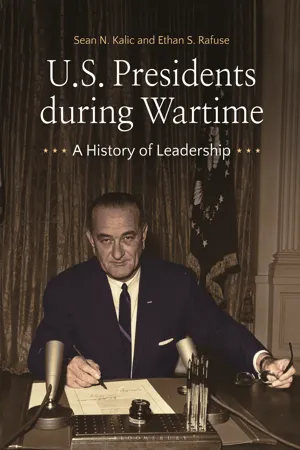
U.S. Presidents during Wartime
A History of Leadership
- Sean N. Kalic, Ethan S. Rafuse(Authors)
- 2023(Publication Date)
- Bloomsbury Academic(Publisher)
As a testament to his impressive abilities and keen intellect, Eisenhower, in his farewell address to the nation, warned the United States about the expansion and growth of the “military industrial complex” and cautioned the nation about the need to maintain the proper balance between the proverbial “guns and butter.” This was a point he had been making throughout his presidency in explaining his approach to the hot war he inherited in Korea and the ongoing Cold War with the Soviet Union. After leaving the presidency, Eisenhower retired to his farm in Gettysburg and lived a relatively quiet life. He played golf, tended to his garden, painted, and focused on establishing his presidential library in Abilene, Kansas, which was to be built on the land of his boyhood home. In March 1969, Eisenhower died, and his family buried him in April 1969 in the chapel on the grounds of his presidential library.Analysis“Duty,” “honor,” and “country” are the three words that definitely characterize the impact Dwight D. Eisenhower had on the U.S. military as well as the nation as a whole. From his first days at West Point, he dedicated himself to the nation and strove to make it better. As a young officer, although he wished to go to Europe and fight in World War I, he dutifully accepted his assignments as a training officer to prepare men for combat in Europe.In Europe, during World War II, Eisenhower flourished as he led the allies from operations in North Africa to planning and overseeing the largest amphibious assault in history, when the Allies landed on the beaches of Normandy, France, in June 1944. After commanding the Allies until the end of the war, Eisenhower took a short break in his military commitments to serve as president of Columbia University until being called back to active duty personally by President Harry S. Truman to serve as supreme Allied commander of NATO. Believing that he had finally finished his military commitments in May 1952, Eisenhower retired from the military. Yet this did not end his commitment to the nation.Serving two terms as president of the United States, Eisenhower ensured that the United States presented an unwavering force in the Cold War with the Soviet Union and its communist allies. Although he was deeply committed to stopping the encroachment of communism, he maintained a calm, steadying hand over the management of the nation’s civil and military affairs. Although many people in the United States saw Eisenhower as more of a manager when he was president of the United States, he was careful to allow this image to be cultivated because it diverted attention away from him specifically. Yet he worked quietly at the center of major policy debates and labored over the pivotal decisions of his administration. He was indeed a strong president who did not seek the limelight but only wanted what was best for the nation. In the end, Eisenhower’s enduring legacy is that of duty, honor, and country, which continues to inspire and motivate people around the world to strive to improve those around them and their country in the process. eBook - ePub
Abolishing the Taboo
Dwight D. Eisenhower and American Nuclear Doctrine, 1945-1961
- Brian Madison Jones(Author)
- 2011(Publication Date)
- Helion and Company(Publisher)
Biographers such as Herbert Parmet and Robert Divine lauded Eisenhower’s execution of political leadership at home and abroad. 27 Parmet’s treatment of Eisenhower accentuated the president’s “remarkable record,” noting that Eisenhower was careful and conservative. He navigated a steady, middle-of-the-road course for the nation. He was not a political genius, but he possessed natural political instincts that allowed him to operate successfully within his party and his government. 28 In Eisenhower and the Cold War, Robert Divine concluded that Eisenhower, not John Foster Dulles, was the architect of the administration’s Cold War foreign policy. The president exercised great skill, patience, and caution in negotiating the dangerous diplomatic world he inherited, Divine continued. He argued that Eisenhower’s great foreign policy successes were inherently negative: “He ended the Korean War, he refused to intervene militarily in Indochina, he refrained from involving the United States in the Suez crisis, he avoided war with China over Quemoy and Matsu.” While he recognized that Eisenhower experienced failures in Cuba and Vietnam, where problems lingered for later administrations, Divine praised the president as an advocate of peace and restraint amidst a throng of cold warriors. 29 In the realm of nuclear issues, revisionists paint Eisenhower as an energetic, active president who occupied a central role in the formulation of nuclear policy and who pursued, above all else, peace in a world threatened by thermonuclear war. These authors conclude that, as he labored to achieve peaceful uses for atomic science, “Eisenhower dominated the formulation of nuclear policy in a way that no other President has before or since.” In Atoms for Peace and War, historians Richard Hewlett and Jack Holl argued that Eisenhower presided over the origins of the nuclear world and they described Eisenhower’s approach to nuclear policy as consistently proactive, committed, and energetic eBook - PDF
- Stephen Hess, James P. Pfiffner(Authors)
- 2002(Publication Date)
- Brookings Institution Press(Publisher)
CHAPTER Dwight D. Eisenhower I 953~ I 9 61 If a new administration appears to be a tabula rasa, it is not because the tablet is blank but because the writing is invisible. It is there. But it is best dis-cerned after the fact, when those traits and experiences in a president's back-ground that are casual can be distinguished from those that are causal in that they determined the shape and the organization of his presidency. D wight D. Eisenhower, elected president in 1952, was a genial, shrewd, optimistic, confident, successful small-town American of sixty-two years. He had devoted his life to government service in the military, and although he was a newcomer to partisan politics, he was skilled at bureaucratic poli-tics. He had spent much time abroad, which gave a somewhat anomalous internationalist cast to his otherwise conventional beliefs. His aspirations as president were limited to two overriding objectives: peace abroad and a bal-anced budget at home. In keeping with those aspirations, his view of the presidential role was circumscribed. Eisenhower followed the pattern characteristic of the modern presidency by reacting to the style of the president who preceded him. As Roosevelt, the disorganization man, was followed by the tidy Harry Truman, so Eisenhower saw the purpose of his presidency as trying to create an atmos-phere of greater serenity and mutual confidence in the wake of the cocky controversialist whose legacy, he felt, was an unhappy state . . . bitterness 49 5 50 Dwight D. Eisenhower . . . quarreling. 1 (Truman, of course, would have argued that presidential prestige is meant to be used to force desirable actions.) Later, the youthful Kennedy would react to the aging Eisenhower, and so on, back and forth in the whipsaw fashion that almost defines a principle of contrariness in pres-idential succession. eBook - ePub
American–Soviet Relations
From the Russian Revolution to the Fall of Communism
- Peter G. Boyle(Author)
- 2022(Publication Date)
- Routledge(Publisher)
9 The Eisenhower Era, 1953–61Eisenhower’s inauguration as president in January 1953 was followed shortly thereafter by Stalin’s death in March 1953 and the Korean armistice in July 1953. The first thaw appeared in the Cold War, which had gone through its most intense period from 1947 to 1952. Eisenhower’s presidency was marked by a succession of thaws and freezes in the Cold War, yet by 1961, as Eisenhower noted in his Farewell Address, the US–Soviet relationship of suspicion and hostility was basically unaltered and the arms race had escalated dangerously. In one sense, Eisenhower’s record was successful, since he ended the Korean War and, in a time of great peril, defended America’s interests and kept the peace at an affordable cost. In another sense, however, was Eisenhower overly cautious in his relations with the Soviet Union, with the result that opportunities for détente and disarmament were missed? This is perhaps the major question which needs to be examined with respect to US–Soviet relations in the Eisenhower era.As a war hero with a very appealing public personality, Eisenhower had powerful assets to enable him to pursue bold initiatives. On the other hand, to an even greater extent than most presidents Eisenhower was under severe political constraints, while at the same time he was not personally inclined to take any gambles on Soviet goodwill, which he believed to be virtually non-existent. Eisenhower won the presidential election in 1952 by a wide margin, but the Republicans gained control of the Senate only by the casting vote of the vice-president and held a slim majority of eight in the House of Representatives. Moreover, a serious political division existed within the Republican Party between the conservatives and moderates. Eisenhower, a moderate Republican, needed to heal the breach with conservative Republicans which had opened up with Eisenhower’s victory for the Republican nomination over the conservative Robert Taft, who became Senate Majority Leader in 1953. Moreover, McCarthy’s power was at its peak and, although Eisenhower despised McCarthy personally, he needed to avoid a confrontation with the McCarthyists, which could split the Republican Party. Against such a political background, an opening to improve relations with the Soviet Union would have been difficult even if Eisenhower had been inclined to attempt it, which essentially he was not. eBook - ePub
- Peter Dennis, Adrian Preston(Authors)
- 2020(Publication Date)
- Routledge(Publisher)
Dwight David Eisenhower Stephen AmbroseDwight David Eisenhower was the only professional soldier to live in the White House in the twentieth century. He was also the only Cold War President who did not get the US involved in a shooting war, and this despite the high tensions of the 1950s, tensions that offered him numerous opportunities to wave the flag and start the shooting. Eisenhower was elected, in part, because of his promise to end a war, and he did end it within four months of taking office. On an average annual basis, he spent the least amount of money on the armed services of all America’s Cold War Presidents. He believed that the purpose of armed forces was to protect a way of life. What he most feared, next to a nuclear disaster, was that the Cold War would force the US to follow the eighteenth-century Prussian example, where the nation existed in order to serve the army, and in addition drive the United States into bankruptcy.Eisenhower’s hatred of Communism knew almost no bounds. He wanted desperately to stop what he called the Red Tide from taking over South-East Asia — he coined the ‘falling dominoes’ phrase — but not desperately enough to rip apart the fabric of the American system or to endanger peace. When Eisenhower took office the Korean War was still raging. The right-wingers in his own party, led by Senators like Styles Bridges, Joseph R. McCarthy and William Knowland, supported by Vice-President Richard Nixon, were crying ‘Back to the Mainland’. They wanted Chiang Kai-shek ‘unleashed’ and atomic bombs dropped on China. Eisenhower gave the China lobby a stern rebuke in his first major foreign policy address on 16 April 1953, before the American Society of Newspaper Editors.The President spoke on ‘The Chance for Peace’, and in the speech he set the theme for his eight years as Chief Executive. ‘Every gun that is fired, every war ship launched,’ he declared, ‘signified in the final sense, a theft from those who hunger and are not fed. . .. The cost of one modern heavy bomber is this: a modern brick school in more than thirty cities. . ..’ After giving additional examples of the domestic cost of the garrison state that would be required to carry on a military crusade against Communism, Eisenhower stated flatly, ‘This is not a way of life at all.’ He was a true conservative. eBook - PDF
State of the Union
Presidential Rhetoric from Woodrow Wilson to George W. Bush
- Deborah Kalb, Gerhard Peters, John T. Woolley(Authors)
- 2006(Publication Date)
- CQ Press(Publisher)
Eisenhower also focused on the defense of the country, particularly the vast technological increases in missiles, including long-range ballistic missiles; nuclear-powered ships; and planes that flew at twice the speed of sound. On the domestic front, the president noted that the country’s output of goods and services was almost 25 percent higher than it had been in 1952, the year before he took office. He mentioned a variety of other domestic initiatives, includ-ing the national highway system; 25 percent of the system was now open to traf-fic, he said. He also spoke of the civil rights legislation passed in 1957 and 1960— the first civil rights laws since Reconstruction—and called for increased efforts in that area. Eisenhower left office on January 20, 1961, at the age of seventy, having led the nation for most of the decade of the 1950s. He retired to his Gettysburg, Penn-sylvania, farm; wrote his memoirs; and died in 1969 of a heart attack. His succes-sor, Kennedy, only forty-three when he was elected, represented a new generation of American politicians and would usher in a new spirit in U.S. politics. January 12, 1961 ■ 549 T o the Congress of the United States: Once again it is my Constitutional duty to assess the state of the Union. On each such previous occasion during these past eight years I have outlined a for-ward course designed to achieve our mutual objective—a better America in a world of peace. This time my function is different. The American people, in free election, have selected new leadership which soon will be entrusted with the management of our government. A new President shortly will lay before you his proposals to shape the future of our great land. To him, every cit-izen, whatever his political beliefs, prayerfully extends best wishes for good health and for wisdom and success in coping with the problems that confront our Nation. eBook - PDF
Generals of the Army
Marshall, MacArthur, Eisenhower, Arnold, Bradley
- James H. Willbanks(Author)
- 2013(Publication Date)
- The University Press of Kentucky(Publisher)
113 4 Dwight D. Eisenhower Sean N. Kalic General and President Dwight D. Eisenhower has come to repre-sent many things to many different people of several generations. For the veterans of World War II, he was the commanding general who planned and oversaw the initial landings in North Africa and Italy. Next, as supreme Allied commander of Europe, he planned, oversaw the preparation of, and made the decision to launch Op-eration Overlord on the beaches of Normandy. While achieving the Allied victory in Europe, Eisenhower rose to the rank of five-star general. He briefly took a civilian position as president of Columbia University before Harry S. Truman asked him to become supreme Allied commander of the new North Atlantic Treaty Organization (NATO) in the immediate postwar period. After retiring from mili-tary service, Eisenhower found another way to continue to serve his country in the midst of the Korean War. In 1952 Eisenhower ran as the Republican candidate for presi-dent of the United States. After winning the presidency, Eisenhower led the United States through a politically turbulent period in the Cold War. Negotiating a truce to the Korean War, supporting co-vert actions against Communists in Iran and Guatemala, provid-ing funding to the French for their war against Ho Chi Minh and the Viet Minh in Indochina, and firmly entrenching a reliance on nuclear weapons in the United States military are some of the pri-mary actions and decisions made by Eisenhower during his tenure as the president. Beyond his steadfast efforts to combat the forces of Communism, Eisenhower also supported the development of the National Aero-nautics and Space Administration; negotiated treaties for the pres-ervation of the seabed and Antarctica, with an objective of keeping all frontiers free for the sake of scientific research for all; and encour-aged the United States to invest heavily in science and math educa- eBook - ePub
- Landry Brewer(Author)
- 2020(Publication Date)
- The History Press(Publisher)
5 DWIGHT EISENHOWER COLD WAR PRESIDENTDwight David Eisenhower was born on October 14, 1890, in Denison, Texas, but the next year, the Eisenhower family moved to Abilene, Kansas. Eisenhower and his five brothers—Arthur, Edgar, Roy, Earl and Milton—were raised in the family home situated at 201 South East Fourth Street. Eisenhower graduated from Abilene High School in 1909, and after earning a satisfactory score on the service academy exam, he entered West Point in 1911 and graduated in 1915. The following year, he married Mamie Doud of Denver. Eisenhower remained in the United States during World War I training troops in San Antonio, Georgia, Maryland and Gettysburg, Pennsylvania. He did, however, receive the Distinguished Service Medal for his wartime service.148Having risen to the rank of major, Eisenhower was sent to study at the Command and General Staff School at Leavenworth, Kansas, in 1925. He finished his course of study top of his class, after which he was transferred to the War Department in Washington, D.C., where he worked for General John J. Pershing, who sent Eisenhower to the Army War College and then to Paris. In 1929, he was sent back to Washington as aid for Army Chief of Staff General Douglas MacArthur, with whom he spent the next ten years. Eisenhower became a lieutenant colonel in 1936, a full colonel (temporary) in March 1941, then brigadier general (temporary) the following September. Then, following the Japanese attack of Pearl Harbor on December 7, 1941, Eisenhower was summoned from Fort Sam Houston, Texas, to the War Department in Washington, where he began working directly under Army Chief of Staff General George C. Marshall developing global war plans for the United States. In March 1942, General Marshall recommended that Eisenhower be promoted to major general (temporary).149Abilene boyhood home of Dwight D. Eisenhower. Courtesy of www.wikimedia.org eBook - PDF
Presidents from Eisenhower through Johnson, 1953-1969
Debating the Issues in Pro and Con Primary Documents
- John King, John R. Vile(Authors)
- 2005(Publication Date)
- Greenwood(Publisher)
Nonaligned nations were trying to carve out their own niche in the Cold War, independent of the two superpowers and manipulating the tensions between them. Moreover, the Middle East served, as it does today, as a major source of oil for Western economies. Although scholars of the period 64 FROM EISENHOWER THROUGH JOHNSON have yet to direct the attention to this area that it deserves, the Middle East was a crucial area for the United States during the Eisenhower years. Throughout the decade, Americans worked both overtly and covertly to advance national interests in the region. The CIA assisted in the overthrow of the Iranian Prime Minister in 1953, and American Marines went to Lebanon to help restore political stability to the country amid internal strife. In addition, the French and British revisited nineteenth-century imperialist practices by bombing Egypt in order to wrestle back control of Suez Canal from Egyptian President Gamal Abdel Nasser, putting the Eisenhower foreign policy team in an awkward spot. Turmoil in the region led, by 1957, to the promulgation of the Eisenhower Doctrine, a congressional resolution clearing the way for the president to assist countries threatened by "armed aggression from any nation controlled by international communism." The establishment of Israel as a state in 1948 had led to increased tension that confronted American foreign policymakers with unprecedented diplo- matic questions. A recent book on relations between the United States and Israel defines the origins of that relationship as a struggle within the American foreign policy establishment between a "special interest para- digm" and an "Americannationalinterestparadigm.'^Americanstatesmen had to manage a complex relationship with Israel under the umbrella of Cold War tensions. eBook - ePub
Delivering the People's Message
The Changing Politics of the Presidential Mandate
- Julia R. Azari(Author)
- 2014(Publication Date)
- Cornell University Press(Publisher)
Taft, in the words of Eisenhower biographer Jim Newton, “was a leader of the U.S. Senate and an ideological archetype, a sharp critic of labor unions and the New Deal, an isolationist so committed to American nonintervention that he opposed war against Nazi Germany until the U.S. was attacked at Pearl Harbor.” 22 Eisenhower provided contrast across the board: he advocated a softer and more “pragmatic” approach to New Deal programs 23 and served as “the logical choice for internationalist-minded Republicans.” 24 In his extensive documentation of Eisenhower’s presidential philosophy, Greenstein observes that “the unique characteristic of Eisenhower’s approach to presidential leadership was his self-conscious use of political strategies” that allowed him to reconcile the competing roles of “chief of state and the nation’s highest political executive.” 25 Further documentary evidence suggests that Eisenhower and his political staff viewed his relationship with the electorate primarily through the lens of trusteeship. A memo from Press Secretary Jim Hagerty to the president in 1958 illustrates the trusteeship idea in the Eisenhower White House. Hagerty, addressing concerns about how to maximize political influence under the new term limits, suggests the following stance to Eisenhower: It seems to me that during the next two years it might be wise to follow the old Roman idea of “The Tribune of the People” and place repeated public emphasis of the Office of the President on what you have always done—work for the welfare of the American people without regard to partisan politics. Everyone in the country realizes that you cannot succeed yourself eBook - PDF
American Presidents, Religion, and Israel
The Heirs of Cyrus
- Paul Merkley(Author)
- 2004(Publication Date)
- Praeger(Publisher)
While the dignified and well-educated leaders of Europe's most advanced nations, Britain and France, thrashed about and permitted tin-pot tyrants to escape their grasp, the people of Israel had supported their leaders' con- stant and courageous actions—and so had the American people. And now, after the dust had settled, only Israel had formally associated herself with Eisenhower's own foreign policy in the Middle East. This was a sobering revelation for Eisenhower. In the remaining three years of Eisenhower's presidency, Arab regimes in the Middle East became more and more unstable, mainly owing to political wrecking operations conducted by President Nasser. Throughout all this, Israel proved to the United States the value of her intelligence gathering, and in countless small ways cooperated with the U.S. government as a part- ner in pursuing their shared purposes in the area. Some years after his retire- ment, Eisenhower conceded that applying pressure to Israel to vacate Sinai in 1957 had been a mistake. Eisenhower is even quoted as saying to friends some time in his last years that stronger pressure upon him from American Jews would have helped avert this colossal blunder! 81 Richard Nixon agreed: "In retrospect I believe that our actions were a serious mistake." 82 JOHNR KENNEDY (1961-1963) "Old $12 Bibles" THE RENEWED THREAT TO ISRAEL'S PEACE IN THE EARLY 1960S The thousand days of the presidency of John F. Kennedy coincided with a moment of exceptional tranquility for Israel. As we have seen, almost immediately after the debris of the Suez crisis of 1956-1957 was cleared 50 American Presidents, Religion, and Israel away, Israel began working to restore the old alliance with the U.S. gov- ernment by demonstrating her value as an ally in support of the Eisen- hower Doctrine.
Index pages curate the most relevant extracts from our library of academic textbooks. They’ve been created using an in-house natural language model (NLM), each adding context and meaning to key research topics.

