History

Gerald Ford
Gerald Ford was the 38th President of the United States, serving from 1974 to 1977. He assumed office after Richard Nixon's resignation and is best known for his efforts to heal the nation following the Watergate scandal. Ford's presidency was marked by economic challenges and foreign policy issues, and he is remembered for his pardoning of Nixon.
Written by Perlego with AI-assistance
Related key terms
1 of 5
11 Key excerpts on "Gerald Ford"
 eBook - PDF
Killing the President
Assassinations, Attempts, and Rumored Attempts on U.S. Commanders-in-Chief
- Willard M. Oliver, Nancy E. Marion(Authors)
- 2010(Publication Date)
- Praeger(Publisher)
14 Ford was sworn in as vice president on December 6, 1973. 132 KILLING THE PRESIDENT Throughout most of the Watergate affair, Ford believed that Nixon was innocent of the charges against him, and he often publicly defended Nixon against the growing attacks. As the events of Watergate and Nixon’s involve- ment in it became clear, Ford was caught by surprise. 15 During this time, Ford’s pleasant and upbeat personality contrasted sharply with Nixon’s dark side, which was made worse by the growing suspicion of his involvement in Watergate. Nixon resigned from the presidency on August 9, 1974, and Ford immedi- ately took the oath of office. The ceremony took place in the East Room of the White House at noon. Ford never sought the position, but became the thirty- eighth president of the United States, and the first to serve without being elected as either president or vice president. On September 8, about a month after becoming president, Ford announced that he decided to grant a full pardon to Nixon for any crimes that he might have committed while in office. He justified the pardon by saying that he strongly believed that the nation needed to be spared the spectacle of a former president standing trial. He believed that the country needed to put the events of Watergate behind it and move forward with other things that needed to be done. There was also concern about Nixon’s health. The former president had a serious attack of phlebitis and was very sick. However, Ford was criticized for the pardon, with some claiming that Nixon was trying to short-circuit the judicial process. Many strongly believed that Nixon should be criminally charged and face the consequences of his actions, even if it meant time in jail. Years later, it was said that Ford’s presidency never recovered from the pardon. 16 As president, Ford faced a difficult political environment and the daunting challenge of restoring public trust in government. eBook - PDF
Richard Nixon, Watergate, and the Press
A Historical Retrospective
- Louis W. Liebovich(Author)
- 2003(Publication Date)
- Praeger(Publisher)
"As President, he made a controversial decision of conscience to pardon former Pres- ident Nixon and end the national trauma of Watergate. In doing so, he placed his love of country ahead of his own political future." 4 Obviously, the Kennedy Li- brary and Foundation is not a bastion of conservative Republican politics, and the honor suggests an extraordinary act of bipartisanship. Ford lost the 1976 presidential election to political neophyte Jimmy Carter, the governor of Georgia, and he almost lost the Republican nomination to for- mer California Governor Ronald Reagan. He would have been the first incum- bent president to be denied his party's nomination in almost one hundred years. Was the pardon an act of courage, or was it a political blunder by a politi- cian who could not see what a disaster he was creating for himself and his party? Probably, the truth lies somewhere in between. Ford could have waited a year or so to see how the Nixon prosecution wended its way through the sys- tem. Perhaps the special prosecutor's office (Jaworski had resigned by then) would not have prosecuted Nixon, or perhaps the courts would have seen fit not to allow the case to be heard. Ford wanted Watergate over with but the pardon had just the opposite effect, which he should have been able to foresee after having served twenty-four years in Congress. Watergate dominated the public consciousness for several more years, and the nation's "long national night- mare" was not over. As an act of courage, it is to be greatly admired; as a polit- ical tactic, it was the one of the most inept gestures of the twentieth century. Perhaps, twenty-five years later, some who did not live through the era or who were not students of politics at the time could see in hindsight that Ford's in- terest in healing wounds outweighed the anger of the time. That is the advan- tage of historical retrospect, but it does not show much perception of the moods of Washington and the country in 1974. eBook - PDF
The Road to 9/11
Wealth, Empire, and the Future of America
- Peter Dale Scott(Author)
- 2007(Publication Date)
- University of California Press(Publisher)
THREE THE PIVOTAL PRESIDENCY Ford, Rumsfeld, and Cheney We had to struggle with the old enemies of peace: business and financial monopoly, speculation, reckless banking, class antagonism, sectionalism, war profiteering. They had begun to consider the Government of the United States as a mere appendage to their own affairs. We know now that Govern-ment by organized money is just as dangerous as Government by organized mob. Franklin Delano Roosevelt, 1936 50 A PIVOTAL SHIFT: THE HALLOWEEN MASSACRE OF NOVEMBER 1975 Historians of the 1970s once tended to overlook Gerald Ford’s presi-dency as an unimportant interlude, a time of relatively tranquil confusion and indecision between the more dynamic eras of Nixon-Kissinger and Carter-Brzezinski. The events of 9/11 suggest the opposite, however: that the Ford presidency, in which the management team of Rumsfeld-Cheney first emerged, was a pivotal moment, one during which the prerogatives of the deep state and the military-industrial complex were reasserted, fol-lowing the massive (and at first glance apparently successful) congres-sional revolt against them in the Watergate crisis. Books about Watergate inevitably structure that crisis as an Aeschy-lean drama about the hubris and retributive downfall of a man. It is time to reassess Watergate as a single chapter in an ongoing American (and not only American) crisis of authority, whose origins are as old as the Republic itself but which became acute in the two decades between the election of John F. Kennedy in 1960 and of Ronald Reagan in 1980. The most dramatic moment of that crisis may well have been the palace rev-olution of August 1974, still imperfectly understood, when Kissinger told his president bluntly that “he had to resign” because “an impeach-ment trial would paralyze foreign policy and be too dangerous for the country.” 1 But Nixon’s forced resignation did little to resolve the ongoing crisis. eBook - ePub
Fight House
Rivalries in the White House from Truman to Trump
- Tevi Troy(Author)
- 2020(Publication Date)
- Regnery History(Publisher)
Gerald Ford Defined by Rivalry: Robert Hartmann versus Donald Rumsfeld and Dick CheneyG erald Ford became president in August of 1974 with little executive preparation for an extremely challenging task. Although he had been a congressman from Michigan for decades, he had never run for president, and he is the only person to become president without running on a national ticket first. After ascending to the vice presidency via appointment, he only served in that position for nine months in a collapsing Nixon administration before taking on the top job. When he did so, he had to learn how to do the job, manage two competing staffs, and reassure a worried nation, all at the same time. As a result, while the Ford administration was one of the shortest in American history, it was also one of the most tumultuous in terms of staff infighting.Too Nice for the Job?
When one thinks of Gerald Ford the man, incessant conflict does not come to mind. In fact, a startling number of descriptions of Ford focus on what a nice guy he was. Brent Scowcroft, who would replace Kissinger as national security advisor, observed that “there is no guile, no convolution, no complexity with Gerald Ford. He was comfortable in who he was.”1 Ford’s manner served him well in his tenure as a congressman from Michigan and as House minority leader, the post from which he gained the vice presidency. As Stephen Hess wrote, “As the House minority leader, Ford’s skills as a consensus builder and compromiser were practically a job description.”2As president, though, Ford’s niceness was part of the problem. Immediately after acknowledging that Ford had the right skills and temperament for his House job, Hess also noted that “running the White House required a more commanding approach.”3 Donald Rumsfeld, who served in the House with Ford before becoming his White House “staff coordinator”—the title the Ford administration gave to the chief of staff role—had a similar view. He explained that “President Ford came into office with wonderful training and success that didn’t suit him for an executive function. He started out functioning basically like a legislator.”4 Robert Hartmann, a Ford loyalist and speechwriter who would be at the heart of much of the conflict in the Ford administration, told Ford directly and in his typically earthy way that Ford was too soft: “You don’t suspect ill motives of anyone until you’re kicked in the balls three times. As a human being, that’s a virtue. As a president, it’s a weakness.”5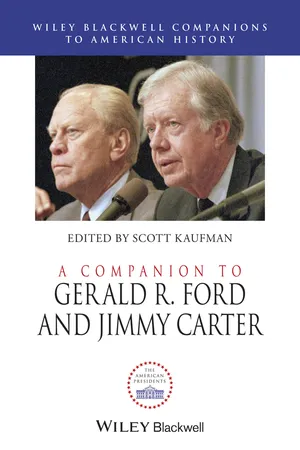 eBook - ePub
- Scott Kaufman(Author)
- 2015(Publication Date)
- Wiley-Blackwell(Publisher)
Chapter Three Gerald Ford From Michigan to WashingtonScott KaufmanPresident Lyndon B. Johnson once reportedly said, “Jerry Ford is so dumb he can’t chew gum and walk at the same time.” Similarly, commented Detroit Mayor Jerome Cavanagh, “There’s nothing wrong with Jerry Ford except he played football too long without a helmet” (Rozell, 1992: 20). That Ford slipped down the steps of Air Force One and was portrayed as a kindly buffoon on Saturday Night Live did little to change such perceptions.Ford was, in fact, a highly intelligent, driven individual who had a long political career that culminated in his accession to the presidency through the most unlikely of means. While he served in the Oval Office for a short two years, it is still surprising that so little has been written on him, particularly insofar as his pre-presidential life. Consequently, anyone desirous of learning about Ford from his birth through his vice presidency will have to do a significant amount of searching. This essay seeks to relieve some of that burden.Ford: A Pre-Presidential Biography
Born Leslie Lynch King, Jr., in Omaha, Nebraska, in July 1913, Ford was the son of Leslie, Sr., and Dorothy Ayer Gardner. A victim of spousal abuse, Gardner separated from her husband about two weeks after her son’s birth and moved into her parents’ house in Grand Rapids, Michigan. She divorced her husband that December. In 1917, she married Gerald Rudolf Ford, a local salesman who was known for his honesty and strong work ethic. Though he did not officially adopt his stepson, he and Dorothy renamed her son Gerald Ford, Jr.; not until 1935 did Ford legally change his name.Ford was impressed with stepfather’s hard work and his parents’ support for charity. He himself became known for his decency and goodwill. He joined the Boy Scouts, eventually becoming an Eagle Scout. While not an exceptional student academically, he was an excellent football player. It was through football that he learned the importance of “[d]iscipline, preparation, teamwork, and adherence to a game plan” (Brinkley, 2007: 5), qualities he took with him into the world of politics. Furthermore, it was football that allowed him to get a scholarship to attend the University of Michigan. There he was a benchwarmer until his senior year in 1934, when he played on the first string and was named the squad’s Most Valuable Player. That distinction allowed him to participate in the 1935 College All-Star Game against the Chicago Bears. The college team lost, but Ford performed well enough to earn offers from two professional teams. He rejected them both for he desired instead to become a lawyer. eBook - ePub
The Nixon Effect
How Richard Nixons Presidency Fundamentally Changed American Politics
- Douglas E. Schoen(Author)
- 2016(Publication Date)
- Encounter Books(Publisher)
In the United States, these twin effects—increased partisanship and loss of public trust—are self-reinforcing. The political and ideological divisions that Watergate exposed and exacerbated changed both parties forever. The more partisan it grew, the more disillusioned the American electorate became with our political institutions. The souring public mood, in turn, motivated both parties to put forth increasingly partisan candidates. On goes the cycle, with the nation’s most pressing problems left unaddressed, and the American people telling pollsters that they don’t expect their children to live as well as they have. That’s another way of saying that people have lost their faith in the American dream.All this may sound like a lot of baggage to be hanging on one political scandal. To be sure, as I’ve tried to suggest here, Watergate arose out of a context of other events and factors. But if there is one political event in the last half century most responsible for the state of our politics today, Watergate is surely it. Passage contains an image
– CHAPTER 10 – Nixon’s Final ComebackThe PostpresidencyNow Richard Nixon’s name will live in obloquy, at least pending some distant work of revisionists which challenges the imagination.—ARKANSAS GAZETTE, AUGUST19741I don’t know what the future brings, but whatever it brings, I’ll still be fighting.—RICHARD NIXON, FROST/NIXON: THE COMPLETE INTERVIEWS2I believe that in Reagan’s second term the voice was the voice of Reagan but the hands were the hands of Nixon.—ARNOLD BEICHMAN 3There he was, back on the front page, making policy. God, what a comeback. Who’d have believed it possible?—STEPHEN AMBROSE 4H e was stretched out flat on his back,” Gerald Ford remembered. “There were tubes in his nose and mouth, and wires led from his arms, chest and legs to machines with orange lights that blinked on and off. His face was ashen, and I thought I had never seen anyone closer to death.”5 It was October 1974, and Ford, who had become president two months earlier on Richard Nixon’s resignation, was visiting the former president in Long Beach Memorial Hospital. Nixon had suffered another severe episode of phlebitis, a malady that plagued him over the years, and he had never been in such severe medical straits. His left leg was enlarged, he had a blood clot and large hematomas, consistent with Grey Turner’s sign, which can predict acute pancreatitis.It was hard to miss the symbolism of Ford’s visit: the new president sitting at the bedside of the disgraced former president, who now lay possibly near death. Nixon’s condition, it must have seemed to his many opponents and critics, was a metaphor for the damage he had wrought upon the country as well as his own moral ruin. Even if he survived his medical ordeal, he would surely never a play a role in national affairs again.
Passage contains an image
– CHAPTER 10 – Nixon’s Final ComebackThe PostpresidencyNow Richard Nixon’s name will live in obloquy, at least pending some distant work of revisionists which challenges the imagination.—ARKANSAS GAZETTE, AUGUST19741I don’t know what the future brings, but whatever it brings, I’ll still be fighting.—RICHARD NIXON, FROST/NIXON: THE COMPLETE INTERVIEWS2I believe that in Reagan’s second term the voice was the voice of Reagan but the hands were the hands of Nixon.—ARNOLD BEICHMAN 3There he was, back on the front page, making policy. God, what a comeback. Who’d have believed it possible?—STEPHEN AMBROSE 4H e was stretched out flat on his back,” Gerald Ford remembered. “There were tubes in his nose and mouth, and wires led from his arms, chest and legs to machines with orange lights that blinked on and off. His face was ashen, and I thought I had never seen anyone closer to death.”5 It was October 1974, and Ford, who had become president two months earlier on Richard Nixon’s resignation, was visiting the former president in Long Beach Memorial Hospital. Nixon had suffered another severe episode of phlebitis, a malady that plagued him over the years, and he had never been in such severe medical straits. His left leg was enlarged, he had a blood clot and large hematomas, consistent with Grey Turner’s sign, which can predict acute pancreatitis.It was hard to miss the symbolism of Ford’s visit: the new president sitting at the bedside of the disgraced former president, who now lay possibly near death. Nixon’s condition, it must have seemed to his many opponents and critics, was a metaphor for the damage he had wrought upon the country as well as his own moral ruin. Even if he survived his medical ordeal, he would surely never a play a role in national affairs again. eBook - PDF
Presidents and Civil Liberties from Wilson to Obama
A Story of Poor Custodians
- Samuel Walker(Author)
- 2012(Publication Date)
- Cambridge University Press(Publisher)
Ford’s account: Ford, A Time to Heal, pp. 161–8. Ford wanted to delete the phrase “long national nightmare,” but its author threatened to resign if he did: Robert T. Hartmann, Palace Politics: An Inside Account of the Ford Years (New York: McGraw-Hill, 1980), p. 159. Pardon materials: Buchen Files, Box 32, GFPL. The Post-Watergate Era 322 view.” Incredibly, Nixon regarded the pardon as an insult. Accepting it, he recalled, was the “most painful decision of my political career,” as it implied admitting his guilt. The pardon controversy finally ended in March 1975 when a Wisconsin federal judge dismissed a suit challenging its constitutionality. The judge’s opinion, however, was a damning indictment, writing that Nixon had been a “putative rebel leader,” engaged in “an insurrection and rebellion against constitutional government itself.” Nonetheless, the Constitution gives presidents unlimited discretion in granting pardons, and Ford’s deci- sion represented a “prudent public policy judgment.” 4 BETWEEN WATERGATE AND NEOCONSERVATISM Watergate and its aftermath cast a long shadow over Gerald Ford’s presidency. He stands as a minor president, a decent person but with a limited vision who accomplished little of significance in his 895 days in office. His presidency is nonetheless extremely important because of the dramatic events that swirled around him: the exposés of the intelligence agencies, efforts by Congress to curb presidential power and the intelligence agencies, and finally the surging tide of neoconservatism in national politics. Caught between his brand of traditional conservatism and the hard edge of the New Right, Ford was a transi- tional president. 5 On civil liberties, Ford had a mixed record. He was genuinely appalled by Nixon’s abuses of power and sought to distance himself from them. eBook - PDF
- Stephen Hess, James P. Pfiffner(Authors)
- 2002(Publication Date)
- Brookings Institution Press(Publisher)
CHAPTER RichardM. Nixon 1969-1974 Gerald R. Ford 1974-1977 If the U.S. government were to choose presidents on the basis of a written test, Richard M. Nixon in 1968 would have appeared near the top of the list. Besides having been in the House of Representatives and the Senate, he had served as vice president for eight years, and no other vice president had been given so many duties. Then too, having been out of office since his defeat by John Kennedy in 1960, presumably he had also had eight years to contemplate the nature of the office that had first eluded him. That with all his experience Nixon became the first president to be forced to resign may say much about the qualities most necessary in an American president, qualities that are beyond the scope of this study. It may say something about how little anyone can know about being president before taking office, a point made by Nixon in a television interview on January 4, 1971, and made earlier, under similar circumstances, by John Kennedy. 1 It may also say something about the way Nixon organized his presidency and the people he picked to assist him—at least that is an assumption made by some in the wake of Watergate. Nixon was clearly a management-conscious president who was seriously concerned with the way the White House would be organized. Theodore White believed that basic to an understanding of the man was an appreci-ation of his fascination with How Things Work. John Osborne of the New Republic, a skilled observer of the Nixon White House, stressed the 91 8 92 Richard M. Nixon and Gerald R. Ford president's continuing struggle for neatness, a constant quest for disci-plined order and precision. 2 The result was that, while the organizational arrangements of all admin-istrations change, usually gradually, Nixon's were in a continual state of flux. eBook - ePub
Eyewitness To Power
The Essence of Leadership Nixon to Clinton
- David Gergen(Author)
- 2001(Publication Date)
- Simon & Schuster(Publisher)
The fourteen months that followed were among my happiest in government. Jerry Ford’s decency made everyone feel welcome on his team. His stance on public issues—hard-line in international affairs, fiscally conservative in economic matters, moderate to liberal on social issues—was also four-square with my own beliefs. A member of the staff need not agree with everything a president believes, but a basic compatibility is infinitely desirable. Philosophically, I happened to be more on Ford’s wavelength—and, indeed, Nixon’s—than those of either Reagan or Clinton, so I soon felt right at home. With some notable exceptions, the men and women Ford had assembled around him were also public-spirited, honorable people who worked hard to restore the integrity and moral authority of the presidency. For all of its internal strife, the Ford White House was a good place to be.Cautionary Tales from His Early Days
When I returned to the White House, Ford was still suffering from a tumultuous, rocky start to his presidency. There is nothing more important to the success of an actor, it is said, than his performance in his first scene and in his last. One shapes his character for the entire play, the other the memories that the audience carries from the theater. The same applies in politics and in other fields of leadership.That was certainly what Gerald Ford experienced in his presidency. For a brief, ethereal moment, the country fell in love with him. His inaugural address was a welcome relief to a people torn apart by scandal, war, and a deteriorating economy. His quiet dignity and lack of pretense provided exactly the stabilizing force that people sought. One morning, the press watched him making breakfast for his wife, Betty, and he became the boy next door. Columnists invented an “English muffin theory of history”—the idea that any man good enough to make English muffins for his wife in the morning must be good enough to run a country.Americans like straight talk and old-fashioned values in their president, and that’s exactly what they saw now. There was an air of Harry Truman about him as he talked plainly to the country and brought a down-home feel to the White House. The Truman parallel ran deep. Both men became president amidst a national crisis; both had to make excruciating decisions; both were simple men from the Midwest, devoted to family; in both cases, their honesty and integrity comforted the nation. Despite great uncertainty about their abilities and intelligence, each of them then saw his approval ratings shoot into the stratosphere in the first days in office, only to fall sharply thereafter. eBook - PDF
In Confidence
Moscow's Ambassador to Six Cold War Presidents
- Anatoly Dobrynin(Author)
- 2016(Publication Date)
- University of Washington Press(Publisher)
THE FORD PRESIDENCY, 1974-1977 I. S earching for the Real G erald Ford Starting Out with the New President D espite the constitutional upheavals caused by Watergate, the transition from Richard Nixon to Gerald Ford was successful, and with it the continuation of the policy of Soviet-American detente. This reached its high point under Ford at his first sum-mit with Leonid Brezhnev at Vladivostok four months after Ford assumed the presidency. There in a snowbound setting they settled on the outlines of an agreement to limit the growth of strategic nuclear weapons. But a zenith also implies a nadir, and thereafter detente went into an inexorable decline for rea-sons ranging from Brezhnevs health to Fords domestic political difficulties. Only hours after Ford took the oath of office on August 9, 1974, Henry Kissinger invited me to the White House and showed me directly to the Oval Office. It was the new presidents first official communication with a foreign representative. Ford seemed elated although somewhat unaccus-tomed to his new situation. But as we had met before and knew each other pretty well, our conversation was not too formal. Ford sent a personal message to Brezhnev unequivocally stating his de-termination to continue Nixons policy of improving relations with the Soviet Union. Nixon had given him a long farewell talk on foreign affairs the previ-ous day, minutely informing the incoming president about his discussions with Brezhnev in Moscow and the commitments they implied. The new pres-ident reaffirmed his invitation for Brezhnev to visit the United States the fol-lowing year and was also prepared to meet him before then on “neutral territory” if the meeting was well prepared. The idea had already been raised in Moscow, and Kissinger had christened it a “mini-summit.” Ford turned for corroboration to Kissinger, who confirmed Fords words with a smile. eBook - PDF
State of the Union
Presidential Rhetoric from Woodrow Wilson to George W. Bush
- Deborah Kalb, Gerhard Peters, John T. Woolley(Authors)
- 2006(Publication Date)
- CQ Press(Publisher)
Eisenhower. “America is not good because it is great,” the President said. “America is great because it is good.” President Eisenhower was raised in a poor but religious home in the heart of Amer-ica. His simple words echoed President Lincoln’s eloquent testament that “right makes might.” And Lincoln in turn evoked the silent image of George Washington kneeling in prayer at Valley Forge. So, all these magic memories which link eight generations of Americans are summed up in the inscription just above me. How many times have we seen it? “In God We Trust.” Let us engrave it now in each of our hearts as we begin our Bicentennial. January 19, 1976 ■ 769 Gerald R. Ford, 1974–1977 Address before a Joint Session of Congress Reporting on the State of the Union January 12, 1977 Gerald Ford delivered his last State of the Union message as an outgoing presi-dent, just eight days before the inauguration of Jimmy Carter. Ford had become president in August 1974 after Richard Nixon resigned during the Watergate scandal. A longtime House member from Michigan, Ford had served as House minority leader before Nixon named him to replace Spiro Agnew as vice president in 1973. Ford is the only president never to have been elected to either the presidency or the vice presidency. In 1976 Ford sought his own four-year term as president. He faced, and over-came, a tough challenge in the Republican primary from Ronald Reagan, the con-servative former California governor who would win the presidency in 1980. Ford’s Democratic opponent in November was former Georgia governor Jimmy Carter. In the end, Carter narrowly defeated Ford, taking 50.1 percent of the popular vote to Ford’s 48 percent, and 297 electoral votes to Ford’s 240. The Democrats also retained their large majorities in the House and Senate.
Index pages curate the most relevant extracts from our library of academic textbooks. They’ve been created using an in-house natural language model (NLM), each adding context and meaning to key research topics.

