History

Bill Clinton
Bill Clinton served as the 42nd President of the United States from 1993 to 2001. He is known for his centrist policies, presiding over a period of economic prosperity and signing the North American Free Trade Agreement (NAFTA). His presidency was also marked by controversies, including the Monica Lewinsky scandal, which led to his impeachment by the House of Representatives.
Written by Perlego with AI-assistance
Related key terms
1 of 5
5 Key excerpts on "Bill Clinton"
 eBook - PDF
American Exceptionalism and the Legacy of Vietnam
U.S. Foreign Policy Since 1974
- Trevor McCrisken(Author)
- 2003(Publication Date)
- Palgrave Macmillan(Publisher)
159 William Jefferson Clinton defeated George Bush in the 1992 presidential election largely by focusing on the nation’s troubled domestic agenda. The Democrats’ rallying cry against Bush was ‘It’s the economy stupid!’ Clinton entered the White House in January 1993 promising to focus on the domes- tic problems facing Americans, and particularly the failing US economy. Nonetheless, Clinton also had to address an international agenda that was much changed from that faced by other post-Vietnam presidents. With the Cold War now firmly consigned to history, scholars, analysts and practi- tioners alike attempted to provide a comprehensive framework through which a far more unpredictable and potentially unstable international system could be understood. During his two terms in office, President Clinton would give an increasingly greater emphasis to foreign policy and preside over more uses of military force than any of his post-Vietnam predecessors. As a result, he would face many of the same questions regarding the continuing influence of the legacy of Vietnam. He would also draw upon the belief in American exceptionalism in an attempt to pursue a foreign policy that he claimed was not divorced from ‘the moral principles most Americans share’. 1 The Clinton foreign policy Particularly during his first term, Bill Clinton was widely criticized for lack- ing coherence, decisiveness and vision in his foreign policy. 2 He was accused of lurching from crisis to crisis without sufficient forethought and then improvising his way through them. His ability to see the merit in all sides of an argument and make their advocates feel he agreed with them gave the impression to his critics that he lacked leadership skills and convictions. He was thought to vacillate from view to view in an ad hoc manner that was detrimental to American interests. Critics argued in particular that Clinton had failed to ‘formulate a strategic vision for the post-Cold War era’. eBook - PDF
Clinton's Legacy
A New Democrat In Governance
- A. Waddan(Author)
- 2001(Publication Date)
- Palgrave Macmillan(Publisher)
1 1 Introduction: The Problem of Defining Clintonism When Clinton took office in January 1993 few would have predicted that he would be leaving the White House eight years later with the country’s fortunes apparently so changed for the better. In particular, as the campaign to elect Clinton’s successor heated up it did so against a very different economic and fiscal backdrop to that of the 1992 presidential election campaign. In 1992 the story of the US economy appeared to be an unhappy one and candidate Clinton was able to attack the Bush administration’s record on employment, wage growth and the climbing budget deficit. Two terms of Clinton government later the economic indicators showed the lowest unemployment rates in over a quarter century, no significant inflation, and a debate in Washington circles about what to do with a budget surplus. If anyone had foreseen these developments in 1992 then they would also have surely predicted Clinton’s elevation to a position alongside the most respected of American presidents. This latter scenario, however, appears even more unlikely to unfold than sustained economic revitalisation and fiscal harmony seemed in 1992. Much of the disaffection with Clinton of course stems from his personal failures. Dogged by scandal throughout his presidency, the Monica Lewinsky saga eventually left even those closest to him, both personally and politically, feeling betrayed. The central concern of this book, though, is not to pass comment on Clinton’s morality, but is to ask whether beneath the surface scandalization there was something of political substance. In other words, is it possible to identify something which was Clintonism which in turn left a substantive Clintonian legacy upon which to build? In particular, did his presidency help the Democratic Party find a new equilibrium after the traumas it suffered during the 1970s and 1980s in presidential politics? eBook - ePub
Hatred of America's Presidents
Personal Attacks on the White House from Washington to Trump
- Lori Cox Han(Author)
- 2018(Publication Date)
- ABC-CLIO(Publisher)
42. William J. Clinton Born: August 19, 1946 Time in Office: 42nd President of the United States, January 20, 1993, to January 20, 2001 Election Results: 1992 Election: 43% of popular vote, 370 (68.8%) Electoral College votes; 1996 Election: 49.2% of popular vote, 379 (70.4%) Electoral College votes Spouse: Hillary Rodham (m. 1975) Children: Chelsea.Surrounded by controversy for much of his political career, Bill Clinton was the 42nd president of the United States. Born William Jefferson Blythe on August 19, 1946, in Hope, Arkansas, he never knew his father, who died three months before Clinton’s birth. Eventually adopting the last name of his stepfather Roger Clinton, an alcoholic and abusive husband who was also by all accounts an inadequate stepparent, Bill did not have a happy or stable childhood. Whatever stability the young Clinton had was thanks to his maternal grandparents, who cared for him during his mother’s absences. An ambitious and extremely intelligent student, Clinton attended Hot Springs High School and worked as an intern for Arkansas senator William Fulbright. Upon graduation, he enrolled at Georgetown University to study international relations. After attending Oxford University on a Rhodes Scholarship, he entered Yale Law School and then obtained a teaching position at the University of Arkansas. During his studies at Yale he met Hillary Rodham, whom he married in 1975.Armed with political aspirations from an early age, Clinton made an unsuccessful run for the Arkansas House of Representatives in 1974. Just two years later, he was elected Arkansas attorney general, which he followed with a successful bid for governor in 1978. Lacking experience and political discipline, he was not reelected in 1980. Two years later, however, he reclaimed the office. Reelected three times, Clinton honed his political skills and styled himself a “New” Democrat. His centrist, pragmatic approach to politics won him fans from both sides of the aisle but alienated others who criticized him as an opportunist. After declining to make a run for the White House in 1988, Clinton threw himself into the 1992 race. He only managed 43% of the popular vote, but it was enough to defeat the incumbent, Republican George H. W. Bush, and independent business executive Ross Perot. During his two terms in office (he cruised to reelection over Republican nominee Robert Dole in 1996) he presided over a booming economy and fulfilled a number of campaign promises. He also governed as a centrist and often worked with Republican lawmakers. Unfortunately, political controversies and personal scandals overshadowed his accomplishments, and the latter even led to his impeachment by the GOP-controlled House of Representatives in 1998. Nonetheless, Clinton left the White House with respectable approval ratings. Following his two terms in the White House, he devoted himself to the Clinton Foundation, an international nonprofit philanthropic organization. Ethical and legal problems dogged the foundation, but Clinton and his defenders asserted that these criticisms stemmed from long-standing political animosities. In addition, his wife’s two failed presidential runs were immense disappointments to him. eBook - PDF
The Clinton Presidency
The First Term, 1992-96
- D. Hill, P. Herrnson, D. Hill, P. Herrnson(Authors)
- 1999(Publication Date)
- Palgrave Macmillan(Publisher)
Clinton: the Man and His Times 3 family leave and educational measures. The overall success rate was greater than any president since Eisenhower. But campaign reform was dead and welfare reform had been postponed. Moreover, some of the victories were achieved at the high price of pork-barrel deals and the dissipation of political capital and public image. November 1994 brought an even greater challenge. The Republicans gained control of both chambers of Congress - the House of Representatives for the first time in 40 years. Policy momentum passed to the new Speaker of the House, Newt Gringrich, and his ten-point 'Contract With America' agenda, with its promise of a coherent and cohesive opposition to the White House. Clinton shifted his ground in response to these electoral upheavals, emphasizing his centrist cre- dentials and moving towards balanced budget proposals which Democrats had earlier rejected. From a low point at the beginning of 1995 as the Republican-controlled 104th Congress began, however, Clinton staged a comeback. This was aided significantly by the pro- longed stand-off over the budget and the consequent shutdown of the federal government in the winter of 1995-6, which Clinton success- fully used to attack the Republicans as dogmatic extremists. Though these strategies were successful in reviving Clinton's fortunes, his signing of the Republican welfare bill in August 1996, after twice vetoing earlier versions, marked the end of an era of federal entitle- ment which had begun with the New Deal. The New Democrat Clinton that sought a second term was very different from the 'New New Deal' aspirant to office of 1992. THE CHARACTER DEBATE All presidents are judged not only on their programme achievements but on their 'style': that combination of action, management and image which plays such a powerful part in the evaluation of the modern presidency.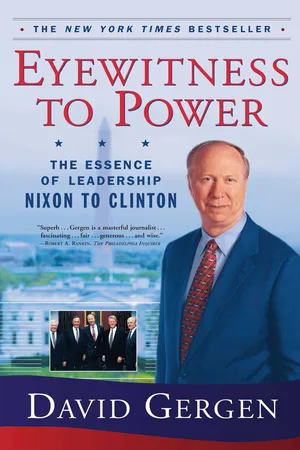 eBook - ePub
Eyewitness To Power
The Essence of Leadership Nixon to Clinton
- David Gergen(Author)
- 2001(Publication Date)
- Simon & Schuster(Publisher)
Franklin Roosevelt had many of the same personal qualities as Clinton and, if anything, was more devious. Yet he turned out to be the finest president of the century. John F. Kennedy—the man who once told British prime minister Harold Macmillan that he got a headache if he went more than three days without sex—was far more promiscuous at the White House. Yet he continues to be admired.Clinton will always be our paradox. When he decamps and the dust settles, we will look back and see that despite the scandals, he left the country far better off than he found it. Economically, socially, even culturally, the nation made substantial gains during his stewardship. For America, the nineties turned out to be one of the brightest decades of the twentieth century, and Clinton was one of its prime movers. He will be remembered well for that. Yet, a sense of aching disappointment hangs over his presidency. How much more he could have achieved… how much went smash.Winston Churchill once remarked that he expected to be well remembered in history because he intended to write it. Bill Clinton is capable of writing memoirs that could rival Churchill’s in insight; he is that talented. No matter how thoughtfully he writes, however, history will always offer a mixed verdict on his years in the White House.The mystery will remain. What happened to this man, so gifted and caring? How did he get so much right—and still get so much wrong? What lessons can we draw? What does the Clinton experience tell us about the qualities we should be seeking in future presidents?That’s the story I would like to tell here to the extent that I can. Much of it will be centered on the year and a half when I served him at the White House. It is only a piece of his presidency, but it is a time that helps us to understand this president at his best and see the roots of the trouble that came to haunt him. Part of it is also my own tale, joining up with a Democratic president after three tours with Republicans.Clinton’s Early Promise
As I considered his phone call in 1993, I thought back on the ten years or so since we had met. He was governor of Arkansas then, and I had come to know him as he undertook reforms in education and economic development, trying to lift a poor southern state up from the bottom. I admired him as a New Southerner, one like Terry Sanford, who had first inspired me to enter public service when he was governor of my native North Carolina. Both men had been courageous in tackling race, the most difficult issue of our region. Clinton was not only the youngest American elected governor in four decades, but the magazine I worked for, U.S. News & World Report
Index pages curate the most relevant extracts from our library of academic textbooks. They’ve been created using an in-house natural language model (NLM), each adding context and meaning to key research topics.

