History

1992 Presidential Election
The 1992 Presidential Election was a pivotal moment in American politics. It saw Democrat Bill Clinton defeat incumbent Republican George H.W. Bush and independent candidate Ross Perot. Clinton's victory marked the end of a 12-year Republican presidency and the beginning of a new era in American politics.
Written by Perlego with AI-assistance
Related key terms
1 of 5
12 Key excerpts on "1992 Presidential Election"
 No longer available |Learn more
- (Author)
- 2014(Publication Date)
- The English Press(Publisher)
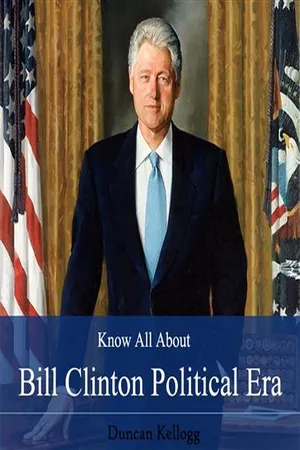
________________________ WORLD TECHNOLOGIES ________________________ Chapter-1 United States Presidential Election, 1992 and Bill Clinton Presidential Campaign United States presidential election, 1992 1988 ← November 3, 1992 → 1996 Nominee Bill Clinton George H. W. Bush Ross Perot Party Democratic Republican Independent Home state Arkansas Texas Texas Running mate Al Gore Dan Quayle James Stockdale Electoral vote 370 168 0 States carried 32 + DC 18 0 Popular vote 44,909,806 39,104,550 19,743,821 Percentage 43.0% 37.5% 18.9% ________________________ WORLD TECHNOLOGIES ________________________ Presidential election results map. Red denotes states won by Bush/Quayle, Blue denotes those won by Clinton/Gore. President before election George H. W. Bush Republican Elected President Bill Clinton Democratic The United States presidential election of 1992 had three major candidates: Incumbent Republican President George H. W. Bush; Democratic Arkansas Governor Bill Clinton, and independent Texas businessman Ross Perot. Bush had alienated much of his conservative base by breaking his 1988 campaign pledge against raising taxes, the economy was in a recession, and Bush's perceived greatest strength, foreign policy, was regarded as much less important following the collapse of the Soviet Union and the relatively peaceful climate in the Middle East after the defeat of Iraq in the Gulf War. Clinton won a plurality in the popular vote, and a wide Electoral College margin. Nominations Republican Party nomination • Republican candidates o George H.W. Bush, President of the United States from Texas o Pat Buchanan, conservative columnist from Virginia o Harold E. Stassen, Former Governor of Minnesota ________________________ WORLD TECHNOLOGIES ________________________ Candidates gallery President George H.W. Bush of Texas Conservative Columnist Pat Buchanan of Virginia ________________________ WORLD TECHNOLOGIES ________________________ Former Governor Harold E. eBook - ePub
Presidential Campaigns, Slogans, Issues, and Platforms
The Complete Encyclopedia [3 volumes]
- Robert North Roberts, Scott John Hammond, Valerie A. Sulfaro(Authors)
- 2012(Publication Date)
- Greenwood(Publisher)
Presidential Campaigns: From George Washington to George W. Bush (Oxford: Oxford University Press, 2004).Burnham, Walter Dean, et al., The Election of 1996: Reports and Interpretations (New York: Chatham House, 1997).Burns, James MacGregor, and Georgia J. Sorenson, Dead Center (New York: Scribner, 1999).Hanes, Walter, Jr., Reelection (New York: Columbia University Press, 2000).Hohenberg, John, Re-Electing Bill Clinton: Why Americans Chose a “New Democrat” (Syracuse, NY: Syracuse University Press, 1997). Passage contains an image
Campaign of 2000
The campaign and election of 2000, depending on whom you agree with, was either the first or last American presidential election of the century and millennia. But regardless of how one counts it, it was without question one of the strangest political events in memory. By all accounts, it produced more frustration, anger, and bewilderment than any presidential election since 1968. The actual campaign season itself was strangely unremarkable, even bland; rather, it was the outcome of the election that agitated an entire country.In the 2000 election, the incumbent vice president and Democratic standard-bearer for president, Albert Gore Jr., won more total popular votes than any American in history to that point, and yet still lost the election. The forces that led to his defeat were likely set in motion two years earlier in a failed attempt by the Republican-dominated Congress to discredit President Bill Clinton and remove him from office. President Clinton, the epitome of political survival, weathered the storm, but the toll was exacted, the unity of the party shaken, the resolve of the Republicans steeled. Even though the Clinton administration had been successful on many fronts—a healthy, expanding economy, the first balanced budget in decades—the Republicans were in a good position to mount a serious challenge to return one of their own the White House. The odor of personal scandal associated with the Clinton White House clung to the Democrats, and in particular to the vice president, who had nothing to do with Clinton’s humiliating indiscretions but was now paying a high political price for it. Going into the 2000 campaign, Gore was clearly the Democratic front-runner, but he found himself behind in the polls to the GOP contender. The electorate seemed primed for a change, and the prospect of a Gore presidency was, too many, not change enough. No longer available |Learn more
- Stephen Wayne(Author)
- 2019(Publication Date)
- Cengage Learning EMEA(Publisher)
36 From a partisan perspective, the electorate was almost evenly divided, but it had also become more conservative. In 1992, with the economy in recession, budget and trade deficits rising, and layoffs of white-collar managers and blue-collar workers dominating the news, Bush was placed on the defensive. His performance in office was evaluated nega-tively. Although the president was credited with a successful foreign policy, espe-cially the reversal of Iraq’s invasion of Kuwait, the lower salience of foreign policy issues in 1992 undercut the president’s achievements within that policy realm and even served to highlight his inattention to domestic matters. The economy was the principal issue and Clinton its principal beneficiary. With slightly more Democrats in the electorate than Republicans, Clinton received the votes of three out of four Democrats. For the first time since 1964, Republican defections actually exceeded those of Democrats. Turnout, that traditionally advantages the Republicans, was neutralized in 1992 with Democratic voters turning out at a higher rate than Republicans. Still, Clinton’s partisan advantage could have been offset by a lopsided vote of Independents against him, but they divided their support among the three candidates (the third being H. Ross Perot), giving Clinton a plurality of their vote (38 percent) with Perot and Bush splitting the rest. 37 By 1996, domestic concerns were still dominant, but the economy was stron-ger, crime had decreased, and the nation remained at peace—all conditions that favored the incumbent. Despite misgivings about some aspects of the president’s personal character and behavior, voters saw him as more caring, more in touch with the times, and more visionary than his Republican opponent, Robert Dole, and they responded accordingly, reelecting the Democratic president but also the Republican congressional majority. eBook - ePub
Politics in an Era of Divided Government
The Election of 1996 and its Aftermath
- Harvey L. Schantz(Author)
- 2013(Publication Date)
- Routledge(Publisher)
CHAPTER 3 The Presidential Campaign and Vote in 1996Job Ratings of Presidents—and Success or Failure at the Polls
MILTON C. CUMMINGS JR.In an election year that some commentators asserted produced the dullest and least exciting presidential campaign in many decades, there were nonetheless a number of noteworthy features in the final voting returns. President Bill Clinton, the Democratic nominee, won a decisive victory over former Senator Bob Dole, his Republican opponent, and Ross Perot, the candidate of the Reform Party. Clinton carried thirty-one of the fifty states and the District of Columbia, and won 379 electoral votes to 159 for Dole. Clinton's victory marked the first time since 1936 that a Democratic president had been elected to a second full term. And he was only the fourth Democratic president in history–along with Franklin Roosevelt, Woodrow Wilson, and Andrew Jackson–to win two consecutive presidential terms.1Clinton's vote went up between 1992 and 1996; but the vote for the other presidential candidate who ran in both years, Ross Perot, dropped sharply, from 18.9 percent in 1992 to 8.4 percent four years later. Even so, Perot's 1996 presidential showing was the sixth largest vote percentage polled by a third-party or independent presidential candidate since the Civil War. In addition, though little noted, there was another sign in 1996 that many voters were not wedded firmly to the two major parties. Between 1992 and 1996, the vote for minor-party candidates for president other than Perot more than doubled.2 Those “other” minor-party tallies included close to 700,000 votes for Ralph Nader on the Green Party ticket, and nearly half a million votes for Harry Browne on the Libertarian ticket.The 1996 voting for Congress also produced an outcome that would have a powerful impact on relations between the president and Congress for at least the next two years. The Republican party suffered a moderate net loss of seats in the House of Representatives and gained strength in the Senate. But the election left the Republicans with clear majorities in both houses of Congress, and Clinton continued to face a Congress controlled by the opposition party after his second inauguration. eBook - ePub
- John Clifford Green(Author)
- 2016(Publication Date)
- Routledge(Publisher)
Although his share of the popular vote was greater than in 1992, Clinton’s electoral coalition proved to be fairly stable. His 54.7 percent share of the two-party vote in 1996 was essentially the same as the 53.5 percent he received in 1992 (Pomper 1997, 182). In the electoral college balloting, Clinton won two states he had lost four years earlier (Florida and Arizona) and lost three states (Colorado, Georgia, and Montana) he had previously won by narrow margins. And even though the final vote margin was smaller than that predicted by most preelection polls, the outcome of the race seemed to be determined long before the ballots were cast.When placed in the context of recent elections, the 1996 contest was most reminiscent of 1984 (see chapter 3 ; Herrnson and Wilcox 1997, 138; Sabato 1997, 145). In both of these races, a popular incumbent president, running in the midst of a strong economy and peace abroad, was reelected. The incumbent chose to focus on the economy and the improvements in the state of the nation that had occurred during his first four years, while the challenger failed to develop an effective message or pursue strategies that could overcome the external factors that determined the dynamics of the race. Moreover, in both cases, the challenger was perceived as a representative of a style and approach to politics whose time had passed.From a campaign finance perspective, however, the election differed greatly from 1984. The financial patterns exhibited by the candidates demonstrated how presidential campaigns have adapted to the constraints imposed by the Federal Election Campaign Act (FECA), first operative in 1976, taking advantage of the opportunities afforded under the law to make the most of their campaign dollars. More importantly, the election highlighted the issues raised by new forms of funding. When Ronald Reagan was seeking reelection in 1984, parties were just beginning to discover the value of soft money, and issue advocacy advertising had not yet become a matter of public debate. By 1996, these unlimited kinds of funding were integral parts of the electoral strategies in both parties (see chapters 7 and 8 eBook - ePub
- Alan Grant(Author)
- 2019(Publication Date)
- Routledge(Publisher)
him the major issue. Barry Goldwater and George McGovern both found their own suitability for the Presidency seriously questioned, and Bill Clinton’s character and experience were also themes in the 1992 election. Perhaps the worst position a Presidential candidate can be in is when he is attempting to follow a President of his own party, if the administration has seriously declined in popularity. Hubert Humphrey, the Democratic nominee in 1968, had been Johnson’s Vice-President and thus was connected with the government’s unpopular Vietnam policy. He was therefore in a position of either having to defend policies for which he was not personally responsible, or seeming to be disloyal to the President if he criticized them. What is more he could not claim the experience of an incumbent President. Vice President George Bush’s problem in 1988 was rather that of establishing his own identity after serving eight years in the shadow of a popular President. Although opponents tried unsuccessfully to connect him with the Iran-Contra scandal in the minds of the public, Bush had to establish a new image as his own man with his own ideas and policies. On the other hand, being Ronald Reagan’s heir-apparent undoubtedly helped him both in securing the Republican nomination and in the election campaign itself.2 Voting in Presidential Elections
Any campaign manager planning the strategy for achieving a majority of the Electoral College votes will bear in mind the factors that influence the American electorate in deciding how to vote in Presidential elections. The three main criteria are issues, the candidates and party identification.For an issue to be significant in electoral choice it requires knowledge and feeling on the part of the voter: he has to know about the issue, care strongly about it and know the positions of the candidates on it. Relatively few voters are likely to decide how to vote on the basis of one single issue but a general disenchantment or contentment with the policies of the existing government may have their effects, although in the American system, where the President and Congress are separate and often divided in party control, determining who is to blame or whom to credit with achievements is more difficult for voters. In 1992, however, the state of the economy was clearly the key factor; 43% of electors said that jobs and the economy were the major influences on their vote, and the budget deficit was named by a further 21%. President Bush, successively battered by Buchanan, Clinton and Perot, took the lion’s share of the blame from the electorate with fewer than one in three approving of his handling of the issue. In 1996, with rising prosperity, low inflation, falling unemployment and a reduced federal deficit, Bill Clinton undoubtedly benefited from the return of the ‘feel good factor’ among a substantial proportion of the electorate. eBook - ePub
43
Inside the George W. Bush Presidency
- Barbara A. Perry, Michael Nelson, Russell L. Riley(Authors)
- 2022(Publication Date)
- University Press of Kansas(Publisher)
Other major divisions between Bush and Gore voters were economic and, perhaps more important, cultural. A strong correlation existed between voters’ annual incomes and their support for Bush. He won the votes of 37 percent of those who earned $15,000 per year or less, but 54 percent of those who earned $100,000 or more. The more religious voters claimed to be, the more likely they were to vote for Bush: 59 percent of those who attended services at least once a week supported him, compared with 38 percent of those who seldom or never attended church. Married women supported Bush (53 percent), as did gun owners (61 percent), self-identified members of the religious right (80 percent), Protestants (63 percent), voters who valued “moral leadership” in a president more than “managing the government” (70 percent), small-town and rural residents (59 percent), opponents of stricter gun-control laws (74 percent), and opponents of legalized abortion (71 percent). Roman Catholics, who had supported Clinton in both 1992 and 1996, narrowly swung to Bush (52 percent).Partly because he had his hands full waging his own campaign, Bush’s narrow victory was accompanied by disappointing results in the congressional elections. Democrats gained one seat in the House, which was not enough to retake control of that chamber, and five seats in the Senate, creating a 50–50 division that made Vice President Cheney’s tie-breaking vote decisive. For the first time since 1954, a Republican president governed with a Republican Congress, but only for a few months. In May 2001 Republican senator James Jeffords of Vermont joined the Democrats, giving them a 51–49 majority.The contested nature of the incredibly close 2000 election—including the irregularities in ballot design and vote counting in Florida, Bush attorney Ted Olson’s determination to take the case to “federal court right from the beginning,” and the strict partisan divide among the Supreme Court justices, who voted 5–4 in Bush’s favor—left Democrats angry and bitter. On January 6, 2001, Gore “was very good . . . presiding over his own defeat” when, as president of the Senate, he announced the official tally of the electoral votes submitted by the states and declared Bush the winner, according to House Republican Dennis Hastert. But House Democratic leader Richard Gephardt recalls that the close and controversial nature of the election “was a huge impediment for many of my members to accept this president and want to deal with him in any way. They just thought it was stolen.” Republican attorney Fred Fielding remembers the “really deep, deep sense of anger and mistrust” among Democrats, who felt, “‘We wuz robbed!’”2002: Midterm MomentumThe controversy surrounding Bush’s election shadowed him when he entered the White House on January 20, 2001. Still, he made progress on most of the policies he had emphasized during the campaign: a tax cut (a record $1.35 trillion after several rounds of negotiations with Congress), education reform (with bipartisan support, his No Child Left Behind bill was on the road to enactment) and, largely through executive action, defense reform and faith-based involvement in social services delivery. According to Margaret Spellings, who joined the administration as Bush’s domestic policy adviser, Jeffords’s defection to the Democrats and the loss of Republican control in the Senate “ended up being the best things that ever happened to No Child Left Behind, no doubt about it , . . . because Ted Kennedy believed in the stuff more than Jim Jeffords did by a country mile.”26 eBook - PDF
Political Culture and Voting Systems in the United States
An Examination of the 2000 Presidential Election
- Brian L. Fife, Geralyn M. Miller(Authors)
- 2002(Publication Date)
- Praeger(Publisher)
Chapter 1 The 2000 Presidential Election A CLOSE CONTEST The 2000 presidential election has been the focus of a great deal of scholarship. The sheer closeness of the contest is undoubtedly the primary motivational fac- tor that has led many evaluators to scrutinize what really happened, particu- larly in the state of Florida, and to ascertain why the choice of the people, Dem- ocrat Al Gore, did not occupy 1600 Pennsylvania Avenue as of January 20, 2001. The proximity of this race is depicted in Table 1.1. With more than 105 million votes cast, the "official" margin of difference be- tween Gore and Republican George W. Bush, who both garnered the support of more than 50 million individuals, was 540,520 votes. This was fewer than the more than 613,000 voters who voted for candidates other than Gore, Bush, Ralph Nader, or Pat Buchanan (see Table 1.1). The more important tally under Article II of the U.S. Constitution, however, is the vote in the Electoral College. The framers of the Constitution stipulated that to be elected president, a candidate must receive a simple majority in the Electoral College. Today, there are 538 total electoral votes. Thus, 270 votes are needed to win the election; otherwise, the electoral outcome is determined in the U.S. House of Representatives. Un- like some other elections, where the popular vote was close but the vote in the Electoral College exaggerated the margin of victory (e.g., John F. Kennedy ver- sus Richard Nixon in 1960), the Electoral College vote was indeed reflective of a very close election and a divided electorate, as is illustrated in Table 1.2. By "winning" Florida, Bush received 271 votes in the Electoral College (one more than is required by the Constitution). A number of different scenarios would have catapulted Gore into the White House (besides the Florida court bat- tles). A victory in his home state (Tennessee) would have made him president. eBook - PDF
- Robert V. Friedenberg(Author)
- 1993(Publication Date)
- Praeger(Publisher)
Chapter 9 The 1992 Clinton-Bush-Perot Presidential Debates Dan F. Hahn In I960, for the first time, two candidates for president of the United States met in a series of what were called "debates," and many people hoped that a tradition was being started. Then after three presidential elections in which no debates were held, in 1976 for the first time, an incumbent president debated his challenger. Again, the hope of many was that a tradition was being established. This time the hope seems to have been realized, as 1992 represented the fifth consecutive presidential election in which such debates have taken place. A second tradition, one in which this chapter participates, is the tra- dition within academia of subjecting these debates to analyses—micro- scopic and macroscopic, ideological and neutral, rhetorical and statistical—that is to say, analyses that follow all the academic and per- sonal analytic fads and foibles of various researchers. This particular analysis of the 1992 debates is a rhetorical analysis, primarily based on a close reading of the texts of the debates, hence only indirectly and incidentally concerns the fact that the debates were media phenomena. The plan throughout has been to identify the strategies of each candidate then evaluate the debates according to how close they came to fulfilling their strategic goals. CANDIDATE STRATEGIES: THE FIRST DEBATE Clinton In the first debate, Governor Bill Clinton leading in the polls, sought to: (1) play up his own strengths, such as his understandings of the eBook - ePub
- Scott Kaufman(Author)
- 2015(Publication Date)
- Wiley-Blackwell(Publisher)
Détente and Confrontation (1994). In any case, Soviet aggressiveness had escalated over the previous twenty years, an evolution that was traced by Bruce D. Porter (1984) and that was widely seen as ominous by the public. By 1980, large majorities said they supported a US defense build-up and a tougher stance vis-à-vis the Soviet Union.Outside of the Iranian trauma and East–West conflict, other key changes were taking place in the international context, often barely noticed by analysts focused on the Cold War. In The Shock of the Global, edited by Niall Ferguson, Charles S. Maier, Erez Manela, and Daniel J. Sargent (2010), twenty-one chapters attend to the rise of globalization in economic and other realms including human rights, cross-national political Islam, popular culture, and public health.The Campaign and Election
As is often the case, the first lengthy interpretations of the election of 1980 came in the form of journalistic accounts by political reporters. The first of these was The Pursuit of the Presidency 1980 (1980) edited by Richard Harwood and consisting of a collection of essays by Washington Post reporters. Coming out only weeks after Election Day, The Pursuit of the Presidency traced the campaign month-by-month and declared the election “the most astonishing landslide in American history” (Harwood, 1980: cover). Over the next two years, Elizabeth Drew (1981), Jack Germond and Jules Witcover (1981), and Theodore White (1982) joined the conversation. In America in Search of Itself, White provides a journalistic account but also puts 1980 into the context of presidential elections since his first The Making of the President books made him famous in 1960.Of course, participants in the election have offered a variety of explanations and interpretations. It is customary for the losing side to complain about the injustice—and the winning side to trumpet the justice—of the electoral verdict, and memoirs of the 1980 election are no exception. The most important participants were the presidential candidates themselves, who, unsurprisingly, have fundamentally different understandings of what happened in 1980. In his memoir Keeping Faith eBook - ePub
Political Communication
Politics, Press, and Public in America
- Richard M. Perloff(Author)
- 2013(Publication Date)
- Routledge(Publisher)
6 Voters' lack of interest had many causes, including the candidates' failure to say anything new, the large gap between the candidates in the polls, and disgruntlement with the modern poll-dominated campaign. Of course every election can't be a barn burner, a “real turn-on” electoral matchup like 1992. And the lack of voter interest may have reflected a satisfaction with the economy and the course the country was taking; in other words, “If it ain't broke, don't fix it”—or don't concentrate on it, for that matter.Nonetheless, there was a silver lining in the cloudy discussions of issues that transpired in 1996. Campaigns, after all, are conversations between people and their leaders, complex discourses about the issues that face the country, dialogues that provide some indication of how far and fast the public wants to move on controversial problems. Over the course of the long campaign, citizens and candidates began to reach consensus on the kind of government they wanted in an age of dwindling resources.As the campaign approached, in the wake of Republican victories in the 1994 elections, there was a good deal of talk about “voter anger” and dissatisfaction with Big Government. By the end of the campaign, the talk had disappeared. What happened? Washington Post reporter Dan Morgan observed:For one thing, two government shutdowns and the GOP assault on spending programs forced Americans to look beyond the talk-show abstractions portraying an evil federal establishment and define for themselves what they did and did not want from Washington. The shutdowns, which closed some national parks and caused all manner of inconveniences, provided a direct education in the sweep and reach of federal activities. It was a powerful reminder that tax dollars sent to Washington don't all disappear. They buy real things: everything from Amtrak service to school lunche.… Then there is the uncertain, but lingering psychic impact of the April 1995 bombing of the Alfred R Murrah building in Oklahoma City. In one horrifying morning, it transformed the abstraction of the “federal government” into televised pictures of frightened, bleeding people emerging from their demolished workplace. The pictures put a human face on bureaucrats, and revealed a kinder, gentler federal operation, with a day care center on the ground floor.7 eBook - ePub
- Susan L. Senecah(Author)
- 2004(Publication Date)
- Routledge(Publisher)
CHAPTER ELEVENFraming of Newspaper News Stories During a Presidential Campaign Cycle: The Case of Bush-Gore in Election 2000
Michael Nitz University of North DakotaHolly West Mountain View HospitalThe presidential election of 2000 will go down in history as one of the closest ever. It was one of only three elections (along with 1876 and 1888) in which the popular vote winner did not receive an Electoral College majority. It ended with the closest possible division of seats in the Senate, fourth closest in the House, and second closest electoral vote (Ceaser & Busch, 2001). Wayne (2001), in his overview of the events of Election 2000, stated that the presidential campaign was the most expensive, one of the longest, and highly competitive. Ceaser and Busch (2001) called it the Perfect Tie, because almost all partisans voted for candidates from their own party and all the short-term factors worked equally on voters in different and offsetting directions.This chapter argues that the environment was possibly one of those factors. Early prognosticating seemed to indicate that the environment was shaping up as a critical issue in both the Democratic primary and the 2000 general election (Ceaser & Busch, 2001). The environment was an issue on which candidates differed substantially (Abramson, Aldrich, & Rohde, 2002). Gore had been anointed as the most pro-environment presidential candidate in modern history who would make environmental protection the centerpiece of his administration. Bush’s record on the environment had been criticized almost from the announcement of his candidacy. Ralph Nader, as candidate for the Green Party, tried to place environmentalism on the campaign agenda.How this issue of the environment was framed in media coverage during the 2000 presidential campaign cycle is the focus of this chapter. First, the nature of environment as a political issue is discussed. Second, the media are introduced as key shapers of this process. Third, framing is proffered as a concept that can help explain this process. Iyengar’s (1991) predominant frame thematic-episodic conceptualization, along with several other aspects associated with framing, is discussed.
Index pages curate the most relevant extracts from our library of academic textbooks. They’ve been created using an in-house natural language model (NLM), each adding context and meaning to key research topics.

