History

George H. W. Bush Presidency
George H. W. Bush served as the 41st President of the United States from 1989 to 1993. His presidency was marked by foreign policy successes, including the end of the Cold War and the Gulf War. Domestically, he faced economic challenges and ultimately lost his bid for re-election to Bill Clinton in 1992.
Written by Perlego with AI-assistance
Related key terms
1 of 5
8 Key excerpts on "George H. W. Bush Presidency"
 eBook - ePub
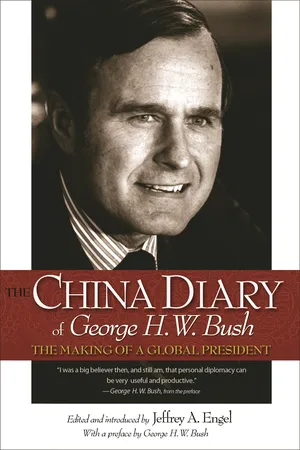
The China Diary of George H. W. Bush
The Making of a Global President
- Jeffrey A. Engel, Jeffrey Engel(Authors)
- 2011(Publication Date)
- Princeton University Press(Publisher)
BUSH IN CHINAThe Making of a Global President
I nterest in George H. W. Bush’s presidency has grown in direct proportion to the violence and instability of the twenty-first century’s first decade. Many recall with fondness the end of the Cold War and Bush’s White House tenure, conjuring halcyon (if not necessarily accurate) memories of a more optimistic moment for the international community, when American-led peace and democracy seemed ready to flower throughout the world. Fascination with Bush’s legacy—in effect, a desire to glean from his presidency applicable contemporary lessons—grows steadily. His diplomatic record is widely lauded, with successful navigation of the Cold War’s end, Germany’s reunification, victory in Panama and the Gulf, and negotiation of the North American Free Trade Agreement heading his administration’s list of achievements.Yet George H. W. Bush himself largely remains an enigma, as the implications of those achievements remain in dispute. A generation after he left office, Bush’s diplomatic reputation offers less a collection of guiding principles than a canvas upon which contemporary commentators paint their own preferred outlines of a successful foreign policy. To some, Bush has become a sage embodiment of a more pragmatic American foreign policy; to others, the poster child for policies built on narrow interests rather than universal ideals. Depending on which particular axe the speaker chooses to grind, Bush was a reaper of geopolitical good fortune or a sower of international discontent.Timing explains much of this confusion. Juxtaposed in history’s stream against the eloquent certitude of Ronald Reagan, the intellectual flexibility of Bill Clinton, and the unbridled certainty of George W. Bush, the elder Bush, known for his prudence (itself a malleable virtue), remains largely ill defined as an international strategist. This is a particularly unfortunate puzzle, because decisions made by Bush’s White House not only were historic in their own right but also left a lasting imprint on the central strategic questions of the twenty-first century, including the inherent tensions between political stability and economic modernization, and the promise of a democratic peace alongside the potential chaos of ethnic and religious strife catalyzed by popular rule. A generation later, not even the flashpoints of American foreign policy have changed: they remain Iraq, China, Russia, free trade, and oil. The questions that troubled Bush during that more optimistic time continue to plague American policymakers today.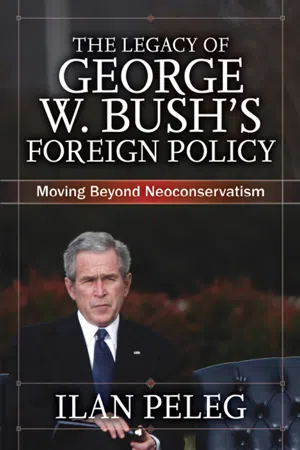 eBook - ePub
The Legacy of George W. Bush's Foreign Policy
Moving beyond Neoconservatism
- Ilan Peleg(Author)
- 2018(Publication Date)
- Routledge(Publisher)
Bush became president at the time that the United States was the recognizable global hyperpower, easily the single most dominant country in the world. While the United States had to deal with an increasingly diverse, polyarchic world, 7 its dominance has provided it with an opportunity to guide the world toward new horizons. That dominance put the man in the White House in a unique position of influence. Third, the fact that September 11 constituted in the minds of most professional observers, and the public at large, a new, ambiguous, and unusually complex situation in which the United States was challenged by a nonstate representing an ill-defined ideology and unspecified demands allowed the White House, more than any other American institution (such as Congress), to define the situation and implement a solution. More than any other event in memory, 9/11 threw the ball into the president’s court: it was an event that gave the president of the United States as much power as any leader ever had in reshaping the world. Those three factors, in combination, facilitated the Bush revolution in foreign policy. But the specific shape that this revolution took was determined by the personality of the president, the interactions that he had with his closest advisers, the decision-making process that he created within his administration, and the ideological messages that he chose to absorb, adopt, and implement. It is to the president’s personality that we now turn. C LASSIFYING B USH George W. Bush has become one of America’s most controversial presidents ever. He is now in a league with Richard Nixon. Writes Noonan: “Americans don’t really know, deep in their heads, whether this president, in his post-9/11 decisions, is a great man or a catastrophe, a visionary or wholly out of his depth.” 8 In order to take the measure of Bush we need to look deeper into the type of leadership he provided during his time in office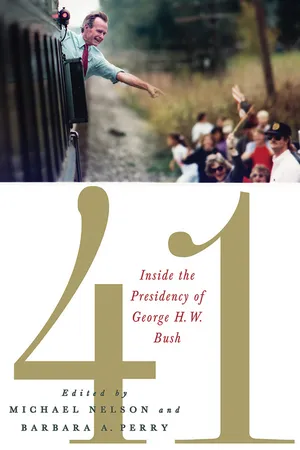 eBook - ePub
41
Inside the Presidency of George H. W. Bush
- Michael Nelson, Barbara A. Perry, Michael Nelson, Barbara A. Perry(Authors)
- 2014(Publication Date)
- Cornell University Press(Publisher)
There is in the popular memory no prominent and durable achievement that serves to anchor Bush in the public mind. The success of the first Gulf War faded in retrospect because it was a fast-won venture in a country few Americans knew and because Saddam Hussein’s survival to fight another day became a persistent reminder of unfinished business. Bush’s success in bringing the Cold War to a peaceful and satisfactory conclusion did not permanently elevate his public stature because his diplomacy was quiet, modest, and often indirect and because Ronald Reagan already occupied that particular pedestal. And Bush’s major domestic victories were either in areas more closely associated with the life’s work of others (such as Senators Edward Kennedy and Tom Harkin and the Americans with Disabilities Act) or created such polarizing political effects (such as the 1990 budget accord and Clarence Thomas’s Supreme Court appointment, which is described in chapter 7 by Barbara A. Perry and Henry J. Abraham) that even today they constitute an indefinite public legacy. 17 Moreover, as both Michael Nelson (chapter 1) and Hugh Heclo (chapter 2) explain, Bush’s uneven relationship with an evolving Republican Party left him at the end of his career without the kind of cohesive core constituency—“Bush Republicans”—to which a firm historical identity might be secured. If the popular judgment about George H. W. Bush has been subject to wide swings, the overall scholarly assessments of his presidency to date have been practically inert. The best place to see this is in Bush’s positioning in the historical rankings of presidents, those surveys of scholars occasionally compiled to arrange administrations from best to worst. The flaws in these rankings are often noted, but they do provide a rough picture of how historians and political scientists evaluate each president at a given moment eBook - ePub
- Michael Eric Siegel(Author)
- 2017(Publication Date)
- Routledge(Publisher)
A high-profile presidency would only raise public expectations at a time when any president would be hard-pressed to satisfy the country’s complex and conflicting political demands. Bush instead sought to dial back his exposure, particularly on substantive issues, trimming the role of the presidency in the lives of most Americans. In this way he was making a virtue of necessity: his inability to affect a swaggering leadership style dovetailed with his minimalist agenda. 105 In some respects, Bush was an effective leader. He understood that he served as president during a time of profound change. In many ways, he was the last Cold War president, and he was also practically driven to confront the mounting budgetary deficits the country confronted in the early 1990s. According to Barilleaux and Rozell: Bush saw his mission as being to guide the country effectively during a period of transition, rather than precipitating large-scale changes. He managed events competently, he protected the powers and prerogatives of his office, and he effectively minimized the influence of his opinions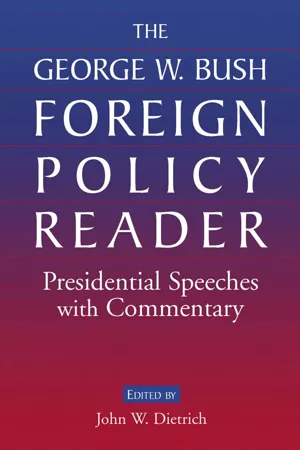 eBook - ePub
The George W. Bush Foreign Policy Reader:
Presidential Speeches with Commentary
- John W. Dietrich(Author)
- 2015(Publication Date)
- Routledge(Publisher)
Chapter 1Bush and the World of 2000
For many generations of Americans, there has been one major event that has served as a defining moment in national or world affairs. The attack on Pearl Harbor turned December 7 into a date that would “live in infamy.” The assassination of President John F. Kennedy riveted the country. The terrorist attacks of September 11, 2001 (9/11) are this generation’s defining event. The images and emotions of that day are seared into the memories of hundreds of millions of people around the world. Since then, Americans have seen dramatic changes in their daily lives, political views, and perceptions of personal and national security.The events of 9/11 had a particularly powerful effect on the foreign policy of President George W. Bush and his administration. September 11 forced Bush to turn more attention to foreign policy, reinforced his conviction that the country needed strong presidential leadership, and gave him a sense of mission. The attacks also changed Bush’s policy priorities. New challenges, such as building an antiterrorism coalition and overthrowing regimes in Afghanistan and Iraq came to the fore, while other issues were lowered on the agenda. In addition, the war on terrorism has redefined who is a U.S. ally and who is an enemy. On a deeper level, 9/11 challenged the continued relevance of the long-standing strategic doctrines of containment and deterrence. Domestically, influence shifted away from Congress toward the executive branch. And among the President’s advisers, power shifted toward those favoring strong responses.Bush’s foreign policy, therefore, can be divided into two periods. The first period began when presidential candidate Bush laid out his vision of the world and it continued through his first eight months in office. The second period began with the events of 9/11 and continued through the rest of the first Bush administration. Although useful, this division should not be over-read as implying that Bush was completely reborn on 9/11, with no preexisting policy challenges or personal views. Focusing only on the second period would leave the observer with little sense of what Bush’s policies might have been in the absence of 9/11. Bush’s specific actions in response to the attacks would also be harder to understand. Most important, ignoring the first period would make it impossible to judge whether Bush’s longer-term bold, and by some accounts revolutionary, post-9/11 policies are entirely a function of 9/11, or whether those events simply reinforced and refocused his preexisting views on America’s national security and world role. Some background knowledge about Bush’s personal foreign policy experience, his decision-making style, the major policies he planned for his administration, his overall foreign policy vision, and the people he appointed as key advisers is, therefore, crucial to understanding Bush’s foreign policy both before and after 9/11.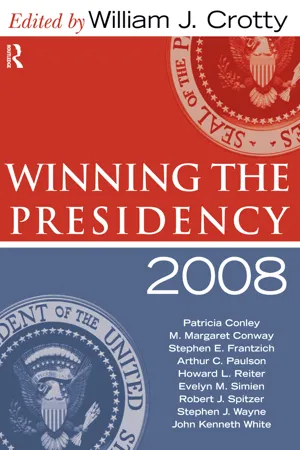 eBook - ePub
- William J. Crotty(Author)
- 2015(Publication Date)
- Routledge(Publisher)
The Bush Presidency and the 2008 Presidential Election Context and Imprint WILLIAM J. CROTTYWe need to be able to read the page before we turn it.—SENATOR PATRICK J. LEAHY calling for a truth commission to investigate the Bush administrationThis chapter focuses on the factors leading up to the 2008 presidential election, those that combined to set the environment in which the presidential race would be fought. It serves as an introduction to the analyses to come in each of the following chapters and provides an overview and context for understanding the 2008 presidential race.The Bush-Cheney Presidency: Setting an Agenda for the 2008 Race
The actions and policies of the Bush administration established, directly and indirectly, the agenda for the presidential campaign. The accomplishments, failures, and ambitions of the Bush administration were the baseline from which all else flowed. Given the controversial and historically pathbreaking actions of the administration in a number of areas, it constituted a level of significance that is difficult to summarize. The issues generated by the Bush-Cheney years raised questions about the nation’s constitutional design as well as the wars in progress, the relevance of established legal procedures, and, most markedly for the 2008 race, an economy in deep trouble. How such concerns were to be addressed and their impact on the presidential contest and its outcome are questions at the heart of the 2008 presidential contest.With this as prelude we turn to a discussion of governance—policy, administration, and law during the Bush-Cheney years. The canvas is exceptionally broad—academicians, legal analysts, foreign and domestic policy experts, and the courts will be debating and dealing with the issues raised as well as their budgetary and social consequences and America’s relations with the international community for decades and generations to come. The Bush presidency was in a very real sense a transitional presidency, one that set an agenda for the 2008 campaign and one the incoming Obama administration must address in its many multilayered facets.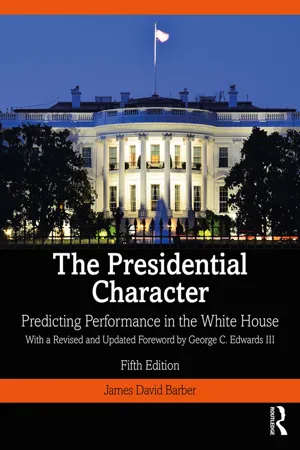 eBook - ePub
The Presidential Character
Predicting Performance in the White House, With a Revised and Updated Foreword by George C. Edwards III
- James David Barber, James Barber(Authors)
- 2019(Publication Date)
- Routledge(Publisher)
But then the election ended and the national amnesia process began. In tune with the climate of expectations, cycling on after the combative election, Bush the conciliator emerged, wrapping his arms around those he had just been stabbing in the back. The season of political despair, disillusionment and degradation was passed away and faith, hope and charity came on. A new era.Mr. Bush's Presidential style was defined in his first independent political success in Texas in 1962, when as local party chairman he defused a conflict between the John Birch Society and establishment Republicans. Bush the negotiator took that on as his main talent, and so it remains.His rhetoric is coachable as the '88 campaign brought out. He speaks about as well as Gerry Ford. His homework falls short of B-plus, as demonstrated by his lack of knowledge about such heavy issues as abortion and defense. When it comes to curiosity about reality, George Bush is no Jack Kennedy, no Harry Truman. He inherits from Mr. Reagan a practical prejudice for the rich masked by "conservatism," and a readiness to manipulate the media.Why expect from President Bush anything other than a continuation of the Reagan mythological politics?A close look at Mr. Bush's world view and character in the context of the situation he confronts makes plausible a different pattern. Although Mr. Bush, sounding like Herbert Hoover, urges us to believe that all is going well, the truth is that it is not. The evidence is at last coming through that there is trouble in River City—big, deep, harsh trouble that seems about to drop upon us.One need only speak aloud certain words to recall what is happening: drugs, deficit, nuclear weapons, disease, economic domination, foreign ownership, weakened education, dollar decline, third world debt, terrorism, slipping technology, children in poverty, refugees, environmental deterioration, guns for sale, human rights violations, civil wars.The worst political danger is interdependence plus anarchy. To suppose that these global cancers will simply waft away if we just dream on is folly, and folly competes with conspiracy as the worst of political solutions.We need to get peace and justice organized—institutionalized—internationally. Not just a flaky summit meeting now and then, or some little bilateral agreements. Turning around our international decline is going to take major new initiatives, large-scale and long-term, backed by the public. How might a President Bush make that happen? How might he destroy the chance? eBook - PDF
Striking First
The Pre-emption and Preventive War Doctrines and the Reshaping of US Foreign Policy
- B. Glad, C. Dolan, B. Glad, C. Dolan(Authors)
- 2016(Publication Date)
- Palgrave Macmillan(Publisher)
policy or adapted to U.S. demands. If other nations questioned these deci- sions, the United States would assert the right of self-defense and pursue its national interests based on the concept of protecting national sovereignty. When the support was forthcoming, as was the case in the immediate aftermath of 9/11, the United States wrapped itself in the cloak of international approval (UN Security Council resolution 1441). Where they did not, as was the case with war against Iraq, the United States acted (almost) unilaterally and publicly excoriated those who demurred. Bush's doctrine was designed to speak loudly and use a big stick. Matched with public support, congressional acquiescence, and Bush's willingness to go-it- alone if necessary, the United States, it seemed, had the means to enforce its will with or without the support of others. At home, the administration cut many constitutional corners undermining the civil liberties of U.S. citizens in detention centers, denying them their right to be charged with crimes, denying their right to an attorney, even incarcerating children without charges. The Bush administration also called for the United States to dramatically outspend potential rivals on defense to the point that no one will ever think of catching up to the United States in weaponry. Currently, the United States spends more on defense than the next fifteen countries combined! The Crisis Presidency and George W Bush One of the key lessons in leadership studies, is that while skill is important, leader- ship is largely contextual. As circumstances change, the politically permissible levels of power also change. American history gives us evidence along these lines. In times of peace and calm, the normal checks and balances of the Madisonian system tend to bind a president and limit his range of political power. But in times of great upheaval, as Fisher states in chapter nine, the Madisonian checks designed to balance power, go into remission.
Index pages curate the most relevant extracts from our library of academic textbooks. They’ve been created using an in-house natural language model (NLM), each adding context and meaning to key research topics.

