History

President Rutherford B Hayes
Rutherford B. Hayes was the 19th President of the United States, serving from 1877 to 1881. He is known for overseeing the end of Reconstruction and for his efforts to reform the civil service. Hayes also advocated for civil rights and attempted to reconcile the North and South after the Civil War.
Written by Perlego with AI-assistance
Related key terms
1 of 5
9 Key excerpts on "President Rutherford B Hayes"
 eBook - PDF
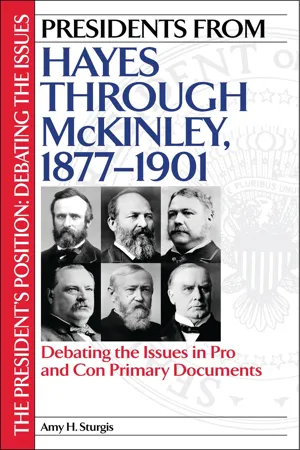
Presidents from Hayes through McKinley, 1877-1901
Debating the Issues in Pro and Con Primary Documents
- Amy H. Sturgis(Author)
- 2003(Publication Date)
- Greenwood(Publisher)
1 RUTHERFORD B. HAYES (1877-1881) Rutherford B. Hayes's inauguration in effect closed the Civil War era in the United States and ushered in a new one. Hayes succeeded three presidents intimately tied to the recent war: Abraham Lincoln, who served as chief executive from 1861 to 1865, during the conflict; Andrew Johnson, the controversial and ultimately impeached former vice presi- dent who assumed the presidency from 1865 to 1869, after Lincoln's as- sassination; and Ulysses S. Grant, the victorious leader of the Northern forces in the war, who rode his military success to the White House from 1869 to 1877. The focus of all three men—the fallen hero, the suspect Southerner, and the lauded general—remained on the conflict, whether it be executing the war or managing its aftermath. Administering the war-torn nation, rebuilding the economy, and occupying the former Con- federate states required the attention and resources of the nation. Hayes, as president, entered the political landscape with a new message, in ways both intentional and unintentional: other subjects required the focus of the country; it was time for U.S. citizens to put the Civil War behind them and consider the future. Hayes brought an impressive pedigree with him to the White House. Born the son of an Ohio farmer on October 4, 1822, Hayes graduated at the head of his class from Kenyon College and then earned a law degree from Harvard University. He established a successful legal practice in Cincinnati, where he represented defendants in several fugitive-slave cases and became active in the fledgling Republican party. His wife, the former Lucy Ware Webb, was herself very well educated, and her cul- 10 FROM HAYES THROUGH MCKINLEY tured background complemented his professional lifestyle. After serving with the Union army during the Civil War, Hayes was elected first to Congress (1865) and then to the governorship of his home state of Ohio (1868-1876). eBook - PDF
The Unitary Executive
Presidential Power from Washington to Bush
- Steven G. Calabresi, Christopher S. Yoo(Authors)
- 2008(Publication Date)
- Yale University Press(Publisher)
In our judgment, Grant is a misunderstood president; though he made some significant mistakes, some of which led to scandals, Grant came out on the right side of the big questions of his day. His reputation has wrongly suffered because of the scandals that plagued the end of his administration as well as his failed efforts to make Reconstruction work one hundred years ahead of its time. 196 19 Rutherford B. Hayes Rutherford B. Hayes became president in 1877 , when the power of the Republican Party was at a low point. This ebbing of the tide of Republican power was reflected in the presidential election of 1876 , in which Hayes decisively lost the popular vote contest to Democrat Samuel Tilden, but was awarded the presidency by a special Electoral Commission that concluded he had won in the Electoral College. After the Electoral Commission had awarded him the presidency, Hayes set about picking a cabinet and, as-tonishingly under the circumstances, resolved to do this completely inde-pendent of Congress. As Leonard White reports, “Powerful Senators had expected to be consulted. They were not.” White further notes, “The Senate oligarchy promptly accepted the challenge, declined to confirm as a matter of courtesy, and sent the nominations to committees, not even excepting their fellow Senator, John Sherman. A storm of public indignation swept across the country and shortly thereafter the Senate confirmed all the nomi-nations. ‘For the first time since the Civil War,’ [historian Wilfred] Binkley wrote, ‘the Senate had been vanquished on a clear-cut issue between it and the President. The upper House had passed its zenith.’” 1 Hayes thus came into office with a striking show of independence and pro-reform sentiment. He was off to a good start. eBook - ePub
African Americans and the Presidents
Politics and Policies from Washington to Trump
- F. Erik Brooks, Glenn L. Starks(Authors)
- 2019(Publication Date)
- Greenwood(Publisher)
During his acceptance of the Republican nomination for president, Hayes used the phrase “the blessings of honest and capable local self government,” signaling his intention to limit the federal government’s efforts to implement reconstruction policies. Southern states did not keep their promise to respect rights for southern blacks. In fact, stricter laws impeding equality for blacks were implemented as part of the Jim Crow era in the South. U.S. presidents for nearly the next 100 years had to deal with the negative effects of these laws.The United States was moving from a majority agricultural economy to one based on technology and was expanding by gaining more western territory. This was one factor that ended the emphasis on slavery, which was based on economic support of the southern agricultural economy. However, racism and discrimination against African Americans was still a major issue, particularly in the southern states. Jim Crow laws forbade equality in voting, home ownership, employment, education, and practically all facets of social and political engagement.Rutherford Birchard Hayes 19th President of the United States Presidential Term: March 4, 1877–March 4, 1881 Political Party: Republican Vice President: William A. WheelerRutherford Birchard Hayes was born on October 4, 1822, in Delaware, Ohio. He earned a law degree from Harvard University before returning to Ohio to practice law. He opposed slavery and was active in the Republican Party. Hayes served as a Union soldier during the American Civil War and became a major in the 23rd Ohio Regiment. He had political support from blacks when he ran for the presidency, as did other Republican candidates at the time, due to the party’s support for equality for blacks. For example, Frederick Douglass became the first black man to address a major political party convention when he spoke for racial equality at the 1876 Republican convention that nominated Hayes. Hayes lost the popular vote due to suppression of Republican votes in the South, particularly against black voters in Louisiana, South Carolina, and Florida. However, after he led in a very contentious Electoral College vote of 185 to 184, Hayes was declared the winner against his Democratic contender, Governor Samuel J. Tilden of New York.President Hayes was the last president of the Reconstruction era. By the time he was elected president, Reconstruction in the South was all but over. Only Louisiana and South Carolina still implemented reconstructive policies, as by 1876 they were the only two states in the South that still had governors who were affiliated with the Republican Party. The focus of Hayes’s administrative theory of government was meritrocratic, or the equal treatment of individuals without regard to political affiliation. For example, his cabinet selections included one member who was an ex-Confederate and Democrat and another who was a Liberal Republican in 1872 and opposed the election of Ulysses Grant as president. eBook - ePub
Maligned Presidents: The Late 19th Century
The Late 19th Century
- M. Skidmore(Author)
- 2014(Publication Date)
- Palgrave Pivot(Publisher)
3 Rutherford B. HayesAbstract:Despite his troubled election that brought jeers of “Your Fraudulency,” or “President RutherFRAUD B. Hayes,” undoubtedly Hayes was a man of integrity and ability. He worked vigorously to protect his office, battling Congress on appointments, and won. He sought to conciliate the South, and received assurance from its leaders that they would ensure black rights. In response, he withdrew the few remaining troops of occupation. Southern leaders refused to honor their commitments, and Hayes’s southern policy was a failure. He was naïve, but there was so little support remaining nationally for ensuring civil rights that perhaps no president could been successful at the time. Regardless, he was a strong and vigorous leader, and does not fit the stereotype of the weak Gilded Age president.Skidmore, Max J. Maligned Presidents: The Late 19th Century. New York: Palgrave MacMillan, 2014. DOI : 10.1057/9781137438003.0004.Grant’s successor, Rutherford B. Hayes (1877–1881), today is far less controversial than Grant, partly because Grant is the more interesting figure, and also because those who write about him are likely to have more vested interest one way or the other in their subject than those who write about Hayes. Hayes, however, also presents strengths, and was not a colorless character—nor was there anything colorless about his election: he came to office in what was the most controversial election in the history of the United States, the election of 1876 with its alleged “Compromise of 1877.”Initially, “the new First Family remained unknown.” Reporters and others knew something of Hayes and his past, praised his “apparent firmness and personal courage,” and knew that he had “a good war record and was sensible in his few public statements.” Although he “interested the public,” however, he—unlike Grant—“was hardly a man to draw a crowd.”1 There were rumors that First Lady Lucy Hayes would ban alcohol from the executive mansion. After considering the matter, Hayes took her advice and adopted the ban, causing Mrs. Hayes to go down in history as “Lemonade Lucy.”2
- Edward O. Frantz(Author)
- 2014(Publication Date)
- Wiley-Blackwell(Publisher)
The Republican Era: 1869–1901: A Study in Administrative History (1958). Johnson’s intemperate remarks combined with perceptions that the civil service varied from inefficient at best through incompetent and corrupt at worst, aroused support for Jenckes’s bill both in the press and in Congress. Many Radical Republicans (among whom Jenckes was prominent) backed reform, but others led by Thaddeus Stevens did not want reform legislation to thwart their control of patronage. All Radicals agreed to directly curtail Johnson’s patronage with the 1867 Tenure of Office Act, but they split over the Jenckes bill when Stevens moved successfully to table and kill the measure. The vote was bipartisan, and to a degree it revealed an urban/commercial support for, versus rural hostility to, reform. Among the Radical congressmen who did not follow Stevens was Rutherford B. Hayes from Cincinnati, Ohio.Governor Hayes
In supporting Jenckes, Hayes began a lifelong commitment to civil service reform, which can be followed in his own words in Charles Richard Williams, ed.), The Diary and Letters of Rutherford Birchard Hayes: Nineteenth President of the United States (1922–1926). More primary source material may be found in Charles Richard Williams’s appreciative biography Life of Rutherford Birchard Hayes: Nineteenth President of the United States (1914), which reprints many of Hayes’s speeches.Although Hayes embraced reform, he at times dismayed ardent reformers by never swerving from his loyal support of the Republican Party. And the party discovered that he had a knack for winning close elections. He was an enormously popular Civil War hero who was wounded five times while leading his Ohio regiment. His distinguished military career has been covered by T. Harry Williams, Hayes of the Twenty-Third: The Civil War Volunteer Officer (1965), and in less detail by Ari Hoogenboom, Rutherford B. Hayes: “One of the Good Colonels” (1999). Having been separated from his family for four war years, Hayes did not like being absent in Washington six months annually as a congressman and agreed in 1867 to run for the governorship of Ohio. He ran on a radical platform, advocating an “impartial suffrage” amendment, and won an extremely narrow victory over the racist appeals of the Democrats.Hayes quickly discovered that the limited executive patronage he controlled was a headache. Having succeeded a fellow Republican and personal friend, Jacob Dolson Cox, Hayes anticipated no trouble over a few necessary appointments. But William Henry Smith, who had orchestrated Hayes’s nomination, assumed he would be Hayes’s chief patronage adviser and was angered because Hayes consulted with Cox and others about appointments. Smith, in a huff, resigned his position as Ohio’s secretary of state and become editor of the Cincinnati Chronicle No longer available |Learn more
The American President
A Complete History
- Kathryn Moore, Kathryn Moore(Authors)
- 2018(Publication Date)
- Union Square & Co.(Publisher)
R UTHERFORD B. H AYES ★ ★ ★ NINETEENTH PRESIDENT ★ ★ ★LIFE SPAN • Born: October 4, 1822, in Delaware, Ohio • Died: January 17, 1893, in Fremont, Ohio NICKNAME • Dark-Horse President RELIGION • No formal affiliation, but attended Methodist services after his marriage HIGHER EDUCATION • Kenyon College, 1842 • Harvard Law School, 1845 PROFESSION • Lawyer MILITARY SERVICE • Civil War: served with Twenty-Third Ohio Volunteer Infantry Regiment June 1861 to June 1865; began as a major and rose to rank of major general FAMILY• Father: Rutherford Hayes (1782–1822)• Mother: Sophia Birchard Hayes (1792–1866)• Wife: Lucy Ware Webb Hayes (1831–1889); wed on December 30, 1852,in Cincinnati, Ohio• Children: Birchard “Birch” Austin (1853–1926); James Webb Cook (1856–1934); Rutherford “Ruddy” Platt (1858–1927); Joseph Thompson (1861–1863); George Crook (1864–1866); Frances “Fanny” (1867–1950); Scott Russell (1871–1923); Manning Force (1873–1874)POLITICAL LIFE • Cincinnati city solicitor (1858–1861) • US representative (1865–1867) • Ohio governor (1868–1872; 1876–1877) PRESIDENCY • One term: March 4, 1877–March 4, 1881 (inauguration held on March 5 since the 4th was a Sunday) • Republican • Reason for leaving office: announced at start of presidency he would not seek second term• Vice president: William A. Wheeler (1877–1881)ELECTION OF 1876• Electoral vote (disputed and went to committee which determined results): Hayes 185; Samuel Tilden 184• Popular vote: Hayes 4,036,572; Tilden 4,284,020The year was 1876 and the presidential election was mired in controversy. Both parties contested the results, each accusing the other of fraud. The final result was not yielded through the democratic process, but, rather, by deals made behind the scenes. The winner, and new president, was Republican candidate Rutherford B. Hayes.CABINET ★ ★ ★ ★ ★ ★ ★ ★ ★ ★SECRETARY OF STATE William M. Evarts (1877–1881) eBook - ePub
After Lincoln
How the North Won the Civil War and Lost the Peace
- A. J. Langguth(Author)
- 2014(Publication Date)
- Simon & Schuster(Publisher)
Rutherford B. Hayes Passage contains an image
CHAPTER 19
RUTHERFORD BIRCHARD HAYES (1876)
F ROM HIS TENTATIVE ENTRANCE TO the world, Rutherford B. Hayes was considered diffident. His father had uprooted the family from New England to seek his fortune in a rustic town on a branch of the Ohio River, and within a few years, he had become partner in a distillery and a stalwart of the Presbyterian Church. But when the noxious fevers of an 1822 epidemic struck Ohio, Hayes was carried off three months before his namesake was born.The infant looked destined to follow. Neighbors asked regularly whether Mrs. Hayes’s baby had survived the night.But Sophia Birchard Hayes had recently also lost a daughter, and she dedicated herself to sustaining this son, with his large head and enormous, watchful eyes. Her mission became more urgent when her older son went larking on a river with friends, crashed through its ice, and froze to death.In time, Rutherford was robust enough to go off to Kenyon College, although any form of sport was beyond him. On graduation, he returned home to study with a local lawyer. But the townspeople who found the young man unassuming missed his strong instinct for self-improvement.He traveled to Massachusetts to enroll in Harvard Law School and applied himself to his courses. In later years, though, classmates remembered little about him but his good nature.During that period, his mother’s brother had become the wealthiest businessman in the state, and Hayes seemed likely to set up a desultory law practice and spend his days reading for pleasure while he awaited his inheritance.Instead, he married Lucy Ware Webb, a doctor’s daughter who channeled his talents into becoming an advocate for local workingmen. While Rud Hayes still indulged his bookish interests at the Cincinnati Literary Club, he also took on and won celebrated cases that furthered his reputation. In politics, he was a Whig—opposed to slavery but no abolitionist. Yet his practice expanded to include the defense of runaway slaves, and he once found himself on a legal team with Salmon Chase. eBook - PDF
Ohio
A History of the Buckeye State
- Kevin F. Kern, Gregory S. Wilson(Authors)
- 2023(Publication Date)
- Wiley-Blackwell(Publisher)
The remain- ing justices available to serve on the commission were all Republicans. Davis’s succes- sor, Joseph P. Bradley, ultimately had the deciding vote in giving the presidency to Hayes, with 185 electoral votes to Tilden’s 184. Figure 10.6 This is a campaign banner for the 1876 Republican presidential ticket of Ohio governor Rutherford B. Hayes and New York Representative William A. Wheeler. Hayes and Wheeler had both earned reputations for honesty, which the Republicans needed after the scan- dals of the Grant administration, and all factions of the Republican Party were able to unite behind them. Source: Library of Congress Prints and Photographs Division (LC-DIG-ppmsca-07604) Late Nineteenth-Century Politics and Presidents: Why Ohio? 263 It remained for the electoral votes to be officially counted in Congress. With Hayes’s opponents calling him “Rutherfraud” and “His Fraudulency,” Democrats filibustered the vote count to delay the result and try to extract concessions from Republicans. Talks began among Hayes’s supporters and southern Democrats, out of which supposedly came a bargain or the “Compromise of 1877.” In exchange for acquiescing in Hayes’s election and promising to respect black civil rights in the South, Democrats received assurances that upon becoming president, Hayes would remove the remaining federal troops who were protecting the capitals in Louisiana and South Carolina, recognize Democratic “home rule” in the South, promote federal support for a transcontinental railroad through the South, and appoint a southerner to the cabinet. With a deal in place, the story goes, the official vote count ended. At 4:10 a.m. on March 2, 1877, with four guards armed with revolvers surrounding him, the presiding officer of the Senate, Republican Thomas Ferry of Michigan, announced Hayes the winner. eBook - PDF
- Marcus A. Stadelmann, Marcus A. Stadelmann, PhD(Authors)
- 2021(Publication Date)
- For Dummies(Publisher)
House of Representatives without even campaigning. He was still fighting in the Civil War. He served two terms and then was elected governor of Ohio. As the First Lady of Ohio, Lucy became involved in public education for the disadvantaged and worked for state funding of orphans whose parents had been killed in the Civil War. Rutherford decided to retire from politics when his term as governor was up in 1872, and moved the family to Fremont, Ohio, to be close to his favorite uncle, who CHAPTER 10 Reconstructing a Country 131 was in poor health. After his uncle passed, Rutherford became quite wealthy, inheriting a large amount of money and a large estate, which he and Lucy called Spiegel Grove. In 1875, the Republican Party decided to nominate Rutherford one more time for governor of Ohio. He easily won and was considered the front-runner for the Republican nomination in 1876 if President Grant decided not to run for a third term. Riding the bumpy road to the White House The election of 1876 turned out to be the most controversial election in U.S. history — until the 2000 election, that is. The Democratic nominee, Governor of New York Samuel Tilden, won the popular vote by more than 200,000 votes. In the Electoral College, Tilden appeared to have won 203 electoral votes to Rutherford Hayes’s 166. Although all results showed that Samuel Tilden had won, the Republican Party disputed the outcome of the election. It claimed that Blacks had been denied the right to vote in many parts of the South, especially in South Carolina, Louisiana, and Florida. The election officials refused to accredit the Democratic electors in these three states. The officials instead had the three states give their electoral votes to Rutherford Hayes. Now the election was tied, with each candidate receiv -ing 184 electoral votes. Not surprisingly, chaos ensued in the capital. The Democrats controlled the House, and the Republicans controlled the Senate.
Index pages curate the most relevant extracts from our library of academic textbooks. They’ve been created using an in-house natural language model (NLM), each adding context and meaning to key research topics.

