History

Jimmy Carter
Jimmy Carter served as the 39th President of the United States from 1977 to 1981. He is known for his efforts to promote human rights and his role in brokering the Camp David Accords, which led to a peace treaty between Israel and Egypt. Carter's presidency was marked by energy crises and economic challenges, and he later became a prominent advocate for humanitarian causes.
Written by Perlego with AI-assistance
Related key terms
1 of 5
10 Key excerpts on "Jimmy Carter"
 eBook - PDF
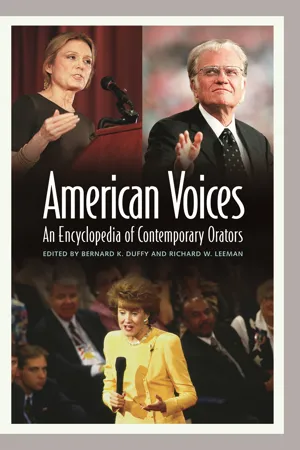
American Voices
An Encyclopedia of Contemporary Orators
- Bernard K. Duffy, Richard Leeman, Bernard K. Duffy, Richard Leeman(Authors)
- 2005(Publication Date)
- Greenwood(Publisher)
Of those three presi- dents, only Jimmy Carter received the award for his postpresi- dential work. 60 James Earl "Jimmy" Carter (1924- ) that led to his election in 1976. By the end of his presidency, however, his rhetoric of moral- ity and reality was describing a continuing en- ergy problem, a painful hostage crisis, and a weak economy. Rather than creating an image of leadership, his rhetoric of the people and his message that the people were the solution came to imply that the people were the cause of the nation's problems. His plain style of rhetoric, with its accompanying informality and realism, gave a clearer sense of the present than a vision for the future. That same blend of realism with virtue that seemed to incapacitate him as a pres- ident, however, has stood him well since 1981. As a man of conscience confronting a world with its shortcomings, challenging it to do bet- ter, and leading by his own example, Jimmy Carter has used simple and direct public speak- ing that has fit the man and his mission. INFORMATION SOURCES Research Collections and Collected Speeches The Jimmy Carter Presidential Library and Museum in Atlanta, Georgia, contains a variety of relevant ma- terials and speeches. Archival holdings of speech drafts had not been fully cataloged as of this writing. Carter, Jimmy. A Government as Good as Its People [GGP]. New York: Simon and Schuster, 1977. . Public Papers of the President: Jimmy Carter [PP]. 4 vols. Washington, D.C: Govern- ment Printing Office, 1977-81. Windt, Theodore. "Jimmy Carter." In Presidential Rhetoric (1961-1980) [PR], ed. Theodore Windt, 2nd ed. Dubuque, Iowa: Kendall/Hunt, 1980. Web Site The Jimmy Carter Presidential Library and Mu- seum [JCL]. This Web site contains a sampling of im- portant presidential speeches, as well as his "Law Day" speech in 1974 and his Nobel Lecture in 2002. http://www.jimmycarterlibrary.org Audiovisual Material There are no major audiovisual collections of Jimmy Carter's speeches.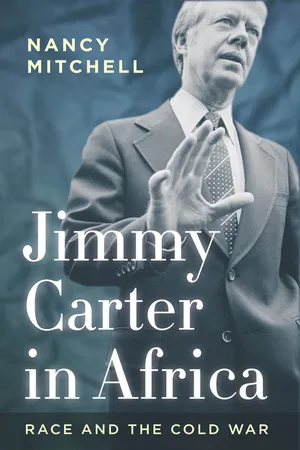 eBook - ePub
Jimmy Carter in Africa
Race and the Cold War
- Nancy Mitchell(Author)
- 2018(Publication Date)
- Stanford University Press(Publisher)
Conclusion Jimmy CarterI think what has chiefly struck me in human beings is their lack of consistency. . . . It has amazed me that the most incongruous traits should exist in the same person and for all that yield a plausible harmony. I have often asked myself how characteristics, seemingly irreconcilable, can exist in the same person.—W. Somerset Maugham, The Summing UpJimmy Carter was a complex man who led the United States in a complex era. He lived humbly but was not humble. He exercised patience but was impatient. He believed in forgiveness but was unforgiving. He promised that his administration would be transparent, but he personally was the least transparent of men. He embraced the cause of human rights but exuded little human warmth. He questioned, in the wake of Vietnam, the need to contain the Soviet Union everywhere, but he did not want it to expand anywhere on his watch. He sought the acclaim of the crowd but was above all a solitary man.These contradictions were perfectly attuned to the United States in the late 1970s, years of discord and disappointment when many Americans were grappling with the meaning of the US failure in Vietnam, the Watergate scandal, and the future of liberalism. The consensus with which Americans had fought the early Cold War had been shattered. Jimmy Carter governed in—and reflected—this era of fracture.Carter was, as a campaign staffer noted in 1976, “a very odd duck.”1 Four years in the most public of spotlights—five years, including the campaign—did not change this assessment. “Carter was impossible to understand. I know that Mr. Vance felt that very strongly,” David Newsom, who as the undersecretary for political affairs had worked closely with Cyrus Vance, declared. Zbigniew Brzezinski described Carter as “a deeply private man.” When Andrew Young was asked if he felt he really knew Carter, he admitted, “I do, and I don’t.”2This flummoxed journalists, who sought clarity and snappy leads. At first blush, during the primary campaign, attempting to understand Jimmy Carter posed an interesting challenge, but as his campaign and then his presidency wore on, Carter’s opacity became a source of frustration. How many stories could a journalist write about what made Jimmy tick?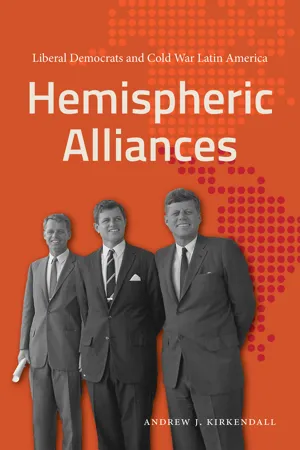 eBook - ePub
Hemispheric Alliances
Liberal Democrats and Cold War Latin America
- Andrew J. Kirkendall(Author)
- 2022(Publication Date)
- The University of North Carolina Press(Publisher)
Chapter 8 Jimmy Carter and Human Rights in South AmericaArthur Schlesinger Jr. had hoped that a liberal candidate would emerge in 1976. He wanted Ted Kennedy not to rule himself out in 1975, as he seemed to be doing. He dismissed former Georgia Governor Jimmy Carter as “an intelligent, ambitious opportunist.” An unknown on the national stage, Carter was a devout Christian who displayed his beliefs in a way that was unknown among political leaders at the time; he promised a more moralistic approach to foreign policy than that provided in previous years. Generally, Schlesinger was concerned about Carter’s anti-government rhetoric in terms of domestic policy and noted, following the 1976 convention, that he assumed that the Massachusetts senator would “serve as the ideological conscience of the Carter administration—and no doubt make Carter a better President than he would be without pressure from the left.” Generally, he thought that Carter lacked vision and did not support what Schlesinger called “affirmative national government.” As time went on, as he wrote to the new ADA president in mid-1978, “I do not think that Carter is, or is likely to become, either a liberal or even a Democrat.”1But despite Schlesinger’s own skepticism, Carter became committed to the new liberal Democratic understanding of human rights. Some have argued that his interest in human rights and humanitarian affairs stemmed in part from his failure to engage with the civil rights movement in the 1950s and 1960s. As president, Carter expanded his interest in Latin America. Carter had visited Argentina, Brazil, Colombia, Costa Rica, and Mexico as governor of Georgia. He and his wife “read a chapter in the Bible in Spanish” every night before retiring. In a speech before the Chicago Council on Foreign Relations in March 1976, he had argued that “it must be the responsibility of the President to restore the moral authority of this country in the conduct of foreign policy.” In a speech before the Student National Medical Association on the campaign trail in April, he criticized the Republicans for neglecting Latin America and Africa. He criticized Secretary of State Kissinger for suggesting that the United States and military-led Brazil shared the same values, which he called a “gratuitous slap in the face of all those Americans who want a foreign policy that embodies our ideals, not subverts them.” Congressman Fraser sought to reassure a wavering leader of the American Civil Liberties Union in Southern California, who was considering not voting for Carter, that Fraser himself was pleased that Carter mentioned “human rights in every one of his foreign policy speeches.” The party platform included criticism of “extensive American interference” in Chile and the need to “make clear our revulsion at the systematic violations of basic human rights that have occurred under some Latin American military regimes.” In Carter’s October debate with Ford, Carter listed the 1973 coup in Chile as one of the primary reasons for “the deep hurt that’s come to this country” in terms of its international reputation.2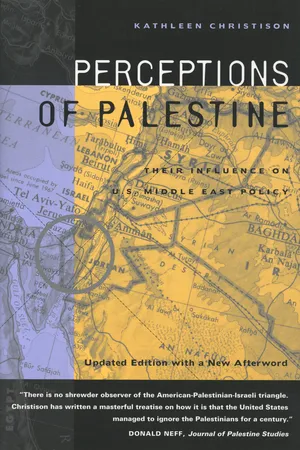 eBook - PDF
Perceptions of Palestine
Their Influence on U.S. Middle East Policy
- Kathleen Christison(Author)
- 2023(Publication Date)
- University of California Press(Publisher)
Although not an evangelical Christian, Carter was and is an idealist, and in his public life both during and since his presidency he has demonstrated a missionary zeal about trying to make a difference in the world. In the mid- 1990s, following a series of private interventions in Bosnia, North Korea, Jimmy Carter / 159 and Haiti, Carter told an interviewer that he had "one life and one chance to make it count for something." His faith, he said, "demands—and this is not optional—my faith demands that I do whatever I can, wherever I can, whenever I can, for as long as I can with whatever I have to try to make a difference." 3 Carter's sense of mission took him into areas of diplomacy that others might have shunned as too risky. He was not a politician in the usual sense, not inclined toward the kind of deal making and maneuvering that is usually the stuff of politics in Washington, and, in the early months of his presidency and during his per- sonal diplomacy in the 1990s, he was essentially oblivious to the criticism his policies and actions generated. Carter was genuinely impatient with diplomatic formulas, and more than once in the first few months of his presidency he broke the bonds of the old frame of reference on the Palestin- ian issue, almost without realizing the consternation and dismay his state- ments and actions caused Israel and Israeli supporters in the United States. This style led some to regard him as politically naive and a loose cannon, but in fact his actions, if not specifically planned, were the deliberate acts of a man who knew his mind and was irritated with the limitations of diplo- matic language. Carter was as unsympathetic toward the Arabs' rigidity, particularly their refusal to make peace with Israel, as he was toward Israeli and U.S. blinders, especially the refusal to accept the existence of the Pal- estinians and the PLO. eBook - ePub
- Michael Eric Siegel(Author)
- 2017(Publication Date)
- Routledge(Publisher)
He did have his accomplishments, however. He was directly responsible for mediating a peace process between Israel and Egypt and helped those adversaries agree to sign the Camp David peace treaty in 1978. Carter was able to convince Israel’s prime minister, Menachem Begin, and Egypt’s president, Anwar Sadat, to move beyond their deadlock over “positions” and toward agreement on the fulfillment of “interests.” Although Israel and Egypt demanded control of the Sinai Peninsula, which the Israelis had captured in the 1967 “Six-Day War,” Carter and his mediation team helped reconcile the Israeli interest in security with the Egyptians’ interest in sovereignty. 131 Carter successfully negotiated the Panama Canal Treaty—a feat which several presidents prior to him had failed to accomplish. He placed the issue of human rights on the international agenda, and perhaps his influence led to the release of political prisoners in Argentina and other countries. Finally, he was responsible for nominating more women and minorities to the federal bench than any other president before him. Despite his achievements, this Democratic president had trouble leading a Democratic-controlled Congress, did not establish clear policy objectives, presided over a huge economic downturn (interest rates reached 17 percent and inflation stood at 12.5 percent), and failed to rally the nation to particular causes of importance in many respects. 132 His practice of telling the nation the truth, as he defined it, proved unsuccessful. The most famous case of Carter’s straightforward speaking to America is now known by a word he didn’t use: In 1979, he gave what is now known as the “malaise” speech, which is memorable because of the nature of Carter’s remarks. He pointed out flaws and shortcomings in himself and the nation as a whole eBook - ePub
Star-Spangled Men
America's Ten Worst Presidents
- Nathan Miller(Author)
- 2008(Publication Date)
- Scribner(Publisher)
Jimmy CarterO n New Year’s Eve, 1977, as Jimmy Carter’s first year in the White House was ending, the president was in Teheran, the guest of honor at a glittering state dinner given by the Shah, Mohammad Reza Pahlavi. Raising his glass in a toast, Carter declaimed: “Iran, because of the great leadership of the Shah, is an island of stability in one of the most troubled areas of the world.” Seeing only what he wished to see, Carter completely ignored a rash of violent anti-Shah, anti-Western demonstrations that had exploded earlier that day in this “island of stability.”Within little more than a year, Islamic radicals sent the Shah into exile, never to return, attacked the U.S. embassy in Teheran, and seized fifty-three Americans, who were held hostage for 444 days. Carter’s handling of the hostage crisis reinforced an aura of ineptness and ineffectiveness that already hung about him, and it consumed his energies, his credibility, and his administration. He left office in 1981 the most unpopular president of the century with the possible exception of Herbert Hoover, who was saddled with the blame for the Great Depression. Only 13 percent of those Americans polled expressed confidence in Carter as his term ended. Even the disgraced Richard M. Nixon had better numbers when he was forced to resign.It was Carter’s misfortune to become the nation’s thirty-ninth president at a time when a free-floating gloom hung over the country. The American people were disillusioned by the mediocrity and mendacity of their own government as shown by Watergate, panicked by the abrupt end of the post-World War II economic boom, and helpless before inflation, mushrooming drug use, racial strife, and the blackmail of terrorists and Arab sheikhs who restricted oil production and raised prices. Equally disturbing was a pattern of defeats and embarrassments around the globe. Vietnam and Cambodia had fallen to the Communists in 1975, underscoring the futility and waste of the war in Southeast Asia. eBook - ePub
The Post-Heroic Presidency
Leveraged Leadership in an Age of Limits
- Michael A. Genovese, Todd L. Belt(Authors)
- 2016(Publication Date)
- Praeger(Publisher)
8 It is Jimmy Carter’s attempt to govern in this age of limits that is the subject of this chapter.In the case of Carter, as with any president, there were many successes: the emphasis on human rights in U.S. foreign policy, the Camp David Accords, normalization of relations with China, the Panama Canal Treaty, the Strategic Arms Limitations Treaty II (SALT II), the transition to black rule in Zimbabwe, Civil Service reform, no major scandals, and no wars during his tenure of office. But overall, public and scholarly opinion rate his presidency as disappointing.While Carter avoided many of the excesses of other recent presidents, in the long run, he was unable to generate sufficient support or exercise decisive leadership, and his presidency ended with Gallup poll job approval ratings in the low-30-percent range. In the end, he was defeated in his 1980 bid for reelection. Not since 1932—with Herbert Hoover in the midst of the depression—has an incumbent president been so soundly defeated. As a sign of Carter’s low standing, in his 1984 bid for reelection, Ronald Reagan was still running against the memory of Jimmy Carter!If, as we have suggested, Jimmy Carter is only partially to blame for the shortcomings of his presidency and larger trends have adversely affected the performance of the modern presidents—trends that presidents have been unable to devise workable strategies with which to deal—how then are we to understand presidential performance? What is important, the individual? The institution? Circumstances?Overall, as suggested in Chapter 1 , three factors affect the performance of presidents: skill, structure, and opportunity. By skill we mean the ability and talents each president brings to office.9 This will vary greatly from president to president. By structure, we mean the organization and distribution of power and responsibilities in the political system. Bearing in mind that the United States, with its system of checks and balances, has been described as an anti-leadership system that frustrates attempts at the exercise of presidential power.10 By opportunity, we mean the times in which a president operates and the expansive or restrictive cycle of the day.11 eBook - ePub
How Did We Get Here?
From Theodore Roosevelt to Donald Trump
- Robert Dallek(Author)
- 2020(Publication Date)
- Harper(Publisher)
In 1974, as Carter’s gubernatorial term was coming to an end, he saw Nixon’s demise as an unprecedented chance for a populist Democrat to win the White House. As president, Eizenstat asserts, Carter lacked many of the principal attributes of most twentieth-century presidents. “But,” Eizenstat adds, Carter “brought to the Oval Office his own unique intellect, inquisitiveness, self-discipline, political courage, and resilience in the face of setbacks.” Most of all, he is now recalled for his morality—his unyielding commitment to Christian principles of honesty and humane treatment of peoples everywhere, as well as a profound abhorrence of the prospect of nuclear war.On taking office in January 1977, Carter confronted challenges at home and abroad that tested all his abilities and resilience. From the start, he intended to separate himself and his administration from the corruption and secretiveness that were then the most memorable features of Nixon’s administration.During Carter’s limo ride to the White House from the inauguration, he exited the car and walked hand in hand with his wife, Rosalynn, for a mile on Pennsylvania Avenue—symbolizing a new openness in government. And to rid the country of the enduring recrimination over Vietnam, he pardoned those who had burned their draft cards or fled to Canada to escape service in the war and faced indictments for draft dodging.1Carter began his presidency with recollections of Harry Truman and the similarity of the problems that bedeviled him and still confronted Carter, especially in foreign affairs: peace, human rights, arms control, and the Middle East. Keeping the peace in the face of Soviet and Chinese “adventurism” and advancing the cause of human rights everywhere were noble but elusive ambitions. Carter inherited the terrifying prospect of having to fight a nuclear war, and he knew that his predecessors had been tempted to use these weapons in Korea and Vietnam as well as during the Cuban missile crisis. Truman and Eisenhower had rejected suggestions of using atomic bombs against China during the Korean fighting; Kennedy had turned aside actions against Soviet arms in Cuba that could have triggered a nuclear exchange; and Johnson had resisted proposals to defeat or at least intimidate the North Vietnamese with the threat of a nuclear attack. If aides had followed through on everything Nixon said in his private ravings, we could have triggered a nuclear war. Carter understood, as the diplomat and historian George Kennan had believed, that no human being is to be trusted with control of these weapons of mass destruction.2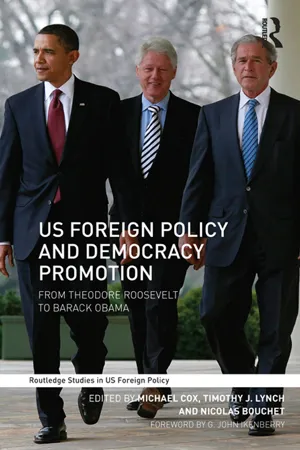 eBook - ePub
US Foreign Policy and Democracy Promotion
From Theodore Roosevelt to Barack Obama
- Michael Cox, Timothy J. Lynch, Nicolas Bouchet, Michael Cox, Timothy J. Lynch, Nicolas Bouchet(Authors)
- 2013(Publication Date)
- Routledge(Publisher)
Yet the general verdict on Carter’s foreign policy is still generally negative. He is seen by some on the right as the naive idealist who came belatedly to embrace a more coherent anti-communism after 1978. More left-leaning commentators commend the early foreign policy and deplore the proto-Reaganism of his reaction to the Soviet invasion of Afghanistan in 1979. Many commentators across the political spectrum see Carter’s foreign policy leadership as fundamentally confused – both in terms of its goals and its internal management. 2 On the narrower theme of democracy, Carter’s stance and record are difficult to assess. His position on democracy promotion was structured around the prior commitment to ‘human rights’ as the guiding principle (especially early in his presidency) of foreign engagement. The commitment to democracy promotion was also profoundly affected by the underlying dynamic of the administration – the move towards more orthodox policies of containment of communism in the later period – and by the intense bureaucratic and personal rivalries between White House and State Department. This chapter begins with a consideration of the administration’s general commitment to human rights, focusing particularly on President Carter’s own understanding of the concept and its links to democracy promotion. It discusses the operationalization of the policy, especially in the context of the bureaucratic politics of the administration. How far did the human rights policy succeed in its goals? To what extent did it help or hinder the cause of global democracy? There follows a section on policy towards the Soviet Union. What was Carter’s contribution to the unravelling of Soviet communism? The policy Jimmy Carter’s commitment to human rights in foreign policy was developed in a rather ad hoc fashion on the campaign trail in 1976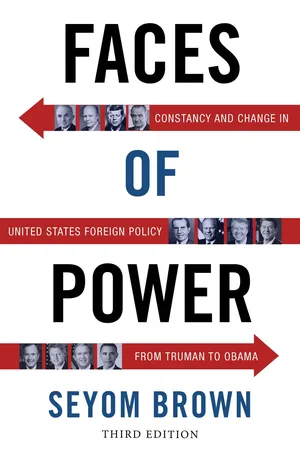 No longer available |Learn more
Faces of Power
Constancy and Change in United States Foreign Policy from Truman to Obama
- Seyom Brown(Author)
- 2015(Publication Date)
- Columbia University Press(Publisher)
Time), and prominent multinational corporation directors. It was largely from his Trilateral Commission contacts that candidate Carter formed his Foreign Policy and Defense Task Force and subsequently his top-level and sub-cabinet appointments to his administration.Carter’s success as presidential candidate was largely attributable to his ability to present himself variously as populist and establishmentarian, human rights idealist and geopolitical realist, country boy and impeccably mannered dinner-party host, Bible-quoting “born-again Christian” and devotee of existentialism. He was credible in each of these roles, depending upon whom he was talking with, and—most remarkably—credible also in his professions of guileless honesty.5 The aura of credibility undoubtedly was a reflection of the fact that all these facets were the real Jimmy Carter, that he indeed was an amalgam of all of them, and a true believer in the mystical ethos that this was the essence of the nation he felt called upon to represent. With Walt Whitman’s America, he could proclaim: “Do I contradict myself? / Very well then I contradict myself, / (I am large, I contain multitudes.)”Some of Carter’s main problems as president appear to have stemmed from his continuing to display in his executive role the all-things-to-all-people quality that got him elected. To give vent in the Oval Office to the contradiction-laden instincts of Mr. Everyman was to fail to establish and stick to priorities among values and objectives without which consistent and credible policy is impossible to sustain. Each of Carter’s most trusted advisers sensed that the chief was most sympathetic with one’s own approach and would carry back to subordinates and sometimes to the public such presidential guidance as one wanted to (and did) hear. Moreover, the president himself, often giving expression to the formulations of his different advisers, frequently would deliver himself in policies and pronouncements of a sequence of inconsistent moves and postures.
Index pages curate the most relevant extracts from our library of academic textbooks. They’ve been created using an in-house natural language model (NLM), each adding context and meaning to key research topics.

