History

John F. Kennedy
John F. Kennedy was the 35th President of the United States, serving from 1961 until his assassination in 1963. He is remembered for his inspirational leadership, particularly during the Cuban Missile Crisis and his commitment to civil rights. Kennedy's presidency also saw advancements in the space race with the establishment of the Peace Corps and the pledge to land a man on the moon.
Written by Perlego with AI-assistance
Related key terms
1 of 5
10 Key excerpts on "John F. Kennedy"
 eBook - ePub
- (Author)
- 2015(Publication Date)
- Times Books(Publisher)
President John F. Kennedy
Courage and idealism at the White House 22 November 1963President John F. Kennedy , whose assassination at the age of 46 is reported on another page, has died in the fullness of his fame. Whatever qualifications there may be about some of his detailed policies – and no man could hold that awesome office without receiving his measure of criticism – he will take his place in the roll of strong Presidents. Throughout his time in office he had major difficulties with Congress, but he was the master of his own Administration, a man of decision and nerve. Had he lived he would have remained a forceful influence on international affairs for many years to come. In that sense he was still a man of promise.President Kennedy’s years in office will always be marked with distinction, above all for his handling of the Cuban crisis. It was then that he took the supreme risk, told the American people, and indeed the free world, what had to be faced, and firmly blocked the advancing convoy which was bringing medium-range rockets to sites in Cuba, from which they would profoundly have altered the strategic balance of power. The decisiveness of United States policy at this time not only won President Kennedy an abiding place among the great Presidents of the United States but leading, as it has done, to an easing of the cold war, and last July to the nuclear test ban treaty, may well be regarded as one of the real turning-points in history.Youngest EverHe was the youngest man ever to be elected to the White House. He was the first President to be born in the twentieth century; the first Roman Catholic, and the first of purely Irish descent. He was the first since Harding to come to the Presidency directly from the Senate. But for the most part these were mere accidents of history. He happened to be a signpost to new trends in American life and politics. eBook - PDF
- Alan Brinkley(Author)
- 2000(Publication Date)
- Harvard University Press(Publisher)
John Kennedy served in ofªce for fewer than three years. His tangible accomplishments during his foreshortened term were relatively mod-est. By most of the normal standards by which historians assess presi-dents, Kennedy seems now to be an undistinguished, even a minor ªgure. Indeed, a survey of historians in 1981, asking them to rank the presidents, placed Kennedy 13th. Another survey, conducted in 1996 by the New York Times, again placed him about in the middle of the pack. The historical John Kennedy, as opposed to the Kennedy of leg-end, was a cautious, practical, skillful politician, driven by political real-ism much more than by lofty ideals. Members of his administration boasted that, unlike some of the militant cold warriors of the 1950s, they were pragmatists, not ideologues. Kennedy himself seemed to move through his political life as a slightly bemused observer of his own success, as if reluctant to take himself or anything he did too seriously. It is one of the many ironies of Kennedy’s posthumous image that a man who was himself so uncomfortable with passionate commitment would inspire so much of it in others. 3 Th e Posthumous Lives of John F. Kennedy 211 As president, as through his pre-presidential career, Kennedy walked gingerly through difªcult moments and difªcult issues, always search-ing for a middle ground, always leery of creating unnecessary conºict. He was slow to embrace the civil rights movement, uncertain in his relations with the corporate world, conservative in his embrace of Keynesianism, awkward in his dealings with Congress. Through most of his presidency, his foreign policy was largely reactive, driven by ex-ternal events rather than by a coherent sense of goals. A plan by the Eisenhower administration drove him into the Bay of Pigs. A decision by Nikita Khrushchev drove him into the Cuban missile crisis. A decade of precedent led him reluctantly into Vietnam. eBook - ePub
Hollywood Goes to Washington
American Politics on Screen
- Michael Coyne, Coyne, Michael(Authors)
- 2011(Publication Date)
- Reaktion Books(Publisher)
The era from John Fitzgerald Kennedy’s Inauguration to Richard Nixon’s resignation has had an unparalleled hold on the imagination of modern America. The 1960s had initially appeared to herald a new optimism and idealism, but the pervasive influence of television made Kennedy’s murder an instantaneous global trauma. It was the first act in a national nightmare that lasted a decade. Within a year, race riots had begun to erupt in major US cities, and flames would engulf more than a hundred of them before the 1960s drew to their bloodied, wearied close. Within two years, Lyndon Baines Johnson had increased the American military commitment to Vietnam. Assassins would claim the lives of Martin Luther King and Robert Kennedy, just two months apart, in the summer of 1968 – and LBJ was hounded from office, a broken man denounced as a child killer. Yet, far from ‘bringing us together’ as he had promised in the election of 1968, Johnson’s successor would eventually give way to his own worst paranoid impulses, and he became mired in a scandal with which his name will forever be linked. In that decade between Dallas and Watergate, 58,000 young Americans died in Vietnam. Little wonder that, even now, millions of Americans dolefully recall 22 November 1963 as the day the American Dream soured irrevocably. In a very real sense, the United States has never enjoyed the same unforced optimism or the same sureness of purpose since the day those shots rang out in Dealey Plaza. Many moviemakers have used their art to mourn America’s loss – and to ask the reason why.John Fitzgerald Kennedy: America’s Prince Charming
If John Kennedy had not existed, Hollywood might have been hard pressed to invent him. He was the first truly telegenic politician of the telecentric age. The details of his political legacy, his family, his putative romances – and, most of all, his murder – have all become the stuff of legend. In the decades since his death, he has come to represent a plethora of myths to a pluralist society, and his enduring appeal extends far beyond America’s shores. Handsome hero-warrior. Poet-statesman. Favourite son of one downtrodden race, staunch defender of another. Witty, charismatic, blessed with all the gifts of the world’s richest nation. Young war hero who became his era’s greatest hope for peace, but vigilant in America’s interests – like the presidential eagle, bearing the olive branch in one hand and a cluster of arrows in the other. Fallen father-leader, his loss all the more tragic because he was so youthful. There was much to regret and mourn in the passing of such a man.John Kennedy has come to symbolize all myths to all men, but chief among these is his image as a latter-day Lincoln. The John F. Kennedy Library in Boston stocks a postcard titled ‘Lincoln and Kennedy – Coincidence or Fate?’, detailing sixteen common points of reference between the lives and deaths of the two men. Clearly, the curators of the Kennedy legend have consciously striven to exploit comparisons with Abraham Lincoln, and understandably so. Kennedy was ‘Lincolnized’ in the cruellest way possible.Assassination aside, nowhere is the ‘Kennedy as Lincoln redux’ eBook - PDF
- J. Logsdon(Author)
- 2011(Publication Date)
- Palgrave Macmillan(Publisher)
Understanding Kennedy’s Commitment to Apollo In the American public memory, John F. Kennedy stands as one of the most successful and important of U.S. presidents. This public image, however, is not universally shared by scholars of the presidency and of American gov- ernment. A half century after John Kennedy entered the White House, they disagree on how best to evaluate the Kennedy presidency. Some por- tray Kennedy as “a worldly, perceptive, strong, and judicious leader exud- ing confidence and charisma, deeply affected by the early crises of his administration, recognizing the rapid changes taking place in the world, and responding with a New Frontier of foreign policy initiatives.” Others have portrayed Kennedy as “a shallow, cynical, passionless and vainglorious politician, a traditional Cold Warrior, a weak and vulnerable president not always in control of his own foreign policy.” A more nuanced assessment is that President Kennedy was a “complex figure whose personality embraced elements of both images.” 4 I believe that the narrative in the preceding chapters supports this last view, but also suggests that in the case of Kennedy’s commitment to the race to the Moon, it is the more positive of the two general portrayals that best describes his choices and behavior. In deciding to go to the Moon, and then reiterating that choice several times after extensive White House reviews, Kennedy demonstrated with respect to space a steadiness of pur- pose and a clear understanding of the arguments for and against imple- menting his choice. He had the flexibility to pursue a cooperative path if it were open to him, but his judgment that space leadership was in the U.S. national interest made him determined to compete if competition was necessary. eBook - PDF
Killing the President
Assassinations, Attempts, and Rumored Attempts on U.S. Commanders-in-Chief
- Willard M. Oliver, Nancy E. Marion(Authors)
- 2010(Publication Date)
- Praeger(Publisher)
8 John F. Kennedy INTRODUCTION On Friday, November 22, 1963, the attractive forty-six-year-old president, John F. Kennedy, was on a political trip to Texas to reach out to the people of that state. His beautiful and elegant wife Jackie was traveling with him, some- thing she rarely did. She was so popular with voters that Kennedy wanted her to be there as a way to increase his appeal with the citizens of Texas. The cou- ple arrived at Dallas’s Love Field from Fort Worth at 11:38 A.M. and proceeded to a motorcade that would give thousands of Dallas residents a view of the president and first lady. On the sixth floor of a warehouse that overlooked the motorcade’s route, a young ex-marine with communist leanings and a checkered past built a sniper’s nest out of cartons of books. No American president had been assassinated since Leon Czolgosz had shot and killed William McKinley more than sixty years earlier. Now Lee Harvey Oswald was about to place in his rifle’s cross- hairs a popular president who had already made history dealing with the Soviet Union, Cuba, civil rights, and other issues. The story of this assassination is arguably the dominant American story of the twentieth century. JOHN FITZGERALD KENNEDY The thirty-fifth president of the United States, John F. Kennedy, was born on May 29, 1917, in Brookline, Massachusetts, the second of nine children. 1 His father was Joseph P. Kennedy, a wealthy Irish Catholic businessman from Boston, and his mother was Rose Fitzgerald, whose father was John F. ‘‘Honey Fitz’’ Fitzgerald, the mayor of Boston. Because his father was appointed by President Franklin Roosevelt to serve as an ambassador to the Court of St. James in London, Kennedy spent much time in Europe as a young man. He graduated from Harvard University and studied briefly at Stanford Business School. He greatly admired his older brother, Joe, whom his father predicted would one day become president. But Joe was killed during World War II on a bombing mission. eBook - PDF
Presidents from Eisenhower through Johnson, 1953-1969
Debating the Issues in Pro and Con Primary Documents
- John King, John R. Vile(Authors)
- 2005(Publication Date)
- Greenwood(Publisher)
Still, the new president inspired a great many Americans. The youngest person ever elected to the American presidency, Kennedy, and his beautiful young wife, Jacqueline (Jackie), exuded charm and style. Kennedy's enthusiasm and idealism brought unprecedented energy and optimism to America. Moreover, he was confident. "Sure it's big job," he was quoted as saying after his election to the presidency, "but I don't know of anybody who can do it better than I can." Kennedy spoke of a "New Frontier" and brought with him to the presidency "new frontiersmen," young academics largely from the Ivy League and New England to help him lead America through the 1960s and expand and spread American idealism across the globe. Not withstanding the way in which Kennedy's affluence and elite education enhanced the image of the presidency, Kennedy connected with Americans more intimately than his two immediate predecessors. Kennedy televised his press conferences and talked about reform in the areas more immediate to common people than missiles and monetary policy. Kennedy spoke of tax reform to ignite economic recovery, and of education, wages, women's rights, health care, and training for workers in depressed regions of the country. In early 1961, optimism reigned in America, Kennedy enjoyed great popular support, and many Americans believed they were, in fact, on the verge of a "New Frontier." In articulating the ideal of the New Frontier, Kennedy tapped into an idea popular since historian Frederick Jackson Turner promulgated his "frontier JOHN FITZGERALD KENNEDY 75 thesis" in 1893, contending that the frontier experience was central to American culture. From the beginning, frontiers had confronted American life in Appalachia, in the Northwest, and in the West, and the task of taming the frontier and bringing to it the American way of life had both rallied citizens throughout their history and shaped their culture. eBook - ePub
Currents in American History: A Brief History of the United States, Volume II: From 1861
A Brief History of the United States, Volume II: From 1861
- Alan C. Elliott, Terry D. Bilhartz(Authors)
- 2023(Publication Date)
- Routledge(Publisher)
Sputnik launching and once again felt, if not secure, at least confident. True, the nation no longer held a monopoly on atomic technology as it did in 1945, but, it still was the first among equals in the development and delivery of nuclear weaponry. If the Soviets had more powerful missile boosters, this largely was because their cruder and heavier warheads, owing to inferior technology, demanded greater lift than the American counterparts. Moreover, the United States, with its high-flying U-2 spy planes with cameras on board sensitive enough to read license plate numbers on the streets below, could keep a close eye on the intercontinental ballistic missiles (ICBMs) that the Soviets were producing. Both superpowers had enough weapons to destroy the world several times over, but the United States at least could take comfort in knowing that it was not outgunned.After winning the election, Kennedy came to symbolize the can-do spirit that energized America in the early 1960s. Elected at age forty-two, younger than any man in history, Jack Kennedy, with his elegant and beautiful thirty-one-year-old bride, Jackie, replaced the oldest man ever previously to occupy the White House. Kennedy's family and staff, which included the boyish, thirty-five-year-old attorney general Robert Kennedy, played touch football, not golf. The glamorous style of Jack and Jackie caused such a stir that reporters began to use the Greek word charisma to describe the growing Kennedy mystique. Good looks, poise, charm, self-assurance, energy, and intelligence characterized both the president and the first lady. Kennedy's cabinet appointments, labeled by author David Halberstam as the “best and the brightest,” also looked sexy when contrasted with the staid businessmen of the Eisenhower administration.“The world is changing,” proclaimed Kennedy in his acceptance speech. “We stand on the edge of a New Frontier… of unknown opportunities and perils… the New Frontier of which I speak is not a set of promises—it is a set of challenges.” At his inauguration, he returned to these same themes of opportunity, optimism, and sacrifice: eBook - ePub
The Presidential Character
Predicting Performance in the White House, With a Revised and Updated Foreword by George C. Edwards III
- James David Barber, James Barber(Authors)
- 2019(Publication Date)
- Routledge(Publisher)
But it was in "the gift of winning public confidence and support" that Kennedy knew he would find his main thrust and challenge. Fourteen years later, as he moved on the Presidency, he reached back into his past to find a way beyond the critics' doubts.Kennedy as President
There was a gap of fourteen years. Kennedy had his ups and downs, and it would be wrong to say he did not continue to grow as Congressman, Senator, contender for the Vice Presidential nomination in 1956. But Kennedy as Presidential candidate and as President of the United States could have been anticipated; his style, world view, and character had their roots in his earlier years.The Kennedy rhetoric—only partly a matter of speechmaking—was much the same as it had been from the start, though the Presidential candidate showed a confidence in delivery well beyond his 1946 performance. But the directness, the projection of restrained rage, the intellectuality, the humor and statistics, candor and vagueness were his trademarks. He urged without preaching, inspired without condescending. And the effect on his partisans was electric. Theodore White remembers not so much the size of the crowds as their "frenzied quality." The response to Kennedy was symbolized in "the jumpers":The jumpers made their appearance shortly after the first TV debate when trom a politician Kennedy had become, in the mind of the bobby-sox platoons, a "thing" combining, as one Southern Senator said, "The best qualities of Elvis Presley and Franklin D. Roosevelt." The jumpers were, in the beginning, teenage girls who would bounce, jounce and jump as the cavalcade passed, squealing, "I seen him, I seen him." Gradually over the days their jumping seemed to grow more rhythmic, giving a jack-in-the-box effect of ups and down in a thoroughly sexy oscillation. Then, as the press began to comment on the phenomenon, thus stimulating more artistic jumping, the middle-aged ladies began to jump up and down too. .. .20The "star quality," the Kennedy "mystique" was there again. Apparently Kennedy's personal cool, his critical stance toward self-satisfaction, his call for a higher standard of performance, and his thirst for action—or some part or symbiosis of those—fit the mood of the young, and, increasingly in a culture where the young are thought to show the way, the not so young. After the television debates with Nixon, Kennedy was remembered not so much for what he said as for the impression of expertise, precision, and judgment he conveyed.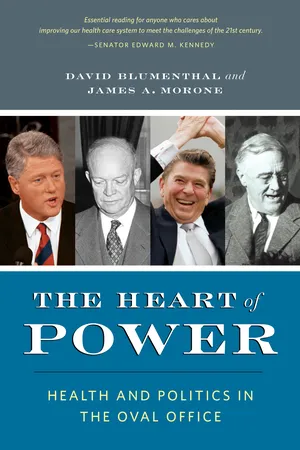 eBook - PDF
The Heart of Power, With a New Preface
Health and Politics in the Oval Office
- David Blumenthal, James Morone(Authors)
- 2010(Publication Date)
- University of California Press(Publisher)
And finally, i nev i tably, i ndel i bly, the p i cture of Jack i e Kennedy, her dress splattered w i th blood, claw i n g her way out of the back seat of the pres i dent i al l i mous i ne on November 22 , 1963 . Kennedy could have been wr i t i n g about h i s own le g acy when he con-cluded h i s book, P r ofiles i n Co ur a g e, by mus i n g that hero i c Amer i cans 132 John F . Kennedy always rema i n “ elus i ve, ” troubl i n g us w i th the i r “ complex i t i es, i ncon-s i stenc i es and doubts .” Kennedy en j oyed more popular support than any modern pres i dent ; i n the first year, h i s approval rat i n g s never fell below 72 percent and even now, more than four decades after h i s death, the publ i c fa i thfully ranks h i m atop the pres i dent i al charts— i n some tall i es, as the g reatest of all . H i stor i ans respond g rump i ly, vot i n g h i m dub i ous d i st i nct i ons such as “ the most overrated publ i c fi g ure i n Amer i can h i s-tory ” (as one g roup d i d i n 1988 ) , and rout i nely t i ck off h i s fa i lures—a m i xed record abroad, a mea g er one at home, and that muddle of a per-sonal l i fe . 1 But perhaps those who d i sm i ss Kennedy are measur i n g h i m a g a i nst the wron g metr i c . John Kennedy was the class i c char i smat i c—a leader who mana g ed to art i culate and embody i n h i mself the asp i rat i ons and i deals of a nat i on . The 1950 s ’ fears—born of Sputn i k and the m i ss i le g ap, of soc i al stale-mate and a nat i on g row i n g soft i n the face of a Sov i et Sparta—were thrust as i de by i ma g es of youth, ener g y, and v ig or (pronounced “ v ig aah ” on the touch football fields of Hyann i sport, Massachusetts ). Here was a navy war hero who had g u i ded h i s comrades to safety, tow i n g one of them by clasp i n g a l i fe preserver strap between h i s teeth and sw i mm i n g a g a i nst the current . eBook - PDF
When Sorrow Comes
The Power of Sermons from Pearl Harbor to Black Lives Matter
- Melissa M. Matthes, Melissa M. Matthes(Authors)
- 2021(Publication Date)
- Harvard University Press(Publisher)
His death was monumentalized; he and his death were exceptional. “Let us not think of him as a vanquished leader lying dead on the frontiers of the earth, but as a victorious hero, alive in the presence of Christ on the ever- widening frontier of eternity.” 21 “More than a man has been assassi-nated. A principle of freedom—of love—of religion—of speech—has also been wounded.” 22 We A ll Ki lle d Kenn e d y 87 For the ministers, Kennedy’s martyrdom was a testament to the legitimacy of the state for which he died. His sacrifice for the nation confirmed American greatness. If one so noble, so admirable, loved American ideals and was willing to die for us, then surely we were worthy. Exactly what those ideals were remained hazy. Nevertheless, Kennedy was imagined as having put himself literally in the line of fire for the United States. Many of the sermons compared JFK’s death to the crucifixion of Jesus Christ: John Kennedy died for us. He died as the symbol of freedom and justice and the dignity of man. . . . By his death we are redeemed. 23 Tonight three deaths engage our attention beyond all others. The first occurred almost twenty centuries ago. It came upon a cross, unjustly, at the hands of men who hated. . . . When shots rang out and when hammer clanged upon a bloody nail both were against the majesty of God. 24 Some even suggested that Kennedy and Jesus were killed for parallel reasons: “Our Lord was crucified because he challenged and corrected the status quo of his generation.” 25 Many sermons noted how both Jesus and Kennedy were killed on a Friday; several referred to “that other Friday” (i.e., Good Friday), striving to establish a correspondence. 26 Some noted that Lincoln too was killed on Good Friday, thus creating a holy trinity among the three martyrs. They suffered “cruel assassination” so that others might live. “I am come that they may live and might have life abundantly.
Index pages curate the most relevant extracts from our library of academic textbooks. They’ve been created using an in-house natural language model (NLM), each adding context and meaning to key research topics.

