History

President Johnson
President Johnson refers to Lyndon B. Johnson, the 36th President of the United States who served from 1963 to 1969. He is known for assuming the presidency after the assassination of John F. Kennedy, and for his efforts in advancing civil rights legislation, including the Civil Rights Act of 1964 and the Voting Rights Act of 1965. His presidency was also marked by the escalation of the Vietnam War.
Written by Perlego with AI-assistance
Related key terms
1 of 5
10 Key excerpts on "President Johnson"
 eBook - ePub
The End of Ambition
The United States and the Third World in the Vietnam Era
- Mark Atwood Lawrence(Author)
- 2021(Publication Date)
- Princeton University Press(Publisher)
3
Lyndon Johnson’s World
FROM THE OUTSET of his presidency, Lyndon Baines Johnson made abundantly clear where his priorities lay. Behind closed doors and in the public spotlight, the new president urged passage of an array of ambitious social and economic reforms, including a major tax cut, meaningful civil rights legislation, and a raft of antipoverty measures. LBJ invoked the need to honor John F. Kennedy, who had backed all of these initiatives, but Johnson also left no doubt of his desire to go beyond what his predecessor had proposed. LBJ’s rhetoric soared as he described his sweeping vision of social change. In his State of the Union speech just six weeks into his presidency, Johnson called for nothing less than an “unconditional war on poverty in America” and vowed not just to ameliorate the problem but to “cure it.” In the realm of civil rights, he promised to “abolish not some, but all racial discrimination.”1 Thus dawned the era of the Great Society, the remarkable years of domestic innovation that saw Congress destroy Jim Crow, extend voting rights, establish Medicare and Medicaid, pump federal resources into education, revamp U.S. immigration laws, and much else. For all of these accomplishments, historians have little difficulty judging Johnson one of the most—if not the most—transformative presidents in the second half of the twentieth century.LBJ had no such ambitions in the realm of foreign affairs, as the 1965 State of the Union address also made clear. The president turned to the international scene in the closing sections of the speech and made headlines only with assurances that he would keep going with efforts to lower tensions with the Eastern bloc. All in all, as the New York Times editorial page put it, LBJ’s foreign policy “continues as expected, along familiar lines.”2 eBook - PDF
American Voices
An Encyclopedia of Contemporary Orators
- Bernard K. Duffy, Richard Leeman, Bernard K. Duffy, Richard Leeman(Authors)
- 2005(Publication Date)
- Greenwood(Publisher)
He thereby influenced the agenda of discussion and set the standard by which he later could be judged as having kept the faith. Moreover, by fo- cusing on the sphere of politics in which he was most adept—congressional deliberation—John- son managed subtly to suggest that he was a leader not utterly subordinate to Kennedy; after all, the thinker depended upon the doer to get the bills through. The most pressing domestic issue when John- son took office was civil rights. Inspired by the moral fervor of the protest demonstrations, Kennedy in 1963 had submitted a strong civil rights bill, which Johnson advised him to justify as a moral and constitutional obligation. But the bill was still languishing in committee at the time of Kennedy's death. Johnson quickly con- cluded that he must secure the passage of a bill at least as strong as Kennedy's. During the next few months, public address played but a slight role; the president relied instead on the inter- personal persuasion at which he was most gifted. He met with civil rights leaders and ad- vised them which members of Congress to visit. And he concentrated his own attention on the Senate minority leader, Everett Dirksen of Illi- nois, whose support he needed to break the Southern filibuster. The Civil Rights Act passed Congress in June 1964 and was quickly signed into law. Johnson offered brief remarks on the occasion, as he tended to do when signing major bills. These remarks mixed bipartisan praise for Congress and recognition of significant achieve- ments with reminders that much hard work re- mained and exhortations to press toward further improvement of the human condition. Following passage of the Civil Rights Act, Johnson pursued two rhetorical objectives: to Lyndon Baines Johnson (1908-1973) 205 reconcile the South to the law and to shape the future direction of the civil rights movement. In speaking to Southerners, he employed a combi- nation of rhetorical strategies. eBook - ePub
Congress, Presidents, and American Politics
Fifty Years of Writings and Reflections
- Lee H. Hamilton(Author)
- 2016(Publication Date)
- Indiana University Press(Publisher)
So the democratic process asks us to recognize that we might not always be right. It asks that we enjoy—not just accept—the inconvenient fact that others may disagree with us. It asks us to fight hard for our convictions, but to yield gracefully.Looking back on the Johnson administration, one thing that impresses me now about Lyndon Johnson is that of all the presidents I have known, he stands out, first, as someone who had a clear vision of where he wanted the country to go. He had no doubt about his agenda: attack racism and injustice, bring people out of poverty, expand opportunity, improve the lives of Americans. Johnson might be criticized for overreaching or maybe for being too idealistic. But unlike many other presidents, Johnson knew where he was headed. Second, he knew how he would bring it about, and that was with the federal government leading the way. For Johnson that was key, and the legislation he got through Congress, particularly during the early years of his presidency before he got overwhelmed by Vietnam, was transformational.Congress also, in my view, gets fairly high marks on its legislative record during the Johnson years, particularly during the 89th Congress: it was seriously trying to address the nation’s problems, and although the Democrats had large majorities in both the House and the Senate, legislation was generally developed in consultation with the Republican minority, trying to accommodate their views as much as possible. The result was that most of the major bills passed Congress with fairly broad support from both the Democratic and Republican sides, and, although amended from time to time, they have continued as the basic law of the land.My initial years serving in Congress were not in any way during ordinary times. It was a turbulent period, as the nation was dealing with war, riots, and assassinations. Many Americans were shaking their heads in disbelief over what was happening in our country. Congress also had to wrestle with complex and divisive issues of poverty, health care, and discrimination. Overall I believe Congress acquitted itself well during a challenging time in our nation’s history. eBook - ePub
Hatred of America's Presidents
Personal Attacks on the White House from Washington to Trump
- Lori Cox Han(Author)
- 2018(Publication Date)
- ABC-CLIO(Publisher)
A president’s job approval ratings typically exhibit what is referred to as a “decay curve” during their presidency. This simply means that for almost all presidents their job approval ratings trend downward over time. For most presidents, this indicates that making public policy will become more challenging. For other presidents, it means that it becomes downright impossible as opposition to their administration grows. The latter was the case with Johnson. Even though he felt confident that he could win in 1968, the “race” between Kennedy and Johnson lasted only 15 days. On March 31, 1968, in a speech to the country from the White House, Johnson said: “With American sons in the fields far away, with America’s future under challenge right here at home, with our hopes and the world’s hopes for peace in the balance every day, I do not believe that I should devote an hour, or a day, of my time to any personal partisan causes. Or to any duties other than the awesome duties of this office—the Presidency of your country. Accordingly, I shall not seek, and I will not accept, the nomination of my party for another term as your President.”Historians credit Johnson with major advances in bolstering civil rights and in fighting poverty in the United States. However, his presidency also resulted in the marginalization of Congress, the press, and the public in foreign policy decisions. His successor, Richard Nixon, did much the same thing. As a result, Congress revoked the Gulf of Tonkin Resolution in 1971 and passed the War Powers Resolution in 1973 over the veto of Nixon. By 1974, Arthur Schlesinger Jr. coined the phrase “imperial presidency” and wrote a widely read book of the same name that was highly critical of the capacity for Johnson and other presidents to make policy unilaterally.Randall E. Adkins and Paul Landow Further ReadingCalifano, Joseph. The Triumph and Tragedy of Lyndon Johnson: The White House Years . New York: Simon and Schuster, 2015.Caro, Robert A. The Years of Lyndon Johnson: Means of Ascent eBook - ePub
Perspectives on Presidential Leadership
An International View of the White House
- Michael Patrick Cullinane, Clare Frances Elliott(Authors)
- 2014(Publication Date)
- Routledge(Publisher)
9 LBJ If Not for VietnamSylvia EllisLyndon Johnson rarely ranks in the top ten of American presidents. Yet his domestic record was in many ways unparalleled. He was labeled “Lincoln’s successor” on civil rights due to his executive leadership on the issue, oversaw a strong economy for most of his term, and introduced landmark Great Society legislation designed to tackle a range of health, environmental, poverty, education, and housing issues. Despite these achievements, many of which still shape the American social and political landscape, he does not feature in the pantheon of American presidential heroes and is rarely cited as a great leader. This is despite the fact that in recent years, LBJ has, to a large degree, been rehabilitated by academics in the growing literature on his presidency.1 While some earlier works emphasized Johnson’s mismanagement of U.S. foreign policy, dwelled on his power-hungry nature, and/or questioned his administration’s management of its avalanche of programs, recent studies have been more generous in their appraisal of his record and his leadership skills. This shift in scholarly judgment of LBJ’s leadership qualities is reflected in a recent rise in his position in presidential rankings by historians, achieving third place in a Newsweek survey of leading American historians in 2012 and 11 th in a survey of British scholars the previous year.2 His stock remains low with the American public, however. The Newsweek survey also canvassed the American public, and LBJ did not feature in their top ten. This continues a long trend. In a 1988 Louis Harris poll, Johnson was placed at or near the bottom in 11 categories on modern American presidents. In 1999, a C-SPAN poll of viewers placed Johnson 19 th, and, over a decade later, in February 2011, he occupied the same position in a Gallup poll.3 Part of the explanation for this lack of appreciation of LBJ’s leadership qualities is, of course, related to his handling of the Vietnam War. Indeed, “If Not for Vietnam” is the title of this article because most analysts explain Lyndon Johnson’s poor showing by adding a similar rider to their own judgments on the 36 th president, and that included his contemporaries and political aides. In 1972, former U.S. Ambassador Averell Harriman told LBJ’s biographer, Doris Kearns Goodwin: “ ‘If it hadn’t been for Vietnam’ then Lyndon Johnson would ‘have been the greatest President ever.’ ”4 Two decades later, Richard Goodwin, a speechwriter for the Johnson administration, acknowledged that the “ghost of Vietnam” haunted the Johnson presidency: “for years afterward, the moans of the battlefield . . . obscured the narrative of achievement and spacious vision that may ultimately rank Lyndon Johnson among our very great leaders.”5 This article explores the strengths and weaknesses of LBJ’s presidential leadership. Though Vietnam may be the main reason why the public and even many scholars consistently downplay Johnson’s qualities, it is not the only one. His record is also tarnished by questions surrounding his political methods, style, and character. And, at present, a contemporary disdain for American liberalism means that he is in danger of becoming, as one commentator put it, “the invisible president.”6 eBook - ePub
The Presidential Difference
Leadership Style from FDR to Barack Obama - Third Edition
- Fred I. Greenstein(Author)
- 2012(Publication Date)
- Princeton University Press(Publisher)
Lyndon Johnson ranks with Henry Clay as one of the most gifted practitioners of the art of the possible in American history. Here he is seen in a nose-to-nose exercise in political persuasion with Rhode Island senator Theodore F. Green. Johnson’s political prowess was not coupled to a disposition to assess the feasibility of his policies. In 1965, he led the United States into a military intervention in Vietnam without exploring its costs and probable consequences. By 1968, there were a half-million American troops in Vietnam, and the Johnson presidency was on the ropes.(George Tames/NYT Pictures, The New York Times Company)CHAPTER 6
Lyndon B. Johnson and the Primacy of Politics
All I have I would have given gladly not to be standing here today. The greatest leader of our time has been struck down by the foulest deed of our time. Today John Fitzgerald Kennedy lives on in the immortal words and works that he left behind.– LYNDON B. JOHNSON, ADDRESS BEFORE A JOINT SESSION OF CONGRESS ,NOVEMBER 27, 1963Let this session of Congress be known as the session which did more for civil rights than the last hundred sessions combined; as the session which declared an all-out war on human poverty; as the session which finally recognized the health needs of all our older citizens; as the session which helped to build more homes, more schools, more libraries, and more hospitals than any single session of Congress in the history of our Republic.– LYNDON B. JOHNSON ,STATE OF THE UNION ADDRESS ,JANUARY 8, 1964I have today ordered to Vietnam the Airmobile Division and certain other forces which will raise our fighting strength from 75,000 to 125,000 men almost immediately. Additional forces will be needed later and they will be sent as requested.– LYNDON B. JOHNSON, eBook - PDF
- Maurice R. Berube(Author)
- 1991(Publication Date)
- Praeger(Publisher)
He modeled himself after Franklin D. Roosevelt and was an old-line Southern Rooseveltian 60 American Presidents and Education liberal. He responded to the urgent domestic demands of his era with a combination of liberal ideology and political pragmatism. The major domestic event of Johnson's time was the civil rights movement. It was an idea whose time had come, and Johnson reversed his conservative Southern prejudices to help enact major civil rights laws. Concommitantly, mass poverty was rediscovered during the early 1960s; consequently, pov- erty and civil rights were to blend together. The civil rights movement spurred an educational reform movement— "equity reform"—that emphasized the education of the poor. This contrasts sharply with the second major reform movement in the 1980s—"excellence reform," sponsored by the Reagan administration—that emphasized the other end of the spectrum: the education of the best and brightest in order to compete with foreign economic powers. Johnson was clear on the importance education held in his vision of America. Six months after the assassination of President Kennedy, he an- nounced his plans for a Great Society, in which education had a most prominent place. He declared: We have the opportunity to move not only toward the rich society, but upward to the Great Society So I want to talk to you today about the three places where we begin to build the Great Society—in our cities, in our countryside, and in our classrooms These are the three central issues of the Great Society. 4 What comprised the Great Society? Essentially, Johnson wove a compre- hensive set of innovative programs that addressed the problem of poverty and the concerns of the civil rights movement. These programs were chiefly in three areas: education, social welfare and civil rights. In education, the major accomplishments fell into three categories.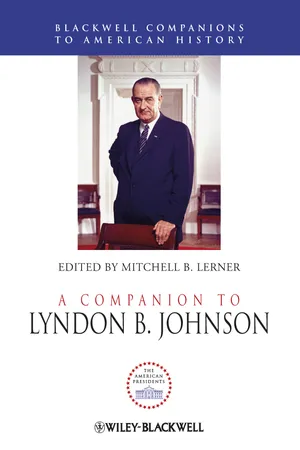 eBook - ePub
- Mitchell B. Lerner(Author)
- 2012(Publication Date)
- Wiley-Blackwell(Publisher)
JFK and LBJ: The Influence of Personality Upon Politics . William Morrow. Passage contains an image
Chapter Three
The Vice Presidency
Marc J. Selverstone
Having spent nearly forty years in government, Lyndon Johnson offers scholars an extraordinarily rich life to recount. Rising from congressional secretary to president of the United States, Johnson was present at the emergence of the welfare state in the 1930s and responsible for its flowering in the 1960s. Between those bookends of his political career, LBJ held some of the key electoral posts in the federal government, including membership in both houses of Congress, as well as Majority Leader of the United States Senate.Yet the thousand days that Johnson spent as vice president, beginning in January 1961, have received comparatively less scrutiny in the writing on his life. Historians have chronicled that period, to be sure, but almost always in the context of broader studies of the man and his presidency. The questions they have asked, moreover, have centered largely around the beliefs and behavior Johnson held and exhibited during his time in Congress and in the White House. Did LBJ, for instance, have firm ideological convictions? Did his rise to power, his “means of ascent,” reveal truths about his political core? Was he a New Deal liberal with an unshakeable commitment to progressive reform? Or was he merely a political pragmatist, a master manipulator who, at worst, sought power for its own sake and at best shed his liberal garb as he saw fit? Answers to these questions have given rise to various interpretive schemes focusing on Johnson's personality, his relentless ambition and yearning for power, and his desire for social justice. But do these perspectives still hold for Johnson's time as vice president? And how might the questions often asked about LBJ shed light on his relationship while in that post with his chief political rival-allies, John and Robert Kennedy?
Passage contains an image
Chapter Three
The Vice Presidency
Marc J. Selverstone
Having spent nearly forty years in government, Lyndon Johnson offers scholars an extraordinarily rich life to recount. Rising from congressional secretary to president of the United States, Johnson was present at the emergence of the welfare state in the 1930s and responsible for its flowering in the 1960s. Between those bookends of his political career, LBJ held some of the key electoral posts in the federal government, including membership in both houses of Congress, as well as Majority Leader of the United States Senate.Yet the thousand days that Johnson spent as vice president, beginning in January 1961, have received comparatively less scrutiny in the writing on his life. Historians have chronicled that period, to be sure, but almost always in the context of broader studies of the man and his presidency. The questions they have asked, moreover, have centered largely around the beliefs and behavior Johnson held and exhibited during his time in Congress and in the White House. Did LBJ, for instance, have firm ideological convictions? Did his rise to power, his “means of ascent,” reveal truths about his political core? Was he a New Deal liberal with an unshakeable commitment to progressive reform? Or was he merely a political pragmatist, a master manipulator who, at worst, sought power for its own sake and at best shed his liberal garb as he saw fit? Answers to these questions have given rise to various interpretive schemes focusing on Johnson's personality, his relentless ambition and yearning for power, and his desire for social justice. But do these perspectives still hold for Johnson's time as vice president? And how might the questions often asked about LBJ shed light on his relationship while in that post with his chief political rival-allies, John and Robert Kennedy? eBook - PDF
- Stephen Hess, James P. Pfiffner(Authors)
- 2002(Publication Date)
- Brookings Institution Press(Publisher)
CHAPTER Lyndon B.Johnson i9 6 3-*9 6 9 On November 27,1963, Lyndon Baines Johnson, president for five days, declared before a joint ses-sion of Congress that the theme of his adminis-tration would be continuity. John F. Kennedy had been assassinated. The nation was in mourning. All appointees of the slain leader were being asked to continue to serve the new president. Unlike Truman, who moved quickly to put in his own people, Johnson made no changes in the cabinet for thir-teen months. And at the White House he combined his staff with Ken-nedy's staff, producing what an assistant called Noah's ark: There's two of everybody. 1 Much later Johnson regretted retaining Kennedy's appointees, but at the time he felt that he had no choice. 2 The nation's paramount need was for stability and reassurance. When Johnson became president, some friction with his inherited staff was inevitable. Kennedy himself had treated his vice president with civility and respect—Johnson had, after all, helped carry enough southern states to enable Kennedy to win in 1960 and had then relinquished the substantial powers of Senate majority leader for the isolation and the superficial responsibilities of a constitutional appendix. But many of Kennedy's aides looked upon Johnson, when they thought of him at all, as some obscure blood relation whose table manners left room for improvement. He was a southerner in a Northeastern regime; nouveau riche, uncultured, and middle-aged in a patriciate that celebrated youth; a Protestant fundamen-78 7 Lyndon B. Johnson 79 talist in the government of the first Catholic president. He was, for them, a usurper, and an ignoble one at that, as Eric Goldman observed. And so the Kennedy holdovers snickered and sniped, half performed their tasks, and engaged in petty sabotage. 3 But those willing to transfer their loyalty to the new president were to have their effectiveness enhanced. eBook - ePub
- John Callaghan, Brendon O'Connor, Mark Phythian(Authors)
- 2019(Publication Date)
- Routledge(Publisher)
4 The Johnson administration and the defence of freedom in Vietnam This chapter focuses on the thinking of the Johnson administration in relation to the ‘problem of Vietnam’ and, in particular, the way in which one powerful idea – that of the domino theory – limited the range of options held to be available in dealing with the problem. The Cold War anti-communist consensus in Washington was at its height when Johnson became president in November 1963, following the assassination of John F. Kennedy. A year later Johnson defeated the Republican candidate, Barry Goldwater, to become president in his own right. Goldwater had talked about “the advisability of invading Cuba, making Social Security voluntary, establishing a ‘national right-to-work’ law, giving control of nuclear weapons to battlefield commanders, and pulling the United States out of the United Nations if Red China were admitted.” 1 He voted against the Civil Rights Act of 1964. He wanted to roll back the communists and voiced the anger of supporters who believed that Dulles and Eisenhower had failed in their promises of 1952 in this crucial respect. His followers were attracted by what they took to be “his moral and existential authority.” 2 Johnson was the moderate in this context. He presided over a swollen Cold War empire with only token oversight from Congress and a largely supine press. Americans had never been richer and had rarely been more complacent about their national superiority. Much of the world had been tied in to American military priorities. Intimate relations were enjoyed with military establishments across the free world. Neutralists like Nasser, Nehru and Sukarno had been anathematised and the meaning of ‘communist’ had been distended to embrace any popular movements proposing social and economic reform or opposing dictatorships sponsored by the US
Index pages curate the most relevant extracts from our library of academic textbooks. They’ve been created using an in-house natural language model (NLM), each adding context and meaning to key research topics.

