History

Assassination of JFK
The assassination of JFK refers to the tragic event on November 22, 1963, when President John F. Kennedy was shot and killed in Dallas, Texas. Lee Harvey Oswald was arrested for the crime but was himself assassinated before standing trial. The event had a profound impact on American society and politics, leading to widespread conspiracy theories and ongoing public fascination.
Written by Perlego with AI-assistance
Related key terms
1 of 5
11 Key excerpts on "Assassination of JFK"
 eBook - PDF
Enemies Within
The Culture of Conspiracy in Modern America
- Robert Alan Goldberg(Author)
- 2008(Publication Date)
- Yale University Press(Publisher)
Mourning continued through the weekend as the three television networks suspended regular programming and the na-tion participated vicariously in the president’s funeral. Americans clung to the images of that November, convinced that history had turned away from promise. The Kennedy assassination may be the most intensively studied event in U.S. history. It is flush with detail and offers hundreds of eyewitnesses, extensive ballistics evidence and autopsy results, and even a film that frames action to the split second. In spite of the attempt of a presidential commission to close the case, Kennedy’s death remains hotly contested ground. Nearly two hundred books and articles appeared within thirty-six months of the assassination. Almost forty years later, bibliographies count more than three thou-sand entries, including films, plays, scores of television programs, and a dozen newsletters. Particularly influential was Oliver Stone’s powerful motion picture JFK, which acquainted a new generation with the intricacies of assassination studies. Conspiracy thinking permeates most of these efforts. Born of bereavement and drawing strength from the memory of a lost Camelot, conspiracy theories challenged the conclusions of the official account that indicted the lone gunman. Once conspiracists were convinced that they had ex-posed the cover-up, new theories and a counterhistory appeared. The assassination, they contend, was actually a coup d’e ´tat that had robbed the nation of its future. 1 A long struggle for authority en-sued, with opinion shapers and average Americans accepting the countersubversive argument. Opinion surveys testify to their suc-cess; conspiracy thinking about the death of John Kennedy was never a fringe phenomenon. To the great majority of Americans, the idea of an assassination conspiracy, if not its consequences, was conventional wisdom. This questioning of authority, moreover, proved contagious and accelerated the loss of faith in core institu-tions. eBook - ePub
Paranormal Nation
Why America Needs Ghosts, UFOs, and Bigfoot
- Marc E. Fitch(Author)
- 2013(Publication Date)
- Praeger(Publisher)
CHAPTER 5
The JFK Assassination and the Paranormal
The assassination of John F. Kennedy as he rode through Dealey Plaza in Dallas, Texas, on November 6, 1963, is often referred to as the moment when the United States’ innocence was totally lost. A young, handsome, charismatic president was shot and killed in front of thousands of people at a time in U.S. history when nuclear Cold War tensions were beginning to boil. Nearly everyone alive at that time remembers where they were and what they were doing when they heard the news; likewise, nearly everyone living today remembers where they were and what they were doing when news of the jetliner crashing into the World Trade Center first reached them on September 11, 2001. These were days in U.S. history that marked dramatic turning points. But the Assassination of JFK marked a more ominous and paranoid moment in U.S. culture, one that would transcend the decades and haunt the aftermath of 9/11. It would also breed an entirely new wave of paranoia and distrust of the U.S. government; a distrust which formed massive conspiracy theories and quickly found its way into paranormal belief systems, where it has thrived ever since.At the time of Kennedy’s assassination, conspiracy theories were nothing new, though very few remembered the “Ring of Gold” conspiracy of WWI or the Pearl Harbor Conspiracy trumpeted at the outset of U.S. involvement in WWII, which posited that Roosevelt had prior knowledge of the coming Japanese attack but allowed it to occur in order to justify entry into war with Germany. These were times of extreme duress and political outrage that would make today’s partisan bickering seem tame. Both the politicians and the public actively feared that the U.S. government was being subverted by outside influences such as Communists, Jews, and bankers. However, that day in Dealey Plaza marked a fundamental change in the U.S. psyche and in the way the government is perceived. Kathryn S. Olmsted, in her work Real Enemies: Conspiracy Theories and American Democracy, World War I to 9/11 , writes, “No longer were conspiracy theorists chiefly concerned that alien forces were plotting to capture the federal government; instead, they proposed that the federal government itself was the conspirator.”1 eBook - ePub
Conspiracy
The Greatest Plots, Collusions and Cover-Ups
- Charlotte Greig, Mike Rothschild(Authors)
- 2020(Publication Date)
- Arcturus(Publisher)
MURDER MYSTERIESWHO SHOT JFK?FROM AGATHA CHRISTIE’S genteel criminals, to the more graphic detective novels of the twenty-first century, a good murder mystery is the book of choice with which to curl up in an armchair for millions of people the world over. And if that murder mystery involves celebrities, sex, politicians, and may in fact be true, that only serves to make it all the more enjoyable!The assassination of John F. Kennedy on 22 November 1963 has generated more conspiracy theories than almost any other crime in history. This is partly because the crime was such a shocking, dramatic event. As we all know, the president was fatally shot in full view of the public while riding along in an open-topped motorcade, with his wife beside him. But it is also because the hastily assembled Warren Commission, set up just one week after the assassination for the purpose of enquiring into what happened, failed to account for the many perplexing aspects of the crime. The Commission found that a lone gunman, Lee Harvey Oswald, had fired three shots at the president. The first of these missed the motorcade; the second wounded both Kennedy and the Governor of Texas, John B. Connally, who was also riding in the limousine; and the third and final shot hit Kennedy in the head, killing him.The related conspiracy theories became known as ‘The Lone Gunman Theory’ and ‘The Single Bullet Theory’ (often jokingly referred to as ‘The Magic Bullet Theory’ because it seemed so unlikely that one bullet could penetrate two people). In time, both theories came to be regarded as highly implausible – not only by the experts but by the majority of the American public, who were polled on numerous occasions in order to obtain their opinions on the matter.To compound the confusions, on 24 November 1963 Jack Ruby, a Dallas nightclub owner, shot Oswald dead while he was in police captivity. Once again, the killing took place in full view of the public. The event prompted a new wave of speculation. How was it that Ruby had found it so easy to flout the tight security surrounding Oswald? Had Oswald been swiftly executed in order to prevent incriminating evidence being brought against establishment figures at the trial? And what about Ruby’s links to the world of organized crime? Was the Mafia involved in some way with Kennedy’s death? Ruby swore that he had been acting on his own, in revenge for the killing, but many disbelieved him. By the time he died of a stroke on 3 January 1967, his motives were still thought by some to be questionable. eBook - PDF
When Sorrow Comes
The Power of Sermons from Pearl Harbor to Black Lives Matter
- Melissa M. Matthes, Melissa M. Matthes(Authors)
- 2021(Publication Date)
- Harvard University Press(Publisher)
” 14 His death was perceived to transcend what could be signified by a transient, impromptu memorial. The event was too co-lossal for such a puny shrine. This elevation meant that ordinary Amer-icans felt insufficient in the face of their gigantic loss. In part because of this church-like ambience, ministers played an important role in framing how Americans might make sense of the tragedy. Who and how Americans mourned was not only of theological importance but of political significance as well. In 1963, according to Gallup polls, 69 percent of Americans identified as Protestants and 24 percent as Catholics; only 2 percent said they had no religious affili-ation. 15 Also, over 55 percent of ministers in the United States were under the age of forty-five in 1963, 16 adding to their likely sense of identifica-tion with the assassinated forty-six-year-old president. But the Kennedy assassination was not a crisis in which the durability of the United States itself was understood as genuinely at risk, although there were deep suspicions about the threat that Soviet and Cuban Com-munism posed to American stability. Many Americans envisaged that a bulwark against this insidious infestation had to be secured. Thus, this tragic event compelled Americans to reassess the meaning of their col-lective life. We A ll Ki lle d Kenn e d y 83 This was also a particularly modern crisis, because in modernity human beings feel themselves abandoned in the eye of the hurricane, out of which each believes they must somehow conceive meaning anew. 17 Without secure foundations, elements of life that once seemed settled, even natural, are reinterpreted and contested. In 1963, Americans were more likely to experience anything unexpected or startling as a crisis, in part because there was precious little they collectively took for granted. eBook - ePub
American History Goes to the Movies
Hollywood and the American Experience
- W. Bryan Rommel Ruiz(Author)
- 2011(Publication Date)
- Routledge(Publisher)
Libra we need to examine how the conspiracy theories surrounding the Kennedy assassination operate as stories with a particular logic and resolution that address the tension, complexities, and emotionality inherent in this historical tragedy.JFKand the Tension between History and NarrativityNot since The Birth of a Nation has a movie provoked so much controversy about the relationship between film and history as Oliver Stone’s JFK . While the film engendered wide-ranging discussions among the American public at the time of its release in 1991, academics from a variety of disciplines have also participated in these dialogues, and continue to engage the film from multiple perspectives.55 In fact, one of the central issues remains the positionality and subjectivity of Oliver Stone as the primary filmmaker and author of this historical film. Where historians may be quick to identify him as the principal author and therefore putative historian of this cinematic text, narrative theory reminds us that such overt identification between author and narrative is misleading. Even if we recognize Stone as the implied author (as some narrative theorists would suggest) we still have to account for the collaborative nature involved in film production.56 Films reflect numerous authorial voices, from directors, screenwriters, producers, cinematographers, to studio executives, among others, and determining any principal authorial intentionality in the narrative remains elusive. Thus, we should resist identifying Oliver Stone as the “historian” representing and interpreting the history of the Kennedy assassination in the film. Nevertheless, we can still interrogate the movie as an historical text with a narrative sensibility influenced by multiple authors, and examine how it represents history in the ways academics traditionally associate with the practice of historical scholarship. Indeed, the film provokes us to consider it in this vein. While some scholars contend that JFK reflects postmodern history, the film is actually grounded in a modernist epistemology, recalling the positivist tradition in American historiography. As a film, JFK No longer available |Learn more
- (Author)
- 2014(Publication Date)
- The English Press(Publisher)
Kennedy , the thirty-fifth President of the United States, took place on Friday, November 22, 1963, in Dallas, Texas, at 12:30 p.m. Central Standard Time (18:30 UTC) in Dealey Plaza. Kennedy was fatally shot while riding with his wife Jacqueline in a Presidential motorcade. The ten-month investigation of the Warren Commission of 1963–1964, the United States House Select Committee on Assassinations (HSCA) of 1976–1979, and other government investigations concluded that the President was assassinated by Lee Harvey Oswald. Oswald was subsequently murdered by Jack Ruby, before he could stand trial. This conclusion was initially met with support among the American public; however, ________________________ WORLD TECHNOLOGIES ________________________ polls conducted from 1966 to 2004 concluded approximately 80% of the American public have held beliefs contrary to these findings. The assassination is still the subject of widespread debate and has spawned numerous conspiracy theories and alternative scenarios. In 1979, the House Select Committee on Assassinations (HSCA) found both the original FBI investigation and the Warren Commission Report to be seriously flawed. The HSCA also concluded that there were at least four shots fired, that there was a high probability that two gunmen fired at the President, and that it was probable that a conspiracy existed. Later studies, including one by the National Academy of Sciences, have called into question the accuracy of the evidence used by the HSCA to support its finding of four shots. Assassination Just before 12:30 p.m. CST, Kennedy’s limousine entered Dealey Plaza and slowly approached the Texas School Book Depository. Nellie Connally, then the First Lady of Texas, turned around to Kennedy, who was sitting behind her, and commented, Mr. President, you can't say Dallas doesn't love you, which President Kennedy acknowledged. eBook - ePub
The Stigmatization of Conspiracy Theory since the 1950s
"A Plot to Make us Look Foolish"
- Katharina Thalmann(Author)
- 2019(Publication Date)
- Routledge(Publisher)
The fact that the official and media accounts of the Watergate scandal, as I demonstrate in more detail in the following chapter, also articulated a very narrow definition of conspiracy which stood in contrast to the “popular” definitions of conspiracy found in conspiracy theories percolating at the time suggests that there is a close link between official discursive constructions of events like Watergate and the assassination, and the trajectory of conspiracy theory in the 1960s and 1970s. The transformation of conspiracy theories during these years, and the ways in which conspiracy theorists reacted to their marginal discursive positions, are the focus of the following section as well as the next chapter.Conspiracy theories about the Kennedy assassination
By the beginning of 1964, a small number of private citizens had set out to take on the job of the Warren Commission: to determine, on their own and once and for all, who had murdered President Kennedy. Like the informants during the Red Scare, the assassination researchers were “self-taught expert[s] challenging the establishment” (Knight, “Outrageous” 173); motivated by growing doubts about the official account of the assassination but also by an unwavering belief in the individual’s ability to uncover the truth,5 they poured over reports and publicly available evidence and traveled to Dallas to reconstruct the events of November 22 or interview witnesses. Unlike the informants during the Red Scare, however, they were no longer part of a conspiracist consensus: by collecting evidence of a conspiracy and postulating conspiracy theories, these private citizens formed a minority in a culture where conspiracy theorizing had largely been disqualified as an irrational and dangerous fringe phenomenon.While these early assassination researchers came from all across the country, the majority was white and stemmed from a middle-class background: they were lawyers, graduate students and professors, teachers, bookkeepers, analysts, and stay-at-home mothers. Revilo P. Oliver, a classics professor at the University of Illinois, Urbana, and member of the John Birch Society, was among the first to claim that Kennedy had been killed by a communist conspiracy, but, in another divergence from 1950s conspiracy culture, a large number of the early assassination researchers actually came from the political left (Goldberg 119). In fact, many had been affected by the anti-communist policies of the Red Scare themselves and initially believed that Oswald had been framed by a right-wing conspiracy.6 eBook - ePub
Growing Up in a Land Called Honalee
The Sixties in the Lives of American Children
- Joel P. Rhodes(Author)
- 2017(Publication Date)
- University of Missouri(Publisher)
Within a horrific matter of seconds, a sequence of high-powered rounds from an assassin’s Italian bolt-action rifle struck the young president, the sharp crack of its discharge reverberating off the tall business district walls through American history. The assassination of John F. Kennedy is the second—albeit obviously the most pronounced—of what psychologists refer to as a “flashbulb memory” in the lives of sixties era preadolescents. So exceptionally emotional was the reaction to the president’s death that the event was mentally captured with freeze-frame-like clarity and a half-century later can still be summoned with remarkable detail. Those who were adolescents and adults on November 22, 1963, can usually tell you exactly where they were at the time, as can many who were children. For the youngest, these recollections are especially complex, because as one of their earliest memories, if not the first, the death of Kennedy also often brought the first real taste of grief, a consuming emotion that stretched a child’s developmental capacities.When Americans talk about remembering the Kennedy assassination, what most really mean is how they first heard that the president had been shot from a friend, coworker, teacher, or news broadcast, and then how they experienced the memorial ceremonies on television. Although the grainy 8mm images of bystander Abraham Zapruder’s color home movie have since provided the nation’s choppy mental visualization of the awful series of events—the final bullet’s violent impact, a blood-splattered Jacqueline scrambling across the back seat, Secret Service agent Clint Hill leaping onto the trunk of the limousine speeding toward Parkland Hospital—no Americans outside of the grassy area where Main, Elm, and Commerce streets converge under a railroad overpass in Dallas actually witnessed the assassination. There was no footage available in real time, and even if there had been, only housewives and preschool children (and students home from school sick) would have been near a television to see it. Yet, by the time Air Force One carrying President Johnson and Kennedy’s coffin arrived back in Washington, D.C., 92 percent of the population had heard, as news traveled across the country, Newsweek magazine said, like a “shock wave.”1 eBook - PDF
- Elizabeth Klaver(Author)
- 2012(Publication Date)
- SUNY Press(Publisher)
In part because so many more documents have been released since Beale’s book was published in 1964, JFK offers a Autopsy and the Social: The Case of John F. Kennedy 119 much more complex representation of the Kennedy assassination. Based on the 1988 book by New Orleans district attorney Jim Garrison, On the Trail of the Assassins, JFK details Garrison’s investigation and subse- quent trial in 1969 of Clay Shaw on charges of conspiring to assassinate Kennedy. Since the original trial and book provoked tremendous criti- cism from the press, it is not surprising that the film would as well. George Will, for instance, called Stone “an intellectual sociopath, indif- ferent to truth,” and described the film as “execrable history and con- temptible citizenship” (in Kurtz 170), a position that well illustrates how the debate turned on the film’s perceived lack of adherence to some sort of ideological, historiographical ethic (determined by George Will and the Warren Report). But as historian Robert A. Rosenstone points out, history is the “construction of a past,” not a window upon it (337). Historians seem to agree that the film, despite its flaws, makes an important contribution to the historical discourse on Kennedy’s assassi- nation. As Rosenstone puts it, like any work of history, JFK “engage[s] the issues, ideas, data, and arguments of that ongoing discourse” (338). In fact, public response to JFK prompted the passing of the President John F. Kennedy Assassination Records Collection Act of 1992, which finally released the assassination documents to the public (Kurtz 174). The film is not simply an attempt to retell (truthfully) the assassi- nation story, as Will would seem to have it. It also tells the story of the conspiracy literature to date, incorporating legitimate information like the research by Epstein on the FBI autopsy report and Lifton on the mis- correlation between the Parkland and Bethesda descriptions of the body. eBook - ePub
- Daniele Ganser(Author)
- 2023(Publication Date)
- Skyhorse(Publisher)
1Vice President Lyndon Johnson was on the plane too. He was sworn in as the new president of the United States while still in flight. In a coup d’état that lasted only six seconds, Johnson had ascended to the top of the executive branch without a popular election. The power elite knew that imperial policies were much more implementable with Johnson, and he did not disappoint the power elite. President Johnson escalated tensions with Vietnam and sent more than two million US troops to Southeast Asia. After Kennedy’s assassination, the US sank into shock and mourning. Kennedy only lived to be forty-six, leaving behind a young wife and two young children. In Europe, too, people mourned the unscrupulous murder of the young, handsome, and charismatic president. In Berlin, acting mayor and later German Chancellor Willy Brandt said, “A flame has gone out for all the people who hope for peace, justice and a better life. The world has become much poorer this evening.”2The Fairy Tale of the Mad Lone Perpetrator Lee Harvey OswaldLike the events of Pearl Harbor and 9/11, the assassination of President Kennedy is one of the key occurrences in American history. Countless books have been published on the subject. That President Kennedy was assassinated is undisputed. That he was not strangled, poisoned, or stabbed, but shot, is also beyond doubt. What is disputed in historical research, however, is the question of whether Kennedy fell victim to a conspiracy involving several gunmen or whether a crazed lone gunman shot the president. This is the first question that every researcher must answer when dealing with the President Kennedy’s assassination. If he was shot by a crazed lone perpetrator, then it was not a conspiracy, for a single individual cannot conspire with himself. If two or more shooters shot Kennedy on behalf of third parties, then it was a conspiracy because the shooters and principals had to conspire in secret beforehand.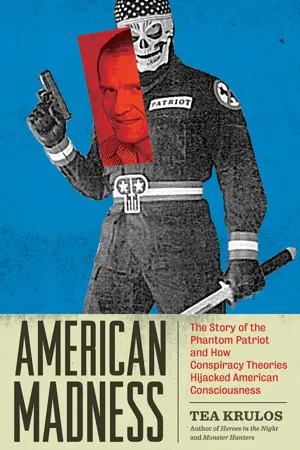 eBook - ePub
American Madness
The Story of the Phantom Patriot and How Conspiracy Theories Hijacked American Consciousness
- Tea Krulos(Author)
- 2020(Publication Date)
- Feral House(Publisher)
While walking through the displays of the Sixth Floor Museum, an enlarged photo of the presidential motorcade that fateful day caught my eye. President Kennedy is grinning and leaning on the car door, smiling at the crowd of Texans who have shown up to catch a glimpse of him. First Lady Jacqueline, in her pink pillbox hat and matching coat, is smiling to the crowd on the other side of the car. Texas Governor John Connally and his wife Nellie are seated in front of them. A stern-looking motorcycle cop floats to the side of the vehicle. Nellie Connally is about to turn around and say, “Mr. President, you can’t say Dallas doesn’t love you.” President Kennedy answers, “No, you certainly can’t.” Those would be his last words.Shortly after this picture hanging on the museum wall was taken, the world would be forever changed and the course of history altered. The JFK motorcade in Dallas, November 22, 1963. The belief in conspiracy in America goes back to the founding of the nation, and a paranoia of conspiracy, treason, and distrust of authority is deeply embedded in our country’s DNA.“Those who now dismiss conspiracy theories as groundless paranoia have apparently forgotten that the United States was founded on a conspiracy theory,” Lance deHaven-Smith writes in his book Conspiracy Theory in America [emphasis his]. The founding fathers cited King George’s plan for “an absolute tyranny” in the Declaration of Independence. In this case, deHaven-Smith writes, the founders’ ability to use conspiracy thinking to read the writing on the wall and look ahead was an important political awakening. George Washington was also a Freemason, a fraternal organization that would evolve into conspiracy lore as the unseen hand that controls all aspects of government.November 22, 1963, is not only the date that Kennedy is assassinated, but part of the American psyche is too. Kennedy dies, and modern American conspiracy theory is born.After shooting the president, Oswald walked down a rear stairwell. He was confronted by a Dallas police officer who had rushed to the building and was in the second-floor lunchroom, but Oswald was let go as he was an employee of the Texas Book Depository. He walked out the front door, shortly before it was sealed, got on a bus which he rode for two blocks (getting off because of heavy traffic), then took a taxi to the rooming house he was staying at. He stopped in for a few minutes, then left.
Index pages curate the most relevant extracts from our library of academic textbooks. They’ve been created using an in-house natural language model (NLM), each adding context and meaning to key research topics.

