History

Malta Summit
The Malta Summit was a meeting between U.S. President George H.W. Bush and Soviet leader Mikhail Gorbachev in December 1989. It marked the end of the Cold War and symbolized a new era of cooperation between the two superpowers. The summit resulted in the declaration that the Cold War was over and laid the groundwork for future arms reduction agreements.
Written by Perlego with AI-assistance
Related key terms
1 of 5
6 Key excerpts on "Malta Summit"
 eBook - PDF
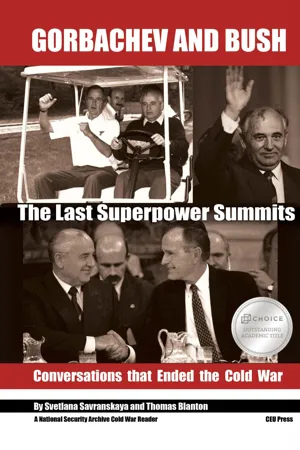
Gorbachev and Bush
The Last Superpower Summits. Conversations that Ended the Cold War
- (Author)
- 2020(Publication Date)
- Central European University Press(Publisher)
19 Between the July idea of a Bush-Gorbachev meeting and the December real- ity at Malta, Eastern Europeans rushed in and took apart the Stalinist empire, including the Berlin Wall. Originally intended by the Americans as an “interim” session to prepare for a full-scale summit in 1990, the Bush-Gorbachev meeting at Malta would take on a life of its own, symbolically bringing the Cold War to a close. Stormy weather and raging seas in Malta would play havoc with the meet- ing planners’ idea of alternating U.S. and Soviet ships as picturesque sites for the meetings—thus providing something of a metaphor for the rush of events in Eastern Europe that played out beyond the control of both superpowers. In effect, the geopolitics of Europe had largely been overturned by the time of the Malta meeting. Certainly Bush’s reticence and embrace of the Communist reformers in the summer of 1989 had helped. Even more important was the forbearance of Gorbachev, his refusal to use force to repress even revolutionary changes of government in Eastern Europe, and his outright permission (to the Hungarians in March 1989, for example) to open their borders. 20 Going into the Malta Summit, the Bush team was determined not to repeat Reagan’s theatricals. Reagan had successfully relieved the Soviet sense of threat through substantive arms control discussions with Gorbachev, including remark- able commitments to the abolition of nuclear weapons. For Bush, instead, as doz- ens of National Security Council and State Department memos make clear, Malta was meant to avoid any substantive discussion of arms control, and simply con- vey, as Secretary of State Baker wrote in his briefing memo on November 29, “a public sense, here and abroad, of a new pace and purpose to the U.S.-Soviet 17 Bush and Scowcroft, A World Transformed, p. 130. 18 Ibid., p. 132 compared to pp. 156–159. 19 For Bush’s actual letter to Gorbachev, July 21, 1989, see Document No.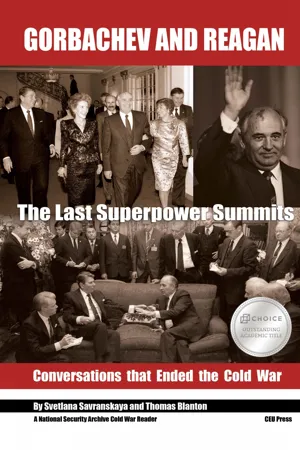 eBook - PDF
Gorbachev and Reagan
The Last Superpower Summits. Conversations that Ended the Cold War
- (Author)
- 2020(Publication Date)
- Central European University Press(Publisher)
Furthermore, preparation for the summit, the summit itself, and the subsequent realization of those agreements achieved or outlined there, do not just cement the constructive changes in Soviet- American relations, but also give them a new impulse for further development in all areas—disarmament, resolution of regional problems, and improvement of bilateral relations. As a result, by the end of the 1980s there will be a serious agreement, which in and of itself will bring definite stability. The Moscow summit should be seen symbolically as the completion of a certain stage in Soviet-American relations and in American foreign policy. Ronald Reagan, 446 who in his first term as president spoke in favor of conducting a confrontational pol- icy toward the USSR, in a way drew a line through the policies of the past with his visit to Moscow, thereby helping to open a new page in relations between the USA and the Soviet Union. This is an important lesson for American foreign policy. It shows that efforts to return to the Cold War’s most critical times are unrealistic. In the foreseeable future, this will likely positively affect formulation of U.S. policy to- ward the USSR. This presents a serious argument in favor of moderate forces in the debate that has been going on for a long time now within the USA, about what rep- resents the normal state of Soviet-American relations—the Cold War or coexistence. It is also necessary to emphasize that apart from its impact on the USA, the summit—in terms of “material” political results—could have great importance for Europe. Our whole plan for resolving the problem of conventional armed forc- es and armaments is centrally important for NATO and for Western Europe first and foremost. For the first time, this plan was presented publicly with such clarity and with such convincing persuasiveness. As a matter of fact, it answers the most important fears and concerns of European states.
- E. Geelhoed, A. Edmonds(Authors)
- 2002(Publication Date)
- Palgrave Macmillan(Publisher)
For example, on 4 March 1960, he wrote to one British citizen, Jack Page, commenting on how hard he had worked “to reach a general agreement on the holding of a summit.” Macmillan believed that “with goodwill we should make valuable progress which can be followed up at later meetings.” 1 The device to be used to resolve these issues was the Four-Power Summit in Paris, involving Eisenhower, Macmillan, Khrushchev, and French President Charles de Gaulle, scheduled for 16 May 1960. Pre- sumably, the four leaders hoped for a historic breakthrough on nuclear testing and perhaps even the basis for resolving the dispute over Berlin. But the initial optimism for the conference ended abruptly when the Soviets shot down an American U-2 reconnaissance aircraft piloted by Francis Gary Powers on 1 May. Khrushchev reacted furiously to this tres- pass of Soviet air space and, failing to get a satisfactory apology from Eisenhower, used the flight as a pretext for torpedoing the summit conference. The collapse of the Paris summit had profound consequences for the Cold War. The nuclear arms race accelerated; the atmosphere of suspi- cion between the Soviet bloc and the West intensified; and the prospect for serious negotiations virtually disappeared. The Soviet Union also began a conscious effort to sow discord throughout the world; in the Caribbean with Cuba, in Africa with the civil war in the Congo, and in Asia with the increasing amount of violence in Indochina. The collapse of the summit and its tense aftermath was a major setback for Harold Macmillan. The repercussions of this failure did not affect his domestic political standing, but they did seriously damage Britain’s capacity to act in the international arena. And, as the individ- ual most responsible for promoting the summit, Macmillan was natu- rally the one who seemed most disheartened by its failure.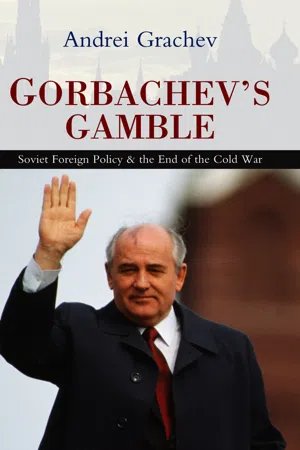 eBook - ePub
Gorbachev's Gamble
Soviet Foreign Policy and the End of the Cold War
- Andrei Grachev(Author)
- 2013(Publication Date)
- Polity(Publisher)
53 At the press conference Gorbachev announced to the journalists that the USSR no longer regarded the US as its adversary.Observed from the outside by other political leaders, the Malta Summit appeared to be an indisputable triumph for Gorbachev. According to Jacques Attali, the reaction of Mitterrand was unequivocal: ‘George Bush confirmed his support for Gorbachev’s policies and expressed his intention to integrate the USSR into the international community.’ As for the position of Gorbachev himself, according to the French President, ‘he has never looked so strong. He’s managed to dominate the Party leadership and progressively eliminate his political enemies.’54Yet Gorbachev’s psychological triumph at Malta unfortunately came too late. If he felt finally rewarded for his efforts (and patience), his satisfaction had a bitter taste; in order to reach this place he had invested an enormous amount of effort and taken numerous unilateral steps. As a result he had wasted an important part of what probably was his most valuable asset, his window of time to prove to the people of his country that his project was worth following and would bring rewards.Finally recognized as the ‘intimate partner’ of the West, he was no longer in a position adequately to fulfil this role, due to the progressive weakening of his internal position. While less and less in control of events at home because of the accelerating deterioration of the economic situation, he was increasingly dependent on Western help. In this new political environment, the initial function of foreign policy was transformed: once Gorbachev’s political trump card and the most effective way to promote the ‘new political thinking’, it increasingly had become perestroika’s last resort. Consequently the diplomatic sphere, which until then had largely been exempt from internal political battles, unexpectedly turned into a front line. ‘In the summer of 1989 the Supreme Soviet without a single opposing vote ratified my nomination to the position of Minister of Foreign Affairs,’ Shevardnadze writes bitterly, ‘but in October 1990 a number of People’s Deputies accused me of causing damage to the national interest.’55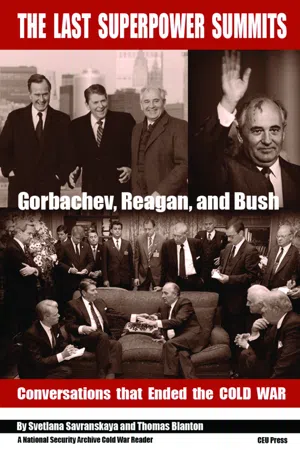 eBook - PDF
The Last Superpower Summits
Reagan, Gorbachev and Bush. Conversations that Ended the Cold War.
- Svetlana Savranskaya, Thomas S. Blanton, Svetlana Savranskaya, Thomas S. Blanton(Authors)
- 2016(Publication Date)
- Central European University Press(Publisher)
I will give thanks that you are pressing forward with glasnost and perestroika; for, you see, the fate of my own family and yours is dependent on perestroika’s success. I look forward to seeing you. With Respect, George Bush , [ Source: George H.W. Bush Library. ] 523 Document No. 79: Memorandum from Baker for the President, “Your December Meeting with Gorbachev” November 29, 1989 This five-page memo from President Bush’s most trusted, long-time friend and ad -viser provides a scene-setter and a provisional script for the president to use with Gorbachev. Baker’s summary details the very limited expectations on the American side for the Malta meeting, namely “to gain a clearer understanding” and to “probe Gorbachev’s thinking” while kicking the major issues down the road to a full-scale summit in 1990. Interestingly, Baker makes a point of spotlighting in the first para -graph the administration’s underlying public relations concern about Gorbachev’s popularity and criticisms of Bush’s “pause.” I. SETTING The Mediterranean encounter will be an important opportunity to gain a clearer un-derstanding of where Gorbachev intends to take the USSR, how his foreign policy priorities relate to his domestic objectives, and the nature of his vision for Europe in the 1990s. It will also be an occasion to lay down markers on the obstacles we see to improved U.S.-Soviet relations and to set priorities for the 1990 Summit. Further, Malta could promote a public sense, here and abroad, of a new pace and purpose to the U.S-Soviet dialogue with you leading as much as Gorbachev. Gorbachev’s Agenda You requested, and the Soviets accepted, an open-ended and unstructured agenda for Malta. But it’s quite possible Gorbachev will bring some attention-grabbing initiatives. We’ll want to respond in ways that keep the focus on our agenda. Gorbachev comes to Malta facing massive economic and social problems on the home front. eBook - ePub
Hanging in There: The G7 and G8 Summit in Maturity and Renewal
The G7 and G8 Summit in Maturity and Renewal
- Nicholas Bayne(Author)
- 2018(Publication Date)
- Routledge(Publisher)
Part IIThe Mature Summit Passage contains an image
5 Progress and Frustration: The Fourth Summit Series, 1989–93
The 1988 Toronto summit said goodbye to Ronald Reagan on a rather self-congratulatory note. The leaders showed no inkling of the momentous changes in store, which would fix 1989 as the year when the Cold War ended. Even the Paris Arch summit of July 1989 was almost taken unawares; the historic shifts then beginning in Poland and Hungary only caught the leaders' attention at the last moment. But Paris 1989 clearly marks the start of a new summit series. The five summits of 1989-1993 were dominated by the consequences of the end of the Cold War and the entirely new task of encouraging working democracies and market economies in the former Communist countries, first in Central Europe and then in Russia itself. This chapter applies the familiar triple analysis political leadership, reconciling interdependence and collective management-to the summits of this series.1Political Leadership: Pressures on the Summit Process
The third summit series had been distinguished by a striking continuity of leaders in power, a general consensus of centre-right policies and the disappearance of former finance ministers. In the new series, the personal continuity among the leaders was soon broken, with Reagan giving way to George Bush and Thatcher to John Major. There was a rapid turnover of Japanese leaders, which weakened Japan's role in the summits by comparison with Nakasone's long tenure in the mid-1980s. The same discontinuity prevailed in Italy. Political continuity lasted much longer, with a Conservative leader still in London and a Republican President in Washington. Both Kohl and Mulroney were renewed in office early in the series, the former becoming leader of a reunited Germany. But by the end this was broken too, with the Democrat Bill Clinton as US President at Tokyo III in June 1993 and the Liberal Jean Chrétien becoming Canadian Prime Minister only weeks after the summit. Former finance ministers were re-appearing among the leaders. These had provided six out of eight in 1978 but dwindled to zero by 1982. They were back at four again in 1992, with Jacques Delors, Giulio Andreotti, John Major and Kiichi Miyazawa.
Index pages curate the most relevant extracts from our library of academic textbooks. They’ve been created using an in-house natural language model (NLM), each adding context and meaning to key research topics.

