History

End of Cold War
The end of the Cold War refers to the period of geopolitical and ideological transition that occurred between 1989 and 1991, marked by the collapse of the Soviet Union and the dissolution of the Eastern Bloc. This era saw a significant shift in global power dynamics, the spread of democracy, and the emergence of the United States as the world's sole superpower.
Written by Perlego with AI-assistance
Related key terms
1 of 5
9 Key excerpts on "End of Cold War"
 eBook - PDF
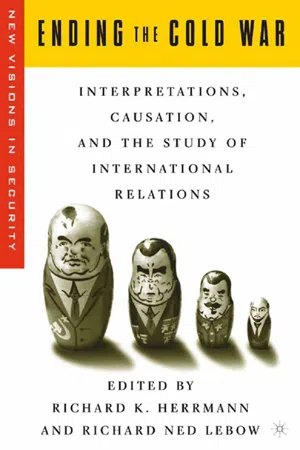
Ending the Cold War
Interpretations, Causation and the Study of International Relations
- R. Herrmann, R. Lebow, R. Herrmann, R. Lebow(Authors)
- 2004(Publication Date)
- Palgrave Macmillan(Publisher)
Chapter 1 What Was the Cold War? When and Why Did it End? Richard K. Herrmann and Richard Ned Lebow T he end of the Cold War constitutes one of the most remarkable trans- formations of the twentieth century. Its peaceful and unexpected end was a dramatic watershed, as was the collapse of the Soviet Union, which followed in its wake. Both events had momentous and diverse conse- quences for hundreds of millions of people. The indirect consequences—unipo- larity, accelerated globalization, and diminished fear of Armageddon—were global and still reverberate through the societal groups, countries, and regions that constitute the international community. Yet the end of the Cold War re- mains poorly understood. Even before critical parts of the historical record be- came accessible, the received wisdom in the United States was that the West “won” through unrelenting pressure on the Soviet Union. In the former Soviet Union, the end of the Cold War is most often attributed to “new thinking” and is regarded as a triumph of ideas over dangerous and deeply entrenched institu- tional practices. The emerging evidence suggests that both interpretations are at best only part of a very complex story. The end of the Cold War poses a formidable challenge to international rela- tions theory. Scholars of all persuasions failed to predict the possibility of such momentous, let alone peaceful, change. In the aftermath, they struggled to find explanations consistent with their theories and to make sense of the emerging post–Cold War world. The Cold War might be described as a “mere data point” that cannot be used to test or develop theories, but at the same time, the Cold War’s end has also been described as a “big bang” that created a new political universe. The latter description appears closer to the truth given the response of eBook - ePub
A Companion to U.S. Foreign Relations
Colonial Era to the Present
- Christopher R. W. Dietrich(Author)
- 2020(Publication Date)
- Wiley-Blackwell(Publisher)
Chapter Fifty‐One The Changing History of the End of the Cold War Sarah B. Snyder As one of the defining features of the twentieth century, much has been written about the Cold War and its end. As one scholar who recently tackled the topic put it, the end of the Cold War “has attracted a massive literature” (Service 2015). Surveying the waves of remembrances and analyses in the nearly 30 years since, we can, nonetheless, identify several key narratives. This chapter discusses four of the most important. First, considerable debate exists surrounding periodization – or, put another way, when the Cold War ended. Second, specialists on U.S. foreign relations disagree about how effective U.S. policy was in ending the Cold War. Third, and related to the second point, observers evaluate the relative contributions of key political actors quite differently. Finally, scholars are increasingly attentive to the legacies of the Cold War's end. Periodization As with the origins of the Cold War, dating when the Cold War ended, and even when its end began, has produced considerable scholarly debate. Though the historian Robert Service (2015) has argued that there is “no definable date” for the end of the Cold War, a number of key moments between 1989 and 1991 have gained proponents. Among the earliest points around which arguments have coalesced are those that align with the end of U.S. President Ronald Reagan's time in office. Former U.S. official Jack Matlock (2004) argues, “Psychologically and ideologically, the Cold War was over before Ronald Reagan moved out of the White House.” Reagan himself agreed with this chronology, telling reporters as he flew home to California following George H. W. Bush's inauguration that “The Cold War is over” (Fitzgerald 2000). For those most focused on the threat of nuclear weapons, the December 1987 Washington Summit, which was noteworthy for the signing of the Intermediate‐Range Nuclear Forces Treaty, is an appropriate endpoint eBook - PDF
America in the World
The Historiography of American Foreign Relations since 1941
- Frank Costigliola, Michael J. Hogan(Authors)
- 2013(Publication Date)
- Cambridge University Press(Publisher)
105 The Cold War came to an abrupt and rather surprising end in 1991, at least considering what might have been. In the twenty years henceforth, the historiography of the conflict has grown immensely, shedding new light on all aspects of the Cold War. The opening of former communist bloc archives, those of other nations that were inescapably drawn into the superpower struggle, and the continued wealth of access to American and Western European sources have made this growth possible. In addi- tion, the “cultural turn” in historical studies of the last two decades has broadened the array of topics that historians consider under Cold War history. This essay highlights some of the trends and work on the his- tory of the Cold War since roughly 1995 with primary emphasis on rela- tions between the war’s two main antagonists – the United States and the Soviet Union. Though necessarily not inclusive of all of the works on the Cold War, it strives to provide an overview that will aid future research. Origins of the Cold War: 1945–1953 The first phase of Cold War historiography was characterized by heated debate between “orthodox” historians, 1 who laid blame for the Cold War almost entirely at the feet of Stalin and the Soviet Union, and “revisionist” historians, 2 who contended that the Cold War was largely the responsibil- ity of the United States. The result was one of the most contentious histo- riographical clashes in U.S. history. 3 Over the ensuing decades historians put forth innumerable works and various interpretations – among them postrevisionism, 4 national security, 5 corporatism, 6 and world-systems analysis 7 – in an effort to move beyond the orthodox-revisionist divide 6 The Cold War Curt Cardwell Curt Cardwell 106 concerning the origins of the Cold War. However, despite the increased knowledge of the Cold War that this scholarship produced, no satis- factory overarching synthesis ever emerged.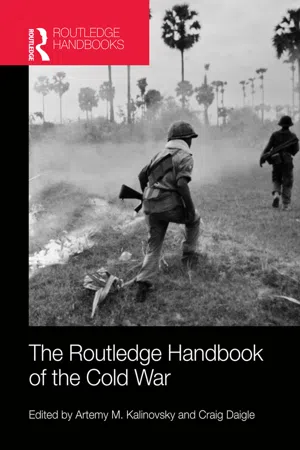 eBook - ePub
- Artemy M. Kalinovsky, Craig Daigle, Artemy M. Kalinovsky, Craig Daigle(Authors)
- 2014(Publication Date)
- Routledge(Publisher)
PART IX The End of the Cold War
Artemy M. Kalinovsky and Craig Daigle Passage contains an image
Explanations for the End of the Cold War
Artemy M. Kalinovsky and Craig Daigle DOI: 10.4324/9781315882284-26Few topics of Cold War history have provoked as much scholarly debate as its beginning and its end. In one camp are those who insist on the primacy of the US role in ending the conflict, and especially the vision of Ronald Reagan.1 For these scholars, it was the combination of Reagan’s vision of a world without nuclear weapons, his toughness in relations with Moscow, and his ability to articulate the superiority of the American way of life that helped to demonstrate the bankruptcy of the Soviet model. Nonsense, say others – the Cold War ended not because of anything Reagan did, but because of Soviet leader Mikhail Gorbachev’s determination to reform the Soviet Union and, in so doing, end the Cold War competition with the United States.2 International Relations theorists have been vocal as well, arguing that explanations for the end of the Cold War need to be found in structural causes – namely, Soviet economic problems and the large debts of East European states.3 Others have justly argued that any account of the Cold War’s end needs to pay equal, if not greater, attention to what took place in Europe and the actions of elites there.4 And as the chapters that follow demonstrate, one must also take into account the role of transnational institutions and movements like Solidarity in Poland and of paradigms like neoliberalism, in order to understand the end of the Cold War.One of the reasons that these debates have such resonance is because, like the debates about the Cold War’s origins, debates about its end have had and continue to have serious implications for contemporary politics. Debates about the Cold War’s origins in the 1960s and 1970s were inevitably tied to the critiques and justifications of US Cold War policies, particularly American involvement in the Vietnam War. Debates about how it ended are linked to questions about America’s place in the world, its proper relations with its allies, and even which vision of America, precisely, triumphed over communism – the New Deal vision that promised state intervention to promote equality, or the more individualistic version espoused by Ronald Reagan. Those who believe, for example, that Reagan’s toughness played a key role in ending the Cold War have used their reading of history to justify a more interventionist role for the US in the post-Cold War world. Differing interpretations of the end of the Cold War, and the terms on which it was negotiated, continue to have an impact on Russia’s relations with the United States and in Europe, including with former Soviet republics and East European satellites.
- Elizabeth Cobbs, Edward Blum, Jon Gjerde, , Elizabeth Cobbs, Edward Blum, Jon Gjerde(Authors)
- 2016(Publication Date)
- Cengage Learning EMEA(Publisher)
The U.S.S.R. still possessed military capabilities only margin-ally reduced from those of previous years; it commanded the power to halt the processes of change at their inception. But a half-decade of rising demands for political and economic self-determination had taken their toll on Soviet energy and will. For Gorbachev, the price of Soviet impositions on the peoples of east-ern Europe had become both physically and morally exorbitant. The time had arrived to terminate the Soviet Union ’ s hegemonic rule. END OF THE COLD WAR AND RISE OF TERRORISM 463 Copyright 2017 Cengage Learning. All Rights Reserved. May not be copied, scanned, or duplicated, in whole or in part. Due to electronic rights, some third party content may be suppressed from the eBook and/or eChapter(s). Editorial review has deemed that any suppressed content does not materially affect the overall learning experience. Cengage Learning reserves the right to remove additional content at any time if subsequent rights restrictions require it. Throughout the last years of the Cold War, the Soviet-American conflict rested on the assumption that it remained the supreme phenomenon of international life, dwarfing all other regional and national causes. … Somehow such depictions of global confrontation scarcely reflected the real-ities of the existing international order. The fundamental supposition that the military might of the United States carried the essential responsibility for the lim-itation of Soviet ambition sustained, over time, the country ’ s multitrillion-dollar defense expenditures, but it ignored the role of other nations, whether acting independently or in combination, as factors in international stability. Every country, large and small, defended its interests against predators. Nowhere did the dominoes fall in accordance with the predictions of Communist expansion. eBook - PDF
- Norman Housley(Author)
- 2000(Publication Date)
- Yale University Press(Publisher)
8 The United States, the Cold War, and the Post-Cold War Order Philip Zelikow It is impossible to analyze the settlement of the Cold War without comprehending what was being settled. In other words, a theory of settlement must be accompanied by a theory of what the Cold War was about. The Cold War can best be understood as the final phase, lasting nearly half a century, of a long global struggle between two fundamentally different conceptions for the organization and governance of modern society. That struggle began as the international system of the nine-teenth century was coming to its end in the bloody chaos of World War I. 1 Out of those ruins arose a new conception of gov-ernment and society, one that had not held power anywhere be-fore the war, and was offered as the ultimate response both to the industrial revolution and to the modern requirements for toted war. This form of governance claimed unlimited power over its subjects in order to transcend the traditional divisions of society and unite them in pursuit of Utopian ideals. These ideals differed, principally between a focus on a global conflict of nations and races or a global struggle of social classes. But all these varieties 159 Philip Zelikow 160 of totalitarianism were united in their hostility, even revulsion, toward the liberal democracies. Once the Bolshevik regime had survived the trials of civil war in Russia and the fascist dictator-ships also began attaining power, first in Italy, the battle lines were drawn around the world. By early 1941 the totalitarian states held most of the world's military power. But then the two most powerful states in the world, Germany and the Soviet Union, went to war against each other. The Cold War Becomes Evident, 1943-1946 The Cold War began as the outcome of World War n was coming into view. eBook - PDF
Global Rules
America, Britain and a Disordered World
- James E. Cronin(Author)
- 2014(Publication Date)
- Yale University Press(Publisher)
And the initial confrontations with the old order were bruising and did not produce easy victories. Nor did it appear that the Soviet Union, or its allies and satellites in Eastern Europe, was about to give up in the competition with capitalism. These regimes appeared stable and strong, at C H A P T E R 7 Ending the Cold War and Recreating Europe ENDING THE COLD WAR AND RECREATING EUROPE 181 least in terms of military power and internal security. Things began to shift by the mid–1980s, both at home and abroad. Economic growth brought at least a grudging acceptance of what Thatcher and Reagan were trying to do in terms of domestic policy. In defense and foreign policy, the process of rearmament in the United States and Britain allowed the countries’ leaders to think more seriously about bargaining with the Cold War enemy. They also sensed genuine movement on the part of the Soviets and the possibility of better relations, although none dared dream of what would soon come to pass. The assumptions and techniques by which the global economy operated were also now more or less dominated by the neoliberal vision of Thatcher and Reagan and it was in 1989 that the phrase “the Washington consensus” had emerged to describe the new consensus governing international economic relations. There was in place by that time a much broader set of Washington or, better yet, Anglo-American or “Atlantic Rules” that applied not only to domestic and foreign policy but to the very consti-tution of states. The new rules were predicated on the importance of markets operating freely within countries and of expanding markets beyond national boundaries; they involved a strong preference for market-based and rights-based democracy; and they envisioned a rules-based international order. The collapse of socialism not only created an opportunity for spreading the wisdom of economic openness and market-based democracy and extending its scope; it was also its proof and rationale. eBook - PDF
The Making of Global International Relations
Origins and Evolution of IR at its Centenary
- Amitav Acharya, Barry Buzan(Authors)
- 2019(Publication Date)
- Cambridge University Press(Publisher)
112 112 5 The World after 1945: The Era of the Cold War and Decolonisation Introduction This chapter picks up the story of international history from where we left it in Chapter 3 at the end of the Second World War. We argued there that the Second World War produced many major changes in GIS both normative and material, enough to count as a transition from the version 1.0 Western-colonial GIS established during the nineteenth century, and continuing after the First World War, to version 1.1 Western-global GIS after 1945. We call it version 1.1, rather than 2.0, because although the changes were many and big, they were changes in the system/society rather than changes of it. International relations was still set up as a system of states, and many of its defining primary institutions remained in place. The next section summarises briefly the continuities and discontinu- ities from the pre-1945 GIS. The one following looks in more detail at the main themes of version 1.1 GIS during the period from 1945 to 1989: the era of the Cold War and decolonisation. Continuities and Discontinuities from the Pre-1945 World As argued in Chapter 3, there was a lot of continuity between the period before 1914 and the interwar years. The main discontinuity came from the First World War itself, with the scale of death, destruction and cost creating a great shock wave that amplified the defence dilemma to a suf- ficient extent to call into question the viability of great power war. By contrast, the Second World War generated several major changes to the material and ideational structure of GIS (Buzan and Lawson, 2014a). It also far outpaced the First World War in the scale of death, destruc- tion and cost, but added to this the spectre of nuclear weapons, which massively further amplified the fear of war, and made the possibility of humankind committing species suicide clearly apparent to all. While the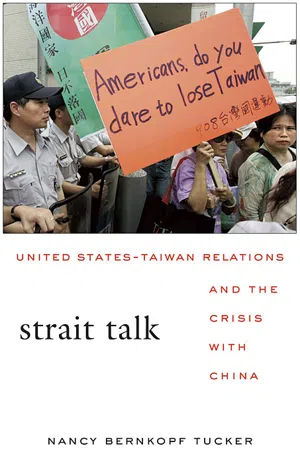 eBook - PDF
Strait Talk
United States-Taiwan Relations and the Crisis with China
- Nancy Bernkopf Tucker(Author)
- 2011(Publication Date)
- Harvard University Press(Publisher)
THE END OF THE COLD WAR T he ending of the cold war and the collapse of the Soviet Union posed enormous challenges to George H. W. Bush, a man whose ca-reer had been rooted in caution and political calculation. He expected to be a foreign policy president, but rapid change demanded imagination and courage, not conventionality and prudence. As he said himself, he lacked the “vision thing.” Thus, he approached Soviet reform gingerly, distrusting new realities. Moreover the public expected a “peace dividend” that drained resources from defense and diplomacy, narrow his options, dis-may the Pentagon, and worry critics in Congress. Bush seemed at his best building a coalition to fight the Persian Gulf War (1991). Using his carefully honed networking skills, he cajoled world lead-ers into contributing forces or funds—or both—to save Kuwait’s indepen-dence from Iraq, thereby assuring US dominance over the region and ac-cess to oil. Bush tried a variation on personal diplomacy after violence erupted in China in 1989, but far less successfully. The student protests and China’s brutal suppression of them undermined the president’s plans to build closer and stronger relations with China. Outraged Americans demanded that Beijing be isolated, loans and trade be frozen, and human rights become central in Sino-American relations. Congress and human rights groups condemned Chinese leaders. Bush, however, ignored their censure and labored to maintain ties, encountering heavy criticism after public dis-closure of his efforts. As the broad consensus that had sustained Sino-American relations since 1971 broke down, Bush found himself repeatedly at odds with Con-gress and the public. Renewal of China’s most-favored-nation trade treat-ment evolved into a wrenching and taxing annual congressional ordeal. Disputes materialized over arms sales and prison labor. The president, however, barely criticized China, convinced US national interests de-manded repairing the Tiananmen rift.
Index pages curate the most relevant extracts from our library of academic textbooks. They’ve been created using an in-house natural language model (NLM), each adding context and meaning to key research topics.

