History

Start Cold War
The start of the Cold War refers to the period of heightened tension and rivalry between the United States and the Soviet Union following World War II. This era was characterized by ideological, political, and military competition, as well as the development of nuclear weapons. The Cold War had a significant impact on global politics and international relations for several decades.
Written by Perlego with AI-assistance
Related key terms
1 of 5
10 Key excerpts on "Start Cold War"
 eBook - PDF
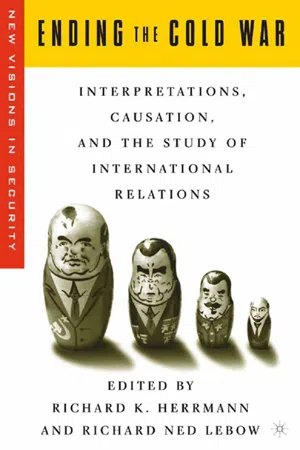
Ending the Cold War
Interpretations, Causation and the Study of International Relations
- R. Herrmann, R. Lebow, R. Herrmann, R. Lebow(Authors)
- 2004(Publication Date)
- Palgrave Macmillan(Publisher)
In these constructions, the Cold War may have begun as both an ideological and geopolitical contest, but had by the 1960s evolved into at least a tacit, if not explicit, division of the world that 2 Richard K. Herrmann and Richard Ned Lebow served the imperial ambitions of both Washington and Moscow. The facade of intense competition was cultivated and exploited by the superpowers as an ex- cuse to justify continued domination of allies and the extensive use of violence to preserve and extend their respective spheres of influence and control in the Third World. In the conferences and interviews associated with this project, we encoun- tered yet another construction of the Cold War that has many adherents in Moscow. In this reading, the Cold War was primarily driven by American de- termination to achieve global hegemony and destroy the countervailing power of the Soviet Union. Former Soviet officials and scholars who hold this view contend that Washington pursued an anti-Russian strategy throughout the post–World War II period, and has continued to do so after the collapse of the Soviet Union. They take umbrage at the notion that the Cold War ended in the late 1980s, insisting instead that the central causal forces driving this conflict be- came even more pronounced in the following decade. In the extreme version of this understanding of the Cold War, advanced by officials who opposed Gor- bachev, the Soviet leadership and the post-Soviet Russian leadership lost their will to resist American hegemony, and their lack of resolve led to a collapse of Soviet capabilities. Russians who construct the Cold War this way suggest that Russian-Ameri- can relations are likely to become conflictual again, and may even take on global proportions if Russian power is revitalized and Washington adheres to its impe- rial and anti-Russian course. They suggest that future historians may look back on the 1990s as a mere hiatus in an enduring rivalry. eBook - PDF
America in the World
A History in Documents since 1898, Revised and Updated
- Jeffrey A. Engel, Mark Atwood Lawrence, Andrew Preston, Jeffrey A. Engel, Mark Atwood Lawrence, Andrew Preston, Mark Atwood Lawrence, Mark Lawrence, Jeffrey A. Engel, Andrew Preston(Authors)
- 2023(Publication Date)
- Princeton University Press(Publisher)
7 The Beginning of the Cold War The Soviet-American alliance against Nazi Germany fractured within a few months after the end of the Second World War, and the two superpowers settled into a bitter rivalry that American newspaper columnist Walter Lippmann dubbed a “cold war.” This deterioration resulted from numerous sources of disagreement, some of them rooted long before 1945. The two nations had regarded each other warily ever since the Bolshevik Revolution of 1917 had brought communists to power in Russia and established a national ideology opposed to the American creed of free enterprise and democracy. The outbreak of global war in 1941 thrust Washington and Moscow together as partners against fascism, yet old resentments festered. The Cold War resulted not just from past disagreements, however, but also from conflicting visions of the future. U.S. and Soviet leaders advanced contrasting ideas about how to remake the world once the fighting came to an end. For Joseph Sta- lin, ensuring the physical security of the Soviet Union was paramount. He aimed to destroy German power, assert control over eastern Europe, and extend Soviet influence toward the Mediterranean, oil-rich Southwest Asia, and the Far East. This desire for territorial domination, rooted in a profound sense of insecurity honed by repeated invasions of the Soviet Union, contrasted sharply with U.S. plans for the postwar order. Convinced that global catastrophe—first the Great Depres- sion and then the Second World War—had resulted from nations pursuing nar- row economic and territorial advantages, U.S. leaders hoped to establish an open world order based on free trade, self-determination, and international cooperation. Like Woodrow Wilson in an earlier day, U.S. officials believed that the universal application of such principles would serve the interests not only of the United States but also of the whole international community. eBook - PDF
America in the World
The Historiography of American Foreign Relations since 1941
- Frank Costigliola, Michael J. Hogan(Authors)
- 2013(Publication Date)
- Cambridge University Press(Publisher)
105 The Cold War came to an abrupt and rather surprising end in 1991, at least considering what might have been. In the twenty years henceforth, the historiography of the conflict has grown immensely, shedding new light on all aspects of the Cold War. The opening of former communist bloc archives, those of other nations that were inescapably drawn into the superpower struggle, and the continued wealth of access to American and Western European sources have made this growth possible. In addi- tion, the “cultural turn” in historical studies of the last two decades has broadened the array of topics that historians consider under Cold War history. This essay highlights some of the trends and work on the his- tory of the Cold War since roughly 1995 with primary emphasis on rela- tions between the war’s two main antagonists – the United States and the Soviet Union. Though necessarily not inclusive of all of the works on the Cold War, it strives to provide an overview that will aid future research. Origins of the Cold War: 1945–1953 The first phase of Cold War historiography was characterized by heated debate between “orthodox” historians, 1 who laid blame for the Cold War almost entirely at the feet of Stalin and the Soviet Union, and “revisionist” historians, 2 who contended that the Cold War was largely the responsibil- ity of the United States. The result was one of the most contentious histo- riographical clashes in U.S. history. 3 Over the ensuing decades historians put forth innumerable works and various interpretations – among them postrevisionism, 4 national security, 5 corporatism, 6 and world-systems analysis 7 – in an effort to move beyond the orthodox-revisionist divide 6 The Cold War Curt Cardwell Curt Cardwell 106 concerning the origins of the Cold War. However, despite the increased knowledge of the Cold War that this scholarship produced, no satis- factory overarching synthesis ever emerged. No longer available |Learn more
- (Author)
- 2014(Publication Date)
- College Publishing House(Publisher)
______________________________ WORLD TECHNOLOGIES ______________________________ Chapter 4 Cold War (1953–1962) 1962 World map of alignments: NATO member states Other allies of the USA Colonized countries Warsaw Pact member states Other allies of the USSR Non-aligned nations The Cold War (1953–1962) discusses the period within the Cold War from the death of Soviet leader Joseph Stalin in 1953 to the Cuban Missile Crisis in 1962. Following the death of Stalin unrest occurred in the Eastern Bloc, while there was a calming of international tensions, the evidence of which can be seen in the signing of the Austrian State Treaty reuniting Austria, and the Geneva Accords ending fighting in Indochina. However, this thaw was only partial with an expensive arms race continuing during the period. Eisenhower and Khrushchev When Dwight D. Eisenhower was sworn in as U.S. President in 1953, the Democrats lost their two-decades-long control of the U.S. presidency. Under Eisenhower, however, the United States' Cold War policy remained essentially unchanged. Whilst a thorough rethinking of foreign policy was launched (known as Operation Solarium), the majority of emerging ideas (such as a ______________________________ WORLD TECHNOLOGIES ______________________________ rollback of Communism and the liberation of Eastern Europe) were quickly regarded as unworkable. An underlying focus on the containment of Soviet communism remained to inform the broad approach of U.S. foreign policy. An important strand in American politics of this period was McCarthyism. Named after Wisconsin Senator Joseph McCarthy, this was a period of intense anti-communism which lasted from 1948 to about 1956. The government of the United States prosecuted the leadership of the Communist Party USA as well as other individuals suspected of being communists. McCarthy's career faltered in 1954 as his hearings were televised for the first time, allowing the public and press to view his tactics. No longer available |Learn more
- (Author)
- 2014(Publication Date)
- Learning Press(Publisher)
______________________________ WORLD TECHNOLOGIES ______________________________ Chapter- 4 Cold War (1953–1962) 1962 World map of alignments: NATO member states Other allies of the USA Colonized countries Warsaw Pact member states Other allies of the USSR Non-aligned nations The Cold War (1953–1962) discusses the period within the Cold War from the death of Soviet leader Joseph Stalin in 1953 to the Cuban Missile Crisis in 1962. Following the death of Stalin unrest occurred in the Eastern Bloc, while there was a calming of international tensions, the evidence of which can be seen in the signing of the Austrian State Treaty reuniting Austria, and the Geneva Accords ending fighting in Indochina. However, this thaw was only partial with an expensive arms race continuing during the period. ______________________________ WORLD TECHNOLOGIES ______________________________ Eisenhower and Khrushchev When Dwight D. Eisenhower was sworn in as U.S. President in 1953, the Democrats lost their two-decades-long control of the U.S. presidency. Under Eisenhower, however, the United States' Cold War policy remained essentially unchanged. Whilst a thorough rethinking of foreign policy was launched (known as Operation Solarium), the majority of emerging ideas (such as a rollback of Communism and the liberation of Eastern Europe) were quickly regarded as unworkable. An underlying focus on the containment of Soviet communism remained to inform the broad approach of U.S. foreign policy. An important strand in American politics of this period was McCarthyism. Named after Wisconsin Senator Joseph McCarthy, this was a period of intense anti-communism which lasted from 1948 to about 1956. The government of the United States prosecuted the leadership of the Communist Party USA as well as other individuals suspected of being communists. McCarthy's career faltered in 1954 as his hearings were televised for the first time, allowing the public and press to view his tactics. eBook - PDF
Consumed by War
European Conflict in the 20th Century
- Richard C. Hall(Author)
- 2014(Publication Date)
- The University Press of Kentucky(Publisher)
Chapter 12 ORIGINS OF THE COLD WAR The origins of the settlement of the Second World War began during the actual fighting. This settlement is inseparable from the beginning of the Cold War, the third phase of the twentieth-century European conflict. The Cold War began as the Second World War concluded and prevented a formal resolution of that war for some time. German war aims were fairly straightforward, though they tending toward the fantastical. The Germans wanted to dominate Europe eco- nomically and politically as far as the Ural Mountains. This involved the defeat of France in western Europe and the conquest of Soviet Russia for the acquisition of lebensraum in eastern Europe. This lebensraum was partly economic, intended to ensure that Germany would never have to endure economic travails because of a British blockage. It was also partly political: Hitler wanted to ensure German domination of Europe for a thousand years. Mussolini sought the realization of a new Roman Empire in the Med- iterranean region. Germany's eastern European subordinates were mainly interested in realizing their national objectives, usually at their neighbors' or one another's expense. Both the Finns and the Romanians wanted to regain and expand territories previously ceded to Soviet Russia. The Allied objectives were more problematic. Britain and France ini- tially went to war to protect Poland, but after the first month of the con- flict, the German-Russian victory over Poland made this goal unrealistic. German successes throughout Europe in 1940 further obscured Allied war aims. For Britain, the sole remaining enemy of German expansion plans, simple survival became paramount in the face of German domina- tion of the European continent. Origins of the Cold War 191 Stalin had two major objectives. One was ideological: he sought to preserve and spread his version of accelerated Marxist Leninism. The other was political: he wanted Soviet power to survive. eBook - PDF
A World Safe for Commerce
American Foreign Policy from the Revolution to the Rise of China
- Dale C. Copeland(Author)
- 2024(Publication Date)
- Princeton University Press(Publisher)
By securing a strong economic and political Second World War and Cold War 243 position on the periphery, the United States would be able to direct the post- war recovery of most of the globe and keep the Soviets from drawing large parts of it to its side. If the Soviets decided to work with Washington and keep order within their own smaller sphere, great. But if not, then the United States would have the power base needed to deal with anything that arose in the future, and with the problems on the ground in the present. I will be talking about the causes of the Cold War and the way it played out over forty-five years for the next three chapters. Before I proceed, therefore, I need to briefly address what might seem to be a self-evident truth: that eco- nomic interdependence could have had little to do with either the Cold War’s origins or with the crises and tensions that pockmarked its history until the late 1980s. After all, U.S.-Soviet trade from late 1945 onward remained at very low levels given what seemed to be strong geopolitical reasons for not trading, particularly American fears that trade would promote Soviet relative economic growth within the new more zero-sum, bipolar world Washington now faced. It would thus seem that economic interdependence drops out as a causal vari- able that might explain both the start of the Cold War and its dynamics over some four decades. Indeed, both realists and liberals usually completely ignore the economic aspects of the U.S.-Soviet relationship from 1945 to the 1980s, presuming that low or almost nonexistent trade could not possibly have had much of a role in the Cold War struggle. eBook - PDF
A People and a Nation
A History of the United States
- Jane Kamensky, Carol Sheriff, David W. Blight, Howard Chudacoff(Authors)
- 2017(Publication Date)
- Cengage Learning EMEA(Publisher)
Bettmann/Getty Images Copyright 2019 Cengage Learning. All Rights Reserved. May not be copied, scanned, or duplicated, in whole or in part. Due to electronic rights, some third party content may be suppressed from the eBook and/or eChapter(s). Editorial review has deemed that any suppressed content does not materially affect the overall learning experience. Cengage Learning reserves the right to remove additional content at any time if subsequent rights restrictions require it. CHAPTER 24 The Cold War and American Globalism | 1945–1961 706 be held responsible for events there. Just possibly, some dared to think, Harry Truman was on his way to winning the Cold War. 24-2e Twin Shocks Then, suddenly, in late September, came the “twin shocks,” two momentous developments that made Americans feel in even greater danger than ever before—two decades later, they were still dealing with the reverberations. First, an American reconnaissance aircraft detected unusually high radioactivity in the atmosphere. The news stunned U.S. officials: the Soviets had exploded an atomic device. With the American nuclear monopoly erased, Western Europe seemed more vulnerable. At the same time, the communists in China completed their victory in that nation’s civil war—the end came more quickly than many expected. Now the world’s largest and most populous countries were ruled by communists, and one of them had the atomic bomb. The bipartisan foreign policy of 1945–1948 broke down, as Republicans, bit- ter over Truman’s reelec- tion, declared that traitors in America must have given Stalin the bomb and allowed China to be “lost.” Rejecting calls by Kennan and others for high-level negotiations, Truman in early 1950 gave the go- ahead to begin production of a hydrogen bomb, the “Super,” and ordered his national security team to undertake a thor- ough review of policy. Kennan bemoaned the militarization of the Cold War and was replaced at the State Department by Paul Nitze. eBook - PDF
- Peter Calvocoressi(Author)
- 2013(Publication Date)
- Routledge(Publisher)
The European dilemma was intensified when Gorbachev proposed to apply the zero option to short-range or battlefield nuclear weapons also. The response could no longer be flexible and a Russian attack would start with considerable advantages, offset only by the counter-fear of an all-out American riposte with what might be left of the strategic missile force. The Reagan–Gorbachev exchanges of 1986–87 and the ensuing START agreements checked the arms race but did not give Gorbachev what he needed in the long term. This phase of the Cold War ended without any settlement or even discussion of the 52 THE COLD WAR opponents’ relations in their principal field of battle: Europe. That issue was only fleet- ingly and obliquely addressed when the United States, rather than making peace or at least constructing a working relationship with the evolving new Russia, gave priority to bundling Moscow’s ex-satellites into NATO. Gorbachev’s failure to do better prob- ably contributed to his own downfall and to the incoherent, although at times brave, politics of Yeltsin, so bequeathing to Putin an isolated and disintegrating state, its remaining strengths much overrated (as in 1945) but adequate if he could master local proconsuls and oligarchs, defeat separatism in the Caucasus and reassure the Russian peoples with the right amount of bravado. The perplexities of the United States The 1980s were the decade in which the superpowers ceased to be regarded as so far above and beyond all other states as to constitute a distinct species. This was pre- eminently true of the USSR, which no longer looked like a match for the United States, was no longer able to dominate central or eastern Europe, was in acute economic decline and was threatened with disintegration. eBook - PDF
- K. Aldred, Martin A. Smith(Authors)
- 1999(Publication Date)
- Palgrave Macmillan(Publisher)
44 The second and, to some extent at least, complementary inter- pretation of the sources of Soviet weakness places the emphasis on the Soviet Union’s relatively limited superpower scope and role when compared to the United States. It has been argued that the Soviet Union was unable to fully compete with the United States in terms of power projection because it ultimately lacked the econ- omic resources to underwrite such a competition. Some have argued from a longer historical perspective that the Soviet Union, as the successor to Imperial Russia, remained locked into traditional Russian strategic thinking which focused on building up influence over ter- ritories close to its existing borders rather than further afield across the seas. In this vein, Jan Nijman, in 1993, compared the Cold War spheres of influence of the US and the USSR and concluded that they confirmed ‘the notions of the Soviet Union as a regional land power, and the United States as a global sea power’. 45 The initial tenor of Soviet policy and outlook in the Cold War period was, of course, determined by Stalin. It has frequently been argued since his death in 1953, not least by some of his successors, The Two Cold War Superpowers 33 that he overestimated the importance of military strength as the single most important factor of power. There is evidence, however, that Stalin did believe that the economic and political aspects of power were important too. During the 1930s in particular he had been especially preoccupied with the forced development of Soviet heavy industry. Although this produced a narrow and limited in- dustrial base, and the social costs which the Soviet people had to pay for Stalin’s industrialisation drive were exceedingly heavy, econ- omists have conceded that some impressive statistical results were achieved.
Index pages curate the most relevant extracts from our library of academic textbooks. They’ve been created using an in-house natural language model (NLM), each adding context and meaning to key research topics.

