History

Impacts of the New Deal
The New Deal, implemented by President Franklin D. Roosevelt in the 1930s, had significant impacts on the United States. It provided relief to millions of Americans during the Great Depression, created jobs through public works programs, and established social security and labor laws. The New Deal also expanded the role of the federal government in regulating the economy and providing social welfare.
Written by Perlego with AI-assistance
Related key terms
1 of 5
11 Key excerpts on "Impacts of the New Deal"
- Aaron D. Purcell(Author)
- 2014(Publication Date)
- The Kent State University Press(Publisher)
First, scholars questioned who was responsible for the reforms of the New Deal, with one group maintaining that Roosevelt and his advisors were the key and, and another arguing that the people generally, rather than Roosevelt and his advisors, were the chief instigators in identifying areas for reform. Second, scholars have either interpreted the 1930s as a period of American liberalism in which the New Deal was the engine for change, or they have viewed the New Deal as a conservative moment when government officials sought to appease business, labor, and popular demands for change. As a result, one group of historians portrayed Roosevelt as a near socialist, while other scholars argued that Roosevelt took steps to save capitalism. Finally, scholars have searched for New Deal connections to other reform movements, especially focusing on the Populist Movement of the late nineteenth century, the Progressive Era of the early twentieth century, and the Great Society programs of the 1960s. 10 Historians have argued variously that the New Deal went too far, that it did not go far enough, that it created more problems than it solved, or even that its shaky foundations are the reason for the economic and social instability of the Great Recession of the early twenty-first century. The varied scholarship on the New Deal and the Great Depression presents an example of how historical interpretation changes over time. One constant across all these studies is the importance of historical revisionism, or the re-examination of previous historical interpretations. The corpus of scholarship on the New Deal and the Great Depression fits well within a few major categories, or schools, of historical interpretative thought that developed. It is important to remember that scholars representing these schools of thought wrote across a wide period of time and their interpretations changed over the decades eBook - PDF
- Alan Brinkley(Author)
- 2000(Publication Date)
- Harvard University Press(Publisher)
But most of its limited discussion of domestic issues centered on how the New Deal had “found the road to prosperity” through aggressive compensatory meas-ures: ªscal policies and social welfare innovations. 60 The changing landscape of liberalism was visible as well in some of the ªrst retrospective celebrations of the New Deal, in the way early defenders of its legacy attempted to deªne its accomplishments. In 1948, Arthur M. Schlesinger, Jr., published an essay entitled “The Broad Accomplishments of the New Deal.” The New Deal, he admit-ted, “made no fundamental attempt to grapple with the problem of the economies of concentration or of the decline in outlets for real invest-ment.” But that, he claimed, was not really the point. The New Deal’s most signiªcant accomplishments were much simpler and more impor-tant: “The New Deal took a broken and despairing land and gave it new conªdence in itself. . . . All [Roosevelt’s] solutions were incomplete. But then all great problems are insoluble.” 61 The importance of the New Deal lies in large part, of course, in its actual legislative and institutional achievements. But it lies as well in its ideological impact on subsequent generations of liberals and in its ef-Th e Late New Deal and the Idea of the State 61 fects on two decades of postwar government activism. And in that light, the New Deal appears not just as a bright moment in which reform energies brieºy prevailed but as part of a long process of ideological adaptation. For more than half a century Americans concerned about the impact of industrialization on their society—about the economic instability, the social dislocations, the manifest injustices—had harbored deep and con-tinuing doubts about the institutions of capitalism. Few had wanted to destroy those institutions, but many had wanted to use the powers of government to reshape or at least to tame them. eBook - PDF
- Jenice View, Andrea Guiden Pittman, James Mitchell, Charlotte L. Johnson, Erik Alexander, Caroline R. Pryor, Michael E. Karpyn, Jenice View(Authors)
- 2021(Publication Date)
At the same time, students will encounter the NAACP’s initiation of legal campaign against segregation, the role of Black women as fundrais- ers and community organizers when federal relief program failed Black communities, the impact of both the Scottsboro Trial and the Tuskegee Experiments, and the founding of the National Negro Congress. In other words, where many textbook chapters on the New Deal Era focus on the economic impact of the Great Depression, this explains how existing social and economic inequities worsened or, at the very least, became more com- plicated during the 1930s. In this, we would expect students to compare the narrative and supporting evidence of both this book and the locally adopted United States history textbook. As an instructional planning note when teaching Compelling Question 4 on the legacy of the New Deal era, it would be critical to circle students back to the textbook African-American History (Hine, Hine & Harrold, 2011), as the text 38 | COOK AND EARGLE notes that a lasting impact of the New Deal Era is the onset of political realign- ment that occurs as Black voters begin to support the Democratic Party. Source 2: Robert C. Weaver, “The New Deal and the Negro: A Look at the Facts,” July 1935. Robert C. Weaver served in Franklin D. Roosevelt’s “Black Cabinet” and would go on to serve in the John F. Kennedy and Lyndon B. Johnson administrations. In this article, published in the aca- demic journal Opportunity, Journal of Negro Life, Weaver makes a case that the New Deal programs are positively impacting Black people in both urban and rural areas of the United States. When used with the textbook options, students should consider the authorship (a Black male working within the Roosevelt administration) in comparison to the text- books (offering often conflicting evidence on the promises and achieve- ments of the New Deal programs). No longer available |Learn more
- (Author)
- 2014(Publication Date)
- Research World(Publisher)
The number of unemployed in 1929 was estimated at less than 4%, but by 1933 the unemployment rate had jumped up to approximately 25%. The New Deal was designed for complete economic recovery during the depression. However, the New Deal did not achieve full economic recovery. It actually had a limited economic impact. The New Deal failed to lower the unemployment rate below 14%. However, the New Deal did help maintain an average of 17% level the unemployment throughout the 1930s. Mo st scholars believe that there were three versions of the New Deal in between 1933 and 1940. The first New Deal took place between 1933 and 1935 and was focused on both farm and factory. The second New Deal was introduced in 1935. In this New Deal, the country's welfare system was dramatically changed and expanded. One example of the New Deal’s new welfare programs was the Works Progress Administration (WPA), which was created to “return the unemployed to the work force”. During the New Deal period, the federal government evolved into an arbitrator in the competition among elements and classes of society, acting as a force to help some groups and limit the power of others. This elevated and strengthened newer interest groups which allowed these to compete more effectively. By the end of the 1930s, business found itself competing for influence with an increasingly powerful labor movement, with an organized agricultural economy, and occasionally with aroused consumers. This was accomplished by creating a series of government institutions that greatly and permanently expanded the role of the federal government. Thus, perhaps the strongest legacy of the New Deal was to make the federal government a protector of interest groups and a supervisor of competition among them.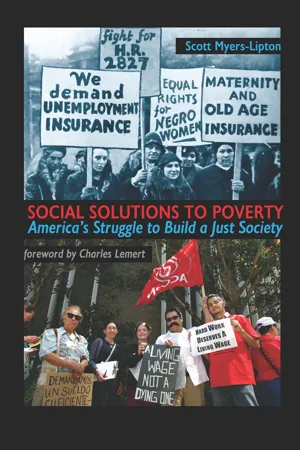 eBook - ePub
Social Solutions to Poverty
America's Struggle to Build a Just Society
- Scott Myers-Lipton, Charles C. Lemert(Authors)
- 2015(Publication Date)
- Routledge(Publisher)
38The New Deal policies had a profound impact on the nation, as they fundamentally changed the relationship between the federal government and its citizens. The federal government had adopted the sociological perspective that one’s destiny is not solely determined by one’s effort, but that social factors beyond one’s control play an important, if not decisive, role. Since these social factors were national in scope, the federal government had a responsibility to intervene and help solve the problem. Of course, this required the government to become deeply involved in the economy and the lives of its citizens, which led to an expansion in the size and scope of the federal government. This also led to an enormous increase in the resources spent on public assistance. For example, in 1913 and 1923, the federal government spent only 1 percent of the budget on public aid; in 1933, it had increased to 7 percent and by 1939, it spent 27 percent.39Yet, with such a transformation, the New Deal was not successful in ending the depression. In 1939, six years into the New Deal, unemployment was still at 17 percent. Although the WPA employed three million people a year, there were another ten million people who needed jobs. The Economic Security Act, as highlighted by the earlier analysis of the Lundeen bill, revealed the deficiencies of the New Deal. Roosevelt’s “cradle to grave” security system had developed into a patchwork of programs that left many people in need without the necessary support. Public assistance was not based on need, but rather was dependent on which state the individual lived in, how long she had lived in that state, how much he had made in his previous job, or a particular characteristic, such as age or race. At the same time, it maintained the belief that there were the deserving and undeserving poor, who warranted different treatment and benefits.40
- Elizabeth Cobbs, Edward Blum, Jon Gjerde, , Elizabeth Cobbs, Edward Blum, Jon Gjerde(Authors)
- 2016(Publication Date)
- Cengage Learning EMEA(Publisher)
Its cardinal aim was not to destroy capitalism but to devolatilize it, and at the same time to distribute its benefits more evenly … . … And ever after, Americans assumed that the federal government had not merely a role, but a major responsibility, in ensuring the health of the economy and the welfare of citizens. That simple but momentous shift in perception was the newest thing in all the New Deal, and the most consequential too. Humankind, of course, does not live by bread alone. Any assessment of what the New Deal did would be incomplete if it rested with an appraisal of New Deal economic policies and failed to acknowledge the remarkable array of social inno-vations nourished by Roosevelt ’ s expansive temperament … . THE DEPRESSION, THE NEW DEAL, AND FRANKLIN D. ROOSEVELT 243 Copyright 2017 Cengage Learning. All Rights Reserved. May not be copied, scanned, or duplicated, in whole or in part. Due to electronic rights, some third party content may be suppressed from the eBook and/or eChapter(s). Editorial review has deemed that any suppressed content does not materially affect the overall learning experience. Cengage Learning reserves the right to remove additional content at any time if subsequent rights restrictions require it. For all his alleged inscrutability, Franklin Roosevelt ’ s social vision was clear enough. “ We are going to make a country, ” he once said to Frances Perkins, “ in which no one is left out. ” In that unadorned sentence Roosevelt spoke volumes about the New Deal ’ s lasting historical meaning. Like his rambling, comfortable, and unpretentious old home on the bluff above the Hudson River, Roosevelt ’ s New Deal was a welcoming mansion of many rooms, a place where millions of his fellow citizens could find at last a measure of the security that the patrician Roosevelts enjoyed as their birthright. eBook - PDF
Bold Relief
Institutional Politics and the Origins of Modern American Social Policy
- Edwin Amenta(Author)
- 2021(Publication Date)
- Princeton University Press(Publisher)
The problem lay mainly in the un-democratic nature of the American political process. Because of that the few were able to thwart the many. Then the moment passed. The Impact of War on New Deal Social Policy Like the Depression, the war had a significant impact on the possibilities of American social policy. Also like the Depression and its decade, however, the war does not provide an adequate explanation of U.S. social policy in the 1940s. To the contrary, social scientists generally argue that major wars do not typically provoke the decline of social policy—the results of the American 1940s —but have a stimulant effect on it. Wars tend to induce states to make commitments to citizens in return for citizens' efforts on be-half of the state. Wars also tend to increase the fiscal capacities of states, making greater social spending possible. In the next chapter, which com-pares American and British policy developments in the 1940s, I argue that neither of these processes is certain or likely to lead to greater social policy. Although I postpone a sustained discussion until then, a few words here are in order. There is no doubt that how the war was run, who was running it, and what happened during wartime worked to the detriment of New Deal social policy. In the United States, the war took attention away from those most in favor of expanded domestic policy. Having spent the Depression con-cerned mainly with domestic issues, the Roosevelt Administration had to put them aside just before and during the war. The administration needed to marshal its political capital to gain control over the prosecution of the war. Moreover, some consequences of the Second World War tended to mitigate in the short run some of the domestic problems New Deal social policy was designed to solve. In America, the war temporarily ended unem-ployment, removing the urgency from the high-profile employment pro-grams of the 1930s. The war was not always working against New Deal reformers, however. eBook - PDF
Party Polarization in America
The War Over Two Social Contracts
- B. Dan Wood, Soren Jordan(Authors)
- 2017(Publication Date)
- Cambridge University Press(Publisher)
As described in Chapters 3 and 4, speculation by the wealthy, banks, and financial institutions was also a major factor in the 1929 stock market crash and Great Depression. The New Deal reforms regulated speculation with other people’s money, making it less likely. Second, some New Deal programs implemented the principles of Keynesian economics to make the economy more stable. The Social Security Act of 1935 and postwar expansions established unemployment and social welfare benefits. Both programs operate as automatic stabilizers on the economy. When the economy is in decline, unemployment and welfare benefits increase, thereby pumping money into the economy. When the economy is robust, unemploy- ment and welfare benefits decline, thereby reducing government expenditures. Thus, unemployment and welfare programs smooth out fluctuations in the business cycle. Finally, the increasing centralization of macroeconomic policymaking since 1946 has been important to stabilizing the economy. Since the Employ- ment Act of 1946, and subsequent Humphrey–Hawkins Act of 1978, the president, Congress, and Federal Reserve System have been responsible for the health of the economy. From Roosevelt through Obama, presidents and Congress have used spending and tax policy to address economic declines. Equally important, the Federal Reserve has become increasingly sophisticated in using monetary policy to smooth the ups and downs of the business cycle. Thus, the U.S. economy is no longer the business-friendly market economy that existed from 1789 through 1932, but is now a centrally managed market economy. 140 The New Deal Social Contract through the 1970s The Expanding Middle Class Greater macroeconomic stability after the New Deal produced an environ- ment in which more citizens could thrive, rather than scramble for the bare necessities of life. For this and other reasons, the postwar period experienced strong growth. eBook - PDF
The Defining Moment
The Great Depression and the American Economy in the Twentieth Century
- Michael D. Bordo, Claudia Goldin, Eugene N. White, Michael D. Bordo, Claudia Goldin, Eugene N. White(Authors)
- 2007(Publication Date)
- University of Chicago Press(Publisher)
The New Deal meant much more than just a move- ment toward centralization of the public sector. It brought with it some fundamental and dramatic changes in the very character of American federal- ism, changes that would leave a permanent imprint on the intergovernmental system. In this paper, we explore the impact of the New Deal on the structure and workings of U.S. fiscal federalism, drawing on an extensive database on inter- governmental fiscal flows. We try to place the New Deal programs in the con- text of earlier intergovernmental structure and to follow their legacy into the second half of the twentieth century. It is our sense that the New Deal irrevoca- bly altered the evolution of American federalism and did this largely through the widespread introduction of a fiscal instrument that had seen only modest use earlier: intergovernmental grants. The introduction of major grant pro- grams in a form that involved close cooperation between federal and state au- thorities marked the end of a period in which different levels of government functioned with a high degree of independence. To make use of the terminol- ogy of the political scientists, we moved from a system of “coordinate” (or “dual”) federalism, in which the various levels of government function in rela- tively independent spheres, to one of “cooperative” federalism, in which there is much more sharing of fiscal functions and greater interplay among levels of government in the management and funding of public programs.’ In this way, the New Deal set American federalism on a new course that has brought in- creasing interaction among levels of government; its legacy is unmistakable. Much of our work has involved the careful assembling of the relevant data on public expenditures, revenues, and intergovernmental financial flows. This, as we shall see, is a tricky business involving some critical issues of definition, timing, and assignment of spending and revenue data. eBook - PDF
The Achievement of American Liberalism
The New Deal and Its Legacies
- William H. Chafe, William Chafe(Authors)
- 2002(Publication Date)
- Columbia University Press(Publisher)
The New Deal launched other programs as well, offering financial assis-tance to imperiled homeowners, farmers, and small businesses. Even taken to-gether, these early relief programs were modest when measured against the gravity of the problems they were trying to address. For the people they helped, they were a godsend. For millions of others, they were simply an al-luring but unattainable promise. These early experiments in providing relief revealed both the extent and the limits of the New Deal commitment to social welfare. Roosevelt and those around him clearly rejected the rigid conservative views of those who considered any aid to the poor dangerous and improper. In 1931, as gover-nor of New York, Roosevelt had challenged that orthodoxy. Government had a clear responsibility, he told the state legislature, “when widespread eco-nomic conditions render large numbers of men and women incapable of supporting either themselves or their families because of circumstances be-yond their control which make it impossible for them to find remunerative labor. To these unfortunate citizens aid must be extended by government— not as a matter of charity but as a matter of social duty.” 4 As president, he continued to reject the conservative argument against social assistance. But Roosevelt, Hopkins, and most of the other critical figures in shaping the New Deal welfare state also feared the debilitating effects of what was still widely known as “the dole.” Harry Hopkins, looking at the effects of the FERA in 1933, said, “I don’t think anybody can go on year after year, month after month accepting relief without affecting his character in some way un-favorably. It is probably going to undermine the independence of hundreds of thousands of families .
- Margaret Weir, Ann Shola Orloff, Theda Skocpol, Margaret Weir, Ann Shola Orloff, Theda Skocpol(Authors)
- 2020(Publication Date)
- Princeton University Press(Publisher)
In the Progressive Era, it proved impossible to unite these interests around new social-spending programs, but during the New Deal, a cross-class coalition was able to form around the Social Security Act. Again today, the feedback from the programs established by the So-cial Security Act has shaped the possibilities for joining interests around alternative futures for social policy. If I have made some sense here of the origins of America's belated wel-fare state, perhaps the insights derived from such an institutional-political process approach will be of use to both academics and those active in today's policy debates. Policy options are always constrained by the leg-acies of existing policy, politics, and administration, and our choices to-day are burdened by our past—not least by the legacies of the initial leg-islation of America's incomplete welfare state, the Social Security Act— and we will do well to understand the limits to our alternatives. Yet the past development of American social policy shows as well that alterna-tives did exist. In the 1980s, we again find ourselves faced with alternative futures for American social provision. I conclude with the hope that these lessons about our past will serve to enhance the possibilities for more generous public social provision in America. Redefining the New Deal: World War II and the Development of Social Provision in the United States EDWIN AMENTA AND THEDA SKOCPOL Accounts of the development of public social provision in the United States often focus on major periods of domestic reform, in particular the New Deal of the 1930s and the Great Society of the 1960s. By compari-son, the period during and immediately after World War II seems incon-sequential. When the wartime period is discussed, students of social pol-icy frequently claim that it consolidated the changes wrought by the New Deal.
Index pages curate the most relevant extracts from our library of academic textbooks. They’ve been created using an in-house natural language model (NLM), each adding context and meaning to key research topics.

