History

Glasnost and Perestroika
Glasnost and Perestroika were policies introduced by Soviet leader Mikhail Gorbachev in the 1980s to reform the political and economic systems of the Soviet Union. Glasnost, meaning "openness," aimed to increase transparency and freedom of expression, while Perestroika, meaning "restructuring," sought to modernize and decentralize the economy. These reforms ultimately contributed to the eventual dissolution of the Soviet Union.
Written by Perlego with AI-assistance
Related key terms
1 of 5
12 Key excerpts on "Glasnost and Perestroika"
 eBook - PDF
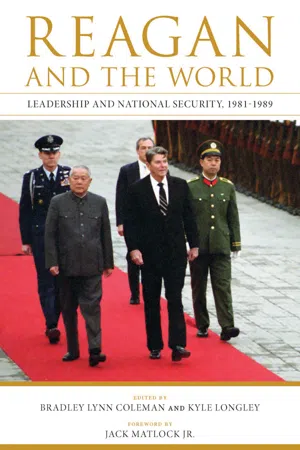
Reagan and the World
Leadership and National Security, 1981–1989
- Bradley Lynn Coleman, Kyle Longley, Bradley Lynn Coleman, Kyle Longley(Authors)
- 2017(Publication Date)
- The University Press of Kentucky(Publisher)
He talked a lot about perestroika, glasnost, all of those things, but he never really changed.” 13 That is just about as misleading a remark about Gorbachev as it is pos-sible to find, for it misses all the essential points. The respects in which Gorbachev did not change were that he remained highly intelligent, flex-ible, and, crucially, open-minded. But precisely because of that flexibility and open-mindedness, he changed his understanding even of those con-cepts he began with and used throughout his general secretaryship. Thus, the Russian word perestroika, which means “reconstruction,” was initially a synonym for reform of the Soviet system, especially economic reform, at a time when the very word reforma was taboo, as it had been from early in the Brezhnev era. But under the umbrella of the rather neutral term per-estroika, Gorbachev radicalized the political agenda, and perestroika came to stand for root-and-branch political reform amounting to a transforma-tion of the political system. Similarly, the Russian term glasnost, meaning “openness” or “trans-parency,” began as advocacy of a somewhat more open dialogue between the Soviet party–state and its citizens, with more information given to the public, and over a very few years it developed into something almost syn-onymous with freedom of speech and publication. By the later 1980s, offi-cial Soviet publishing houses were printing in huge editions literary works that prior to the Gorbachev era would have landed their possessors subject to arrest if a single copy of the book or article, whether in a printed edition published abroad or in samizdat typescript (underground dissident pub-lication), were found in their possession. eBook - PDF
The Soviet Attitude to Political and Social Change in Central America, 1979–90
Case-Studies on Nicaragua, El Salvador and Guatemala
- D. Paszyn(Author)
- 2000(Publication Date)
- Palgrave Macmillan(Publisher)
As Abel Aganbegyan put it: Perestroika and Soviet±Nicaraguan Relations 59 We plan to step up the pace of growth in the economy, but this cannot be separated from the process of democratization and of what we call glasnost, a greater openness in all aspects of govern- ment and social organization. 8 Gorbachev himself described the concept of glasnost in the following terms: Glasnost accentuates an environment allowing citizens to effect- ively participate in discussing all of the country's affairs, in elab- orating and making decisions that affect the interests of all of us and monitoring the implementation of these decisions. 9 Also, Gorbachev made it clear that the process of perestroika was to be carried out within the socialist framework despite the introduction of the market economy. To quote him: I would like to point out once again that we are conducting all our reform in accordance with the socialist choice. 10 The essence of perestroika lies in the fact that it unites socialism with democracy and revives the Leninist concept of socialist con- struction both in theory and in practice. 11 The Soviet leader and his team of reformers increasingly acknowl- edged the viability of market forces as a legitimate means of economic development capable of coexisting with socialism. But the reforms were not meant to turn the Soviet Union into a Western-style free market democracy; they were designed to improve the efficiency, productivity and humanity of the existing one-party system and thereby ensure the viability of the USSR as a superpower in world affairs. Gorbachev's programme of domestic reforms was accompanied by calls for `new thinking' (novoe politicheskoe myshlenie) in the realm of foreign relations. It is to state the obvious that a nation's foreign policy is in large part determined by its domestic and economic potential. Thus, `new thinking' and perestroika were mutually reinforcing. eBook - PDF
Moscow Theatres for Young People: A Cultural History of Ideological Coercion and Artistic Innovation, 1917–2000
A Cultural History of Ideological Coercion and Artistic Innovation, 1917-2000
- Kenneth A. Loparo, Manon van de Water(Authors)
- 2006(Publication Date)
- Palgrave Macmillan(Publisher)
Unlike his predecessors Gorbachev encouraged an examination of the country’s history and its current problems. In his launching of Perestroika (restructuring) and Glasnost (openness) he attempted to solve the country’s domestic and international troubles. He freed Andrei Sakharov in 1986, sending a signal that even prominent dis- senters would not be persecuted for their views. Iurii Liubimov returned from abroad, where he lived and worked since 1983, to the Taganka in 1988. Top meetings were held with U.S. President Ronald Reagan to discuss arms control. Independent organizations, including some polit- ical parties, started to appear in both Russian and non-Russian parts of the country. The party and the legislative system were restructured. At the same time Gorbachev faced ethnic unrest from the republics and the satellite states, a declining economy, and an increase in political opposition. Some thought that Gorbachev reformed too much, too fast; others criticized him for reforming too little, too slowly. As has been discussed in more detail in chapter 1, Gorbachev never completely discarded the potential of Marxist-Leninist ideology and insisted on the guiding role of the Communist Party. However, with the politics of Glasnost and Perestroika he took away both the idealistic and the pragmatic basis for the legitimacy of the regime. The coup in 1991, marked the end of the Gorbachev years, as well as seventy-four years of Soviet Communist reign. All facets of life had been impacted by the rapid ideological shifts and struggle to survive in the plethora of unstable ideological trends and cultural expressions that came to characterize Russia’s transcultural and transideological environment. The theatres for young audiences were, in this respect, no exceptions. Glasnost and Perestroika 89 THEATRE FOR YOUNG PEOPLE ON THE EVE OF PERESTROIKA As indicated in the previous chapters, theatre for young audiences as an institution was inviolable. eBook - PDF
- R. Solomon(Author)
- 1999(Publication Date)
- Palgrave Macmillan(Publisher)
Economic reform was bound to clash with these cherished features of the system. 8.1 Glasnost and Perestroika Mikhail Gorbachev, trained in the law at Moscow State University, spent 20 years as a local politician in Stavropol in southern Russia where he was born. His southern accent was at times the butt of jokes in Moscow, to which he was called in 1978 to be in charge of agriculture for the Communist Party. He was made a full member of the Politburo in 1980. In March 1985, he became the youngest general secretary of the Party in the history of the Soviet Union. He immediately projected a new style of leadership, in sharp contrast to his predecessors. He 110 The Transformation of the World Economy displayed vigour, a smiling countenance, an attractive and stylish wife, and a willingness to mingle with the populace. It is reported that in nominating Gorbachev to be general secretary, Andrei Gromyko said that ‘this man has a nice smile, but he has got iron teeth’. 7 Shortly before he became general secretary, Gorbachev used the term ‘radical reform’ – startling in the Soviet context – to signal his intentions. In addition to economic reform (on which more below), Gorbachev’s early moves included glasnost – greater openness and self-criticism in society, accountability of public officials, and an end to censorship. Glasnost also carried the demythologising of Stalin much further than Khrushchev had ever done. At the Moscow airport in the autumn of 1988, I was startled to see a donation box for the victims of Stalin, into which departing travellers were invited to deposit their left-over roubles. Glasnost also included a shift in attitudes towards the outside world. A ‘world view’ was adopted with respect to ecology and international economic relations. Soviet officials began to admit their interdepend- ence with other countries and to think about joining international economic institutions such as the GATT and the International Monetary Fund and World Bank. eBook - PDF
- Charles E. Ziegler(Author)
- 2009(Publication Date)
- Greenwood(Publisher)
They were experimenting, trying to reshape a moribund system and yet preserve most of the central elements of that system. It was a strategy that could not succeed. PERESTROIKA AND GLASNOST Perestroika, broadly defined as the restructuring of the Soviet economy, was at the heart of Gorbachev’s reform program, as outlined in his book of the same title. Gorbachev, who never abandoned his belief in the inherent superiority of socialism, initially sought to modernize the Soviet economy by correcting some of its more egregious failures while leaving the basic structure intact. For the first two years, Gorbachev stressed the importance of acceler- ating economic performance, improving worker discipline, and attacking al- coholism (which seriously impaired productivity). These measures had been proposed during the brief tenure of Yurii Andropov, who had been a cautious voice for reform and one of Gorbachev’s patrons in the leadership. Such pal- liatives did not get to the root of the problem, however. By mid-1987, it was increasingly apparent that more was needed than simply adjusting the Soviet system of central planning. One very unpopular reform that Gorbachev pursued and then abandoned was his attack on alcohol. Drinking to excess has a long and honored tradition in Russia. By custom, once a bottle of vodka was opened, it was drained. And for most serious Russian drinkers, a liter bottle was barely adequate for one man. Gorbachev’s anti-alcohol campaign consisted of reducing shop hours, destroying vineyards, cutting back on production, and drastically raising prices. Thirsty Russians countered by making homebrew, or samogon—one So- viet official told this author that arrests for bootlegging in Leningrad increased tenfold in just a few months. As in the Stalin campaign, communists were to set an example for the rest of the people. Bottles of mineral water were served at official functions, and Party establishments went dry. eBook - PDF
- S. Fortescue(Author)
- 2010(Publication Date)
- Palgrave Macmillan(Publisher)
127 6 Perestroika as Revolution from Above Archie Brown Perestroika is an ambiguous concept. The term was chosen by Mikhail Gorbachev partly because the word ‘reform’ had been taboo in Soviet ruling circles ever since the ‘Prague Spring’ of 1968, the unfolding of which also put paid to Aleksei Kosygin’s modest attempt to reform the Soviet economy. Gorbachev had used the word perestroika in speeches and writings on a number of occasions even before he became General Secretary of the Central Committee of the Communist Party of the Soviet Union (CPSU) in March 1985. What he meant by it, however, changed over time, especially during the period of less than seven years in which he was Soviet leader. In 1985 he believed that the Soviet system was reformable and ‘perestroika’ was for him essentially a synonym for reform. The imprecision of the word had the initial advantage that almost everyone could be in favour of perestroika because they meant so many different things by it. In retrospect, con- servative Communists felt they had been hoodwinked. Given their political outlook, they should have opposed the reforms of the pere- stroika era more vigorously and earlier than they did. They were kept on board not only by the hierarchical nature of Soviet politics and the power and authority which accrued to the general secretaryship. What also wrongfooted them was Gorbachev’s success in establishing the dividing line in Soviet politics as lying between a pro-perestroika progressive majority and a reactionary anti-perestroika minority. Perestroika was linguistically as well as politically ambiguous. The word means reconstruction, and reconstruction in turn can mean any- thing from restructuring an existing edifice to constructing a building anew from the foundations up. At the beginning of the period in which Gorbachev headed the CPSU, perestroika had for him the first and narrower of these two meanings, notwithstanding the fact that he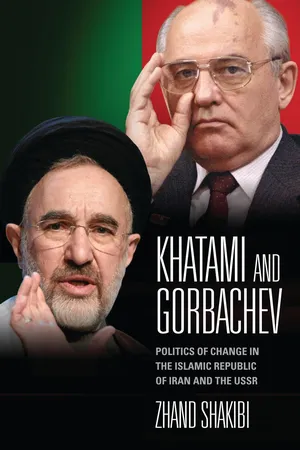 eBook - PDF
Khatami and Gorbachev
Politics of Change in the Islamic Republic of Iran and the USSR
- Zhand Shakibi(Author)
- 2010(Publication Date)
- I.B. Tauris(Publisher)
8 THE POLITICS OF GLASNOST’ Gorbachev, having made the Russian word ‘ glasnost’ world renowned remarked, ‘This old Russian word carries within it many meanings. Thus it is no accident that not one foreign interpreter could fully reflect its essence. But, democratic West caught the basic meaning of glasnost’-a condition and function of freedom.’ 1 One of the vital elements in the politics of change is how Gorbachev and Khatami handled the politics of glasnost’. One issue is the gradual lessening of censorship and restrictions on freedom of speech, the mass media, and publication of books. Gorbachev and Khatami believed such liberalisation was essential for the (re)establishment of a relatively strong link between society and state and incorporation of society to a greater degree than before into the political field. They considered it an essential condition of the return to the original goals of the revolution. Glasnost’ was also an integral part of the practical side of the politics of change. Gorbachev and Khatami understood that through glasnost’ they could strengthen the link between themselves and the people and rally popular support behind the politics of change. Glasnost’ was simultaneously a goal and vital tool of the politics of change. Gorbachev’s and Khatami’s respective approaches to the politics of glasnost’ determined the overall contours of the politics of change and played a determining role in the dynamics leading to the achievement of the non-goals. Thus the judiciousness and effectiveness of these men’s policy and strategy for the politics of glasnost’ needs to be examined. If in the first instance these strategies were flawed, resulting in failure to achieve a significant degree of glasnost’ or in poor management of the press and mass media in the struggle, the chances for the achievement of the non-goals greatly increased. This chapter shows how Gorbachev achieved success in the gradual promotion of eBook - PDF
- Robert V. Daniels(Author)
- 2008(Publication Date)
- Yale University Press(Publisher)
Gorbachev and the Reversal of History B y the end of the s, it had become obvious to all but the most ob-durate skeptics that the reforms initiated in the Soviet Union under the leadership of Mikhail Gorbachev represented no mere tinkering with the Soviet system but an attempt at fundamentally redirect-ing what had manifestly become an obsolete political and economic structure. Whether the effort would succeed against the resistance of conservatives and amid conditions of economic crisis and nationality ferment was another mat-ter, as was the question how and why Gorbachev managed to undertake such a radical reform to begin with. Gorbachev clearly did not conceive his reform program all at once. Cer-tainly its enunciation unfolded only step-by-step, and then in response to events and problems as they emerged. Initially, perestroika was indeed no more than tinkering, though it was based, as Gorbachev himself reported, on con-siderable discussion beforehand with intellectual critics of the old Brezhnev system. 1 For a time it was little more than a restatement of Andropov’s program of discipline, incentives, and the acceleration of economic development within the framework of the old system. Roughly a year after becoming general secretary, Gorbachev seems to have decided on a major new departure, centering on the concept of glasnost. There is plenty of evidence, some from Gorbachev himself, that he was encountering serious resistance in the party apparatus and in the central economic bureau-cracy, opposing even the modest Andropovite reforms he was pursuing up to that time. Ironically, the relaxation of Stalin-type despotism made it harder for a reformist leader to command change from above; the behavior of the bureaucracy in the face of the Chernobyl nuclear disaster only confirmed this fact.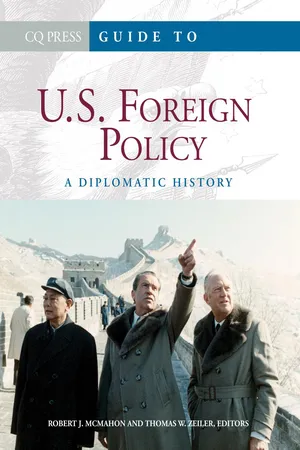 eBook - PDF
Guide to U.S. Foreign Policy
A Diplomatic History
- Robert J. McMahon, Thomas W. Zeiler, Robert J. McMahon, Thomas W. Zeiler(Authors)
- 2012(Publication Date)
- CQ Press(Publisher)
Gorbachev’s assumption of power eventually led to the end of the Cold War, because both perestroika and glasnost had diplomatic implications. He designed both of these governing philosophies, it must be emphasized, to reform and strengthen communism, not to replace it. Just as Vladimir Lenin had temporarily allowed capitalism under his New Economic Program in the 1920s, Gorbachev said that the Soviet Union could borrow from democratic capitalism in the short term in order to fix the mistakes and the deep, structural inadequacies of its Communist system. Communism, in the long run, would prevail. Perestroika and glasnost could therefore be ideologically justified, and Gorbachev, at least for a few years, successfully prevented the Old Guard, who did not want to mend the system, from retaking power. CHANGES IN SOVIET POLICY For these domestic reforms to succeed, Gorbachev had to fundamentally change Soviet foreign policy. Years of providing military aid around the world, particu-larly in Africa and Latin America, propping up the economies of the Communist bloc, and the costs of an enormous standing army at home (the Soviet Union comprised the largest land mass in the world and required that troops be sta-tioned in the Arctic, on the borders of Europe and China, and in the Pacific) and in Eastern Europe had taken their toll. Enormous discrepancies in its balance-of-payments structure had begun to strain the Soviet treasury to the point of near bankruptcy. Gorbachev calculated that if he did not cut defense spending, his c h a p t e r 2 9 Glasnost and Perestroika 435 BUSH AND GORBACHEV CONTINUE THE MOMENTUM George H. W. Bush, Reagan’s vice president, succeeded Reagan and continued to support Gorbachev. In 1989, Gorbachev allowed the “Velvet Revolution” to proceed in Eastern and Central Europe, and every Eastern European state, with the exception of Romania, peacefully replaced communism with democracy. eBook - PDF
Kazakhstan, Kyrgyzstan, and Uzbekistan
Life and Politics during the Soviet Era
- Timur Dadabaev, Hisao Komatsu, Timur Dadabaev, Hisao Komatsu(Authors)
- 2016(Publication Date)
- Palgrave Macmillan(Publisher)
Especially in defense-oriented and high-tech industries, the limits of such a system are obvious, and stagnation in such development comes very fast if the system does not respond properly. We missed this time, at the time of Brezhnev, and this was the time. [Male, 1943, Russian, Andijan, Uzbekistan] As a result, although these respondents held positive views of Gorbachev personally, they viewed the systemic changes that occurred during the per- estroika era negatively: “Gorbachev was also good in his own way. Well, about perestroika, I have heard only after the collapse of the Soviet Union. They said they will rebuild something and offer jobs. But for people, it meant only suffering with many people being laid off (IN, village of Tarsuu, Kyrgyzstan). Gorbachev as a Contradictory Egoist The economic and political reforms championed by Gorbachev that occurred in the Soviet Union were conducted under various slogans. Many of these slogans were ambiguously explained to the public, leaving fertile ground for interpretation. The slogans’ ambiguity and lack of explanation combined with their increasing use in everyday life created more confu- sion, which was later associated with Gorbachev’s style of governance. To start with, the very term “perestroika” meant little to the public, and in many narratives, people still find it difficult to define. It could mean both partial refurbishment and complete reconstruction. Neither meaning was properly conveyed to the public, thus strengthening the image of “empty talk” in a new linguistic coverage. Other terms associated with Gorbachev, such as “acceleration (uskorenie)”, “pluralism (plyuralizm)”, “consensus (konsensus)” and “new type of thinking (novoe myshlenie)”, seem to be taken from his slogans. These words became the subject of a great number of jokes and comedic performances on television talk shows; in most cases, they were not meant to symbolize the entire Soviet or Communist nomen- clature but Gorbachev in particular. eBook - ePub
Russia in the Twentieth Century
The quest for stability
- David R. Marples(Author)
- 2014(Publication Date)
- Routledge(Publisher)
In late December, when the Congress granted Gorbachev enhanced powers, the President nominated Gennady Yanayev as his Vice-President – a strange choice. Only at the second attempt, and after prolonged persuasion from Gorbachev, could Congress be persuaded to accept it. Yanayev was a dull apparatchik with no interest in reforming the Soviet system. Other appointments made by Gorbachev in the same period did not augur well for the future of a reform program and democracy – Boris Pugo as the chief of police, and Kryuchkov as the head of the KGB – while the loss of Shevardnadze and especially of Aleksandr Yakovlev suggested that the President had made a significant about-face. By early 1991, Gorbachev had begun to demand restrictions on freedom of the press. Mass demonstrations in Moscow were banned. The experiment in political change appeared to be over. Gorbachev’s challenge, clearly, was the growing power of the republics, and of Russia in particular. (Plate 8.2) The perils of Perestroika By most calculations, the introduction of Glasnost into Soviet society has to be considered a success, even though the open criticisms of the Gorbachev administration served to lower its credibility and Gorbachev appeared to resent personal attacks on his leadership. Perestroika proved much more difficult. Soviet reports on the economy had never been frank, particularly the reporting of harvests and other economic statistics. The state continued to fix prices for goods and to subsidize struggling firms. There is no doubt that the economy was a key priority for the Soviet leader, but what was the goal of Gorbachev’s proposed economic reforms? Was it even possible to reform the archaic system? If so, how far could Gorbachev go? That there should be some decentralization, concessions to local decision-making, redistribution of profits and the like seems self-evident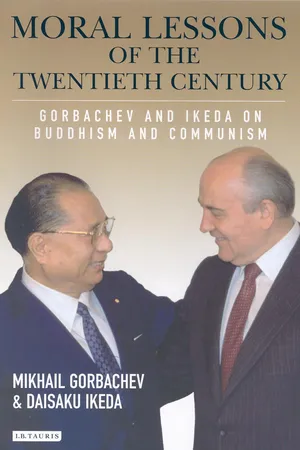 eBook - ePub
Moral Lessons of the Twentieth Century
Gorbachev and Ikeda on Buddhism and Communism
- Mikhail Gorbachev, Daisaku Ikeda(Authors)
- 2005(Publication Date)
- I.B. Tauris(Publisher)
CHAPTER TWOPerestroika and Freedom
Ikeda: In 1990, you told me that the main significance of Perestroika is the freedom it brought. In thinking about how freedom is put to use, you cited an example that recalls a Platonic allegory. The rays of the sun blind a person who suddenly emerges into the light after long confinement in a dark prison or a deep well. Similarly, people who have suddenly received freedom use their newly acquired independence solely to dwell on the past instead of examining the present and thinking about the future.You, of course, sincerely believe in Perestroika, as is shown in a letter written to me by Chingiz Aitmatov. I received this letter, which bears the title “A Parable Related to Gorbachev”, soon after you retired from the presidency.In the Kremlin.That meeting stands out in my mind more than all others. I assume that Gorbachev summoned me with a concrete aim, most probably, as I now think, to discuss the pressing situation in Middle Asia, particularly the national crisis. But, perhaps because of my own unintentional fault, instead of concerning substantial business, our conversation took an entirely different turn. This is why.To understand the heart of what happened, the reader must realize that Perestroika as a process of unprecedented democratic reforms was in full swing. But a subterranean rumble of dissatisfaction and ever-rising criticism was distinctly gathering momentum from the right and the left—from the democrats and the bureaucrats. Everyone had his own arguments and reasons. The national economy was steadily sinking.Certainly Gorbachev’s mind was uneasy at that hour. Although the imprint of inner anxiety lay on his face, he controlled himself as usual. When he smiled cordially, his eyes occasionally flashed with the characteristic Gorbachev sparkle.We were seated across from each other at a desk in one of his Kremlin offices. In a natural fashion, before getting down to the main topic, Gorbachev demonstrated interest in my literary affairs—what was new, what was I working on, could he expect a novel or a short story? Soon? Without realizing it, he touched on a very tender topic. In those days, I had practically no time for literary worry. I decided to tell him all about it.
Index pages curate the most relevant extracts from our library of academic textbooks. They’ve been created using an in-house natural language model (NLM), each adding context and meaning to key research topics.

