History

Brezhnev Era
The Brezhnev Era refers to the period of Soviet history from 1964 to 1982, during which Leonid Brezhnev served as the General Secretary of the Communist Party of the Soviet Union. This era was characterized by a period of political stability, economic stagnation, and the continuation of the Cold War. It also saw the development of détente, a period of improved relations between the Soviet Union and the United States.
Written by Perlego with AI-assistance
Related key terms
1 of 5
11 Key excerpts on "Brezhnev Era"
 eBook - PDF
- E. Bacon, M. Sandle, E. Bacon, M. Sandle(Authors)
- 2002(Publication Date)
- Palgrave Macmillan(Publisher)
The Brezhnev Era was a complex, transitional one: de-Stalinisation and re-Stalinisation, dissent and obedience, creativity and conformity. Any attempt to divide it up into a pre-1968 (essentially reformist) and post-1968 (conservative) system is too simplistic, and yet there is no doubt that the latter years of the Brezhnev leadership were more conservative than the earlier years. A picture of Brezhnev emerges which tends to reinforce the view of his leadership style: cautious, centrist, non- interventionist. Around him, many groups struggled and vied for influence. Such a survey also highlights the paradoxes of this era. As the state grew weaker so it applied more and more coercion. While it grew increasingly 210 Brezhnev Reconsidered intolerant of dissent, it was also becoming more and more heavily depend- ent on the intelligentsia in order to cope with the complexity of governing a complex modern industrial society. To make informed and effective policy decisions required a broader, more flexible, and more specialised intellectual sector than that offered by the official ideology and its guardians. As we consider the periodisation of the Brezhnev years from the view- point of intellectual life, it is apparent that the health of Leonid Ilyich is not the only factor to decide the location of temporal dividing lines. Several other chapters in this volume also offer a periodisation on a thematic basis. In the arena of international affairs, Mike Bowker notes in Chapter 5 that a disillusionment with détente set in during 1973 and 1974, and led to a hardening of Soviet foreign policy after the Central Committee plenum of December 1974.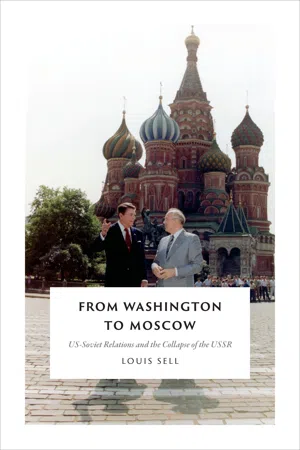 eBook - PDF
From Washington to Moscow
US-Soviet Relations and the Collapse of the USSR
- Louis Sell(Author)
- 2016(Publication Date)
- Duke University Press Books(Publisher)
We remember Brezhnev as a doddering old man, clinging to power past his time. The shuffling gait, slurred speech, and gaffes such as reading the same page of a speech twice became the stuff of jokes and a source of embarrass-ment for many Soviets. Brezhnev’s time became known as the “era of stagna-tion” and in historical perspective the term is well deserved. But in his early years Brezhnev played the rough-and-tumble game of Kremlin politics with sufficient skill to defeat several challenges to his rule. Not an intellectual or an innovator, all his instincts were cautious and conser-vative. Nevertheless, he presided over an era of increasing professionalism and competence in the ruling elite and throughout Soviet society. The first years of Brezhnev’s rule saw relatively high rates of economic growth. The Soviet people experienced the beginnings of a modest consumer society. Individual apartments became more widely available and basic con-sumer appliances could be found to furnish them. Brezhnev brought a sense of stability to Soviet life, a feeling that things were improving and the expecta-tion that they would continue to do so. Brezhnev’s international posture was active and aggressive. Under Brezhnev, the USSR invaded two countries, fought a border conflict with China, threat-ened the invasion of Poland, and together with its Cuban client used military might to install pro-Soviet Marxist-Leninist regimes in several African coun-tries. In Southeast Asia, the Soviets provided Hanoi with massive quantities of weapons used to humiliate the United States. Brezhnev’s military buildup turned Moscow for the first time in history into a truly global power. On the diplomatic front, a series of summit meetings in the 1970s symbolized the achievement of strategic parity with the United States. chapter 2 • Leonid Brezhnev Power and Stagnation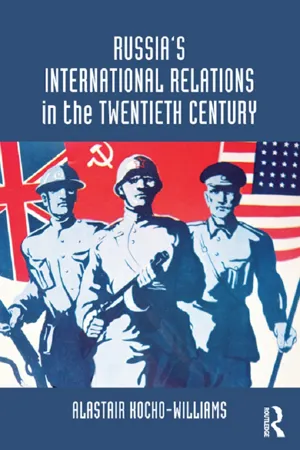
- Alastair Kocho-Williams(Author)
- 2013(Publication Date)
- Routledge(Publisher)
9 The Brezhnev Era With Khrushchev’s departure from office in October 1964, the Soviet Union once again entered into collective leadership under Leonid Brezhnev as General Secretary of the Communist Party of the Soviet Union and Alexei Kosygin as the Premier. In contrast to Khrushchev’s rash gambling, the pair seemed to be much more cautious and, indeed, to embody a more technocratic approach of making the system work. In many ways, the Brezhnev and Kosygin partnership was much more introspective in its early years, not least in reaction to the disasters into which Khrushchev had led the Soviets on the international stage. Brezhnev gradually became the dominant partner and de facto leader of the Soviet Union. As time went on, Brezhnev found that there was still much to be dealt with in terms of foreign policy and in competition with the West. His time in office was marked by an initial reversal of many of Khrushchev’s policy positions and a return to policies that harked back to the Stalin era. Restalinization became a reality under Brezhnev, with repression and control within the Soviet Union and its Eastern European satellites. The economy improved before 1973, but then began to decline and stagnate, not least as a result of heavy expenditure on defence and armaments. Brezhnev’s foreign policy was marked by an initially difficult relationship with China, the United States and the Eastern bloc. While repression was used to deal with an early challenge in 1968 from Czechoslovakia, Brezhnev was able to achieve rapprochement with China and a period of more cordial relations with the United States, known as détente. In the first decade of Brezhnev’s rule his foreign policy appeared to be successful, not least as it was set against the United States’ entrenchment in the quagmire of the Vietnam War. During the 1970s the relationships with the United States and with China seemed to be largely repaired and arms limitation talks began in earnest eBook - ePub
Russia in the Twentieth Century
The quest for stability
- David R. Marples(Author)
- 2014(Publication Date)
- Routledge(Publisher)
By the late 1960s and early 1970s, the indigenous populations in most of the non-Russian republics could be found in positions of authority. In the Baltic republics, particularly Lithuania, Russians had been virtually excluded from the power structure. In Central Asia, the progress had been slower, but already the native populations comprised more than half of the ruling party elite. Was this phenomenon a sign of the success of the Soviet regime or of its failure? The ageing masters of the Kremlin decided the latter. In Belarus, Russians dominated the party leadership; but, in Minsk, Petr Masherov had distanced himself from the corruption and intrigue of the Kremlin. He had remained a more steadfast Communist and moreover one significantly more popular than Brezhnev himself. Masherov’s role was important in keeping alive a Belarusian entity. Belarusians in this period generally had a good standard of living and were free from the political intrigues and high-level official farce in Moscow. At the same time, the Russian language had assumed a position of control over state and urban life. The vast majority of books, journals, and newspapers were published in Russian. Because of the similarity of the Belarusian and Russian languages, and the “invisibility” of the large Russian minority, an acute level of Russian linguistic assimilation took place in the republic, making it much more difficult for subsequent national self-assertion. In Moldavia, the leadership was under firm Russian and Slavic control. One may exaggerate the dilemma that arose before the Politburo by the mid-1970s – the ruling elite itself was Russian (including ten out of twelve members of the Politburo elected in this decade). As the Politburo grew in size, Russian membership was maintained. The authorities also tried to stress the natural friendship and links between the three Slavic nations, their common roots in the Kyivan state of the 10th century, and a common history in which the key aspect was Russian friendship and guidance of the “younger brothers.” Often state propaganda would revert to the war years, to a theme of common actions against a foreign occupant, heroism, and love for the Motherland. In turn, the growing Soviet power in the world was also a common topic. The period had hardly been a successful one for the rival power, the United States, which had suffered badly – particularly in terms of internal protests – during the war in Vietnam. The Brezhnev regime therefore sought to present an image of a state that was united and based on the friendship of its peoples. National distinctions thus were blurred as far as possible. Yet they were never eradicated and would re-emerge during the Gorbachev period as a new and pressing dilemma for the Soviet leadership.Foreign policy under Brezhnev
Introduction
Under Brezhnev, the foreign policy pursued several aims. In Eastern Europe, it faced threats of Communist Party reform and, toward the end of Brezhnev’s leadership, the creation of an independent trade union in Poland. In the developing world, the Soviet Union took advantage of decolonization to spread its influence in India and Afghanistan; in several African countries it established a foothold either directly or by proxy. Relations with China were hostile, and resulted in several military clashes on both sides of the border. At this time China became the main enemy of the Soviet Union. Finally, in the Cold War conflict with the United States, the Soviet leadership was able to reach a position of approximate parity, to promote détente and an official peace campaign. The culmination point was the signing of a SALT-2 Treaty with the United States in Vienna, though the latter did not ratify this, preferring first to ensure that the missile situation in Europe was made more even. By the mid-1970s, the signing of the Helsinki agreement brought a practical end to the Second World War, recognizing the current boundaries, the two German states, and the agreement of the Soviet Union to respect human rights. The period 1964–1982 can be regarded as one of Soviet consolidation and military growth. It saw two Soviet invasions of neighbors – one within Europe and one in the Near East. These were to be justified by the so-called Brezhnev Doctrine, but they revealed that the Communist giant was in essence an imperial regime that would use force to expand its power or to ensure that its satellite states did not try to break the links with Moscow. eBook - ePub
When Ideas Fail
Economic Thought, the Failure of Transition and the Rise of Institutional Instability in Post-Soviet Russia
- Joachim Zweynert(Author)
- 2017(Publication Date)
- Routledge(Publisher)
3The legacy of the Brezhnev period: 1971–1986Why deal with the Brezhnev period?
The Brezhnev years are highly relevant for two reasons for what happened later. First, the reform concepts of the people of the sixties (shestidesiatniki ), which have their roots in this period, provided the background to Gorbachev’s reforms and later to the opposition of a then older generation of economists against Western mainstream economics. In other words, the ideas of one of the two thought collectives in today’s Russian economic science can be directly traced back to this period. Secondly, in order to comprehend the thesis that – not only in ideational terms – the country today is approaching a kind of “neo-zastoi ” (standstill), it is important to be familiar with the ideational foundations of the Soviet order of the 1960s to early 1980s. Both the political ideology of the Brezhnev period, in the centre of which stood the notion of “developed socialism” (see e.g. Evans 1977; Kelley 1977; Sandle 2002) and the development of Soviet economic thought in the 1960s to 1980s are relatively well researched topics (Sutela 1991, 2008; Sutela and Mau 1998), but to my knowledge no systematic research has yet been done into the relationships between economic ideas and the political doctrine behind what has later been labelled the period of zastoi .1It is important to note that the idea of developed socialism and its economic counterpart, the concept of “perfectioning of the economic mechanism”, were by no means inventions of the Soviet politburo. Both had their origin in the context of reformist thinking in Central Eastern Europe, from where they were imported into the Soviet Union. The Soviet versions of the two above-mentioned concepts, as introduced into the official discourse by Leonid Brezhnev in his speech at the 24th Communist Party Congress in 1971, took up key reformist topics (and thus seemingly made concessions to the critics of over-centralisation), yet at the same time decisively tightened the borders within which these topics could be discussed. eBook - ePub
- Mark Lupher(Author)
- 2018(Publication Date)
- Routledge(Publisher)
As the record of his successors confirmed, it was Khrushchevs policies of organizational change, personnel turnover, and power deconcentration that precipitated his downfall. (In my discussion of the Chinese Cultural Revolution and the period of perestroika, I consider the momentous consequences of more wide-ranging and radical assaults on the power monopoly of the communist party.) Understood in this light, Khrushchev’s defeat was an opportunity lost for the Soviet system, when avenues of change, reform, and revitalization were foreclosed that would be reopened only decades later under different and more adverse conditions.Brezhnevian Counterrevolution
The power dynamics of the Brezhnev Era bear scant resemblance to the tumultuous power-restructuring initiatives and organization upheavals of the preceding decade. Two comparisons suffice to underscore the very different trajectory of power and politics under Khrushchev and Brezhnev: The political style of the Brezhnev regime and its internal policies contrast sharply with those of the Khrushchev era.The Brezhnev Era has long been characterized as conservative, with “its antireformist spirit and policies expressed in a galaxy of refurbished conservative catch-phrases, cults, and campaigns—‘stability in cadres,’ ‘law and order,’ ‘the strengthening of organization, discipline, and responsibility in all spheres.’”115 Similarly, analysts have conventionally spoken of Brezhnev’s consensual approach to leadership and his “decisionmaking style[,] which emphasized consensus and a lowest common denominator approach in the Politburo.”116 These characterizations are accurate but do not go nearly far enough. When the power relations and political process of the Brezhnev Era are compared to the patterns in the preceding decades of Soviet power, it becomes evident that an elite counterrevolution occurred under Brezhnev. In contrast to the brutal but effective pressure that the Stalin system brought to bear on the Soviet political elite, pressure that Khrushchev for much of his tenure attempted to bring to bear in new ways, Brezhnev and Brezhnevism manifested an untroubled and complacent ascendancy of officialdom unprecedented in the history of the Soviet Union. Brezhnev was an assiduous consensus builder, who started his working day with several hours of telephone calls to other central and regional party leaders, but his style of political leadership consisted first and foremost of pork barrel politics and the dispensing of patronage, favors, and resources. In Burlatsky’s telling observation, “In general it was not production that Brezhnev preferred to be engaged in, but distribution. This was what Brezhnev-style politics consisted of. Such people are not very competent at deciding important economic, cultural, or political issues, but to make up for it they know exactly whom to appoint and where to appoint him to; whom to reward for services rendered, when and how.”117 Over the course of the Brezhnev years, corrupt politics became increasingly pervasive throughout the Soviet system, and political elites at the central, regional, and local levels, provided they did not directly challenge the rulers at the top, were allowed free rein to build “independent kingdoms” and to enrich themselves, their families, and their followers.118 eBook - ePub
Politics and Justice in Russia: Major Trials of the Post-Stalin Era
Major Trials of the Post-Stalin Era
- Yuri Feofanov, Donald D. Barry(Authors)
- 2019(Publication Date)
- Routledge(Publisher)
Part IIThe Brezhnev Period
Leonid Brezhnev served as leader of the Soviet Union for eighteen years, longer than anyone other than Stalin. The characteristics of his tenure, therefore, cannot easily be summarized in a few words. He came to the general secretaryship of the party as a rather vigorous man, not quite fifty-eight, and he died in office feeble, likely senile, and nearly seventy-six. This dramatic difference has led some analysts to speak of “two Brezhnevs,” the early and the late. As one Russian analyst put it in 1992, “in the mid-’70s Brezhnev the politician was ousted by Brezhnev the sclerotic, gradually slipping into senility.”1Whether one sees the period 1964—82 as being ruled by two Brezhnevs or one, it is certainly true that Brezhnev, throughout his tenure as leader, was much less dynamic than Khrushchev and did not seek to change the Soviet system to anywhere near the extent that either Stalin or Khrushchev changed it. Some speculate that Brezhnev was able to stay in office for so long because a nonentity was welcome after the bloody period of Stalin’s rule and the chaos of Khrushchev. Georgi Arbatov, the longtime director of the USSR Academy of Sciences’ Institute of USA and Canada, is alleged to have said that the reason for Brezhnev’s political longevity was that he was a nobody.2Compared to his predecessors, Brezhnev certainly was a conservative. Under his rule, neither the Stalinist transformations of the late 1920s and early 1930s nor the thaws of the Khrushchev period took place. Nor was Brezhnev inclined to the bloody repressions of Stalin or the harsh treatment that Khrushchev sometimes meted out to colleagues and subordinates.3 eBook - ePub
- Sheila Fitzpatrick(Author)
- 2022(Publication Date)
- Black Inc.(Publisher)
While Brezhnev manoeuvred for primacy among his peers, as Stalin and Khrushchev had done before him, the process was free of bloodletting or even hard landings for those excluded from the inner circle (Brezhnev would usually find them a sinecure lower down the chain, with perks continuing). Despite the minor cult that developed in later years, Brezhnev was basically a much more collegial type than Khrushchev, so that there was a good deal of genuine Politburo collectivity: regular meetings and consultation, no independent ‘harebrained schemes’, collective decisions, and social and family interactions, often arranged by Brezhnev himself. It was a group that had a lot in common. More than half were of working-class or peasant origin and, like Brezhnev, had been sent to higher education under affirmative action programs, usually studying engineering. As young Communist graduates, they benefited from the very rapid promotion available to that cohort in the wake of the Great Purges. Marxism–Leninism was the ideology they had learned in youth, making state ownership of the means of production a given, along with suspicion of the capitalist West. Much of an age, they had gone through the war together, either in senior government and party positions on the home front or, like Brezhnev, serving as political officers in the armed forces.The Brezhnev Era may have been the best of Soviet times or the most boring, depending on your point of view. But nobody has ever said it was the worst of times, and the Soviet leaders had many causes for satisfaction, particularly in the 1970s before the impact of stalling economic growth rates hit home. This was the period in which the Soviet Union first achieved military parity with the United States and competed with it as an equal for influence in the Third World. It had become a major oil producer, and the price of oil on the international market doubled in the second half of the 1970s, much to the Soviet Union’s advantage. The Soviet GNP continued to rise, both absolutely and in relation to other powers, coming the closest it was ever to come to that of the United States in the early 1970s (it was still little more than a third of the US GNP, but in 1946 it had been only a fifth).Two-thirds of the population were living in towns and cities by the 1980s, compared to a third on the eve of the war. There was no worry about unemployment, and housing rents and prices on basic food goods were kept low. Thanks to the apartment building program started under Khrushchev, the proportion of Soviet families living in separate apartments with their own bathrooms almost doubled in a decade. All the indices of consumer welfare rose: if at the beginning of the 1970s, one in every two families had a TV set and one in every three a refrigerator, by the end of the 1980s there was one of each per family. Private cars – frowned on by Khrushchev – were becoming available, if only for the lucky few. Most rural as well as urban children were now getting a secondary education, while the proportion of the population with higher education more than doubled in the Brezhnev period, reaching just under 10 per cent. Since the opening of the Soviet borders to tourism abroad in the mid-1950s, hundreds of thousands of Soviet citizens had had a chance to fall in love with Paris, or at least Prague. Life became easier for all groups of the population, particularly in the towns, not only because material circumstances were improving but also because the regime had abandoned the use of random terror and used even targeted measures of repression sparingly. eBook - PDF
The Limits of Détente
The United States, the Soviet Union, and the Arab-Israeli Conflict, 1969-1973
- Craig Daigle(Author)
- 2012(Publication Date)
- Yale University Press(Publisher)
Under his leadership, the Soviet Union remained a rigidly authoritarian society in which dissidence was stifled, expression remained tightly controlled, and the KGB security police thrived. “Stalin would have his opponents shot,” a Soviet historian observed after Alexander Shelepin, once considered a rival for power to Brezhnev, was dropped from the Politburo. “Khrushchev liked to humiliate them. Brezhnev is more subtle. He just neutralizes them. It takes longer but the effect is the same.” 7 Brezhnev also demonstrated that he was not afraid to use force when necessary. In 1968 , taking a page out of Khrushchev’s playbook, he sent the Red Army into Czechoslovakia to crush the liberalization of the Prague Spring and then lent his name to a doctrine that supported aggression. “When forces that are hostile to socialism try to turn the development of march–october 1973 263 some socialist country towards capitalism, it becomes not only a problem of the country concerned, but a common problem and concern of all socialist countries,” declared Brezhnev, justifying Soviet intervention while stomping on the sovereignty of countries in the Eastern bloc. In 1969 , Soviet troops clashed with Chinese forces along the Ussuri River, raising the prospect of a nuclear war between China and the Soviet Union. And in 1970 , Brezhnev sent more than ten thousand Soviet forces to Egypt, the first time the Kremlin put its own forces in combat jeopardy for the sake of a noncommunist government. At other times, however, Brezhnev appeared as a champion of peace who wanted to avoid war at all costs. Like many Russians of his generation, World War II was the defining experience of his life. Having served as a political commissar in the Red Army, advancing in rank until he became a major general in 1943 , Brezhnev witnessed firsthand the human disaster of war and vowed to never lead the Soviet Union into such destruction. eBook - ePub
- Roger Pethybridge(Author)
- 2021(Publication Date)
- Routledge(Publisher)
CHAPTER VTHE KHRUSHCHEV ERA: DOMESTIC POLICY
In the previous chapter we recorded the critical struggle for power that ensued in Russia after Stalin’s death. It involved much more than the personal fates of the contestants for Stalin’s mantle. Fundamental issues concerning the management of the state, the direction of the economy, and the course of foreign policy were bound up in the gigantic upheaval caused by the removal of a dictator whose word alone had decided all Soviet policies for a period of twenty-five years.Khrushchev was the victor in the fight, which eventually produced another single dictator after a short experiment in collective leadership. But by the time of the Twentieth Congress in February 1956 a fresh breeze had blown into many areas of political thought and action, spreading out from the central whirlwind generated by the rivalry in the Presidium. Makeshift changes had occurred in the direction of industry and agriculture; Stalinist foreign policy had been questioned and on some points rejected; and the party apparatus had been stimulated from its previous torpor in order to serve Khrushchev on his way to the top of the political ladder. The Stalinist inheritance was slowly being rejected.Until the years 1956–7 the traditional political climate was allowed to crumble slowly without any attempt being made to replace it with positive, long-term aims. The leaders in the Presidium could not agree with each other on policy, and no one man was powerful enough to forge a new vision for the Soviet state. Between 1953 and 1956 it was a case of every man for himself—there was no time or opportunity for a systematic revision of Stalin’s Russia.The first sign of a more thoughtful, rational approach to the huge problem of releasing the Soviet Union from the weight of Stalin’s influence was apparent at the Twentieth Congress. The only man in a strong enough position to take such an initiative at that time was Khrushchev. His famous secret speech to the awestruck congress on Stalin’s crimes and errors was a turning point in the progress of the Soviet state. His enunciation of the theory of peaceful coexistence at this time had a similar effect in the sphere of foreign policy, clarifying and appraising the uncertain moves that had been made since Stalin’s death and setting out a blueprint for future action. eBook - PDF
The Crisis of the German Left
The PDS, Stalinism and the Global Economy
- Peter Thompson(Author)
- 2005(Publication Date)
- Berghahn Books(Publisher)
The reification of ideology into anti-communism in the West and Marxist-Leninist catechisms in the East killed off mass politi-cal debate. On both sides of the Wall, real politics became a minority, élitist pursuit with only brief periods when there was limited participa-tion by the working class in political unrest. On the whole the policy of integration had successfully removed the threat of widespread unrest and the traditional working class gradually disappeared from the political scene. This was not only due to the structural changes in employment but is primarily linked to the demotivating experience of Stalinism and social democracy. The true content of the Brezhnev doctrine lay in the attempt to create a pact which could use force to prevent a repetition of 1956. This was accompanied by a Brezhnev contract, which, in return for polit-ical quiescence, guaranteed minimum standards of living. After 1968 this doctrine meant that ‘reform communism’ and the whole of Eastern Europe was ‘Brezhnevised’. This was achieved at the cost of further polit-ical alienation between the party and the masses; an even greater reform deficit than in the Soviet Union and, above all, an even more acute economic crisis (as a result of the smaller nature of the national economies compared with that of the USSR) and a much greater degree of dependence on the West. This process was maintained for some fifteen years until Gorbachov was made General Secretary of the CPSU and intro-duced not only quantitatively but also qualitatively different reforms. Long Cold War and Short Political Century – 47 – This was possible because after the slump of 1929 the world embarked on a long upward turn in economic prosperity which lasted well into the late 1960s. Despite all the short-term crises and booms and slumps, the overall picture was one of growing prosperity in the advanced world, both East and West.
Index pages curate the most relevant extracts from our library of academic textbooks. They’ve been created using an in-house natural language model (NLM), each adding context and meaning to key research topics.

