History

Khrushchev
Khrushchev was a prominent Soviet leader who served as the First Secretary of the Communist Party of the Soviet Union from 1953 to 1964. He is known for his efforts to reform the Soviet Union's political and economic systems, as well as for his role in the Cuban Missile Crisis. Khrushchev's leadership marked a significant period of change and tension in the Cold War era.
Written by Perlego with AI-assistance
Related key terms
1 of 5
12 Key excerpts on "Khrushchev"
 eBook - ePub
- Peter Waldron(Author)
- 2018(Publication Date)
- Routledge(Publisher)
In the final analysis, Khrushchev's heritage stood as both a valuable and dangerous tool for the most recent generation of Soviet reformers. In the struggle for power, proponents of perestroika had to distance themselves from the failures of the Khrushchev years to prevent their political rivals from gaining an additional weapon against the reform process. At the same time, advocates of change needed to elevate the bold reformist vision of the Khrushchev era in order to resuscitate the national government. As the Soviet leader when the Gorbachev generation came of age during the years of the Twentieth and Twenty-second Party Congresses, Khrushchev served as a vital catalyst in the political maturation of a new epoch. It is this historical legacy of anti-Stalinist reform that established Khrushchev's significance for the latest wave of Soviet scholars and demonstrated yet again that the contest over historical memory is also a contest over current political power and policy.The author thanks Drs. Donald Raleigh and Lloyd Kramer for their prompt readings of the initial stages of this paper. An earlier version of this article was presented at the Southern Conference on Slavic Studies at Savannah, Georgia, on 22 March 1991,1 Mikhail S. Gorbachev, Oktiabr' i perestroika: Revoliutsiia prodolzhaetsia (Moscow: Folitizdat, 1987), 27-28. Other speeches, such as Aleksandr Iakoviev's of 17 April 1987, were also vital in broadening the scope of historical analysis in the Soviet Union. See Donald J. Raleigh, "Introduction," in Soviet Historians and Perestroika: The First Phase, ed. Donald J. Raleigh (Armonk, NY: M. E. Sharpe, Inc., 1989), xv.2 Some Western scholars even argued that Soviet historical revisionism played a key role in Gorbachev's political strategy. For example, see Thomas Sherlock, "Politics and History under Gorbachev," Problems of Communism 37 (May-August 1988): 16-42.3 The debate took place in a variety of forums ranging from scholarly articles in academic or literary journals such as Voprosy istorii, Novaia i noveishaia istoriia, Oktiabr', and Novyi mir to book-length memoirs that detailed several aspects of the Khrushchev era.4 Needless to say, this was largely a debate among intellectuals. Blue-collar opinion of Khrushchev, particularly in industrial cities such as Magnitogorsk, where Stalin retains popularity, is another matter. See Stephen Kotkin, Steeltown, USSR: Glasnosl', Destalinization, and Perestroika in the Provinces (Berkeley: University of California Press, 1989), 42-50.5 Of course, Gorbachev relented soon after the coup attempt of August 1991. See Serge Schmemann, "Gorbachev Quits as Party Head; Ends Communism's 74-Year Reign: Cabinet Disbanded: In Deal With Yeltsin, Committee is Created to Govern Nation," New York Times, eBook - ePub
Motherland
Russia in the Twentieth Century
- David R. Marples(Author)
- 2014(Publication Date)
- Routledge(Publisher)
His style of leadership was markedly different from that of his predecessor. He was constantly on the move, touring the country and making speeches. He also made appearances at party congresses in Poland and Czechoslovakia. His friends were promoted to eminent positions. They included the first woman to be prominent in the political leadership (and eventually in the Presidium), Ekaterina Furtseva, who was put in charge of the Moscow party organization; Ivan Serov, who took over the KGB; and Frol Kozlov, who was placed in control of the Leningrad party apparatus. Premier Bulganin was also loyal to his new master. Khrushchev did not hesitate to expand his areas of influence, particularly in foreign policy. From the first, he frustrated the grim Molotov by delving into foreign affairs. In December 1954, Khrushchev and Bulganin went to China on a trip that was a publicity triumph, but one from which Molotov was, inexplicably, excluded. More and more frequently party decrees would be passed on Khrushchev's signature alone, which led to many members of the Presidium being unaware of some events of major importance. Khrushchev's impulsive character would also lead to several dangerous moments for the country.Younger than the Stalin generation by some 15 years, Khrushchev seems to have revelled in his newfound power. Perhaps more than any Soviet leader, Khrushchev was an ideological Communist. He tried to combine the Stalinist concept of the Motherland, and more specifically Great Russia, with party authority and party infallibility, creating in citizens an image of the triumphs of the Soviet state specifically. In doing so he deliberately competed with the main adversary, the United States, at every opportunity. Whereas Stalin worked quietly and deviously to undermine the capitalist giant, Khrushchev expressed the world conflict openly, being both disparaging and dismissive about the rival power. He was frequently intoxicated in public, a liberty that Stalin would never have allowed himself, thus appearing almost comical. There are probably more Soviet jokes about Khrushchev than any of the other leaders. He is remembered for anti-American phrases such as "We will bury you!" and for his boasts and bluster when it was plain that the USSR was not in the superior position that it claimed to be. Because of this attitude, Khrushchev's brief time in power assumed much more importance than was warranted by this stocky figure. It was a time of extremes, of experiments, of early successes but very fundamental failures. Khrushchev was the first Soviet leader to take over a global power, and he very much wanted to rule in his own stead, without the personality cults, but with most other facets of the leadership, including personal decision-making, intact.Khrushchev's Virgin Lands Program
Under Khrushchev, a reform movement was initiated in agriculture almost immediately. At the September 1953 Plenum of the Central Committee, various authorities in the USSR discussed the question of increasing grain production. By January 1954, the CC CPSU had issued a memorandum entitled "Ways to resolve the grain problem," which was circulated among local party organizations. The goal was to cultivate the so-called Virgin Lands, remote regions of the country that could be devoted to grain production, and which would add around 13 million hectares to the sown area by 1955. Khrushchev devised the plan and he was very much associated with its success and failure. The locations for the program were Kazakhstan, the Volga region, Siberia, the Urals, and the North Caucasus. By 1954, the party was asking for volunteers - primarily through the Komsomol - to travel to the Virgin Lands to take part in the new program. Many of Khrushchev's colleagues had reservations about the plan, which contained typical elements of any Khrushchev scheme - great enthusiasm, the desire for an immediate return on investment, a radical transformation of Soviet agricultural practices, and a general lack of foresight about the likely results. Essentially it took the form of a youth movement to the countryside. In theory priority was to be given to those volunteers with agricultural or technical skills. They travelled on special trains, while equipment and building materials were quickly transported to the east of the country. eBook - ePub
- Roger Pethybridge(Author)
- 2021(Publication Date)
- Routledge(Publisher)
CHAPTER VTHE Khrushchev ERA: DOMESTIC POLICY
In the previous chapter we recorded the critical struggle for power that ensued in Russia after Stalin’s death. It involved much more than the personal fates of the contestants for Stalin’s mantle. Fundamental issues concerning the management of the state, the direction of the economy, and the course of foreign policy were bound up in the gigantic upheaval caused by the removal of a dictator whose word alone had decided all Soviet policies for a period of twenty-five years.Khrushchev was the victor in the fight, which eventually produced another single dictator after a short experiment in collective leadership. But by the time of the Twentieth Congress in February 1956 a fresh breeze had blown into many areas of political thought and action, spreading out from the central whirlwind generated by the rivalry in the Presidium. Makeshift changes had occurred in the direction of industry and agriculture; Stalinist foreign policy had been questioned and on some points rejected; and the party apparatus had been stimulated from its previous torpor in order to serve Khrushchev on his way to the top of the political ladder. The Stalinist inheritance was slowly being rejected.Until the years 1956–7 the traditional political climate was allowed to crumble slowly without any attempt being made to replace it with positive, long-term aims. The leaders in the Presidium could not agree with each other on policy, and no one man was powerful enough to forge a new vision for the Soviet state. Between 1953 and 1956 it was a case of every man for himself—there was no time or opportunity for a systematic revision of Stalin’s Russia.The first sign of a more thoughtful, rational approach to the huge problem of releasing the Soviet Union from the weight of Stalin’s influence was apparent at the Twentieth Congress. The only man in a strong enough position to take such an initiative at that time was Khrushchev. His famous secret speech to the awestruck congress on Stalin’s crimes and errors was a turning point in the progress of the Soviet state. His enunciation of the theory of peaceful coexistence at this time had a similar effect in the sphere of foreign policy, clarifying and appraising the uncertain moves that had been made since Stalin’s death and setting out a blueprint for future action. eBook - ePub
The Rise and Fall of the The Soviet Economy
An Economic History of the USSR 1945 - 1991
- Philip Hanson(Author)
- 2014(Publication Date)
- Routledge(Publisher)
In eschewing economic reforms, however, Khrushchev did the right thing. Subsequent attempts at reform within the confines of a centrally planned, socialist economy only made things worse (Kontorovich 1988 on the 1965 reforms; Hanson 1992 on Gorbachev’s reforms; Tompson 2000 on judgements on Khrushchev in this light). What Khrushchev’s period in office showed was how effective changes in policy could be, in the absence of changes in system. That this is in general likely to be the case was well argued by Antoni Chawluk (1974). Khrushchev’s years in power illustrate it rather well.What this period also showed, however, was that policy changes, too, have their limitations. Developed countries exhibit remarkably stable trend rates of growth (about 2.25 per cent per annum for the UK in the twentieth century) that seem impervious to policy changes. In any case, Khrushchev’s policy-making was a mixed bag. His changes in priorities were, broadly speaking, beneficial to Soviet citizens. At the same time, his launching of campaigns for particular choices of technology (more maize, more silage, the ploughing up of the Virgin Lands, chemicalisation) were often mistaken from the start or overdone or productive of damaging side-effects – or sometimes all three.Still, Khrushchev made a difference. For Soviet people that difference was beneficial: he shifted resources away from the Stalinist priorities of the military and of investment for the sake of investment – what Peter Wiles (1962) called the ‘solipsistic enclave’ of machine tools to produce machine tools to produce machine tools ad infinitum . He also made plenty of mistakes, both economic and political, and these brought him down. But his successors, however grey and repressive their regimes, never reverted to fullblown Stalinist priorities or methods of rule.Policy-making and power
Khrushchev, like other Soviet leaders, took time to get a grip on power. When Stalin died in March 1953, the most likely successor seemed to be either Georgiy Malenkov or Lavrentii Beria. Malenkov, once Stalin’s private secretary and latterly expected by many to be his successor, initially inherited Stalin’s posts as party leader (party first secretary) and head of government (prime minister), but in the reshuffle in September Khrushchev acquired the post of party first secretary. Beria had the secret police. In June 1953 the other leaders ganged up on Beria and arrested him. He was executed in December. From June 1953 to January 1955 Malenkov continued as head of government, but Khrushchev and the party apparatus gradually gained the upper hand. Then Malenkov resigned as Prime Minister, leaving Khrushchev apparently the strongest individual in what many still saw as a collective leadership. From mid-1957, Khrushchev is generally agreed to have been in sole command (Crankshaw 1959, pp. 43–8; Zubkova 2000, pp. 67–8).
- S. Casey, J. Wright, S. Casey, J. Wright(Authors)
- 2011(Publication Date)
- Palgrave Macmillan(Publisher)
Like Stalin, Khrushchev was enthused by technology. Moreover, as leader of the Soviet party and state, he rapidly grasped the new pos- sibilities offered by a combination of rocket and nuclear technologies. Whereas after his assumption of power he had still favoured enormous 281 282 Nikita Khrushchev long-distance bombers and airfields in the Arctic to overcome the geo- graphical distance to the United States, the designer Sergey P. Korolev provided him in the intercontinental missile with a weapon which met his boldest dreams. Now it was possible to project unprecedented mil- itary power over almost unlimited distances. As a result, Khrushchev believed it would be possible to achieve specific political demands from the West and its leading power, the United States, by using the threat of military force. As the Suez Crisis had already showed, and later the Berlin and Cuban missile crises, Soviet foreign policy had changed crucially from that of Stalin. Military threats towards the West became an important link between military potential and foreign policy goals and thereby the dominant characteristic of the new Kremlin leader’s foreign policy. That Khrushchev’s views were shaped less by the trenches of the Second World War than by the technical discoveries of the twentieth century, and that he saw himself as the first Soviet player on the global stage, is also clear from the way in which he allowed the Soviet Union to become active for the first time on almost all the world’s continents. He constantly sought new partners in Asia, Africa and America, as sup- porters in the ideological contest with capitalism, so as to reach his main goal – to demonstrate the superiority of socialism throughout the world and in all areas of society, the economy, technology, sport and culture. However, with this policy Khrushchev overstretched the limits of the Soviet Union’s capacity to act. eBook - PDF
Re-Viewing the Cold War
Domestic Factors and Foreign Policy in the East-West Confrontation
- Patrick M. Morgan, Keith Nelson(Authors)
- 2000(Publication Date)
- Praeger(Publisher)
44 With the formation of the Warsaw Pact, Khrushchev signaled that he was intent on and capable of solidifying the bonds of the Socialist bloc. With the Summit, Khrushchev demonstrated that Moscow could induce negotiations and deal with the West on equal footing. Not surprisingly, Pravda applauded Khrush- chev's model of foreign policy. 45 Meanwhile, Khrushchev and Bulganin conducted an extensive tour of India, Indonesia, Burma, and Afghanistan, and openly challenged the West to an eco- nomic competition in such areas. 46 This reflected their conviction that the world was divided along ideological lines in which newly independent countries and revolutionary "progressive" forces were natural allies. In other words, Khrushchev was implementing his own approach while further discrediting those of the other political contenders. By the end of 1955 Khrushchev had consolidated his author- ity in foreign policy and assured the primacy of the Party's ideological authority. 47 Khrushchev's famous denunciation of Stalin at the 20th Party Congress also contributed to the evolution of his foreign policy and the introduction of missile diplomacy. By condemning the Stalinist slaughter of loyal Party members, he im- plicated Malenkov and Molotov, both of whom were closely linked to Stalin. 48 In the process, Khrushchev officially proclaimed three innovations: First, war be- 106 Re-Viewing the Cold War tween the capitalist and communist camps was not inevitable; second, peaceful co- existence was to be the main line of Soviet foreign policy; third, the transition to socialism could proceed by means other than violent revolution. He also secured his position among the orthodox elements by arguing that the victory of world so- cialism remained certain, although it would not require violent revolt. eBook - ePub
- Mark Lupher(Author)
- 2018(Publication Date)
- Routledge(Publisher)
85 What were these gradual developments?Western commentators have conventionally linked Khrushchev’s ouster to his impetuous and confrontational political style; to his extravagant claims and initiatives, and subsequent defeats and humiliations, on the domestic economic front and in the international arena; and to his penchant for organizational “tinkering” and personnel shake-ups.86 I suggest that Khrushchev and the political events of the Khrushchev era should be viewed in comparative and historical perspective and that his transformation from champion of the party organization into its taskmaster and his subsequent fall be understood in light of power restructuring. In the closing years of the Khrushchev era, the struggle between the central ruler and the elite resurfaced, and processes of bureaucratic encrustation and official power and resource appropriation collided with processes of personal rulership and power deconcentration set in motion from the top. Although partially reminiscent of Stalinism, Khrushchevian power restructuring was distinctly post-Stalinist.The mounting tension between Khrushchev and the party organization at the regional and local levels especially burst into the open at the end of 1960 with the Riazan oblast scandal. Amid the campaign fervor of the late 1950s and under pressure from above for impressive results, the Riazan party organization managed to double and then quadruple regional meat production in 1959. The oblast was initially held up for national acclaim and emulation, but it soon became evident that a deception had been perpetrated and that the regional and local party organizations were rife with corruption, falsification, and malfeasance.87 In Yanov’s view, the Riazan scandal “became the symbol of the corruption of the Soviet prefects and signalled the beginning of what I call the ‘Soviet Watergate’—i.e., a general purge of corrupt party professionals.”88 The scandal made it clear, moreover, that power decentralization had simply reinforced the capacity of regional and local authorities to evade and distort central policy without producing any offsetting improvement in economic performance.89 From early 1961 until Khrushchev’s removal from power in October 1964, he increased the political pressure on Soviet officialdom in ways both familiar and unprecedented.90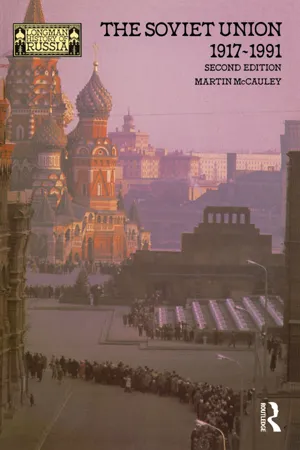 eBook - ePub
- Martin Mccauley(Author)
- 2014(Publication Date)
- Routledge(Publisher)
CHAPTER SIXThe Khrushchev Era
‘THIS GENERATION WILL LIVE UNDER COMMUNISM’
INTERNAL POLITICS
Like Stalin in the early 1920s, Khrushchev was not seen as the eventual leader in 1953 and 1954. However, like Stalin he climbed to power on the back of the party and proved himself a master of political infighting. In the early years his political opponents underestimated him and again in 1957 but he in turn, as if he had learnt nothing from his victories, was to underestimate the force of opposition in 1964. A dedicated Stalinist in the 1930s, and this meant spilling blood, he ascended to the CC in 1934 but the war changed him. He mellowed and a genuine concern about the human cost of the modernisation of the Soviet Union developed in him. Khrushchev had his ups and downs in the Ukraine and Moscow during Stalin's last years but he was not under a cloud, unlike Beria, Molotov, Mikoyan and others when Stalin died.There were two realms in which Khrushchev was convinced that he was first class: party work and agriculture. Although Prime Minister of the Ukraine and after 1958 Prime Minister of the USSR he was not really an administrator. His forte was the spoken word and his ability to communicate with others. Since he eschewed mass terror as a motivator he exhorted, cajoled and tried to persuade orally. He was dynamic and innovative and wished to make others the same. He was fortunate in that neither of his two main competitors for supreme office was in the party secretariat after 14 March 1953. Again neither was an agricultural specialist nor keen to become involved in the rural sector, an Irish bog for aspiring politicians, in 1953.Such was the nervousness of the party and of Malenkov, the USSR Prime Minister, about the ambitions of Beria, head of the Ministry of Internal Affairs and of the security police, that a tactical union led to the arrest of Beria in June 1953. Now the way was clear for a straight contest between Malenkov, head of the government, and Khrushchev, head of the party, as of September 1953. eBook - ePub
- David J. Dallin(Author)
- 2022(Publication Date)
- Routledge(Publisher)
PART FIVE Khrushchev in Command Passage contains an image
Chapter 1 The Year of Troubles
1. Heavy Going
November, 1956, marked the beginning of a year of trouble for Soviet foreign policy. The twelve-month period between the 1956 and 1957 anniversaries of the Soviet revolution began with a dangerous decline in Soviet prestige, which continued until developments permitted Nikita Khrushchev to grasp the reins more tightly and resume his drive.The first stage was a period of weakness that was only slightly concealed behind words and gestures. The power of a dynamic government depends not only on its weapons, the size of its army and navy, and its programs and goals, but also on the solidarity, single-mindedness, and self-confidence of its highest leaders. It was precisely the latter that Moscow lacked at that time.The developments in Hungary had a disturbing effect also on Soviet internal affairs. There were political protests among students in Moscow; in an effort to discover the source of these protests, Khrushchev spent several days at Moscow University. In Leningrad students organized a street demonstration. Hungarian students in Moscow spoke defiantly at Komsomol meetings.1 Trying to maintain his non-terroristic course, Khrushchev refrained from taking measures which a few years earlier would have put a rapid and tragic end to the mutiny; the fact, however, that the most sensitive segment of the nation—the Soviet youth, among them the sons and daughters of the elite—was protesting and making demands was a disturbing development.1 See, among other sources, Hearing before the Subcommittee to Investigate the Administration of the Internal Security Act and Other Internal Security Laws of the Committee of the Judiciary, United States Senate, Eighty-sixth Congress, First Session. Testimony of Alexander Yurievich Kasnakheyev (in our text given as Kaznacheev) (hereafter referred to as Kaznacheev Testimony), eBook - ePub
- Robert Wesson(Author)
- 1978(Publication Date)
- Hoover Institution Press(Publisher)
thereby endangered not only the sacred value of the Soviet system, party supremacy, but his own position as well. To be sure, he was not consistent in this course; several times he turned around to praise Stalin, tighten controls on the arts, and so on. Yet on the whole, Khrushchev did much more than any other person to lead the Soviet Union away from Stalinism.*Although according to Khrushchev, Stalin said that Malenkov knew nothing about agriculture. Khrushchev, Khrushchev Remembers, p. 236.There have been as many attempts to clarify this policy as there are treatments of the period, but none is entirely convincing. One of the two basic contradictory interpretations is that Khrushchev was a liberal at heart who was checked by the dogmatists in the party and had to attack from political necessity.29 The opposite view is that Khrushchev had basically a dictatorial temperament, as his previous career indicated, and that his concessions to liberalism were simply a political tactic that was necessitated by the mood of the country.30 After all, Stalin was a moderate in 1925. It may well be said that Khrushchev was a bully, but also a revolutionary idealist, perceptive but ignorant, a humanitarian gangster.Once he had his hands on the helm, Khrushchev steered in the same general direction as Malenkov—toward liberalization, the loosening and humanizing of the regime—a program the party accepted more cheerfully when it was carried out under party auspices. There was a new emphasis on collective leadership as the Leninist way. Khrushchev and Bulganin seemed to form a well-functioning tandem, with one leader primarily responsible for agriculture and the other for industry, although Khrushchev was plainly in the driver's seat—the press occasionally referred to him realistically but without legal basis as the "head" of the Presidium. It was a token of the more cheerful era that the annual Lenin celebration was shifted from the anniversary of his death, January 21, to his birthday, April 22. Lenin's Testament, with its damaging remarks on Stalin, was published in Kommunist eBook - ePub
Russia in the Twentieth Century
The quest for stability
- David R. Marples(Author)
- 2014(Publication Date)
- Routledge(Publisher)
Sovnarkhoz were to be reversed, and the economy would be run by a Supreme Economic Council, under the chairmanship of Dmitry F. Ustinov, who had been appointed Minister of Armed Forces in 1946 and subsequently, after a merger of this ministry with aviation, the Minister of Defense in March 1953. The Supreme Economic Council supervised the National Economic Council, the National Building Association, and the State Planning Committee. Khrushchev now wished to strengthen party control over the economy and to end his experiment with the regions.The 22nd Party Congress is also remembered for Khrushchev’s definitive split with Stalin. Many of the measures initiated at the 20th Party Congress were now completed. Stalin’s victims were said to be in the millions, and Khrushchev acknowledged that the Soviet leader had signed the death warrants for thousands. Stalin could therefore no longer fittingly remain in the Mausoleum beside Lenin; his body was removed and buried in the Kremlin wall, in a rather prominent place, since his bust is clearly visible from the entrance to Lenin’s Tomb. Portraits of Stalin were taken down, and towns and villages bearing his name had to be renamed. Most poignant was the decision to rename Stalingrad – site of the most famous of all Soviet military victories – Volgograd. In Georgia, however, Stalin’s name remained sacrosanct. Why did Khrushchev return to his anti-Stalin campaign? The most logical explanation is that he needed a diversion from his agricultural and international failures; with regard to the latter, the final break with Stalin was also a direct affront to China. Khrushchev’s relations with Mao had deteriorated badly, but China had adhered to Stalinism and the memory of the USSR’s wartime leader. This time, the reaction to Khrushchev’s policies was more muted. eBook - PDF
Soviet Marxism-Leninism
The Decline of an Ideology
- Alfred B. Evans(Author)
- 1993(Publication Date)
- Praeger(Publisher)
Also, the Soviet Union had found itself in a perilous international setting in the 1930s, encircled completely by capitalist powers and facing the growing danger of a new world war. Inside the country there had not been time to consolidate socialist social changes or to create an advanced economic base. 49 Ideological author- ities of the Khrushchev period asserted that only when Soviet society had entered the period of full-scale construction of communism had the Soviet state become a state of the entire people. The concept of the state of the entire people carried a number of distinc- tive connotations in Soviet works of the late Khrushchev years, including the notion of the widening of the social base of the state. As we have seen, Khrushchev argued not only that the former exploiting classes had been eliminated but also that a consensus of attitudes and values had been achieved in Soviet society. In Khrushchev's view, no major groups within the society were hostile to the existence of the regime. After several decades of socialist construction, and with the consolidation of the collective farm system and party control in the countryside, a bond had been forged between the state and the people. "Every worker, every peasant, every member of the intelli- gentsia can say, 'we are the state, its policy is our policy, and the task of developing and strengthening it and of defending it against any and all en- 94 Soviet Marxism-Leninism: The Decline of an I croachment is our common task.'" 50 Khrushchev advanced the claim that the base of support for the state had broadened to include all classes and groups in Soviet society. Interpreters of the concept of the state of the entire people contended that, as the socialist consensus was strengthened and the state became more secure, the necessity for the exercise of compulsion over the population di- minished.
Index pages curate the most relevant extracts from our library of academic textbooks. They’ve been created using an in-house natural language model (NLM), each adding context and meaning to key research topics.

