History

Henry Kissinger
Henry Kissinger is a prominent American diplomat and political scientist known for his influential role as National Security Advisor and Secretary of State under Presidents Richard Nixon and Gerald Ford. He played a key role in shaping U.S. foreign policy during the Cold War era, particularly in relation to the Vietnam War and the opening of diplomatic relations with China.
Written by Perlego with AI-assistance
Related key terms
1 of 5
10 Key excerpts on "Henry Kissinger"
- Klaus Larres(Author)
- 2013(Publication Date)
- Routledge(Publisher)
The scholar statesman: Henry Kissinger Dieter Dettke Georgetown University, Washington, DC, USAStatesmen become statesmen as much by the power of their office and the force of their personality and vision as by the circumstances and conditions of their time. Rarely does history allow men to join the rank of statesman from a position of derivative power. Metternich, Castlereagh, Bismarck and Disraeli, the great statesmen of the nineteenth century, whose policies Henry Kissinger had studied and admired so much, were able to act on their own visions and perceptions of the raison d'état from positions of great authority without major domestic concerns. They were less restricted by their respective domestic environment and public opinion at home and abroad than statesmen of the first and the second half of the twentieth century. When Kissinger arrived in the corridors of power in Washington in the late 1960s, American foreign policy was in a profound crisis over Vietnam. Initially very little attention was paid to the country's policies towards Europe and Washington's relations with its transatlantic allies. After all, the global power configuration had begun to shift to the disadvantage of the United States. The more US military forces appeared to be bogged down in Indochina, the more American global preeminence was challenged politically as well as economically. Mutual vulnerability became the defining condition for diplomacy in the nuclear age. Regional and local conflicts generated more dilemmas than opportunities and both superpowers saw their freedom to act militarily beyond their borders severely limited.Kissinger's greatest achievement under these conditions was the statesmanship he demonstrated in spite of the Vietnam War and in particular with regard to East-West relations in Europe and elsewhere. He received the Nobel Peace Prize for the Paris Peace Agreement. But what he achieved through negotiations was hardly the comprehensive peace in Indochina he attempted to bring home from Paris. The agreement barely covered the unilateral nature of the US withdrawal and it did not prevent the communist takeover of South Vietnam, Laos and Cambodia. His most important contribution to modern statecraft in the twentieth century was the profound transformation of great power relations at a time of fierce political competition and ideological conflict, the creation of principles to reduce the risk of nuclear war between the United States and the Soviet Union and other agreements with the Soviet Union as well as with China at a critical stage in the development of East-West relations. Indirectly, he thus contributed to a peaceful end of the Cold War.
- G. Berridge, M. Keens-Soper, T. Otte(Authors)
- 2001(Publication Date)
- Palgrave Macmillan(Publisher)
Yitzhak Rabin later recalled that Kissinger `created a kind of personal relationship that forced people to be committed to him'. 110 This was most apparent during his `shuttle diplomacy' to negotiate a Middle Eastern ceasefire in 1973 with which his name will always be identified. This `blend of summitry, diplomacy by conference, travelling circus and secret diplomacy', as one unfriendly commentator described it, hinged to no small degree on personal relations. 111 Conclusion Henry Kissinger has never ceased to capture the imagination of scholars and the general public alike. He was one of the major statesmen of the second half of the twentieth century. In retrospect his period in office between 1969 and 1977 may well be regarded as a significant turning point in post-1945 US foreign policy. First as Nixon's all-too-visible foreign policy wizard and then as Secretary of State, Kissinger played a crucial role in shaping a new framework for post-Vietnam US foreign policy. By the time Kissinger entered the government, the war in South East Asia had destroyed America's cold war foreign policy consensus. This provided a challenge as well as an opportunity for him. It enabled him to bring his conceptual framework to bear on the new situation and respond to it constructively. Superpower de Âtente, the opening to China, the Yom Kippur ceasefire, and the end to the Vietnam War ± though here he failed to secure peace with honour ± these are testimony to his achievements as statesman. Nonetheless, he failed conspicuously to 202 Diplomatic Theory from Machiavelli to Kissinger create a new foreign policy consensus. Perhaps this was beyond the capacity of any outsider, even one of Kissinger's stature. Ultimately, his open avowal of traditional European power politics sat too uneasily with the main tenets of American political culture. The primacy of politics and the national interest are central to his consciously conceptual approach to foreign policy.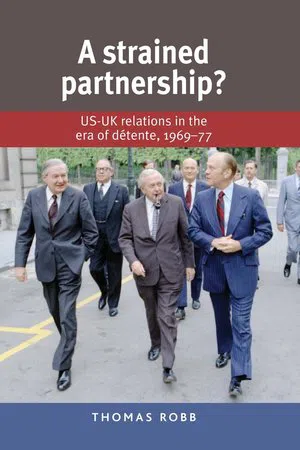
- Thomas Robb(Author)
- 2017(Publication Date)
- Manchester University Press(Publisher)
42 In the opinion of Henry Kissinger a popular myth has developed that Richard Nixon ‘was a man given to histrion- ics, to shouting his prejudices at cowed subordinates, and to dominating his environment by conveying his views with great, and even overpowering insis- tence – frequently under the influence of alcohol’. Rather, in Kissinger’s own assessment, ‘The Richard Nixon with whom I worked on a dail y basis for five and a half years was generally soft spoken, withdrawn, and quite shy’. 43 Likewise, the personality and psychology of Henry Kissinger has attracted a lot of attention. For some, Kissinger was akin to a modern-day Metternich, who shrewdly conducted US foreign policy at a time of considerable chal- lenge for the US. 44 Others have viewed Kissinger’s record less kindly. 45 Some have gone as far to suggest that Kissinger’s actions equate to those of a ‘war criminal’ and that he should be arrested for his misdemeanours. 46 Regardless of where one stands on this, it is indisputable that Kissinger received remark- able attention both in and out of office. One historian has even estimated that Kissinger has been the subject of the largest number of inquiries of any US secretary of state. 47 What is evident is that ‘Kissingerology’ continues to be a flourishing industry, with the now nonagenarian Kissinger still commanding the attention of the world’s policy-making elite and media. 48 Whilst there is much to be gained from analysing the personalities of Nixon and Kissinger, their actions, decisions and policies must be placed prop- erly within the context of the international and domestic system in which they operated. Many existing accounts fail to actually do this and, worse yet, several historians have subscribed to a ‘personality disorder’ theory of the Nixon presidency. For these commentators, Nixon’s personality traits – especially the Introduction 15 ‘darker’ elements – largely explain the course of US foreign policy under his tutelage.
- Jonathan Wright, Steven Casey, Jonathan Wright, Steven Casey(Authors)
- 2015(Publication Date)
- Palgrave Macmillan(Publisher)
15 He had rarely commented upon such profound global changes as decolonization or the role of the People’s Republic of China in international affairs.If Nixon had the practical experience in high diplomacy that Kissinger lacked, the Harvard professor had the knowledge – of history and theory – that the new president craved. Both were extremely ambitious, and both wanted broad recognition of their abilities and intellect. Installed in the White House in early 1969 – one in the Oval Office, the other nearby in the West Wing basement – they had an opportunity to make a major difference in US foreign policy and, in turn, in shaping the course of international relations writ large.American Decline in a Turbulent WorldMuch like his campaign strategies, Nixon’s foreign policy views were, in fact, malleable when he entered the White House in January 1969. They certainly lacked in specificity regarding the major challenges that would preoccupy the new administration. Nixon had, by and large, supported the escalation of the Vietnam War and offered, in 1968, only a non-specified ‘secret plan’ on how to end the war. He had published, in 1967, what many would later consider a remarkably prophetic essay on China, arguing, in essence, that in the long run the United States would have to come to terms with the world’s most populous nation. But in the same essay Nixon also wrote that ‘the world cannot be safe until China changes. Thus our aim, to the extent that we can influence events, should be to induce change.’16 This, of course, was not exactly how US policy would unfold during the Nixon presidency. In various speeches during the presidential campaign Nixon had also referred to ‘a new era of negotiation’ with the Soviet Union. There was a hint of change, but hardly anything approaching a strong commitment to détente. As for the so-called Third World, Nixon was loathe to promote American ideas and liberal democracy as something to be emulated. As he put it in a speech in 1967, ‘It is time for us to recognize that much as we like our own political system, American style democracy is not necessarily the best form of government for people in Asia, Africa and Latin America with entirely different backgrounds.’17 eBook - PDF
Nixon and Israel
Forging a Conservative Partnership
- Noam Kochavi(Author)
- 2010(Publication Date)
- SUNY Press(Publisher)
Dominant by nature and design, Kissinger’s standing as Nixon’s principal foreign policy aide and a key architect of détente meant that his imprint on the Soviet Kissinger, Soviet Jewish Emigration, and the Demise of Détente 51 Jewish emigration policy’s conceptualization, implementation, and outcome was very significant. In the coming pages, we will seek—in line with historian Philip Ze- likow’s advice—to judge Kissinger not so much by policy outcomes, but rather in terms of the degree to which this historically conscious actor succeeded in following his own model of statesmanship. 12 In addition, we will identify factors shaping Kissinger’s behavior, assessing their relative significance and considering what could have been done differently, given contemporaneous circumstances. Kissinger the Scholar’s Advice to the Statesman Few policy-makers came to power more preoccupied than Kissinger with the challenge of mastering the environment. This seasoned student of Metternich, Castlereagh, and Bismarck had been, in his academic ca- reer, palpably torn between, on the one hand, a nearly romantic belief in the inspired statesman’s capacity to shape history by transcending both circumstance and conventional wisdom and, on the other hand, a real- ization that happenstance often makes a mockery of even the most finely calibrated policy. 13 To reconcile these convictions, Kissinger developed recommendations aimed at rendering the policy realm more predictable and thus, more sus- ceptible to the statesman’s creativity. Leaders, he asserted, must develop a clear sense of direction informed by a vision and a profound yet agile conceptualization of the factors and forces at play. 14 This “philosophical deepening,” sorely lacking in the American foreign policy tradition in Kissinger’s judgment, 15 would provide a compass for the ship of state. eBook - ePub
Critical Practices in International Theory
Selected Essays
- James Der Derian(Author)
- 2009(Publication Date)
- Routledge(Publisher)
11 Great men, monumental history, and not-so-grand theory A meta-review of Henry Kissinger’s Diplomacy Source: Forum review article, Mershon International Studies Review (April 1995), vol. 39, no. 1, pp. 173–180. Editor’s Note: In the first issue of the Mershon International Studies Review the Forum section featured a debate concerning the recently published book by Alexander L. George, Bridging the Gap: Theory and Practice in Foreign Policy (1993). The primary thesis of the book, that both scholars and practitioners of foreign policy benefit from better communication and collaboration, went unchallenged. In this chapter, James Der Derian, who authored On Diplomacy (1987) and Antidiplomacy (1992), offers a critique of this assumption through a meta-review of the recent book by analyst-turned-politician Henry Kissinger: Diplomacy (1994a). Diplomacy is a history of the attempt by statesmen to bring order to international politics through a balancing of war and diplomacy, national interest and morality, domestic values and international necessities. For Kissinger, lessons derived from the balance of power politics of classical figures like Richelieu, Metternich, and Bismarck must be applied to current times if the “new world order” is ever to become more than a slogan of aspiration. This is especially true for the United States, where the recurrent tension between Theodore Roosevelt’s realism and Woodrow Wilson’s idealism must be skillfully and diplomatically balanced if the U.S eBook - PDF
Heath, Nixon and the Rebirth of the Special Relationship
Britain, the US and the EC, 1969–74
- Niklas H. Rossbach(Author)
- 2009(Publication Date)
- Palgrave Macmillan(Publisher)
4 Anglo-American Policy Towards European Integration and the Rise of Henry Kissinger The importance of Kissinger That American policy towards Europe changed during the Nixon pres- idency is well known. l Yet, as this chapter bears out, the intentions of the Nixon administration towards Europe actually were not consis- tent. The two previous chapters have dealt with Britain's entry from the more traditional power-political parts of the Anglo-American relation- ship in the sixties, monetary-economic affairs and military-intelligence affairs. This chapter deals with the influence of Henry Kissinger, Nixon's National Security Adviser and later Secretary of State, on the US adap- tation to an enlarged EC. It demonstrates the importance of security thinking over other approaches in the White House and it analyses the Anglo-American efforts to agree on a transatlantic initiative. Henry A. Kissinger knew that the US had to adapt to a world that was multipolar in a political sense. He recognised that the process of European unification to be inevitable, but he was intensely sceptical of European federalism. As far back as in 1969 he argued that the process of European integration had stalled. Although he believed that the US and Europe had to coordinate their interests, he did not believe that federalism should be an American objective. Nor did he believe that European unification had reached a point where Europe was ready for formal overarching transatlantic plans. He even questioned the US support for British EC membership.2 The divergence of opinion between Heath and Kissinger is evident, as Peter Hennessy has demonstrated, by juxtaposing their views on the special relationship.3 Indeed, such is the standing of Kissinger that in the official documentary publication series Foreign Relations of the United States, first ever volume on 'intellectual assumptions' behind an 122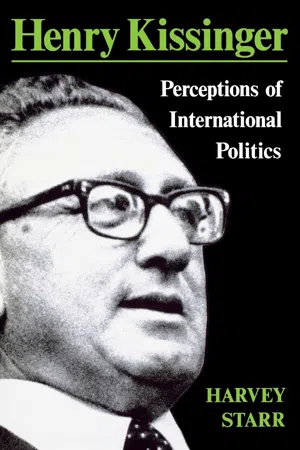 eBook - ePub
Henry Kissinger
Perceptions of International Politics
- Harvey Starr(Author)
- 2021(Publication Date)
- The University Press of Kentucky(Publisher)
44 Similarly, Kissinger praises Nixon for understanding geopolitical structures and balance, of balancing interests, goals, and the capabilities of competing states:It was a hard lesson to convey to a people who rarely read about the balance of power without seeing the adjective “outdated” precede it. It was not one of the least ironies of the period that it was a flawed man, so ungenerous in some of his human impulses, who took the initiative in leading America toward a concept of peace compatible with its new realities and the awful perils of the nuclear age, and that the foreign leaders who best understood this were the two grizzled veterans of the Long March, Mao and Chou, who openly expressed their preference for Richard Nixon over the wayward representatives of American liberalism. . . . For sovereign nations, predictability is more crucial than spasmodic brilliance or idiosyncratic moralistic rhetoric. They must gear their actions to the performance of others over extended periods of time; their domestic survival and international security alike may depend upon it. And it was on this level of shared geopolitical interest transcending philosophies and history that the former Red-baiter and the crusaders for world revolution found each other.45As both Ward and Mazlish point out, as the years passed, Kissinger also sought out men whose intellectual positions fit with his own. Ward comments that Kissinger “would commit himself to the ideas of Nixon, a man for whom he has no personal respect.”46 Mazlish notes that the relationship between the two men was formal and intellectual, that they never became friends. Mazlish contends that, in his relationship with Nixon, Kissinger supported Mazlish’s proposition that Kissinger had a unique ability to fit with different kinds of men.47 Ward echoes this idea: “Perhaps because of his growing confidence in his own ability and his own ideas, Kissinger became able and willing to accept the challenge of trying to put his ideas into action even if the man who would make the final decision was not a man who Kissinger particularly admired.”48 eBook - PDF
American Presidential Statecraft
During the Cold War and After
- Ronald E. Powaski(Author)
- 2017(Publication Date)
- Palgrave Macmillan(Publisher)
For an overview of Nixon’s foreign policy, see Robert Dallek, Nixon and Kissinger: Partners in Power (2007). Fredrik Logevall and Andrew Preston, eds., Nixon in the World: American Foreign Relations, 1969–1977 (2008) contains several scholarly articles on various aspects of Nixon’s foreign policy. For critical accounts of the Nixon-Kissinger policy toward Vietnam, see Gary R. Hess, Vietnam: Explaining America’s Lost War (2009); Larry Berman, No Peace, No Honor: Nixon, Kissinger, and Betrayal in Vietnam (2001); and Jeffrey Kimball, Nixon’s Vietnam War (1998). Kimball also has compiled a collection of documents that include transcripts of Nixon’s White House tape recordings in The Vietnam War Files: Uncovering the Secret History of Nixon-Era Strategy (2004). See also a collection of critical articles in Diplomatic History, 34: 3 (June 2010). RICHARD NIXON, Henry Kissinger, AND THE CONGRESS: ENDING US ... 160 Among the revisionist histories of the Vietnam War are those by Lewis Sorley, A Better War: The Unexamined Victories and the Final Tragedy of America’s Last Years in Vietnam (1999), and James H. Willbanks, Abandoning Vietnam: How America Left and South Vietnam Lost Its War (2004). For studies of J. William Fulbright’s role in the Vietnam drama, see Lee Riley Powell, J. William Fulbright and His Time: A Political Biography (1996); Randall Bennett Woods, Fulbright: A Biography (1995) and his J. William Fulbright, Vietnam, and the Search for a Cold War Foreign Policy (1998); Larry Berman, William Fulbright and The Vietnam War: The Dissent of a Political Realist (1988). Mike Mansfield’s role is examined in Gregory Allen Olsen, Mansfield and Vietnam: A Study in Rhetorical Adaptation (1995). A monumental study of Frank Church’s life is the work by LeRoy Ashby and Rod Gramer, Fighting the Odds: The Life of Senator Frank Church (1994). For an overview of Congress’s efforts to influence the conduct of US foreign policy, see Brian Johnson, Congress and the Cold War (2006). eBook - ePub
Realism in International Relations and International Political Economy
The Continuing Story of a Death Foretold
- Stefano Guzzini(Author)
- 2013(Publication Date)
- Routledge(Publisher)
Henry Kissinger, as National Security Advisor (1969–73) and later Secretary of State (1973–77), had elaborated a set of geostrategic assumptions, which was one of the inspirations of this new policy, the US version of detente. His approach was a historically based realism. He proposed updating the principles of nineteenth century European statecraft and applying them to the circumstances of his time. Yet already, after Kissinger’s first years at Nixon’s side, this task proved not only to have been self-consciously heroic and neoromantic (Hoffmann 1978), but also unrealizable. It did not succeed in accommodating the emancipation of new states, outside the direct control of the central bipolar concert, and the independence of the economic sector of international relations, outside the reach of the classical diplomat. Kissinger’s efforts represent both a grandiose attempt to invigorate the codes of nineteenth century diplomacy, and the limits of such an attempt.Whereas Chapter 5 attested some of the anomalies of realism as an explanatory theory, the failure of Kissinger’s project bears witness to the limitations of reapplying realism understood as a diplomatic practice. As the next chapter of this interlude will show, the crisis of realism as a theory and practice in the main country of International Relations, not only eventually led to a fragmentation of the US foreign policy establishment, but also of the academic discipline.KISSINGER’S GENERAL APPROACH
Kissinger applied a historical approach to the study and practice of diplomacy. His major political endeavour consisted in devising an international order which could combine the flexibility and, indeed, generosity of nineteenth century diplomacy with the changed circumstances of the twentieth century. Vital to the functioning of the European Concert was the existence of what Kissinger calls a legitimate order. A legitimate order, not to be confused with a just one, is an order whose principles are agreed by all of its participants (for more detail, see Chapter 3
Index pages curate the most relevant extracts from our library of academic textbooks. They’ve been created using an in-house natural language model (NLM), each adding context and meaning to key research topics.

