History

The Berlin crisis
The Berlin Crisis refers to the period of heightened tension between the Western powers and the Soviet Union over the status of Berlin, Germany, from 1958 to 1961. The crisis culminated in the construction of the Berlin Wall, which physically divided the city and symbolized the broader division between East and West during the Cold War.
Written by Perlego with AI-assistance
Related key terms
1 of 5
12 Key excerpts on "The Berlin crisis"
 eBook - PDF
A World Safe for Commerce
American Foreign Policy from the Revolution to the Rise of China
- Dale C. Copeland(Author)
- 2024(Publication Date)
- Princeton University Press(Publisher)
economic and geopolitical strength over the long term.15 The Berlin crisis of 1948 arose out of this general context of economic competition and the U.S. drive to consolidate an economic power sphere in Western Europe, although it was not directly a function of economic dependence per se. Because I have cov- ered this case elsewhere, I will only briefly summarize its security-driven roots here.16 By the winter of 1947–48, the importance of the German economy to the economic recovery of all of Western Europe loomed even larger than it had in 1945. At the London Conferences of January–March 1948, Britain, France, and the United States agreed to unite their three occupation zones in Germany and to hand political control over to an independent West German government.17 This was a daunting prospect for a Russian state that had just lost twenty-seven million lives fighting Germany. The fear of a resurgent West Germany was only made worse by the flow of refugees from the Soviet zone that was weakening the East German economy and increasing the strain on the overall Eastern bloc. When Britain and the United States announced currency reforms in mid- June 1948 as a preparatory step to the creation of a unified West German state, the Soviets reacted. They blockaded all ground traffic to Berlin, hoping that this 294 chapter 8 would pressure the West into reversing its recent decisions. The Americans un- derstood that the Soviets’ actions were a defensive reaction to Western moves. As U.S. ambassador to Moscow Walter Bedell Smith wrote to Washington in July, the Soviets desired “a return to [the] status quo,” and would forgo a battle for Berlin if the London agreements were cancelled.18 In discussions over the next two months, the constant Soviet demand was for the reversal of the London agreements, but the Americans held firm. By June 1949, the Soviets ended their blockade and accepted the new status quo, ending the first Berlin crisis of the Cold War. eBook - PDF
A Constructed Peace
The Making of the European Settlement, 1945-1963
- Marc Trachtenberg(Author)
- 2020(Publication Date)
- Princeton University Press(Publisher)
• P A R T I I I • The Cold War Peace C H A P T E R S E V E N The Politics of The Berlin crisis, 1958-1960 IN NOVEMBER 1958, the Soviet leader Nikita Khrushchev announced that his gov-ernment was going to sign a peace treaty with East Germany. When it did so, he said, western rights in Berlin would be ended. He would give the western powers six months to negotiate a settlement that would transform West Berlin into a free city. If, however, the western powers refused to work out a settlement on that basis and sought instead to maintain their position through military force, the USSR would rise in defense of her East German ally. The Soviet Union was thus threatening war if her demands were not met, and this led to a great crisis which lasted with varying degrees of intensity until the end of 1962. What exactly was the crisis about? The Soviets were making threats, but what were they really trying to achieve? How far were they willing to go in their con-frontation with the West if they were unable to achieve their objectives peacefully? And how would the western side react to Soviet pressure? What were the NATO governments willing to do to resolve the crisis, and in particular what arrange-ments relating to Germany as a whole would they prepared to accept? When, if at all, would they be willing to use force rather than capitulate in the crisis? The an-swers to these questions would determine not just the meaning of this episode but also the basic structure of great power politics during The Berlin crisis period. 1 SOVIET POLICY AND THE GERMAN NUCLEAR QUESTION Soviet pressure on Berlin was rooted in the USSR's concern with Germany as a whole, and above all with what was going on in West Germany. 2 Berlin itself was not the problem. The Soviet goal was not to drive the western powers out and 1 For an account of the crisis, see Trachtenberg, History and Strategy, chap. eBook - PDF
Kennedy, Macmillan and the Cold War
The Irony of Interdependence
- N. Ashton(Author)
- 2002(Publication Date)
- Palgrave Macmillan(Publisher)
The irony of the building of the Wall was in fact that by providing a solution to the Berlin problem it served the purposes not only of the Soviet Union and its East German ally, but also of the leading Western powers. To understand why this should have been so, we need first to set British and American policy over the Berlin question in historical context. The starting point for The Berlin crisis, which came to a head with the building of the Wall in 1961, was the failure of the wartime allies to agree on a post-war German settlement. As the Cold War intensified, the Western sectors in Berlin assumed the character of isolated outposts in a Soviet- dominated Eastern Europe. Stalin’s imposition of a blockade on these sectors of the city, and the subsequent airlift of 1948–9 that kept them sup- plied, underlined the status of Berlin as the frontline of the East–West conflict. It was at once the greatest irritant to successive Soviet leaders intent on shoring up their authority and that of their clients in Eastern Europe, and, at the same time, the most vulnerable point in the contain- ment perimeter that the Western allies attempted to establish around the Soviet bloc. The defeat of Stalin’s attempts to starve the population of Berlin into submission in 1949 represented no more than a respite, not a resolution of the problem. The position in Berlin was further complicated by the nature of the wartime occupation rights agreed at Potsdam that still governed the status of the city a decade and a half later. The existence of British, French and American sectors in West Berlin meant that the fate of the city was always prey to Western alliance politics. Not only that, but the presence of good transport links between the Eastern and Western sectors of Berlin and the open nature of much of the zonal boundary, made it the most obvious chink in the ‘iron curtain’. The Berlin crisis 49 eBook - PDF
The United States and the Berlin Blockade 1948-1949
A Study in Crisis Decision-Making
- Avi Shlaim(Author)
- 2023(Publication Date)
- University of California Press(Publisher)
CHAPTER TWO Origins of The Berlin crisis THAT THE IMPOSITION of t h e Soviet blockade on t h e w e s t e r n sec- tors of Berlin on June 24, 1948 constituted a "crisis" for the United States as defined in the last chapter, there can be no doubt. The element of surprise, which has been widely accepted as one of the attributes of crisis, is missing. The American decision-makers were not altogether surprised by the occurrence of the crisis, since they received ample strategic warning, consisting of long-range indica- tors that the opponent might be preparing to act. Although the ex- act timing of the blockade was not predicted, the Americans were well aware, from December 1947 onwards, of the possibility and increasing likelihood of a Russian move to oust the Western powers from Berlin. General Lucius D. Clay, the American Military Gov- ernor in Germany, and his political adviser, Robert Murphy, not only anticipated the crisis but repeatedly advised their superiors that the Russians could sever the land links from the Western zones of Germany to Berlin at any time and urged Washington to con- sider in advance its response to this contingency. 1 But the element of surprise is deliberately excluded from our definition of crisis. On the other hand, all the necessary conditions specified in this defini- tion were present: the blockade constituted a change in the exter- nal environment which was perceived by the American decision- makers as involving a threat to basic values; there was a high proba- bility of involvement in military hostilities; and there was finite time for response. 1. Lucius D. Clay, Decision in Germany (New York: Doubleday, 1950), p. 239; Robert Murphy, Diplomat Among Warriors (London: Collins, 1964), p. 281. On the distinction between strategic and tactical warning, see Alexander L. George and Richard Smoke, Deterrence in American Foreign Policy: Theory and Practice (New York: Columbia University Press, 1974), p. 568. 11 eBook - PDF
- E. Mahan(Author)
- 2002(Publication Date)
- Palgrave Macmillan(Publisher)
The Berlin crisis enters a new phase If Moscow and Washington had hoped that the building of the Wall would stabilize Central Europe in order to allow negotiations, both sides miscalculated badly. The Berlin crisis entered a new phase in which the possibility of nuclear confrontation still loomed. Robert Kennedy recalled that he “couldn’t stress sufficiently the concern the President had, and the concern all of us had, about the possi- bility of war.” 56 Throughout early autumn 1961, repeated air corridor incidents and contention over processing allied convoys on the autobahn intensified East–West tensions. The most serious episode occurred almost a year before the Cuban missile crisis when the two superpowers engaged in a tank standoff at Checkpoint Charlie. 57 The French government fumed over what it regarded as unneces- sary provocation. French officials resented US unilateralism and asserted that if the British and they had been included, the poten- tially explosive situation could have been averted. The tank confrontation reaffirmed the Gaullist belief that institutionalized tripartite planning was needed in order prevent Soviet harassment techniques. 58 After the resolution of the tank confrontation at Checkpoint Charlie, the possibility of war over Berlin flared periodically. In November 1961, Kennedy administration’s proposal for an interna- tional access authority to govern entry to Berlin was rejected by the Soviets. Then, in July 1962, during discussions with US ambassador- at-large Llewellyn Thompson, Khrushchev renewed his threat to sign a peace treaty with East Germany, which would force US, French, and British troops out of West Berlin, but he did not set a time limit. In the meantime, the Soviets stepped up a campaign of harassing both civilian and military aircraft in the air corridors established between West Germany and West Berlin. eBook - PDF
Brokenness and Reconciliation
Yearbook 2019/2020
- Christian Danz, Marc Dumas, Werner Schüßler, Bryan Wagoner, Christian Danz, Marc Dumas, Werner Schüßler, Bryan Wagoner(Authors)
- 2020(Publication Date)
- De Gruyter(Publisher)
https://doi.org/10.1515/9783110658460-011 Matthew Lon Weaver The Berlin crisis and the Defiance of Estrangement Abstract: This essay explores Paul Tillich’s contributions to the debate regarding the status of Berlin during the 1961 crisis. Tillich’s concept of estrangement helps frame and contextualize the broader geo-political conversation about contain-ment and nuclear war. Substantial attention is paid to a televised conversation hosted by Eleanor Roosevelt which included Paul Tillich, Dean Rusk, Henry Kis-singer, James Reston, and Max Freedman, exhibiting a ‘clash of realisms.’ Introduction The 1961 international crisis over the status of Berlin was the culmination of a state of limbo created by the division of Germany following World War II. While France, Great Britain, and the United States had begun the process of reunifying and rebuilding their zones by 1948, using resources provided by the Marshall Plan (including their zones in the city of Berlin), the Soviet Union remained wary of a reunited Germany given its centrality in bringing about two world wars. So-viet discontent with the arrangement created by the other three powers led to Sta-lin’s blockade of road access to Berlin from the west in 1948. After the success of the eleven-month-long airlift to overcome this blockade shared by the British, French, and Americans, Stalin lifted it. 1 By the late 1950s, Stalin’s successor Nikita Khrushchev and East German leaders returned to the Berlin and East/West question. This was understandable in light of the movement of 2.7 million people from East Germany to West Ger-many between 1949 and 1961, as well as the 10,000 people per month leaving East Berlin for West Berlin at the time of the crisis.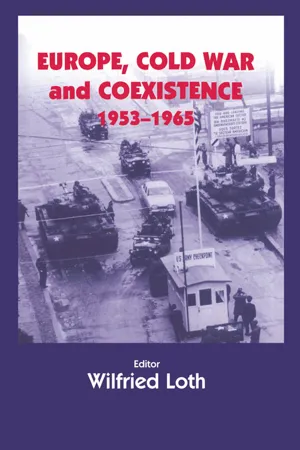 eBook - ePub
- WILFRED LOTH(Author)
- 2004(Publication Date)
- Routledge(Publisher)
PART II: EUROPEAN REACTIONS TO THE BERLIN AND CUBAN CRISES, 1958–62 Passage contains an image
3
Adenauer and Nuclear Deterrence
Klaus SchwabeIThe so-called ‘Khrushchev Ultimatum’ of November 1958 triggering the second Berlin crisis heralded one of the tensest phases of the Cold War in Europe. For the first time, it raised the spectre of a nuclear showdown in which the West no longer enjoyed an unquestioned superiority over the Soviet Union. This Soviet challenge tested first of all the credibility of the policies the Western powers so far had adhered to on the German and the Berlin questions. It tested the Cold War policies of the West by confronting its governments with a number of awkward questions: Were the three former Western occupation powers really resolved to insist on their rights in Berlin? Were they prepared to defend the political independence of the city’s population and its ties to the Federal Republic? Were they determined to uphold West Berlin’s position as the decisive gap in the Iron Curtain—an opening that permitted East Germans to flee to West Germany—created a continuous brain drain that undermined the GDR and, as the Bonn government claimed, thus preserved the chances of reunification? Were the Western powers resolved to risk a military or even nuclear showdown in order to defend all these various interests?The military option was a problem which the West German Chancellor Konrad Adenauer had to cope with as well. In reacting to The Berlin crisis, he appears from hindsight to have been an extreme type of cold warrior because he risked nuclear war rather than consider yielding an inch to Soviet pressure, refusing to make any concessions whatsoever to ‘Russia’ by sticking to what he called a ‘policy of strength’. This course alone, he predicted, would ultimately lead to the collapse of the Soviet Union and would bring about realistic chances of German unification. A closer look, however, reveals that Adenauer was not quite the ‘iron chancellor’ that some admirers (and critics) wanted him to be. To demonstrate this we will cite two examples: the way he reacted to The Berlin crisis and, more generally, the attitude he adopted toward NATO’s nuclear strategy in The Berlin crisis.
Passage contains an image
3
Adenauer and Nuclear Deterrence
Klaus SchwabeIThe so-called ‘Khrushchev Ultimatum’ of November 1958 triggering the second Berlin crisis heralded one of the tensest phases of the Cold War in Europe. For the first time, it raised the spectre of a nuclear showdown in which the West no longer enjoyed an unquestioned superiority over the Soviet Union. This Soviet challenge tested first of all the credibility of the policies the Western powers so far had adhered to on the German and the Berlin questions. It tested the Cold War policies of the West by confronting its governments with a number of awkward questions: Were the three former Western occupation powers really resolved to insist on their rights in Berlin? Were they prepared to defend the political independence of the city’s population and its ties to the Federal Republic? Were they determined to uphold West Berlin’s position as the decisive gap in the Iron Curtain—an opening that permitted East Germans to flee to West Germany—created a continuous brain drain that undermined the GDR and, as the Bonn government claimed, thus preserved the chances of reunification? Were the Western powers resolved to risk a military or even nuclear showdown in order to defend all these various interests?The military option was a problem which the West German Chancellor Konrad Adenauer had to cope with as well. In reacting to The Berlin crisis, he appears from hindsight to have been an extreme type of cold warrior because he risked nuclear war rather than consider yielding an inch to Soviet pressure, refusing to make any concessions whatsoever to ‘Russia’ by sticking to what he called a ‘policy of strength’. This course alone, he predicted, would ultimately lead to the collapse of the Soviet Union and would bring about realistic chances of German unification. A closer look, however, reveals that Adenauer was not quite the ‘iron chancellor’ that some admirers (and critics) wanted him to be. To demonstrate this we will cite two examples: the way he reacted to The Berlin crisis and, more generally, the attitude he adopted toward NATO’s nuclear strategy in The Berlin crisis. eBook - PDF
The European Public Sphere and the Media
Europe in Crisis
- A. Triandafyllidou, R. Wodak, A. Triandafyllidou, R. Wodak, A. Triandafyllidou, R. Wodak, Micha? Krzy?anowski(Authors)
- 2009(Publication Date)
- Palgrave Macmillan(Publisher)
At a press conference, Kennedy referred to Europe, that here appeared as Central Europe, and thus logically bridged the Iron Curtain by the chosen geographical denominator: The President stuck to his position in relation to all questions concerning Berlin in so far as he preferred the diplomatic over the military. He cut short a question related to the possibility of conventional war in Central Europe with a short remark, saying that he hopes to reach a peaceful solution. (Frankfurter Allgemeine Zeitung, 11 August 1961, p. 1) Crisis Events and the Idea of Europe in Post-War Media Debates 131 Similarly, Rusk is quoted as saying, ‘Peace in Central Europe . . . must not be obtained by imposing unduly hard conditions that gave an advantage to one party to the detriment of the other’ (The Times, 11 August 1961, p. 6). French Communist paper L’Humanité saw the solution for the threat to Europe in giving in to the demands by the GDR and Soviet authorities: ‘An immediate negotiation is possible. Its success will secure détente in Europe and the GDR could tone down the measurements it had to implement’ (Le Monde, 15 August 1961, p. 2). The Daily Mirror also referred to Europe as a whole when, quoting Le Monde, it stated that: Now, there is but one possibility to avoid the passage from a cold war to a hot war: the great powers must engage themselves in negotiations for an acceptable solution for Berlin, East Germany and maybe all of Europe. (Le Monde, 15 August 1961, p. 2) In the same vein, The New York Times, again quoted by Le Monde, states: ‘The Berlin crisis has reached a state where the destiny of the world is at stake. Lenin said already that who controls Berlin controls Germany, and who con- trols Germany controls Europe’ (Le Monde, 16 August 1961, p. 2).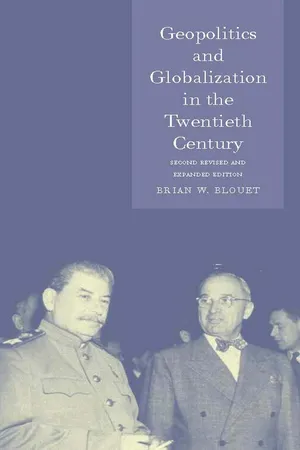
- Brian Blouet, Brian W. Blouet(Authors)
- 2010(Publication Date)
- Reaktion Books(Publisher)
23 the cold war To the geopolitical commentator the roots of the Cold War were apparent in 1941 . Once the battle for control of Eurasia started between Germany and Soviet Union, there could be two results. The combatants might exhaust each other as Truman famously hoped in 1941 or one of the powers would be preponderant in Eurasia. When Britain and the US became allies of the Soviet Union, to prevent a German empire from the North Sea to the Urals, they had joined a cause in which victory would bring a westward extension of Soviet power. A second front would be needed to ensure that the Soviets did not occupy all of Germany up to the Rhine. In retrospect it is obvious that there would be conflict between the totalitarian, communist regime of Joseph Stalin that wanted to extend its power into Eastern Europe and the US which wanted democratic governments and increased eco-nomic interaction. The differing world views were rapidly reflected in postwar despatches sent by diplomats serving in Washington and Moscow. When the Soviet ambassador to the US, Nikolai Novikov, sent his long telegram on 27 September 1946 , he described America’s outward push into the world in Marxist terms: The foreign policy of the United States, which reflects the imperialist tendencies of American monopolistic capitalism, is characterized in the postwar period by a striving for world supremacy. 24 Novikov noted the build-up of US overseas bases and saw that the US was intent on opening the world to US trade and investment, while promoting the dollar as the currency of world trade. 148 . geopolitics and globalization From the US and British perspective the Soviet Union, in spite of signing the Atlantic Charter and the UN declaration, had indulged in territorial aggrandizement in Eastern Europe. Opinion moved rapidly towards a tougher policy in regards to the USSR.
- E. Geelhoed, A. Edmonds(Authors)
- 2002(Publication Date)
- Palgrave Macmillan(Publisher)
3 Khrushchev’s threats tended to obscure the weakness of East Germany at that time. Since World War II, West Germany, under the leadership of Chancellor Konrad Adenauer, had developed into the economic and political powerhouse of Western Europe. Thousands of East Germans, especially in the professions, used Berlin as their point to flee the horrible economic conditions in the east. Moreover, the Western powers refused to recognize East Germany diplomatically, a further humiliation in the eyes of the Soviet Union. In addition, in 1957, after the British–American agreements on defense and the acceptance of the Norstad Plan at the North Atlantic Council meeting, Khrushchev became anxious that the Allies intended to place nuclear weapons in West Germany, and even in West Berlin. The prospect of a rearmed West Germany, combined with the expansion of 1959: Moscow, Washington, London, Paris 63 NATO’s offensive capability in Europe, was a source of serious concern to the Kremlin. 4 Still, Khrushchev’s motivations in fomenting The Berlin crisis remain unclear. Was he attempting to isolate West Germany – a country which was becoming stronger politically, economically, and militarily? Was he attempting to use the Berlin issue to force the Western powers to reco- gnize East Germany and thereby strengthen the Soviet hold on Central Europe? Was he trying to split the NATO allies by playing to some pos- sible differences on the status of Berlin? Was Khrushchev attempting to force the West into a summit meeting where the Soviet premier would be seen as the equal of Eisenhower and the other democratic leaders? Whatever his motivation, as long as Khrushchev kept the ultimatum in effect, the tensions remained. Clearly Macmillan was deeply concerned about the Berlin problem. He seemed particularly worried that the United States might overreact to Khrushchev’s moves. As early as 5 January 1959, he wrote in his diary that he “felt sure . eBook - PDF
The Last Great Game: USA Versus USSR
Events, Conjunctures, Structures
- Paul Dukes(Author)
- 2016(Publication Date)
- Bloomsbury Academic(Publisher)
Part One: Events 22 June 1941 7 December 1941 28 November to 1 December 1943 4-11 February 1945 7 May 1945 26 June 1945 6 August 1945 14 August 1945 9 February 1946 5 March 1946 12 March 1947 5 June 1947 22 October 1947 30 March 1948 4 April 1949 23 May 1949 22 September 1949 30 September 1949 5 October 1949 German invasion of USSR—'Barbarossa' Japanese attack on USA—Pearl Harbor Teheran Conference Yalta Conference German surrender—VE Day UN Charter signed in San Francisco Atomic Bomb on Hiroshima Japanese surrender—VJ Day Stalin election speech Churchill 'Iron Curtain' speech Truman Doctrine speech Marshall Plan speech Announcement of Communist Information Bureau (Cominform) Berlin crisis begins North Atlantic Treaty Organization (NATO) formed Formal Proclamation of the Federal Republic of Germany Western Announcement of Soviet A-Bomb Berlin Airlift ends Announcement of formation of Democratic Republic of Germany 3 1 Introduction The term 'Cold War' is not a new one. It was certainly used by a Spanish writer in the fourteenth century to describe the struggle between Christians and Moslems in the following manner: 'War that is very strong and very hot ends either with death or peace, whereas cold war neither brings peace nor gives honour to the one who makes it.' 1 We can be fairly confident that the Greeks and Romans had a word for it, too. However, the global conflict that has arisen since the Second World War obviously possesses several distinctive features, the most important of which is the final nature of any Third World War arising from it. Any such conflict would be so strong and hot that it would be followed by general death and no peace. There is there-fore at least a little honour owing to those who have prevented the present Cold War from escalating into all-out struggle. Among them, undoubtedly, are the historians and other analysts who have striven to uncover the origins of the Cold War in its various phases.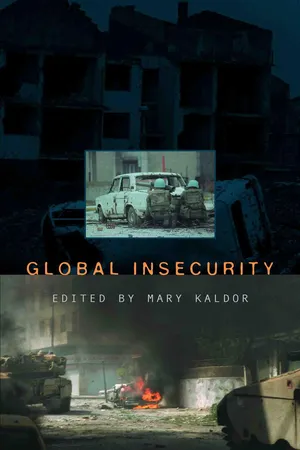 eBook - PDF
- Mary Kaldor(Author)
- 2000(Publication Date)
- Pinter(Publisher)
Meetings -often blocked or interrupted by the (secret) police -were held in Central and East European countries, and numerous statements were released. 2 It increased the visibility, credibility and authority of the dissidents. Neither the official political elite in the East nor their political counterparts in the West were pleased with these developments. It was only after the peaceful revolutions of 1989 had taken place that the majority of Western politicians were ready to embrace the former dissidents as their 'old-time' friends. The Great Cold War was a frozen conflict since war was excluded, although the basic ideological conflict between East and West was neither solved nor totally eliminated. The conflict was softened, however, during the thaw period, especially on the polit-ical level. During this period it was accepted that East and West represented different civilizations, but that this should not hinder the normalization of relations. From the 1960s on, the number of contacts between citizens, tourists, churches, cities, companies, schools, universities, and action groups mushroomed. Even if ideo-logical issues were not discussed it was as a consequence of these contacts that many in the East, in particular the younger genera-tions, became convinced that the communist system and ideology 61 MIENT JAN FABER was not what they wanted and that it should be abolished, step by step. Gradually, the system eroded from within. What lessons can we learn from the Great Cold War period in Europe about how other wars might be frozen and how they might be brought to a peaceful end? It can be argued that the deep involvement and rivalry of the two superpowers not only guaran-teed the continuation of the Great Cold War but also assured its stability. When they together embarked on the road to detente, however, the European countries and their peoples were able to obtain some breathing space to develop their own contribution to detente.
Index pages curate the most relevant extracts from our library of academic textbooks. They’ve been created using an in-house natural language model (NLM), each adding context and meaning to key research topics.

