History

Berlin Airlift
The Berlin Airlift was a massive humanitarian effort led by the Western Allies to supply West Berlin with food, fuel, and other necessities after the Soviet Union blockaded the city in 1948. Over 200,000 flights delivered supplies, demonstrating the resolve of the Western powers during the early stages of the Cold War and ultimately forcing the Soviets to lift the blockade.
Written by Perlego with AI-assistance
Related key terms
1 of 5
10 Key excerpts on "Berlin Airlift"
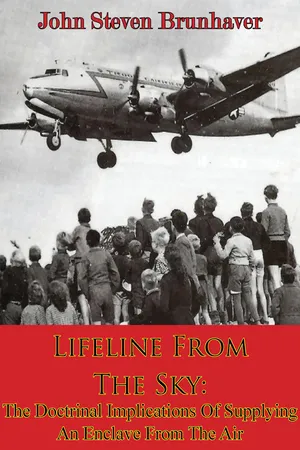
- John Steven Brunhaver(Author)
- 2015(Publication Date)
- Normanby Press(Publisher)
CHAPTER 3—THE Berlin Airlift
“Morale in all of Western Europe has been lifted to inspirational levels. The people see proof in the Airlift of our determination not to abandon them to totalitarian domination. The Airlift has become a symbol of hope.”—Lucius D. Clay, General, US Army Commander in Chief, European CommandThe Berlin Airlift was an immense undertaking to furnish supplies, food, and fuel to the 2.5 million civilian and military inhabitants of West Berlin during the Soviet blockade of ground supply routes. The airlift lasted from 26 June 1948 to 1 August 1949. During that time, airlift forces flew 266,600 sorties and delivered more than 2,223,000 tons, demonstrating that airlift could be an effective instrument in international diplomacy.{62}This chapter will examine what doctrinal imperatives can be gained from studying the Berlin Airlift. The first part of the chapter will be devoted to the discovery of the facts. The analysis will then trace effects back to their causes in terms of factors that influenced the airlift effort. Finally, we will investigate and evaluate the means employed leading to a determination of the doctrinal precepts derived from the Berlin Airlift.Analysis of the evidence for the Berlin Airlift focuses on Berlin’s general situation, the requirements to capabilities ratio, the Soviet threat to the Allied resupply efforts, the airlift operation’s support infrastructure, and the weather’s influences on the operation.Berlin’s General Situation
Intimidating West Berlin into relinquishing its freedom was the first step of the Soviet plan to gain control of Germany, which conflicted directly with the Allied objective to retain control of West Berlin and the three western zones of Germany. For the better part of 1947, the Russians gradually imposed a surface blockade of the western sectors of Berlin. On 24 June 1948, the Russian’s last move in the series to blockade road and rail lines of communication was made and the surface blockade of western Berlin was complete.{63} The blockade of Berlin was a siege directed not only at the population’s stomachs, but also at its minds. The Russian promise to feed the city was a lure to the people to surrender their freedom.{64} No longer available |Learn more
- (Author)
- 2014(Publication Date)
- College Publishing House(Publisher)
________________________ WORLD TECHNOLOGIES ________________________ Chapter 9 Berlin Blockade Berliners watching a C-54 land at Tempelhof Airport (1948) The Berlin Blockade (24 June 1948 – 12 May 1949) was one of the first major international crises of the Cold War and the first resulting in casualties. During the multinational occupation of post-World War II Germany, the Soviet Union blocked the Western Allies' railway and road access to the sectors of Berlin under Allied control. Their aim was to force the western powers to allow the Soviet zone to start supplying Berlin with food and fuel, thereby giving the Soviets practical control over the entire city. ________________________ WORLD TECHNOLOGIES ________________________ In response, the Western Allies organized the Berlin Airlift to carry supplies to the people in West Berlin. The United Kingdom's Royal Air Force and the recently formed United States Air Force flew over 200,000 flights in one year, providing 13,000 tons of daily necessities such as fuel and food to the Berliners. Alongside British and US personnel the airlift involved aircrews from the Royal Australian Air Force, Royal Canadian Air Force, Royal New Zealand Air Force and South African Air Force. By the spring of 1949, the effort was clearly succeeding and, by April, the airlift was delivering more cargo than had previously been transported into the city by rail. The success of the Berlin Airlift brought humiliation to the Soviets who had refused to believe it could make a difference. The blockade was lifted in May 1949 and resulted in the creation of two separate German states. The Federal Republic of Germany (West Germany) and the German Democratic Republic (East Germany) split up Berlin. In remembrance of the airlift, three airports in the former western zones of the city served as the primary gateways to Germany for another fifty years. Postwar division of Germany The red area of Germa ny (above) is Soviet controlled East Germany. No longer available |Learn more
- (Author)
- 2014(Publication Date)
- University Publications(Publisher)
________________________ WORLD TECHNOLOGIES ________________________ Chapter- 5 Berlin Blockade Berliners watching a C-54 land at Tempelhof Airport (1948) The Berlin Blockade (24 June 1948 – 12 May 1949) was one of the first major international crises of the Cold War and the first resulting in casualties. During the ________________________ WORLD TECHNOLOGIES ________________________ multinational occupation of post-World War II Germany, the Soviet Union blocked the Western Allies' railway and road access to the sectors of Berlin under Allied control. Their aim was to force the western powers to allow the Soviet zone to start supplying Berlin with food and fuel, thereby giving the Soviets practical control over the entire city. In response, the Western Allies organized the Berlin Airlift to carry supplies to the people in West Berlin. The United Kingdom's Royal Air Force and the recently formed United States Air Force flew over 200,000 flights in one year, providing 13,000 tons of daily necessities such as fuel and food to the Berliners. Alongside British and US personnel the airlift involved aircrews from the Royal Australian Air Force, Royal Canadian Air Force, Royal New Zealand Air Force and South African Air Force. By the spring of 1949, the effort was clearly succeeding and, by April, the airlift was delivering more cargo than had previously been transported into the city by rail. The success of the Berlin Airlift brought humiliation to the Soviets who had refused to believe it could make a difference. The blockade was lifted in May 1949 and resulted in the creation of two separate German states. The Federal Republic of Germany (West Germany) and the German Democratic Republic (East Germany) split up Berlin. In remembrance of the airlift, three airports in the former western zones of the city served as the primary gateways to Germany for another fifty years.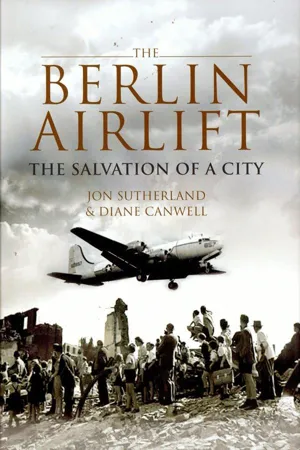 eBook - ePub
The Berlin Airlift
The Salvation of a City
- Diane Canwell, Jon Sutherland(Authors)
- 2008(Publication Date)
- Pelican Publishing(Publisher)
When the Soviet Union collapsed in 1991 the wall had already been torn down and the city of Berlin reunited. The new goal of NATO was the containment of the Russian Federation. Gradually it has come to encompass some of the former Warsaw Pact countries, including Poland, Hungary, the Czech Republic, Slovakia and Bulgaria.The Berlin Airlift was the first Cold War victory. The excitement and relief that had accompanied victory over Germany in 1945 quickly evaporated as former allies stood against one another for control of Europe. In hindsight we can see that the Berlin blockade had its seeds as far back as the Yalta Conference in 1944. It was here that the fateful decision had been made to divide Germany into occupation zones and, more importantly, to divide Berlin itself into four sectors and create an island in the middle of the Soviet zone. Again in hindsight it was probably inevitable that it would cause major problems.Too many assumptions were made, too little was written down, agreed and signed. There was too much reliance on inference and on the false assumption that allies battling against the Germans in 1944 would be similarly allied to one another once Germany had been defeated. Even the Potsdam Conference in 1945 had not seen any real progress in sorting out what the problems would be in occupied Germany. It had already become clear that the Soviets had very different views of Germany and the future of post-war Europe from the Western allies. The two blocs opposing one another sprang up very quickly. General Clay said during the Berlin Airlift itself: 'When Berlin falls, Western Germany will be next. If we withdraw, our position in Europe is threatened and Communism will run rampant.'From haphazard beginnings, the Allies, principally the British and the Americans, conducted an operation of hitherto unknown scale to support the city. In the end very few individuals lost their lives during the Berlin Airlift, it was not a shooting operation, but it was nevertheless very much a military campaign. But it cost Great Britain £17 million to support Berlin during the blockade, the West Germans contributed 150 million DM, and the United States, in addition to the vast commitment of men and equipment, had put in $350 million. These were vast sums of money for the 1940s. eBook - PDF
- Hans-Georg Gadamer, P. Christopher Smith(Authors)
- 2002(Publication Date)
- Yale University Press(Publisher)
168 FORGING A CONSENSUS how flu AIR LIFT work* Fig. 5.1 The Airlift in operation. Photo: Landesbildstelle Berlin. (fig. 5.2). 3 This dramatic undertaking more than anything illustrated the swiftness and extent of Germany's political rapprochement with the United States. The story of the Berlin Airlift has usually been told within the framework of the deteriorating relations between the United States and the Soviet Union. The 1948-49 showdown over the city was the first serious conflict of the cold war. The American defense of the city, cold war historians asserted, formed part of the U.S. commit-ment to the containment of the Soviet Union. West Berlin was the prize the Soviet Union wanted to extract from the West in exchange for the creation of a separate West German state, a prize the United States was unwilling to relinquish. Germany served as the locus for the unfolding of the great power rivalry. 4 Yet in the context of the previous four years of informal and for-mal American-German rapprochement, the Berlin Airlift emerges as a very different story, one that moves the relationship between Forging a Consensus 169 Fig. 5.2 Monthly Airlift deliveries. Photo: Landesbildstelle Berlin. Americans and Germans to center stage. While the change of focus does not negate the traditional cold war interpretation of the Berlin crisis, it highlights the cultural environment in which the cold war unfolded. The Soviet threat to West Berlin did not change the U.S.-German relationship but allowed both countries to redefine it as a geo-strategic necessity. The Soviet threat was a justification rather than the cause of the changed relationship. Germans used it to distance themselves from the legacy of the Nazi crimes and to re-invent themselves as victims not only of harsh material circum-stances but also of a possible communist takeover. Americans used it to justify their embrace of postwar Germany and legitimize the program of democratization.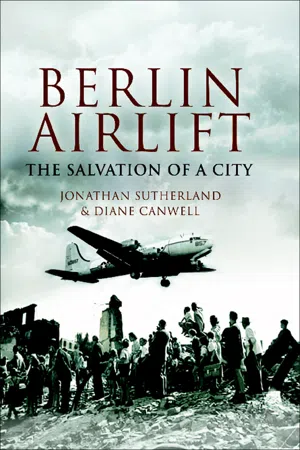 eBook - ePub
The Berlin Airlift
The Salvation of a City
- Jon Sutherland, Diane Canwell(Authors)
- 2007(Publication Date)
- Pen & Sword Aviation(Publisher)
When the Soviet Union collapsed in 1991 the wall had already been torn down and the city of Berlin reunited. The new goal of NATO was the containment of the Russian Federation. Gradually it has come to encompass some of the former Warsaw Pact countries, including Poland, Hungary, the Czech Republic, Slovakia and Bulgaria.The Berlin Airlift was the first Cold War victory. The excitement and relief that had accompanied victory over Germany in 1945 quickly evaporated as former allies stood against one another for control of Europe. In hindsight we can see that the Berlin blockade had its seeds as far back as the Yalta Conference in 1944. It was here that the fateful decision had been made to divide Germany into occupation zones and, more importantly, to divide Berlin itself into four sectors and create an island in the middle of the Soviet zone. Again in hindsight it was probably inevitable that it would cause major problems.Too many assumptions were made, too little was written down, agreed and signed. There was too much reliance on inference and on the false assumption that allies battling against the Germans in 1944 would be similarly allied to one another once Germany had been defeated. Even the Potsdam Conference in 1945 had not seen any real progress in sorting out what the problems would be in occupied Germany. It had already become clear that the Soviets had very different views of Germany and the future of post-war Europe from the Western allies. The two blocs opposing one another sprang up very quickly. General Clay said during the Berlin Airlift itself: ‘When Berlin falls, Western Germany will be next. If we withdraw, our position in Europe is threatened and Communism will run rampant.’From haphazard beginnings, the Allies, principally the British and the Americans, conducted an operation of hitherto unknown scale to support the city. In the end very few individuals lost their lives during the Berlin Airlift, it was not a shooting operation, but it was nevertheless very much a military campaign. But it cost Great Britain £17 million to support Berlin during the blockade, the West Germans contributed 150 million DM, and the United States, in addition to the vast commitment of men and equipment, had put in $350 million. These were vast sums of money for the 1940s.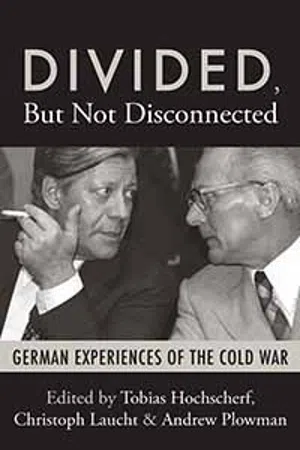 No longer available |Learn more
Divided, But Not Disconnected
German Experiences of the Cold War
- Tobias Hochscherf, Christoph Laucht, Andrew Plowman, Tobias Hochscherf, Christoph Laucht, Andrew Plowman(Authors)
- 2010(Publication Date)
- Berghahn Books(Publisher)
As the Cold War almost turned hot, the airlift presented the Western Allies with a serious strategic and logis-tical challenge and revealed West Berlin’s pivotal geostrategic role in the emerging conflict. To prevent a human tragedy in the Western sectors of Reenacting the First Battle of the Cold War ■ 191 the city, American and British forces launched the biggest air transporta-tion operation in history, supplying over two million people with staple foods, coal, petrol and medicine. While the Berlin blockade cemented the division of Germany and marked the first battle of the Cold War, the perception of the event has undergone remarkable transformation since the late 1940s. Established as the first West German foundation myth in the 1950s, its significance was revived after unification. With considerably fewer eyewitnesses alive at its sixtieth anniversary in 2008, media representations have as-sumed a crucial role as agencies of popular memory. Putting Germans in the mood for the anniversary, Die Luftbrücke plays an important part in the formation of what Alison Landsberg terms ‘prosthetic memory’, a process through which ‘a person does not simply apprehend a histor-ical narrative but takes on a more personal, deeply felt memory of a past event through which he or she did not live’. 2 Since Die Luftbrücke does not attempt to provide an accurate historical account of the events surrounding the airlift but blends fact with fiction, it contributes to the ‘postmodern’ blurring of distinctions between memory and history. This chapter focuses on Die Luftbrücke as the latest attempt to visualize and reinterpret the airlift for a new generation of Germans about fifteen years after unification. It shows how ambivalently the so-called Berlin Republic confronted early Cold War history. Our analysis is divided into three parts, the first of which locates the film within its production con-text.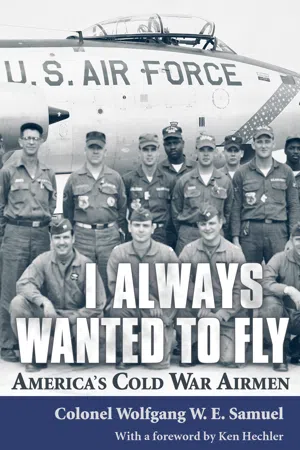 eBook - ePub
I Always Wanted to Fly
America’s Cold War Airmen
- Wolfgang W. E. Samuel(Author)
- 2009(Publication Date)
- University Press of Mississippi(Publisher)
But a new U.S. defense organization and aid to nations in need could not stop determined aggression by a militarily powerful foe. In February 1948 Czechoslovakia came under Soviet control through a communist-inspired coup. The political and military stage was set for an attempt to bring a vulnerable Berlin under Soviet control as well. With Berlin, Stalin could reasonably expect much of Western Europe to follow and fall under the Red Army’s “protective” umbrella. American military weakness was readily apparent, and communist political movements in France and Italy were strong and seemingly on the verge of ascending to power. Soviet planners must have reasoned that the British and Americans might be able to supply their own garrisons in Berlin by air but would not be able to supply Berlin’s civilian population. An airlift supplying even the minimum needs of a city of more than two million inhabitants was too big a task to even contemplate. The Soviets knew for sure that they could not do it. A similar attempt by the Luftwaffe to supply the much smaller 6th Army at Stalingrad had failed miserably. Another strong factor in Stalin’s favor appeared to be the suffering of the vanquished German population, which was cold, hungry, and living mostly in ruins and makeshift buildings, with threadbare clothing and without hope for a better future. Stalin knew that such suffering, combined with the absence of hope, made people pliable tools for exploitation. The stage clearly was set for a Soviet blockade of Berlin.In the spring of 1948 Stalin must have thought that the moment was almost right to oust the Allies from Berlin, although winter would have been a better time to begin such an undertaking. The American and British initiative to revive West Germany’s stagnant economy by introducing a new currency forced Stalin’s hand. On the positive side of the ledger, both the United States and Britain, although militarily weak, had experienced and resolute political and military leaders at their helms. The principal players in the unfolding Berlin drama were:To some, the Berlin Airlift may appear to be an interesting but minor operation, overshadowed by subsequent Cold War events. It was anything but. The stakes were exceedingly high for the West—a continued Allied presence in Berlin, the survival of its people, and the political survival of Western Europe in the face of open aggression should the Soviets succeed. Events began to look a lot like 1937. Because of the West’s military weakness, some senior politicians and some senior military officers as well publicly expressed their fears that American and British military measures would cause the Soviets to react militarily. Would it not be better to let them have Berlin? was a question asked aloud in high places in Washington. Truman, Bevin, and Clay remained unimpressed, however, and were determined not to take their counsel from the barrel of a gun. From January 1948 onward, events moved rapidly toward confrontation.January 1948 eBook - PDF
- Geraint Hughes, S. Dockrill(Authors)
- 2006(Publication Date)
- Palgrave Macmillan(Publisher)
Significantly, they pretended to do ‘repair work’ on roads and railways rather than admitting that they were imposing an economic blockade. In this way they did not technically violate any written agreements. None existed because in 1945 access to Berlin by land and by inland waterways had been understood to be implicit in the presence of occupation forces. On their part, the Western allied powers responded by organising an airlift of unarmed military transport aircraft which travelled along the air corridors prescribed by the 1945 four-power air agreement. (Even during the Berlin blockade air access was administered by a board of military officers which included Soviet representatives!) In other words, no side directly violated written agreements, though the Soviets clearly acted 32 palgrave advances in cold war history against the spirit of the Potsdam agreement. Each side was careful not to give the impression of an imminent military attack, though military personnel and equipment were abundantly visible. While the Soviets sought to demonstrate that Berlin was at their mercy, the Western powers were able to show off their superior air capacity which made it possible to keep the West Berliners supplied with food stuffs and fuel. In the end the Berlin Airlift turned into a propaganda victory for the West, particularly for the USA, in winning the hearts of the Germans and of many others in Europe. War was avoided and the Soviets returned to the conference table even though two German states were already in the process of being established. Inadvertently Stalin convinced the Europeans of the necessity for the Marshall Plan and of the need to forge a Western defence alliance led by the Americans. 24 In East Asia, the confrontation took a very different form. The Chinese regime change created a complex set of issues concerning the international status of Taiwan.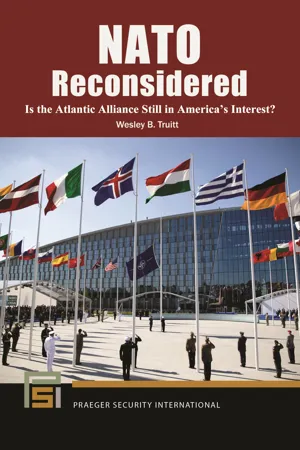 eBook - ePub
NATO Reconsidered
Is the Atlantic Alliance Still in America's Interest?
- Wesley B. Truitt(Author)
- 2020(Publication Date)
- Praeger(Publisher)
CHAPTER 1From NATO’s Founding through the End of the Cold War
“The policy of the great powers is in their geography.”Napoleon1In 1947, two years after the surrender of Germany and Japan in World War II, the United States realized it was at war again. This time it was at war with the Soviet Union, its former “ally.” It was not a shooting war. It was a Cold War. This began a dark, dangerous era in world politics that stimulated a powerful response by the United States to this Soviet challenge to achieve dominance throughout all of Europe.America’s responses began in March of that year when Congress passed the Greek-Turkish Aid Bill, which provided economic and material assistance to those and other governments that were being threatened by Communist subversion. By signing that bill, President Truman signaled the establishment of the Truman Doctrine in which the United States pledged to aid countries in Europe and elsewhere that were threatened by Communist subversion. It was intended to prevent the Soviet Union from taking over more countries in this new Cold War. This was the core of Truman’s containment policy.In June 1948, the Soviet Union closed the land bridge from the Western Zones of Germany to West Berlin, thus beginning the Berlin Blockade. The three great powers had agreed at the Yalta Conference in early 1945 that the city of Berlin, like all of Germany, would be divided into four zones of occupation. Yet, guaranteed access to their zones in Berlin by the Western Powers was left unstated. Berlin lay deep inside the Soviet zone of occupation, and so rail, highway, and canal travel to that city by U.S., British, and French personnel as well as supplies was easily closed by the Soviet Union.Shortly after the blockade was established, the famous Berlin Airlift was undertaken by the United States, resulting in 272,000 flights to West Berlin by American cargo airplanes to supply West Berlin’s people with food and fuel. The airlift ended eleven months later when the Soviets reopened the border. The Berlin Blockade, more than any other event, convinced President Truman that the Soviet Union, our former tacit ally, was bent on dominating all of Central and Eastern Europe.2
Index pages curate the most relevant extracts from our library of academic textbooks. They’ve been created using an in-house natural language model (NLM), each adding context and meaning to key research topics.

