History

Eastern Bloc
The Eastern Bloc refers to the group of communist states in Eastern and Central Europe, as well as the Soviet Union, during the Cold War. This alliance was led by the Soviet Union and included countries such as East Germany, Poland, Czechoslovakia, Hungary, Romania, Bulgaria, and others. The Eastern Bloc was characterized by its political and economic alignment with the Soviet Union.
Written by Perlego with AI-assistance
Related key terms
1 of 5
9 Key excerpts on "Eastern Bloc"
 eBook - PDF
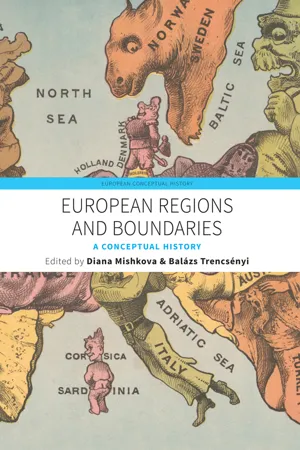
European Regions and Boundaries
A Conceptual History
- Diana Mishkova, Balázs Trencsényi, Diana Mishkova, Balázs Trencsényi(Authors)
- 2017(Publication Date)
- Berghahn Books(Publisher)
200 Frithjof Benjamin Schenk On the other side of the Iron Curtain, in the meantime, the “capitalist West” became the constituting Other of the Socialist bloc. But the concept of Eastern Europe was only rarely accepted as terminology of self-denomination in the political discourse of the Soviet Union or the Socialist bloc. One of the few examples of this practice is the offi cial Short Course ( Kratkii kurs ) on the history of the Communist Party of the USSR written by Stalin in 1938 and revised after World War II (Commission of the Central Committee 1939). In the chapter on “dialectical and historical materialism” (4.2), one reads that “in the space of three thousand years three different social systems have been successively superseded in Europe: the primitive communal system, the slave system and the feudal system. In the eastern part of Europe [v vostochnoi chasti Evropy], in the USSR., even four social systems have been superseded” (History of the Communist Party 1939, 118). Apart from this example, nei-ther “Eastern Europe” nor “the East” were used as concepts of collective identity after World War II in offi cial propaganda in the Soviet Union and the Socialist countries of Central Europe. Instead, the commonwealth of Social-ist countries was labeled offi cially either “COMECON-states,” “states of the Warsaw Treaty Organization,” or just “Progressive Bloc” (Péteri 2010, 5–6). At the same time, renewed nineteenth-century images of Slavic unity (Slavo-phil Bolshevism) (Radchenko 2011, 13–15) or historical narratives stressing the long tradition of Eastern European (Slavic-Baltic) alliances against the Teutonic “Drang nach Osten” were offi cially promoted in the Soviet Union and the socialist countries. Whereas we can hardly find any usage of the term “Eastern Europe” in the offi cial political discourse of the “Socialist bloc,” there were, nevertheless, cautious attempts to attach a deeper historical meaning to the term in the aca-demic field. eBook - PDF
Sources of European History
Since 1900
- Marvin Perry, Matthew Berg, James Krukones, , Marvin Perry, Matthew Berg, James Krukones(Authors)
- 2010(Publication Date)
- Cengage Learning EMEA(Publisher)
If it lost, it would prove itself wrong by its own definition; it would stand revealed as a false faith, defeated by its own god, reality. The citizens of the Imperium of the East long for nothing so much as liberation from the terror their own thought creates. 3 Dissidence and Popular Revolt Opportunities to oppose the Communist regimes of the Eastern Bloc—even by peaceful means—were virtually nonexistent during Stalin’s lifetime. Control was thorough, punishment severe. The sole way to criticize Party rule and survive seemed to be publishing abroad while already living within the safe confines of a foreign country. Only after Stalin’s death in 1953 did Communist authorities begin to relax their grip on society, allowing for a measure of artistic freedom and political discussion that the U.S.S.R. had not experienced since the 1920s. When Copyright 2009 Cengage Learning, Inc. All Rights Reserved. May not be copied, scanned, or duplicated, in whole or in part. 338 Chapter 7 The Eastern Bloc, 1945–1981 Soviet leader Nikita Khrushchev initiated a de-Stalinization campaign in 1956, moreover, criticism of his predecessor’s crimes and excesses began to receive official encouragement and support. This state-sponsored effort, however, did not last. Khrushchev’s successors—above all, Leonid Brezhnev (1906–1982)—led a crackdown on dissidents as part of their neo-Stalinist program. If full-fledged dissidents in the Eastern Bloc remained few, discontent with Communist rule was widespread. That it could, on occasion, assume organized form on a mass scale is most convincingly demonstrated by the events of 1956 in Hungary and of 1968 in Czechoslovakia. While different from one another in certain respects (Hungary proved much bloodier then Czechoslovakia, for example), the similarities of the two situations are noteworthy. In both cases, an Eastern European people confidently asserted its autonomy with respect to the Soviet Union, in the belief that it was safe to do so. eBook - PDF
Intellectual Radicalism after 1989
Crisis and Re-orientation in the British and the American Left
- Sebastian Berg(Author)
- 2017(Publication Date)
- transcript Verlag(Publisher)
Magri summed up the conse-quences of the Eastern Bloc’s disappearance in the following way: For the oppressed, it means the passing away not so much of a model [...] as of an ally and support. And with it is going a legacy of cultural autonomy which the common sense of Marxism, in its most diverse forms, deposited in the world much more widely and deeply than in the Communist parties alone. (1991: 7) Concerning political achievements, not much in the pages of New Left Review could be read as a defence of the Eastern Bloc’s record. Only Paul Auerbach pointed to the credit that should be given “for advancing broad-based literacy and culture, in spite of the debilitating effects of totalitarian-ism and isolation from the rest of the world” (1992: 23-24). These conces- 96 | I NTELLECTUAL R ADICALISM AFTER 1989 sions, however, were undermined by the political system itself: “The inabil-ity to use this human potential in even a moderately effective way is a weighty indication of the failure of the command-administrative system of government” (ibid). Nevertheless, the systems were not totalitarian in the sense that there was no chance of reforming them. Therborn hinted at the examples of Hungary, Slovenia, and the Soviet Union itself to prove that ‘change from above’ was possible (cf. 1993: 187). And Halliday added bitterly: “The historical irony is that communism has lost its appeal just at the moment when it has demonstrated a new political potential, an ability to change that theorists of totalitarianism and many within the Soviet system had doubted” (1990: 14). 2 The most problematic issue for socialists was certainly the lack of de-mocracy in the Eastern Bloc. Comments were numerous and dealt with the problem of introducing socialism in one, or as had often been claimed, in a ‘backward’ country. Giovanni Arrighi explained ways in which Marxist principles were violated in this process. eBook - PDF
Europe Since 1945
A Concise History
- J. Robert Wegs, Robert Ladrech(Authors)
- 2017(Publication Date)
- Red Globe Press(Publisher)
216 The Soviet Union and Eastern Europe have experienced four major phases since 1968 with Soviet directives or experiences the predominant influence in the first and third phases and indigenous east European developments decisive in the second stage. The first phase ensued immediately after the suppression of the 1968 Czech uprising when the Soviet Union sought to shore up its Eastern European empire through a carrot and stick approach. Adherence to the Warsaw Pact and Comecon were stressed and any attempts to challenge the supremacy of the Communist Parties or to develop political pluralism were rejected. To make such a policy palatable, the Soviet Union encouraged consumerism through subsidies and Western credits in order to legitimize communist regimes through an improved standard of living and to divert attention from the absence of political freedom. Although these policies succeeded in the early 1970s, the serious worldwide economic downturn after the mid-1970s coupled with the failures of economic planning in the Communist Bloc brought huge debts and economic chaos to Eastern Europe. The second phase emerged in the late 1970s in Poland and Hungary. The economic downturn and political immobilism of the leadership permitted opposition groups to form openly and challenge the Communist elite and begin the rejection of the Soviet economic model of centralization and one-party dictatorship. A third phase began about 1985 with the coming to power of Mikhail Gorbachev in the Soviet Union; the further development of the Polish Solidarity Movement in the 1980s with its extensive political 11 Eastern Europe and the Soviet Union to the 1970s and Beyond: Decline, Fall and Transition Today, Eastern Europe is again Central Europe – which it has always been historically, culturally and philosophically. Zbigniew Brzezinski, 7 March 1990 217 Copenhagen Oslo DENMARK NORWAY CYPRUS eBook - PDF
- Stefan Berger, Bill Niven, Stefan Berger, Bill Niven(Authors)
- 2014(Publication Date)
- Bloomsbury Academic(Publisher)
Here, the unity of Western civilization is more apparent: numerous scholars argue that communism could be destructive in terms of ruining the economy and terrorizing society, but it was unable to cut off cultural roots. As part of this continuing discussion, in the post-communist political climate a number of historians who started their careers during the 1970s suggested that evidence for the early modern origins of the gap between Eastern and Western Europe presented by the previous generations, that is, the founders of Marxist historical scholarship in the countries of the Soviet Bloc, 57 served political more than scholarly interests. It sought to supply historical arguments to legitimate the post-World War II division of Europe. However, the ensuing discussion revealed that understanding the history of East and West as one of economic and social divergence had been part of the agenda of German, Hungarian and Polish economic history long before the Yalta Conference. Still, with the Soviet Bloc seemingly consolidated for all eternity, it was inevitable that research into the various aspects of European regionalism and ‘backwardness’ would have political implications. Defining the ‘backwardness’, underdevelopment, peculiarities and origins of regional differences in Europe is still on the research agenda of historians of the post-Soviet region, but this agenda is embedded more within a global context, within research into world systems. This research looks at the fall of the European communist systems not just from the perspective of the victory of democracy over authoritarianism but at the same time also focuses on the emergence and decline of neoliberal ideologies and political movements. ON THE MEMORY OF COMMUNISM 191 The decades from the early 1980s through to the present crisis had witnessed the strengthening of East Central European alternative civilian movements and their development into political factors. eBook - PDF
War in the Twentieth Century
Reflections at Century's End
- Michael A. Hennessy, B.J.C. Mckercher, Michael A. Hennessy, B.J.C. Mckercher(Authors)
- 2003(Publication Date)
- Praeger(Publisher)
4 Scholars of the "Stabilization" process have paid close attention to politics, especially the imposition of Com- 66 War in the Twentieth Century munist Party control. There is some debate, however, about when Stalin decided to establish total control over the East bloc and whether or not Soviet actions were a defensive consolidation in response to the en- croachment of the West. 5 The following study starts from certain basic premises. First, the for- eign economic policies of the Soviet Union and the United States were defined within a specific ideological context and reflected basic national security objectives. Second, both superpowers in 1945 had an asym- metrical relationship within their respective alliance systems. The United States and the Soviet Union always enjoyed a favorable advan- tage in terms of population, territory, economic resources, and military power in relation to their allies. The two superpowers also used a va- riety of bilateral and multilateral mechanisms to establish control and influence within their spheres of influence. How the United States and the Soviet Union behaved given their unique and unchallenged position is particularly revealing of the character of their political systems during the period of greatest confrontation and crisis. As a contemporary issue that is discussed in the popular media, questions can be raised about the moral equivalency thesis regarding the exercise of political power, a viewpoint most recently presented in the CNN series on the Cold War. 6 This study will focus on the core countries within the respective alli- ance systems. These countries were selected on the basis of their rela- tively advanced resource and industrial defense production and importance to the strategic plans of the bloc leaders. In the East bloc, Germany, Poland, Czechoslovakia, and Hungary emerged as the critical client states. eBook - PDF
- William J. Duiker(Author)
- 2020(Publication Date)
- Cengage Learning EMEA(Publisher)
The situation was similar in the Eastern European satellites, although cultural freedom varied consider- ably from country to country. In Poland, intellectuals had access to Western publications as well as greater freedom to travel to the West. Hungarian and Yugoslav Communists, too, tolerated a certain level of intel- lectual activity that was not liked but not prohibited. Elsewhere, intellectuals were forced to conform to the regime’s demands. The socialist camp did participate in modern popular culture. By the early 1970s, there were 28 million televi- sion sets in the Soviet Union, although state authorities controlled the content of the programs that the Soviet people watched. Tourism, too, made inroads into the Communist world as state-run industries provided vaca- tion time and governments facilitated the establishment of resorts for workers on the Black Sea and Adriatic coasts. Spectator sports became a large industry, although they were highly politicized as the result of Cold War divi- sions. Victory in international athletic events was viewed as proof of the superiority of the socialist system over its capitalist rival. Accordingly, the state provided money for the construction of gymnasiums and training camps and portrayed athletes as superheroes. 9-3b Social Changes in Eastern Europe The imposition of Marxist systems in Eastern Europe had far-reaching social consequences. Most Eastern European countries made the change from peasant societies to mod- ern industrialized economies. In Bulgaria, for example, 80 percent of the labor force was engaged in agriculture in 1950, but only 20 percent was still working there in 1980. Although the Soviet Union and its Eastern European sat- ellites never achieved the high standards of living of the West, they did experience some improvement. In 1960, the average real income of Polish peasants was four times higher than before World War II. eBook - PDF
A Concise History of the Modern World
1500 to the Present: A Guide to World Affairs
- W. Woodruff(Author)
- 2016(Publication Date)
- Palgrave Macmillan(Publisher)
Poland, Hungary and the Czech Republic have joined NATO. The Poles, Czechs, Hungarians, Estonians and Slovenes are about to the join the EU. There has also been a dramatic move of people, much of it illegal, from east to west. Despite their changed attitudes toward the capitalist West, eastern European countries are likely to remain relatively poor when compared to their western neighbours. The worst scenario is that the economic and political instabil- ity of the countries of eastern Europe will further deteriorate – tempting a despot to seize control. Democracy among the ex- communist states is by no means an assured thing. History is replete with examples of states that evolved from a period of instability into a period of aggression. It is what Serbia and Croatia did recently in the Balkans. Largely because the more liberal and democratic forces of eastern Europe were unable to agree among themselves, communism has been able to make something of a comeback in Poland, Romania and Bulgaria – hardly surprising when it is remembered that the communists have been in charge in eastern Europe for half-a-century. Non-communists simply did not have the necessary administrative skills or experience to replace them successfully. Some people actually fear their new freedoms will be used, as in Czechoslovakia and Yugoslavia, to enlarge ethnic and national divisiveness. The potential for trouble in eastern Europe remains. In the Balkans there is an abundance of weapons and a multitude of grievances. 256 A Concise History of the Modern World Communism and its Collapse in the USSR and Eastern Europe 257 The more optimistic scenario is that eastern Europe will find a compromise between its new freedoms and order. If freedom triumphs, the older traditions will reassert themselves; the resurg- ence of religious belief – Christian and Muslim – is only one such trend. The surprising thing is how much of the old order remains. eBook - PDF
Western Civilization
Beyond Boundaries
- Thomas F. X. Noble, Barry Strauss, Duane Osheim, Kristen Neuschel(Authors)
- 2013(Publication Date)
- Cengage Learning EMEA(Publisher)
Yet even the crackdown in Hungary did not mean a return to the old days of Stalinist rigidity in the Soviet bloc. The Soviets understood that the system had to become more pal- atable, but liberalization was to be contained within certain limits. Above all, it could not challenge communist monopoly rule and the Warsaw Pact. After 1956, the satellites were granted greater leeway, and showed greater diversity, than had previously seemed possible. Hungary’s new leader, János Kádár (1912–1989), collectivized agriculture more fully than before, but he also engineered a measure of economic decentralization, allowing scope for local initiatives and market mechanisms. In East Germany, in contrast, Walter Ulbricht (1893–1973) concentrated on central planning and heavy industry in orthodox fashion. The East German economy became the most successful in the Soviet bloc, primarily because here the new communist regime fell heir to a skilled industrial labor force. Still, that economic growth was built on low wages, so East German workers were tempted to emigrate to West Germany as the West German eco- nomic miracle gleamed ever brighter during the 1950s. The special position of Berlin, in the heart of East Germany yet still divided among the occupying powers, made such emigration relatively easy, and 2.6 million East Germans left for the West between 1950 and 1962. With a population of only 17.1 million, East Germany could not afford to let this hemorrhaging continue. Thus, in August 1961, the Ulbricht regime erected the Berlin Wall, an ugly symbol of the cold war division of Europe. Copyright 2012 Cengage Learning. All Rights Reserved. May not be copied, scanned, or duplicated, in whole or in part. Due to electronic rights, some third party content may be suppressed from the eBook and/or eChapter(s). Editorial review has deemed that any suppressed content does not materially affect the overall learning experience.
Index pages curate the most relevant extracts from our library of academic textbooks. They’ve been created using an in-house natural language model (NLM), each adding context and meaning to key research topics.

