History

Communism in Europe
Communism in Europe refers to the political and economic ideology that emerged in the early 20th century, advocating for a classless society where the means of production are owned and controlled by the community as a whole. It gained significant influence in Eastern Europe following World War II, with countries like the Soviet Union, East Germany, and Poland adopting communist governments.
Written by Perlego with AI-assistance
Related key terms
1 of 5

5 Key excerpts on "Communism in Europe"
 eBook - PDF
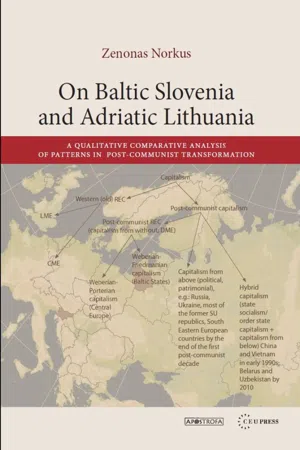
On Baltic Slovenia and Adriatic Lithuania
A Qualitative Comparative Analysis of Patterns in Post-Communist Transformation
- Zenonas Norkus(Author)
- 2012(Publication Date)
- Apostrafa(Publisher)
Within these countries communism was portrayed as socialism, which was the first phase of communism – the highest and ultimate stage of social evolution. The realiza-tion of Karl Marx’s idea of communism was thus delayed until some point in the distant future. The most authoritative list of reforms, obligatory for all com-munist parties that had set out to “build socialism” in their countries, was agreed and signed in Moscow in 1957 by representatives of 64 communist parties attend-ing the fortieth anniversary of the October Revolution. The “Moscow Consensus” included the liquidation of capitalist private property, which was to be replaced with public ownership of the means of production, development of a planned economy, collectivization of agriculture, dictatorship of the proletariat (i.e. politi-cal power monopolization by the Communist Party), and so forth. The critical emic (Marxist) conceptions of the system which appeared in Russia after 1917, and which spread to other countries, are most distinctly represented in the works of the followers of Leon Trotsky. These refer to the system as “deformed socialism” and also as collectivist state capitalism. This differs from traditional capitalism which is based on private ownership, in that the means of production are the property not of individuals, but of a new class of exploiters who own them collectively: the bureaucrat-managers commonly known as the nomenklatura (see e.g. Callinicos 1991; Cliff 1955 (1948), 1964; Djilas 1957 (1955)). According to this view, the social changes, which emerged in Central and Eastern Europe after 1989, were nothing less than the morphing of one “strain” of capitalism into another and amounted to nothing more than a divvying up of the collective prop-erty of the nomenklatura amongst its members, and, therefore, in this way the system returned to capitalism based on private ownership by individuals. eBook - PDF
European Communism
1848-1991
- Ronald Kowalski(Author)
- 2017(Publication Date)
- Red Globe Press(Publisher)
It is to this theme that we must turn. The rise and fall of Eurocommunism Eurocommunism, a term reputedly coined by the Yugoslavian journalist Frane Barbieri in 1975, was a heterogeneous phenomenon whose precise theoretical origins remain disputed. Yet its central purpose was clear. To borrow Trotsky’s aphorism about the significance of Lenin’s April Theses , it can be described as the attempt launched chiefly by the French, Italian and Spanish Communists in the 1970s to re-arm themselves ideologically, in order to build the broader coalitions seen as necessary if they were to acquire some purchase on political power. To understand why this was the case demands a brief survey of the history of Western Communism in Communism in Europe 164 practice since the end of the Second World War, and its failure to advance beyond the ghetto of opposition politics. The Second World War, as Sassoon remarked, provided ‘Western Communists their finest hour’. Their remarkable fortitude in opposing Nazism, certainly after the invasion of the Soviet Union in June 1941, restored their credibility, which had been massively damaged by the con-tortions they had performed in defence of the Nazi–Soviet pact of August 1939. They emerged from the war as major political forces, especially in France and Italy where they won one-quarter and one-fifth of the votes respectively in the first post-war elections. In these countries, and others (Austria, Belgium, Luxemburg and Norway), they had taken part in newly formed coalition governments. Despite their moderation, most evident in their refusal to countenance a revolutionary seizure of power, within two years they again found themselves consigned to the political wilderness, Italy apart. The onset of the Cold War was the primary reason for their expulsion from government, as parties still subordinate to Moscow no longer could be tolerated as partners. eBook - PDF
- Iván Berend(Author)
- 1997(Publication Date)
- Peter Lang International Academic Publishers(Publisher)
The societies of the countries which introduced communism were atomized by the revolution (Russia) or by the war (Central Eastern European countries), during which they also lost a substantial number of their former upper and middle classes, as well as their better educated people. Industrialization and urbanization moved vast masses of peasants to the cities, turning them into workers and a new intelligentsia, and produced a communist version of a mass society. The overall modernization and the upward social mobility were an important way of legitimizing communist regimes, even in such countries where, as in Poland, traditionally anti-communist and anti-Russian sentiment prevailed. Communist regimes referred in their discourse to the ideas of a radiant future, a classless society, social justice, the common cause of workers all over the world, and so on. These ideas found their way only to young zealots, and only in the early stages of the period of real socialism. In a more practical way, identities and solidarities were built not so much with words, as with actual social policies. These consisted, especially after the phase of mass terror, on massive income redistribution and on providing basic material security, albeit on very low level These polices were realized thorough the bureaucratic paternalism of the state As Daniel Chirot aptly observed, communism built its own kind of corporatist society, in which the place of work - the state enterprise - became the main provider of social security .1 ’ It is obvious now that this notion of justice through entitlement 60 Jacek Kochanowicz 14 I use terms communism or communist system in a purely descriptive sense - referring to countries and societies ruled by parties, usually called communist - as much as I am conscious about the unending debate about the proper name for the system in question. 15 Daniel Chirot, “The Corporatist Model and Socialism.” Theory and Society 9:2 (1980). eBook - PDF
Accidental Occidental
Economics and Culture of Transition in Mitteleuropa, the Baltic and the Balkan Area
- Lajos Bokros(Author)
- 2013(Publication Date)
- Central European University Press(Publisher)
All three were reprinted again in a new collection of essays entitled Individualism and Economic Order (The University of Chicago Press, 1948). Subsequent editions of this book constitute now the most common source of references, including that of footnote 19. 18 Accidental Occidental declared goals of Soviet communism. That is why the latter ultimately proved to be unable to achieve its own primary objectives . 21 This conclusion is less important now, after the fall of Soviet commu-nism. Had it been clear a hundred years ago, it would have been possible to avoid one of the most brutal, expensive, inhumane and futile attempts of building a utopian society. Trying to achieve unattainable goals and pursuing them ruthlessly against the will of hundreds of millions through-out a protracted period of time was one of the utmost tragedies of the twentieth century. 1.2. The historical evolution of Soviet communism In late 1917 the Bolshevik revolution was victorious in a geographically extremely vast, closed, poor, still very much underdeveloped and largely agrarian economy completely exhausted and pushed into economic chaos and societal disintegration by a historically unprecedented mecha-nized war. Under these circumstances, to pursue an economic strategy centered on promoting fast reconstruction and growth, especially that of heavy industrial output, was considered important for the new regime not only from the viewpoint of its ideology but it was imperative for sheer survival. In practice, Soviet communist economic and societal governance was born from the Prussian–Russian model of the war economy . That suited the revolutionary party of the Bolsheviks tremendously well. eBook - PDF
Marx and Alienation
Essays on Hegelian Themes
- Sean Sayers(Author)
- 2011(Publication Date)
- Palgrave Macmillan(Publisher)
101 7 Private Property and Communism The distinguishing feature of communism is not the abolition of property generally, but the abolition of bourgeois property. But modern bourgeois private property is the final and most complete expression of the system of producing and appropri- ating products that is based on class antagonisms, on the exploitation of the many by the few. In this sense, the theory of the Communists may be summed up in the single sentence: Abolition of private property. (Marx and Engels, 1978c, 484) Marx defines communism as the abolition of ‘bourgeois property’, that is, private property in the means of production. This familiar formula runs through Marx’s later work. His ideas about what it might mean in practice are developed and filled out in various ways as his political experience accumulates and as his thought matures. These develop- ments are traced by Lenin in State and Revolution (1969b), which gives the classic account of the evolution of Marx’s ideas about communism from 1847, when he wrote Poverty of Philosophy (Marx, 1978a), onwards. Since Lenin’s time, earlier works by Marx have come to light which reveal earlier phases of his thought. 1 In these, as in the later works, com- munism is regarded as the overcoming of private property. In them, however, Marx conceives of property in ways that seem to bear little rela- tion to the familiar juridical idea that he uses later. He treats property 1 These go back to before the time when Marx first identifies himself as a com- munist in 1843–4 (Löwy, 2003, 49–61). Lenin was unaware of The German Ideology as well as what are now usually classified as Marx’s ‘early works’ with the exception of The Holy Family, written with Engels and published in 1845. as an ethical phenomenon. He describes private property as ‘human self- estrangement’, and maintains that communism will lead to the ‘true appropriation of the human essence’ (Marx, 1975e, 348).
Index pages curate the most relevant extracts from our library of academic textbooks. They’ve been created using an in-house natural language model (NLM), each adding context and meaning to key research topics.

