History

Karl Marx and Communism
Karl Marx was a German philosopher and economist who developed the theory of communism, which advocates for a classless society where the means of production are owned collectively. He believed that capitalism would eventually lead to its own downfall and be replaced by communism. Marx's ideas heavily influenced the development of socialist and communist movements around the world.
Written by Perlego with AI-assistance
Related key terms
1 of 5

12 Key excerpts on "Karl Marx and Communism"
 eBook - PDF
Introduction to Sociological Theory
Theorists, Concepts, and their Applicability to the Twenty-First Century
- Michele Dillon(Author)
- 2024(Publication Date)
- Wiley-Blackwell(Publisher)
Karl Marx 37 EXPANSION OF CAPITALISM When you hear the name Karl Marx, it is tempting to wonder why you should be studying his ideas. Marx has been dead for almost 150 years, and communism, the political and social system with which his theoretical vision is associated, has all but disappeared around the world. The dominant communist power of the twentieth century, the Soviet Union, collapsed – an event captured literally by the fall of the Berlin Wall on November 9, 1989. Today, the largest ex-Soviet republic, Russia, has fully embraced capitalism, crystallized by the development of shopping malls even in Siberia and by the expanding global economic reach of Russian billionaire oligarchs, whose ostentatious wealth was foregrounded when Western governments seized their superyachts and sprawling Western properties as one of a number of punitive economic sanctions in response to Russia’s aggressive invasion of Ukraine in 2022. Even more impressively, capitalism has exponentially expanded in China (see Topic 1.1), and the country occupies a pivotal role in the global economy both as a manufacturer and sup- plier of consumer goods, including technology chips, and – with a population of 1.4 billion people – consumers eager to avail of the latest products in the global market. BIOGRAPHICAL NOTE Karl Marx was born in Germany (in Prussia, in 1818) into a middle-class family and com- pleted several years of university education studying law, history, languages, and philos- ophy. Rather than pursue an academic career, Marx turned to journalism and devoted his attention to business and economics, writing about labor conditions during this era of rapid industrialization. The year 1848 was the “Year of Revolutions” in Europe, as workers and ordinary people rebelled against the ruling monarchies in Germany, Italy, Austria, Hungary, and France. eBook - PDF
From Kant to Lévi-Strauss
The Background to Contemporary Critical Theory
- Jon Simons(Author)
- 2002(Publication Date)
- Edinburgh University Press(Publisher)
On the contrary, com-munism is clearly regarded by Marx as one possibility, albeit one which in his view history offers as the ‘solution to the riddle of history’. Other futures are also available to humanity, though none are, in Marx’s view, as desirable from the point of view of genuine human emancipation. This is because it is only communism that confronts the true source of misery and exploitation, which is the ownership by one person over the labour power, and thus creativity, of another. Communism is a necessity from the point of view of the progress of the species; but to say that one form of society is a necess-ity is not to say that history has been programmed in advance to ensure its realisation. Such a conclusion would make a nonsense of everything that Marx says about the vicissitudes of revolutionary action. Capital and the Commodity Form Marx’s work from the 1850s onwards divides more neatly between the political and the economic. As regards the political works which include most notably The Civil War in France (1871) and the Critique of the Gotha Programme (1875), Marx’s principal conclusions con-cerned the importance of class identity in social transformation, and by extension the importance of alliances between classes. What emerges in these works (as in the earlier analyses of the 1848 revolution) is an account of the intensely complex nature of class formation and thus of the highly contingent nature of revolutionary action. It is precisely the complex background against which politi-cal action takes place that necessitated an active and disciplined communist movement to ensure that the proletariat is not led down Simon Tormey 56 the road of compromise with those whose objective class interests clashed with their own. We also gain the impression that Marx believed the revolutions of the capitalist era would be radically different from the bourgeois revolutions of the eighteenth century.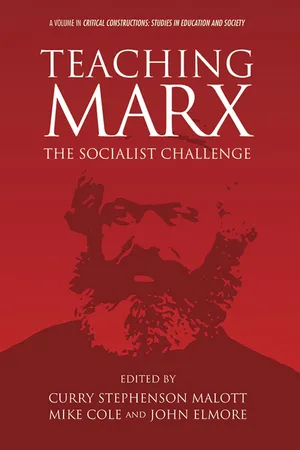 eBook - PDF
Teaching Marx
The Socialist Challenge
- Curry Stephenson Malott, John M. Elmore, Mike Cole, Curry Stephenson Malott, Mike Cole, John M. Elmore(Authors)
- 2013(Publication Date)
- Information Age Publishing(Publisher)
Teaching Marx, pages 3–26 Copyright © 2013 by Information Age Publishing All rights of reproduction in any form reserved. 3 CHAPTER 1 MARX, MARXISM AND (TWENTY-FIRST CENTURY) SOCIALISM Mike Cole INTRODUCTION In this chapter, I begin by briefly introducing Karl Marx. I go on to address the unique strengths of Marxism, as both an analytical framework, and as a harbinger of a non-exploitative future world. In so doing, I look briefly at some historical challenges to it. I then outline two central tenets of scien- tific socialism (how Marx’s co-writer Friedrich Engels described Marxism). The first is Marx’s Labour Theory of Value which provides an explanation of the pivotal position of social class as the basis of surplus value and profit under capitalism. The second is the materialist concept of history which stresses how deeply the processes of production affect our lives. I then raise some common objections to Marxism and socialism, and respond to them, concluding with a brief discussion of the defining characteristics of twenty- first century socialism. This discussion is concretized in chapter 11, where I look at developments in the Bolivarian Republic of Venezuela. 4 M. COLE KARL MARX Karl Marx was born on May 5, 1818 in Trier, Germany. He spent his whole life as both a political activist supporting the struggles of working people worldwide, and as a prolific and most influential writer. His best known political tract, co-written with his collaborator and close friend, Frederick Engels, is The Communist Manifesto, first published in English in 1848. His most celebrated economic works are the three-volume series, Das Kapital, the first volume of which was published as Capital in England in 1887. In Capital Marx developed the theory of surplus value (see later in this chap- ter) which attempted to demonstrate that capitalism was objectively a sys- tem that exploited the working class.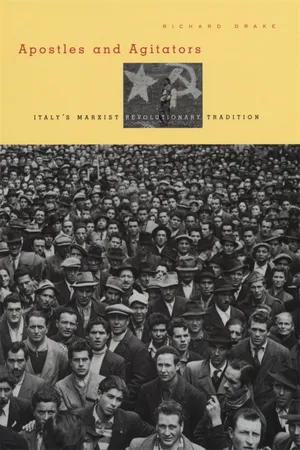 eBook - PDF
Apostles and Agitators
Italy's Marxist Revolutionary Tradition
- Richard Drake, Richard DRAKE(Authors)
- 2009(Publication Date)
- Harvard University Press(Publisher)
From the beginning, Marxism presented itself as a master plan for the transformation of the world into a garden of earthly delights. 18 As a movement, Marxism developed along both the theoretical line laid out by Marx in The German Ideology and the practical line of Engels in The Condition of the Working Class in England. Marx aspired to a per-fect union between theory and practice. In “Theses on Feuerbach” (1845), he wrote: “The philosophers have only interpreted the world in various ways; the point, however, is to change it.” 19 The perfect union that Marx had in mind, therefore, was not one of parity. Theory clearly was to be the handmaiden of practice. The mixing of science with a specific political agenda would draw the withering criticism of numer-ous ideological opponents in the liberal, the conservative, and even the socialist camps. Nevertheless, Marx always enjoyed the support of devoted admirers, such as Engels, who sustained him in his long and arduous struggle to apply the laws of history to the cause of the proletariat. Marx’s conviction that a proletarian revolution was the only cure for the disease of capitalism became the starting point for his own politi-cal activity. While living in Brussels, he established the Communist Correspondence Committee as a coordinating organization for com-munist groups throughout Europe. He soon revealed his domineering nature and clashed with many of the correspondents. In all of these disputes, Marx sought to advance the notion that socialism had to be based on science, that is, on the materialist conception of history, not on sentiment. For Marx, Pierre Joseph Proudhon (1809–1865), the most famous French socialist thinker of the day, embodied the left’s problem with sentimentality. In The Poverty of Philosophy (1847) Marx assailed Proudhon’s ignorance of economics and the effect of material relations on all other relations. eBook - PDF
- Robert V. Daniels(Author)
- 2008(Publication Date)
- Yale University Press(Publisher)
Starting as an intellectual creation by individuals, Marxism became an official rationale of governmental policy and virtually a state religion. Thanks to the enforced manipulation of theory, the pronouncements of Soviet Marxism after Stalin achieved supremacy in cannot be taken seriously as genuine philosophi-cal efforts. The core of Marx’s theory of history, a point of view to which he adhered with but slight shifts of emphasis from the mid- s to the end of his life, is the doctrine of “historical materialism.” Marx and Engels had clearly established this approach when they wrote in The German Ideology in – , “The social structure and the state are continually evolving out of the life process of defi-nite individuals, but of individuals not as they may appear in their own or other people’s imagination, but as they really are, i.e., as they are effective, produce materially, and are active under definite material limits, presuppositions, and conditions independent of their will.” Against the prevailing philosophical ide-alism of their epoch, Marx and Engels exclaimed, “Life is not determined by consciousness, but consciousness by life.” 3 Economic conditions and economically oriented actions, therefore, con-stituted the base of the social structure and as such profoundly influenced all other aspects of human existence and activity. Marx succinctly expressed this model of the social system in the preface to his Contribution to the Critique of Political Economy, published in : “In the social production which men car-ry on they enter into definite relations that are indispensable and independent Marx and the Movement of History of their will; these relations of production correspond to a definite stage of development of their material powers of production. eBook - PDF
The Philosopher's Voice
Philosophy, Politics, and Language in the Nineteenth Century
- Andrew Fiala(Author)
- 2012(Publication Date)
- SUNY Press(Publisher)
We can see then that the Communist Manifesto is enmeshed in the problem with which we began. Marx’s theory and practice are merely the theory and practice of one party within the polis. His political philosophy addresses the formation of political identity within concrete political struggle. It is not philosophy but politics. Marx understands himself as thus merely the spokesman for one Party within the political struggle. Marx is the philoso- pher of the working class in the sense that he speaks both for and to the working class. Theory and Practice in Capital The centralization of the means of production and the socialization of labor reach a point at which they become incompatible with their capitalist integument. This integument is burst asunder. The knell of capitalist private property sounds. The expropriators are expropriated. —Marx, Capital 58 The political interpretation of Marx I have proposed makes the most sense when applied to Marx’s explicitly political works, such as the Commu- nist Manifesto. To establish my thesis more clearly, I will examine the way in which Marx’s less overtly political work is nonetheless engaged in political Marx’s Voice 223 activity. To this end let us jump into the complexities of Marx’s most theo- retical work, Capital. Capital, written by Marx in his exile in London during the 1860s, is Marx’s attempt to make the reality that grounds the revolution- ary will of the proletariat manifest to itself in order to facilitate the political activity of the proletariat. The revolutions of 1848 had failed to bring about lasting universal change and had instead resulted in the nationalism and re- action characteristic of the Second Empire in France and the rise of Bismarck in Germany. eBook - PDF
Marx, Justice and History
A Philosophy and Public Affairs Reader
- Marshall Cohen(Author)
- 2014(Publication Date)
- Princeton University Press(Publisher)
Marx's theory of communist society derives from two in- tellectual currents—one acknowledged in the Manifesto, the other not. In the section of Part Three entitled "Critical-Utopian Socialism and Communism," after distinguishing his position from Babeuf's equalitarian communism, he acknowledges his debt to Owen, Fourier, and Saint-Simon. In the section entitled "German or 'True' Socialism" he conceals his debt to the philosophical communism of Hess, which is descended, through Cieszkowski and Feuerbach, from Hegel's the- ory of community. Among these thinkers, Feuerbach is clearly influenced by philo- sophical materialism; and in The Holy Family Marx claims for this tradition Fourier, Owen, Babeuf, Buonarroti, and Dezamy. Yet even if it is justifiable to call these thinkers philosophical materialists, it is not justifiable to conclude that they take a scientific approach to social change. The antecedents of Marx's theory of communist society are predominantly millenarian. As prophets of a New Jerusalem, Babeuf, Cieszkowski, and Hess rival or surpass Fourier, Owen, and Saint-Simon. To examine Marx's intellectual development is to dis- cover that he had formulated his ideal of communism—through a moral critique of capitalist culture and a call for a rebirth of commu- nity—before he adopted the position of philosophical materialism or developed his sociology of change. To trace the different sources of the two components of Marx's theory of history arouses a strong suspicion that they are incompat- ible. But it does not amount to proof, because it does not eliminate the possibility that Marx united these disparate elements in a complex 220 A Philosophy & Public Affairs Reader but consistent whole. For proof of incompatibility, it is necessary to turn from theoretical antecedents to practical consequences. On one practical consequence of the first importance, the Manifesto and the Preface present opposing positions. eBook - PDF
Marxian Political Economy
Theory, History and Contemporary Relevance
- B. Milward(Author)
- 2000(Publication Date)
- Palgrave Macmillan(Publisher)
Part I Theory and History 2 Marx's Method Introduction Marx's method represents a distinctive approach to the study of politi- cal economy and is often considered to be an alternative to method- ologies employed in economic analysis that are based on the natural sciences. It is important to note that Marx arrived at economics via philosophy and his analysis has its roots in social theory. As a result, Marxian political economy can be considered to be much more com- prehensive in its analysis than other schools of economic thought. However, the distinctive nature of the approach leaves it open to criti- cism from more 'orthodox' methodologies. In particular, Popper (1972) argues that Marx employs 'historicism' in his view that there is a law of historical development, and this leads Marx to adopt 'economic deter- minism', which for Popper is not acceptable because human behaviour is individual in character and can therefore change the course of his- tory. However, this charge made by Popper does not stand close scrutiny, as Marx would undoubtedly agree that this could be the case but that, while human beings do make their own history, it is not under conditions of their own choosing. Rather, they are constrained by the institutional and social structures that are associated with the phase of development in which they exist. Because Marx is concerned with the dynamic process of history, and the fact that he was writing in the nineteenth century, perhaps the best manner in which to view his work is as a framework for analysis that can be transferred to suit the time and the place and therefore must be adapted to the prevailing circumstances. One may suggest that this is precisely the process that was undertaken by Lenin, using the frame- work for a country that had not reached capitalist maturity, and for 13 14 Marxian Political Economy Gramsci in Italy and Lukacs in Hungary. We could also include Mao in China and Castro in Cuba. eBook - PDF
- Syed Farid Alatas, Vineeta Sinha(Authors)
- 2017(Publication Date)
- Palgrave Macmillan(Publisher)
This is a reflection of alienation, the separation between the producer and the product. The social world, actually a product of human action, appears to humans as something external to and coercive of them. Class and Class Consciousness in Capitalist Society Capitalism is maintained by the rule of one class over another, in both material and ideal terms. Marx did not explicitly define class but he uses the concept throughout his works. The Manifesto of the Communist Party by Marx and Engels was commissioned by the Communist League, an international association of workers. Published in 1848, it represents the theoretical and practical programme of the league. The Manifesto begins by saying that the written history of all societies is the history of class struggles. 76 In other words, the motive force of history is class struggle and is characterized by the opposition between classes such as lord and serf, bourgeois and proletarian. Society has always been arranged in a manifold gradation of social rank. In feudal 75 Marx, Capital, vol. 1, 72. 76 Marx and Engels, Manifesto of the Communist Party, 32. 68 S.F. Alatas society there are lords, vassals, guild-masters, journeymen, apprentices, serfs. Marx and Engels refer to these as classes. Bourgeois society that arose from the ruins of feudal society had not done away with class conflict. It established new classes with new conditions of oppression. The new class structure is also simplified with two great hostile camps: bourgeoisie and proletariat. eBook - PDF
Classical Social Theory in Use
Interpretation and Application for Educators and Other Non-Specialists
- Robert Bickel(Author)
- 2013(Publication Date)
- Information Age Publishing(Publisher)
Classical Social Theory in Use, pages 11–139 Copyright © 2013 by Information Age Publishing All rights of reproduction in any form reserved. 11 Karl Marx T hroughout his adult life, Marx was a relentless and insightful critic of prevailing academic and professional knowledge. This was abundantly evident as early as the Economic and Philosophic Manuscripts of 1844 (Marx, 1844/ 2004), a collection of notebooks that give voice to Marx’s early think- ing on the nature of capitalism and its consequences for human beings. The Manuscripts were written while the 26-year-old Marx was in political exile in Paris, fleeing prosecution by the Prussian authorities for the radical character of his articles in Rheinische Zeitung, a weekly newspaper that he co- founded and edited. The following year, Marx was forced to leave France, and for a time, he lived in Brussels. He subsequently settled in London, where he lived and worked until his death in 1883. Marx never sought to publish the Manuscripts, which helps explain their sometimes sketchy, sometimes repetitious, and otherwise unfinished character. In fact, the Manuscripts were not discovered among Marx’s col- lected papers until the early 1930s. When they first appeared in print in the 1950s, they were judged to be essential reading for anyone with a serious interest in Marx and his scholarship (Bottomore, 1956). Here was the early Marx, introducing and explaining at length the seminal concept of alien- ation, an idea that is less conspicuous and less well developed in his later, better-known work. 12 Classical Social Theory in Use Classes and Class Struggle For readers with a casual, popularized knowledge of Marx, it will come as no surprise that he begins the first section of the first manuscript with a reference to a fierce struggle between capital and labor. eBook - PDF
- Gerard Delanty, Engin F Isin, Gerard Delanty, Engin F Isin(Authors)
- 2003(Publication Date)
- SAGE Publications Ltd(Publisher)
The radical republicanism of Marx’s earlier youth seems to have recon-nected here with the demands of the Red Republican and Notes to the People . The point, though, is simply that Marx’s own historical sociology, as evidenced most clearly through his extended journalism (although obviously in evidence in The German Ideology ), depended upon an awareness of national and local specificity, which could be incorporated into a wider theory of historical change. The subtlety of his own writing clearly shows that this is not best understood as a one-dimensional and mechanical set of correspondences. CONCLUSIONS Against those who criticize what we might, somewhat tenuously, call the middle-period Marx associated with ‘scientific’ historical materialism, by examining some of the con-texts and illustrations of his writings, a better appreciation of the overall range, depth and concern for historical context in his historical sociology is at least possible. By so doing, it is to be hoped that perhaps the resources neces-sary to rescue Marx, should he need it, from what E.P. Thompson famously called the KARL MARX AND HISTORICAL SOCIOLOGY 23 ‘enormous condescension of posterity’ might be more clearly visible. For the impact of Marx on the subsequent development of historical sociology has been profound, and yet his own account of historical sociology is today routinely criticized for its lack of atten-tion to historical contingency. In particular, his theories have been severely challenged by the raft of studies that have recently appeared, inspired more by Weber and his ‘ideal-type’ methodology, and focusing on social evolution and the concept of power, for example. The contemporary predominance of neo-Weberian historical sociology, though, seems to have been brought about somewhat at Marx’s expense when it in fact need not have been. eBook - PDF
- A. Hess(Author)
- 2001(Publication Date)
- Palgrave Macmillan(Publisher)
2 Karl Marx’s Critique of Political Economy General presuppositions and/or theoretical affiliations and influ- ences: historical materialism; German philosophy (G.F.W. Hegel, Ludwig Feuerbach), political economy (Adam Smith, David Ricardo, Jean-Baptiste Say, John Stuart Mill), Charles Darwin. Model/paradigm(s): capitalism (200 years). Concepts: labour power, exploitation, class struggle, classes, class as a social relationship, class consciousness, forces of production, relations of production. Empirical environment(s): Germany, England, France, Russia, USA. Karl Marx (1818–83) was not a sociologist. Yet modern contempo- rary sociology would not be the same and certainly at a loss if the contributions of Karl Marx were not to be taken into account. Marx himself did not call his approach ‘sociology’ but rather critique of political economy (Marx, 1983: 158–61). ‘Critique of Political Economy’ can have a double meaning. It could mean that one is critical of political economy; thus distancing oneself from the field of criticism, i.e. political economy. Critique of Political Economy could also mean the criticism of society from the standpoint of politi- cal economy. Traits of both perspectives can be found in Marx’s work. If one reads Marx, the first impression is that he writes pri- marily about the economic sphere; production, labour, and eco- nomic exploitation are the words that appear time and time again – and after all: is not Marx’s most famous work called Das Kapital? Yet despite the fact that Marx, for the most part, uses this ‘economic’ lan- guage, it does not automatically follow that Marx’s thought is purely 10 Karl Marx’s Critique of Political Economy 11 economic or economistic. In Marx’s work we can also find traces that clearly separate him from political economy.
Index pages curate the most relevant extracts from our library of academic textbooks. They’ve been created using an in-house natural language model (NLM), each adding context and meaning to key research topics.

