Politics & International Relations

Friedrich Engels
Friedrich Engels was a German philosopher, social scientist, and political theorist who co-authored "The Communist Manifesto" with Karl Marx. He is known for his contributions to Marxist theory, particularly his analysis of capitalism and its impact on society. Engels also played a key role in shaping the socialist and communist movements in the 19th century.
Written by Perlego with AI-assistance
Related key terms
1 of 5

8 Key excerpts on "Friedrich Engels"
 eBook - PDF
Engels @ 200
Reading Friedrich Engels in the 21st Century
- Frank Jacob(Author)
- 2020(Publication Date)
- Büchner-Verlag(Publisher)
54 van der Linden, »Friedrich Engels’s Herkunft,« 18. 55 Krätke, »Friedrich Engels,« 59. 56 Fülberth, Friedrich Engels, 12. 57 Paul Lafargue, »Persönliche Erinnerungen,« in Friedrich Engels oder: Wie ein »Cotton-Lord« den Marxismus erfand , ed. Michael Krätke (Berlin: Dietz, 2020), 185; van der Linden, »Friedrich Engels’s Herkunft,« 18. Engels had saved suffi-cient money for his later life, and when he died his fortune still counted for more than 30,000 Pounds (approximately more than 4 million Euro today). 58 Georg Fülberth, »Endlich angekommen: Friedrich Engels’s Londoner Jahre 1870 – 1895,« in Friedrich Engels: Ein Gespenst geht um in Europa — Begleitband zur Engelsausstellung 2020 , ed. Lars Bluma (Wuppertal: Historisches Zentrum Wuppertal, 2020), 182 – 195. 59 Ito, »Realismus und Utopismus,« 32. Engels @ 200: An Introduction 15 power in the next decade. 60 At the same time, however, he declared a year later that this was not the final goal for German socialism, as one would rather have to consider the socialists to be revolutionaries who were not intending to dictate the future of human society but wanted to achieve freedom for the masses so that they could decide this for themselves. 61 The impact of the political ideas of Friedrich Engels is, at the same time, important to understand the development of his friend Karl Marx, 62 as it was their friendship 63 and intellectual cooperation that would be responsible for a new interpretation of human history and progress alike. The lives and works of the two friends eventually be-came so interwoven that it is quite challenging to separate them. 64 However, Engels not only supported Marx intellectually, he also sup-ported the latter and his family financially, and in 1851 even accepted fatherhood for the child Marx had had with Helene Demuth, the family’s maid, and thereby saved Marx’s marriage. eBook - ePub
- Dirk Berg-Schlosser, Bertrand Badie, Leonardo Morlino, Dirk Berg-Schlosser, Bertrand Badie, Leonardo Morlino, SAGE Publications Ltd(Authors)
- 2020(Publication Date)
- SAGE Publications Ltd(Publisher)
7 Marx and Marxism in Politics Dingping GuoIntroduction
Marxism has been defined and studied as a political theory, political ideology and political movement. In political studies, Marxism refers to a specific school of social and political theory about human life, historical development, capitalist crisis and communist revolution, which was developed by Karl Marx and Friedrich Engels during the mid-to-late 19th century, and subsequently elaborated on by their disciples from various backgrounds all over the world. Although there are inconsistencies and contradictions in Marx's theory during the different periods of its development, and there are considerable debates and disputes over its nature and structure, some basic consensus can be reached based on an analysis of Marx's works and the studies on the subsequent evolution of Marxist theory. Marxism is not only one of the most important social and political schools of thought, but also the guiding ideology in the communist revolution and the socialist construction of many countries worldwide.Capitalist Development and the Birth of Marxism
Karl Marx, one of the most famous and influential theorists of the modern historical age from whom the socialist or communist movements have derived their ideas, was not only a political thinker but also social philosopher and economist whose research ranged widely over many fields. Marx has had a profound impact on the thoughts and actions of people in many countries since the mid 19th century, and in the 21st century he is still regarded as the greatest instructor by the political left, including the adherents of communist parties, and is derided as a source of political and social chaos by the political right. The ideas and programs developed by Marx and Engels have been generally called Marxism.Born in Trier, German Rhineland, into a Jewish family on May 5, 1818, Karl Marx received a good education and displayed great potential as an outstanding student. During his student days at the universities of Bonn and Berlin, Marx studied law and the history of philosophy, took a strong interest in the works of Georg Wilhelm Friedrich Hegel and joined a student/professor group called the ‘Young Hegelians'. Marx submitted his doctoral dissertation at the University of Jena in 1840 and received a doctoral degree the following year. This dissertation is entitled ‘The Difference between the Democritean and Epicurean Philosophy of Nature’ and can be regarded as the starting point of his transition from idealism to materialism (Jessop, 1999: 98). After his initial failure to establish an academic career, his liberal political views led him to find employment as an editor of a radical newspaper in Cologne, Rheinische Zeitung eBook - ePub
The Life, Work and Legacy of Friedrich Engels
Emerging from Marx’s Shadow
- Eberhard Illner, Hans A. Frambach, Norbert Koubek, Eberhard Illner, Hans A. Frambach, Norbert Koubek(Authors)
- 2023(Publication Date)
- Bloomsbury Academic(Publisher)
CHAPTER 2 Engels on Marx: Biography as politicsWilfried NippelFigure 2.1 World History: The Communists , 1848, Fliegende Blätter, Munich. © In the public domain.After Marx’s death, Friedrich Engels explained what Marx had called their ‘partnership’1 in various terms. He had, he said, always been happy to play ‘second fiddle’ to Marx, but when ‘in matters of theory’ he had been called upon to deputize for Marx, he had – he admitted in a private letter2 – ‘inevitably made blunders’. In a later publication he saw his role as that of ‘representing our views in the periodical press, specifically against our opponents, so that Marx had time to complete his major work. Thus it fell to me to present our approach for the most part … in polemical form’.3In a celebratory piece for Engels’ birthday in 1887, his ‘pupil’ Karl Kautsky wrote – in close collusion with his friend and master – that Marx ‘had systematically elaborated the jointly developed theory for the learned world’, while Engels had defended it polemically against all comers, addressing ‘the great questions of the present day … and the attitude to these issues taken by the proletariat’. At the same time he emphasized that, with Anti-Dühring (published in 1877–8, i.e. during Marx’s lifetime), Engels had composed ‘the foundational work of modern socialism’, in which ‘the most important insights of the whole of modern knowledge are presented from the standpoint of the Marx-Engelsian materialist dialectic’.4 In an obituary, Eduard Bernstein, Engels’ other ‘master pupil’, called him ‘the interpreter and transmitter of the major aspects of our movement’. History will see him as ‘the co-founder of modern scientific socialism’ and grant him ‘the appropriate place beside Karl Marx that he had always modestly declined to assume’.5 eBook - PDF
- Edward A. Purcell(Author)
- 2003(Publication Date)
- Yale University Press(Publisher)
For example, Marx, in the third volume of Capital, teaches that the political force of the state, originally determined by economic relations, can itself in turn affect economic relations. Engels, in an 1890 letter, directly acknowledges that earlier he and Marx had somewhat exaggerated the significance of the economic factor in history. The production and repro-duction of real life, he says here, is the decisive moment in the final instance, but it is not the only one determining the course of history. In addition, various elements of the political and legal superstructure over the economic base, forms of state organization, forms of law, and, finally, all possible mental reflections of the class struggle (i.e., political theories and juridical, philosophi-cal, and religious views) influence the course of historical development. 17 In a word, apart from economic factors, Engels recognizes the significance of intel-lectual factors in history. It seems to me, however, that critics who see Engels's words as tantamount to a departure from the basic principles of historical materialism somewhat exaggerate the significance of the change in him. In fact, the ideas expressed by Engels in the last years of his life represent rather an addendum to, not a departure from, Marx's original point of view. 18 Although Engels does speak about ideas as causes of historical development, all the same he does not take them for primary causes. As before, he treats ideas as mental reflections of the class (that is, economic) struggle, and describes political and legal institutions as the superstructure over the economic base; finally, production remains for him the ultimately determining element in history. 19 In short, Engels's thought comes down to saying that the only primary factor in history —that which in the last instance determines its direction —is an economic factor, production. All other causes influencing the course of historical develop-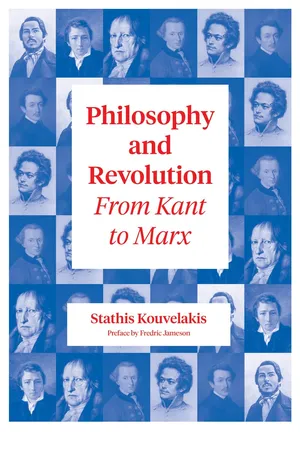 eBook - ePub
Philosophy and Revolution
From Kant to Marx
- Stathis Kouvelakis, G M Goshgarian, G. M. Goshgarian(Authors)
- 2018(Publication Date)
- Verso(Publisher)
89Without disavowing his earlier positions, Engels completely changes their thrust, repeating certain of Hess’s formulations of 1841 in what is virtually their original form. Appearances notwithstanding, he now says, it is England which is in the forefront of the revolutionary development of world history: ‘the significance of the English in recent history is less conspicuous and yet for our present purpose it is the most important’.90 This importance stems from the fact that the English are representatives of the social, a synthesis of ‘the Christian spiritual principle’ of the Germans – religion and the Church – and ‘the Ancient materialist principle’ of the French – politics and the state. Before achieving this synthesis, the English had to contend with the contradiction between the two, owing to their twin origins, French and Germanic;91 but they succeeded in externalizing this division, transforming it into a ‘source of energy’ and objectifying it in the form of practical activity. Simultaneously preoccupied with concrete activity and the salvation of their souls, simultaneously religious and irreligious, the English turned towards industry, trade and colonial conquest. Thus they struck out on the road of anupheaval which is all the more momentous the more quietly it is brought about, and … will therefore in all probability attain its goal more readily in practice than the political revolution in France or the philosophical revolution in Germany. The revolution in England is a social one and therefore more comprehensive and far-reaching than any other.… The only true revolution is a social revolution, to which political and philosophical revolution must lead.92 eBook - PDF
- A. Hess(Author)
- 2001(Publication Date)
- Palgrave Macmillan(Publisher)
But Engels also knew his comrades well. If they approached their fellow workers with the Manifesto in hand, people would resist. Engels suggested thus to Sorge, that to convince, enlighten and ‘instruct’ people ‘… it must be done in English: the specific German character must be laid aside’ (1953: 164). Yet such a language could Karl Marx’s Critique of Political Economy 23 only hide Engels’ own weaknesses and contradictions when it came to America: on one hand he promotes an openness to the new and peculiar conditions of the American working class – especially their immigrant experience; on the other hand Engels was representative of peculiarly German intellectual arrogance – in terms of being the theoretical leader or spearhead convinced of the path that would lead to socialism. Engels’ ambivalence concerning America became obvious when visiting the US in 1888. While crossing the Atlantic on his way to New York Engels began taking notes which showed the usual intellectual arrogance of a man of Kultur. Yet, once in America, things obviously changed. Through personal experience Engels seemed close to rejecting easy answers concerning the United States. He was obviously deeply impressed by what he saw – he never finished the article he intended to write about his American experience. It should be clear by what has been said so far, that in both Marx’s and Engels’ use of the critique of political economy, and in their ‘small writings’ an unresolved tension exists, on one side the ten- sion that arises through attempting to make American reality fit into the critique of political economy; on the other side, as a result of the moral values, high hopes and aspirations of Marx and Engels. Such contradictions were avoided by another classic sociologist for whom class struggle was not the motor of history, but whose work resembles in many ways that of Karl Marx, and continues where Marx stopped: Max Weber. 24 Concepts of Social Stratification
- V. Kubalkova, A. Cruickshank(Authors)
- 2015(Publication Date)
- Routledge(Publisher)
Marx and Engels on international relationsNatural science will one day incorporate the science of man, just as the science of man will incorporate natural science; there will be a single science. Karl MarxTo study any one aspect of Marx's work is an exercise full of frustration: on the one hand one should have a familiarity with almost every field of human knowledge,1 with the theories that his polemical writings repudiate,2 with the historical circumstances in which he wrote each of his works, and with the languages he used or in which he freely quoted.3 On the other hand, since Marx has dominated the political horizons of this century 'one cannot help but feel that everything has been said about him that is possible to say'.4 Perhaps this may be one of the reasons why specialists in particular aspects of social science but who are not experts on Marx feel inhibited if not debarred from undertaking such research into those fields which would seem to be identical with their own. The hardships and pitfalls involved seem not to be worth the possible fruits of their labours since, as is sometimes contended, even where concepts are similar and would seem to be direct ancestors of some contemporary version, the complexity of events — and often terms used to reflect them — has become immeasurably greater and the analysis of the 'prehistoric' version must be of diminished relevance.5Thus, we may find it strange that however carefully marxologists have scrutinised Marx's work, what he had to say on the subject of international relations has been rather neglected. Whether or not it is also because international relations constitutes a problem of a possibly intractable nature for marxism,6 the fact is that it has been acknowledged only on the level of empirical politics and ideological controversy and 'it is still too little an appreciated issue in the context of a thoroughgoing theoretical analysis of Marxian thought'.7 eBook - ePub
Modern Criticism and Theory
A Reader
- Nigel Wood, David Lodge(Authors)
- 2014(Publication Date)
- Routledge(Publisher)
1 Karl Marx and Friedrich Engels
DOI: 10.4324/9781315835488-1Introductory note
Marx (1818–1883) and Engels (1820–1895) first met in Cologne in 1842, but their most productive working period was in Britain from 1845 on, in both Manchester and London. These extracts from The German Ideology (written, 1845–46; published, 1932) illustrate what they regarded as a materialist view of history in their first large-scale attempt to formulate the bases of their disagreement with the ideas of G.W.F. Hegel (1770–1831) and his imitators, the young Hegelians. Principally in his Phenomenology of Spirit (1807), Hegel had conceived of the historical process as the working out of a dialectic whereby meaning and truth are never fixed entities, but are rather staging posts in a progress towards a basic unity or Geist (‘Spirit’) when there would be an absolute knowledge that the world was really an emanation of spiritual understanding or contemplation. Reason is an important tool in this, but it is only that: Geist is the highest form of enlightenment, and its attainment is the goal of all historical striving, a process of periodic Aufhebung, or upheaval/cancellation that introduces emergent social forms amidst residual practices – but the motive force is thought guided by reason.This reassuring sense of history, that it is a record of gradual improvement as Man develops an awareness of others, reflected well on much of the nineteenth-century’s rapid material progress, yet Marx and Engels were more struck by the unequal distribution of its benefits, and that history seemed to provide more of an account of material struggle and occasional decline. The theory of history they favoured is most clearly expressed in the Preface to Marx’s A Critique of Political Economy (1858–59), where a consideration of ‘material conditions of life’ is a way of understanding many abstract and apparently separate beliefs: ‘It is not the consciousness of men that determines their being, but, on the contrary, their social being that determines their consciousness.’ Furthermore, in order to be socially and materially productive (in ‘the social production of their life’), Man enters into ‘definite relations that are indispensable and independent of their will’ (Karl Marx: selected writings, ed. David McLellan [1977], p. 389) The basic – and systemic – economy of life, how one produces and under what conditions, is the prime motive force, refracted within superstructural prohibitions and supposed freedoms allowed by legal and educational systems as well as religious codes. The Base determines human behaviour in ways that are often hidden from individuals by superstructural forces that give the impression that they are open to change and evolution; if they are, then their effect will not be significantly different so long as the capitalist system prevails. In many of the writings collected together in the Economic and Philosophic Manuscripts of 1844 (first pub. in 1932; trans. 1959), it is clear that Marx was struck by the alienation that the working classes experienced, a desperation so deep that it created a hopelessness about any changes to their condition. Appropriating the work of Ludwig Feuerbach, most consistently his views in The Essence of Christianity (1841), Marx and Engels drew a clear line between their investigations and the Enlightenment faith in rational self-improvement, noted in Rousseau and Condorcet as well as Feuerbach. The object of philosophy is to have a material effect on the conditions of life, not to accustom men and women to their lot. In the Manifesto of the Communist Party (1848) and Capital
Index pages curate the most relevant extracts from our library of academic textbooks. They’ve been created using an in-house natural language model (NLM), each adding context and meaning to key research topics.

