Politics & International Relations

Rosa Luxemburg
Rosa Luxemburg was a prominent Marxist theorist and revolutionary socialist who played a key role in the German and Polish labor movements. She was a fierce critic of capitalism and imperialism, advocating for international solidarity and workers' rights. Luxemburg's ideas on democracy, class struggle, and the revolutionary potential of the working class continue to influence leftist political thought.
Written by Perlego with AI-assistance
Related key terms
1 of 5

11 Key excerpts on "Rosa Luxemburg"
 eBook - PDF
- Patricia Owens, Katharina Rietzler(Authors)
- 2021(Publication Date)
- Cambridge University Press(Publisher)
13 Kate Evans, Red Rosa: A Graphic Biography of Rosa Luxemburg (London: Verso, 2015). 14 Nettl, Rosa Luxemburg. 15 Hannah Arendt, “A Heroine of Revolution,” New York Review of Books, October 6, 1966; Sidonia Blattler, Irene M. Marti, and Senem Saner, “Rosa Luxemburg and Hannah Arendt: Against the Destruction of Political Spheres of Freedom,” Hypatia 20.2 (2005): 88–101; Tamboukou, “Imagining and Living the Revolution.” 16 Peter Hudis (ed.), The Complete Works of Rosa Luxemburg, Volume I: Economic Writings I (London: Verso, Kindle Edition, 2013); Peter Hudis and Paul Le Blanc (eds.), The Complete Works of Rosa Luxemburg, Volume II: Economic Writings II (London: Verso, Kindle Edition, 2015); see also Stefanie Ehmsen and Albert Scharenberg (eds.), Rosa Remix (New York: Rosa Luxemburg Stiftung, 2016). 56 Kimberly Hutchings Within this context, it is interesting to speculate as to why, within the field of IR, even in work that does focus on Marxism, Luxemburg rates only passing mention compared to figures of her contemporaries, such as Lenin, Bukharin, Hilferding, and the Austro-Marxists. 17 The Marxist or Marxist-inspired theorists that have contributed to IR over the past thirty years are much more likely to reference Gramsci, Trotsky, or members of the Frankfurt School than Luxemburg – even when these thinkers are echoing aspects of her ideas. In one of the few existing IR texts that deals specifically with the history of Marxist thought on the international, Linklater’s Beyond Realism and Marxism (1990), Luxemburg merits only a mention. I suggest that there are two different reasons for the relative neglect of Luxemburg’s work in IR: first, a historical reason relating to the Cold War context (1950s–1970s) in which IR organized the produc- tion of teaching of IR knowledge in terms of three key “isms”: realism, liberalism, and Marxism.
- Riccardo Bellofiore(Author)
- 2009(Publication Date)
- Routledge(Publisher)
re-evaluation of an original tradition in the Polish case. These events and the topics represent on the whole a very rich and fascinating chapter in the history of socialist political culture, to which it would be worthwhile to dedicate oneself, but, on this occasion, I would only like to clarify the role of Rosa Luxemburg in a specific moment of the European socialist movement, that is, in the years around the time of the First Russian Revolution up to the First *English text revised by August Viglione. World War. In these years Rosa Luxemburg’s thought on trade unions and the party is particularly rich and original in respect of the classical approaches to these subjects in the Marxism of the Second International. Her conceptions, however, cannot be considered as a systematic alternative elaboration; they should more likely be considered as replies to the problems caused by the geographic expansion of socialism, by the growth of social and political experience of the working-class movement, by the new events the movement had to cope with. Between East and West I believe that an essential way of interpreting Luxemburg’s theoretical and political contribution in this historical period is the understanding of her particular position in the international socialist movement. This was already indicated by various scholars, but perhaps not fully developed. Rosa Luxemburg plays a very stimulating and visible role—which differentiates her from other ‘travellers’ of the European Left, such as Karl Radek and even the more influential Parvus 2 —as a binding figure between East and West (Schmidt, 1988), in particular with regard to the entry onto the scene of the labour movement in the Russian Empire and the political and organizational developments of this movement in the area dominated by the ‘model party’ of the Second International, the German Social Democratic Party (SDP) eBook - PDF
- F. L. Carsten(Author)
- 1985(Publication Date)
- Hambledon Continuum(Publisher)
In the columns of this paper and at German Party congresses she crossed swords with Eduard Bernstein, who had just published his articles on 'Problems of Socialism 4 , emphasising the evolutionary transition from capitalism to socialism and 'revising' orthodox Marxism in a Fabian sense. 1 In the columns of Die Neue Zeit Rosa Luxemburg soon crossed swords with another redoubtable figure of the international socialist movement, V. I. Lenin, on the question of the organisation of Russian Social Democracy and the powers of the central committee of the party, which showed that she was well aware of the dangers threatening the revolutionary movement from within. There too she commented vigorously on the Russian revolution of 1905 and discovered in it a new weapon of primary importance, the political mass strike, which she attempted to transfer to Germany. Her close association with Kautsky came to an end after some years during which she learned to distrust his Marxist jargon and to doubt the readiness of the Social Democratic leaders to accompany their revolutionary works by similar deeds. During the years preceding the outbreak of the First World War Rosa Luxemburg became the acknowledged theoretical leader of a left wing within the German Social Democratic Party, whose adherents claimed that they were the only true heirs of Marx's revolutionary ardour. eBook - ePub
- Margaret Goldsmith(Author)
- 2022(Publication Date)
- Routledge(Publisher)
Rosa Luxemburg (1870–1919)Many of the revolutionary women of the nineteenth century were great and romantic figures whose heroic gestures inspired the masses, but none of them made a lasting contribution to revolutionary thought. In fact, it must be admitted that few of them thought clearly at all. Many of them were outstanding examples, but none of them were leaders, none of them were of international importance.Rosa Luxemburg, the leader of the German Spartakusbund during the Great War, and the founder of the German Communist Party, was one of the first women whose mind, and whose actions, have left a permanent impression on the international revolutionary movement. She is generally acknowledged— by friends as well as enemies—to be one of the outstanding figures of our century, because—quite apart from the humanity she shared with earlier women revolutionaries—she combined a stupendous knowledge of economics with a keen imagination and a rare gift for action. She made original contributions to Socialist theory, but at the same time she fought in the front line of her movement. She founded the first German Communist newspaper, Die Rote Fahne> and was a brilliant journalist, but she never remained a passive observer. She was murdered by her opponents while on active service for her cause.She was unusual also, because her knowledge and her contributions were not confined to the revolutionary movement of Germany, the country where she was killed. She was a Jewess, born in Poland, who knew Poland and Russia intimately; she was educated in Switzerland and in Paris, and she spent many years in Germany. She studied every problem before her from an international point of view ; she was perfectly qualified to be a judge and a leader of the International Socialist movement.Rosa Luxemburg was born on the 5th of March, 1870, in the town of Zamosc, in Russian Poland, but when she was three years old her parents moved to Warsaw, where she spent her childhood. Her father was a merchant who was greatly respected in Warsaw, and both he and her mother came of intellectual Jewish families. Russian and Polish were spoken in the home, but Eduard Luxemburg preferred the Polish language. He was one of those Polish Liberals who still hoped for Poland’s independence, despite the fact that in the ’seventies and the ‘eighties the Polish struggle for liberation from Russia was at its lowest ebb.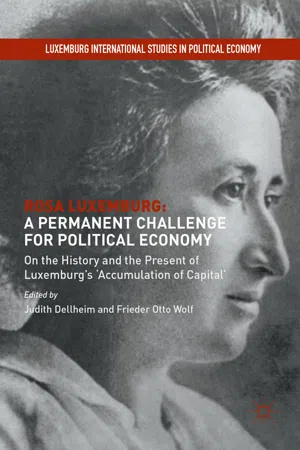 eBook - ePub
Rosa Luxemburg: A Permanent Challenge for Political Economy
On the History and the Present of Luxemburg's 'Accumulation of Capital'
- Judith Dellheim, Frieder Otto Wolf, Judith Dellheim, Frieder Otto Wolf(Authors)
- 2016(Publication Date)
- Palgrave Macmillan(Publisher)
© The Author(s) 2016Begin AbstractRosa Luxemburg: A Permanent Challenge for Political Economy Luxemburg International Studies in Political Economy 10.1057/978-1-137-60108-7_2Judith Dellheim andFrieder Otto Wolf (eds.)2. Rosa Luxemburg and Contemporary Capitalism
End AbstractGreg Albo 1(1) Department of Political Science, York University, Toronto, ON, CanadaIntroduction
Rosa Luxemburg (1871–1919) occupies an unusual place in the traditions of the western, and indeed, global Left, being met variously by scorn, silence and veneration. This is a response, in the first instance, to her powerful political interventions and ceaseless invocation of revolution to break the hammerlock of capitalism on democracy and development. But it is also a reflection of the reaction that greeted her major economic text, The Accumulation of Capital (1913), when it was first published just over a hundred years ago, and the abjuration that still greets that text among social scientists and militants today.For modern social democracy, it has been all but impossible to avoid judging Luxemburg with scorn: hopelessly insurrectionist and naively idealist in the face of a necessary political realism. Her masterpiece polemic, Reform and Revolution (1900), remains, even for readers today, a blistering assault on revisionism, and for modern social democracy an unforgivable breach. For them, its political determinism misread political evolutions in the same way that The Accumulation of Capital misunderstood the changing dynamics of accumulation.Although the official communist parties, from the Bolsheviks after Lenin onwards, turned her into a heroine, Luxemburg’s actual political and economic writings were met with silence. The searing critique of democracy within the post-revolutionary context was too filled with minefields for open discussion; and they had to be sealed off as these parties Stalinised and theoretically ossified (Josef Stalin himself linked Luxemburg with Leon Trotsky’s theories of uneven development, which was for him the ultimate heresy). The Accumulation of Capital , moreover, rivalled V.I. Lenin’s Imperialism eBook - ePub
The Complete Works of Rosa Luxemburg Volume IV
Political Writings 2, On Revolution 1906-1909
- Rosa Luxemburg, Peter Hudis, Sandra Rein, Jacob Blumenfeld, Nicholas Gray, Henry Holland, Zachary King, Manuela Kölke, Joseph Muller(Authors)
- 2022(Publication Date)
- Verso(Publisher)
Introduction: Rosa Luxemburg’sConcept of RevolutionRosa Luxemburg continues to capture the imagination of activists and scholars worldwide; in fact, today interest in her life and works is enjoying a veritable renaissance. This is no small feat for an individual whose intellectual and activist life reached its height in the early twentieth century. It is no small feat for a woman of her generation. And it is no small feat for a disabled Polish Jewish émigré (or exile, depending on your perspective) in Germany. But, on balance, Rosa Luxemburg was not a socialist who thought small or acted small. Although she faced many forms of exclusion in her time, it was impossible for socialists to ignore her clear-minded analysis and single-minded commitment to social change.So why does it become especially difficult to ignore her today, even though she lived in a period so different from ours and the issues she discussed are so rooted in the particularity of her era? It is because of the rise of a whole series of spontaneous grassroots movements for freedom around the world since the global economic recession of 2008, which reached its sharpest and most creative expression in 2020 with the response to the glaring inequities exposed by the COVID-19 pandemic and mass protests against police abuse and for racial justice. These protests and movements—which that spring and summer occurred in over 2,400 US towns and cities and in dozens of countries around the world—were the product of a new generation of activists seeking a liberatory eBook - ePub
The Complete Works of Rosa Luxemburg, Volume II
Economic Writings 2
- Rosa Luxemburg, Peter Hudis, Paul Le Blanc, Nicholas Gray, George Shriver(Authors)
- 2015(Publication Date)
- Verso(Publisher)
I. Lenin, Revolution, Democracy, Socialism: Selected Writings, edited by Paul Le Blanc (London: Pluto Press, 2008), pp. 205–15. § Hannah Arendt, “Rosa Luxemburg, 1870–1919,” in Men in Dark Times (New York: Harcourt, Brace and World, 1968), p. 40. Kowalik, in Rosa Luxemburg and the Critique of Political Economy, edited by Bellofiore, p. 106. IV. The theoretical tool that Luxemburg developed in her critique of Marx may be too compelling, however, to be so easily jettisoned. Some critics have argued that capitalism is more complex, more dynamic than Luxemburg allows. * Others, however, are powerfully drawn to her notion that “the accumulation of capital, as an historical process, depends upon non-capitalist social strata and forms of social organization.” David Harvey, for example, has insisted that “the notion that capitalism must perpetually have something ‘outside of itself’ in order to stabilize itself is worthy of scrutiny.” A consequence of relentlessly seeking new outlets for surplus capital and of securing cheaper inputs for the accumulation process, Harvey notes, is that “the ‘organic relation’ between expanded reproduction on the one hand and the often violent dispossession on the other have shaped the historical geography of capitalism.” † Capital, Luxemburg wrote, “cannot do without the means of production and labor-power of the entire planet.” ‡ It can be argued that this is true of all territories indeed, including the territories of our bodies, our family life, our friendships, our creative drives, our sexuality, our dreams, and multiple community and social and cultural activities—permeated by noncapitalist dimensions and energies even in global regions where an advanced capitalist economy more and more predominates. This is reflected in voracious drives for “privatization” as well as in rampant consumerism in so-called “advanced” countries eBook - ePub
Rosa Luxemburg: Socialism or Barbarism
Selected Writings
- Rosa Luxemburg, Helen C. Scott, Paul Le Blanc, Helen C. Scott(Authors)
- 2010(Publication Date)
- Pluto Press(Publisher)
Luxemburg offers us rich insights even in what some on the Left consider to be problematical texts – for example, when she expresses views divergent from Lenin’s on imperialism, the national question, in the Russian Revolution on the question of land to the peasants and the dissolution of the Constituent Assembly, and in 1904 on questions of party organisation. On certain issues she may, in fact, see more deeply and clearly than Lenin – but even when she doesn’t, she nonetheless adds to our thinking.Especially important for us today, also, is the unresolved issue with which she wrestled over decades: the interplay of Marxist activists with the larger labour movement, negotiating between what she called ‘the two dangers’ of ‘sinking back to the condition of a sect’ or ‘becoming a movement of bourgeois social reform’. We owe it to Luxemburg and to ourselves to give all that she wrote and said and did around this issue both a sympathetic and a critical reading, seeking to develop new and useful insights for advancing the labour and socialist movements, a goal for which she herself was always reaching.Notes
1 . Victor Grossman, ‘Unity – In Memory of Rosa Luxemburg’ (http://mrzine.monthlyreview.org/grossman170106.html ); Pallo Jordan, ‘15 Years Since the Murder of Chris Hani’, Links (http:links.org.au/node/342 ); Paul Le Blanc, ‘Rosa Luxemburg in South Africa’ (http://marxsite.com/Rosa%20Luxemburg%20in%20South%20Africa.htm ); Paul Le Blanc, ‘Conference and Discussion on Rosa Luxemburg at Wuhan University, People’s Republic of China’, Labor Standard (http://www.laborstandard.org/New_Postings/Rosa_in_China.htm ); Sobhanlal Datta Gupta, ed. Readings in Revolution and Organisation: Rosa Luxemburg and Her Critics – Lenin, Luxemburg, Trotsky, Stalin, Lukacs (Calcutta: Pearl Publishers, 1994).2 . Paul Frölich, Rosa Luxemburg: Ideas in Action , 1939, trans. Joanna Hoornweg (London: Pluto, 1972), 28.3 . Rosa Luxemburg Foundation Exhibition, http://www.rosalux.de/cms/index . php?aktuell4 . PierreBroué, The German Revolution 1917–1923 , 1971, trans. John Archer (Chicago: Haymarket Books, 2006), 17.5 . Mary Nolan, Social Democracy and Society: Working-Class Radicalism in Dusseldorf, 1890–1920 (New York: Cambridge University Press, 1981), 3.6 . See Carl E. Schorske, German Social Democracy, 1905–1917 eBook - ePub
- Jan Toporowski(Author)
- 2022(Publication Date)
- Emerald Publishing Limited(Publisher)
At the beginning, her attitude towards Marx is well represented by what I would call Rosa Luxemburg the ‘Marxist’ theoretician. Take the 1903 essay on ‘Stagnation and Progress in Marxism’ (Luxemburg, 1903). The thesis is simple. What Marx left us is fully adequate, without the need for further elaboration. The same Capital remains scarcely used: only volume I is what is understood and used. But Marx's work is definitive: the stagnation of Marxism is thereby due to the fact that reality itself has not matured enough so that the other theoretical gems in Volume II and III could be extracted. In fact, she wrote, ‘it is not true that Marx no longer suffices for our needs. On the contrary, our needs are not yet adequate for the utilisation of Marx's ideas’. Very different is her attitude in The Accumulation of Capital. As she wrote in the Anti-Critique : ‘Marxism is a revolutionary world outlook which must always strive for new discoveries, which more than anything else dislikes formulations valid once and forever, and whose living force is best preserved in the clash of self-criticism and in the lights and thunders of history’ (Luxemburg, 1921). This is what I would call Rosa Luxemburg ‘the Marxian’. The criticisms levelled against The Accumulation of Capital by theoreticians of the Second and Third International, while exploiting some weaknesses in her approach, were unable to understand the novelty of her argument. That is why the best commentators on Rosa Luxemburg ‘the economist’ have been Joan Robinson and Michał Kalecki, and then Tadeusz Kowalik (cf: Bellofiore, 2014), who recognised in her contentions the anticipation of the principle of effective demand. None of these authors, however, grasped the inner connection between Luxemburg's overinvestment theory of the crisis and her unbalanced theory of accumulation and wage, which is grounded on Marx's value theory of labour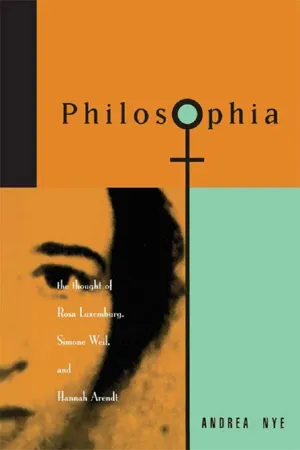 eBook - ePub
Philosophia
The Thought of Rosa Luxemborg, Simone Weil, and Hannah Arendt
- Andrea Nye(Author)
- 2013(Publication Date)
- Routledge(Publisher)
Like other Marxists, Luxemburg did not describe in detail what democratic institutions and practices might be like in socialism. Her Marxist materialism ruled out in principle ideals that are not generated in actual economic and historical processes; a workers' democracy would have to emerge in the course of revolution. But she grappled with problems inherent in any attempt to install a true “rule of the people.” How can the unity necessary in political or social movements be achieved in a way that does not do violence to the diversity and freedom of individuals? An answer to this question, passionately and sometimes angrily discussed between feminists, is crucial for any revolutionary movement. For feminists, the question has often taken the form of the essentialist/relativist dilemma. Either some sufficiently general definition of “woman” or “femininity” must provide unity, a definition which inevitably is exclusive of some groups and perspectives, or diversity and pluralism are claimed as the basis of a unfocused politics of difference.Luxemburg suggests an alternative. A coherence of aims that might provide a nonoppressive unity to replace doctrinal fidelity or party policy can be generated, as were Luxemburg's own theoretical positions, out of close observation and involvement in actual women's movements. Study of, participation in, and hard thought about the actions of oppressed people in times of crisis and discontent isolates directions, meanings, tendencies, common aspirations, and goals to unify policy. The politics that results is not the autonomous creation of any theorist, the intuition of any idealist essence or the application of any theory, but reflects the “sensuous activity” of social agents themselves. As she guides, facilitates, and directs, stands with a social movement, a Luxemburgian leader speaks for others without dictating, makes clear what their actions mean in the aggregate and how they might be organized, coordinated, and carried forward. Such a politics requires open channels of communication, constant reciprocity between leaders and masses, healthy grass-roots activist groups, and institutions that make each accountable to the other. eBook - PDF
Feminism in Coalition
Thinking with US Women of Color Feminism
- Liza Taylor(Author)
- 2022(Publication Date)
- Duke University Press Books(Publisher)
The direction of coalescing wage struggles in “The Mass Strike” was determinable for Luxemburg. All she had to do was look at the concrete demands of the workers to determine what they were after politically. They moved unequivocally in the direction of contesting the oppressive working and living conditions of capitalism. Similarly, Luxemburg also identified a concrete political direction for women workers, challenging the oppressive material conditions of both patriarchy and capitalism, manifested in a clear demand for a concrete commitment on the part of labor activists to also fight for women’s suffrage. Opening an Intersectional Wedge in Marxism: Putting Luxemburg in Conversation with Women of Color Feminists Luxemburg is far from alone in offering a version of Marxism that effectively breaks the ontological and epistemological rigidity of Lenin’s Marxism without following Laclau and Mouffe into the abyss of political indetermi- nacy. Though I do not intend to claim that Luxemburg is an “intersectional” theorist, putting her in conversation with the women of color named in Bohrer’s tracing of the “shared history” of intersectional and Marxist tra- ditions certainly reveals the intersectional possibilities that follow from a methodological orientation toward theorizing out of lived experience. In “Chapter Zero” of Marxism and Intersectionality, Bohrer breaks down this his- torical recuperation into three periods: the nineteenth century, wherein she recovers the voices of Stewart, Sojourner Truth, and Ida B. Wells-Barnett to show how figures central to the development of the intersectional tradition were also “significantly interested in themes that have strong resonances
Index pages curate the most relevant extracts from our library of academic textbooks. They’ve been created using an in-house natural language model (NLM), each adding context and meaning to key research topics.

