History

Eastern Europe
Eastern Europe refers to the eastern part of the European continent, encompassing countries such as Poland, Hungary, Czech Republic, and others. Historically, this region has been influenced by various empires and has experienced significant political and cultural changes. It is known for its diverse ethnic groups, rich history, and complex geopolitical dynamics.
Written by Perlego with AI-assistance
Related key terms
1 of 5
10 Key excerpts on "Eastern Europe"
 eBook - PDF
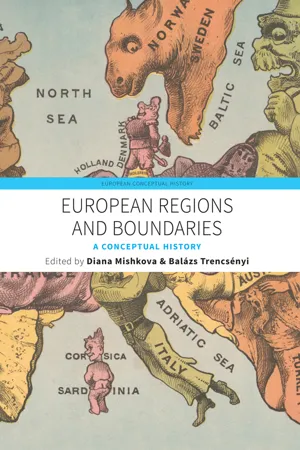
European Regions and Boundaries
A Conceptual History
- Diana Mishkova, Balázs Trencsényi, Diana Mishkova, Balázs Trencsényi(Authors)
- 2017(Publication Date)
- Berghahn Books(Publisher)
Nevertheless, a consensus concerning where to draw the boundaries of a historical meso-region “Eastern Europe” and how to define its structural specificities was hard to find. On the one hand, there were proponents of the concept of East-ern Europe as a space of “backwardness,” reaching from Poland in the West to the Soviet Union in the East (Chirot 1989). Apart from this rather vague definition, we can find a competing model of Eastern Europe in the English academic discourse, referring to those countries located between Germany and Russia that gained independence shortly before or after World War I (Albania, Bulgaria, Czechoslovakia, Hungary, Poland, Romania, and Yugo-slavia) (Kaser and Radice 1985). This definition of Eastern Europe as an area of newly (or re)established nation-states after the fall of the empires of the Romanovs, Habsburgs, Hohenzollerns, and Ottomans is still very popular in English-speaking academic discourse today (Held 1992; Berglund and Aare-brot 1997). In West-German historiography, the tradition of Ostforschung, stressing the entanglement of East European and German history and portraying East-ern Europe as a space of German destiny, could be felt until the 1990s (see, e.g., the series Deutsche Geschichte im Osten Europas [Boockmann, Buchholz, and Conze 1992–2002]). One example of this is the German sociologist and theorist of nationalism Eugen Lemberg, who in 1950 published a collection of lectures on “Eastern Europe and the Soviet Union” (Lemberg 1950). “East-ern Europe” is presented here as a counter-concept to “the West” ( Abend-land ), a space with vague boundaries (either space “behind the Iron Curtain” or the USSR) and populated by “Eastern Europeans” ( Osteuropäer ). This type, writes Lemberg, of the “man of the East ( Mensch des Ostens ) has been influenced neither by the philosophy of the Western Middle Ages nor by the Renaissance or the Enlightenment. He was not trained in logical and rational thinking and is not emancipated. eBook - PDF
American Foreign Policy in Regions of Conflict
A Global Perspective
- H. Wiarda(Author)
- 2011(Publication Date)
- Palgrave Macmillan(Publisher)
CHAPTER 3 Eastern Europe E astern Europe is one of the subregions of Europe, rather like Southern Europe (Greece, Italy, Portugal, Spain) or Northern or Scandinavian Europe (Denmark, Finland, Norway, Sweden). Most of Eastern Europe has now joined the two great European “clubs,” the European Union (EU) and the North Atlantic Treaty Organization (NATO); but because the Eastern countries have a distinct history and were for so long under the control of the Soviet Union, they deserve separate treatment in this chapter. Several features make Eastern Europe distinguishable from the rest of Europe. First, Eastern Europe, like Southern or Northern Europe, was for a long time on the periphery of the great currents of Western history: the Renaissance, the Enlightenment, the Industrial Revolution, and the movement toward democratic government. It missed out on many of the great movements that led to the modern age. And second and related, Eastern Europe is considerably poorer than the rest of Europe. It lacks the affluence, the style, the rich social programs that we associate with Western Europe. In fact, there is a rule that applies generally in this part of the world that says: the farther east in Europe you go, the poorer it becomes. Though we often expect to see poverty, malnutrition, and disease in Africa, Latin America, and South and Southeast Asia, when we see such poverty in Europe it is doubly shocking because we don’t expect to see it there. A third reason for Eastern Europe’s distinctiveness is its forty- five-year subordination, until 1991, to the Soviet Union and its 34 ● American Foreign Policy in Regions of Conflict organization into the Warsaw Pact and Comecon, Moscow’s response to NATO and the EU. More recently, Eastern Europe has been freed from Russia’s yoke and is seeking to join the world of modern, devel- oped European states; but it has not yet fully consolidated its new democratic status and it is still subject to Russian pressures. eBook - PDF
- Balázs Trencsényi, Constantin Iordachi, Péter Apor, Balázs Trencsényi, Constantin Iordachi, Péter Apor(Authors)
- 2021(Publication Date)
- Central European University Press(Publisher)
The shape of this community and the realization of these possibilities in general will depend, here as elsewhere, on the free play of historical contin-gencies and chiefly on major cultural trends. I mentioned the “geographic milieu” of the history of Eastern Europe in this sense at the Congress of Brussels, regarding this merely as a frame in which the “principal trends that left their mark on each era” could flow. 3 Eastern Europe, as I defined it, that is to say North-East Europe, limited from the West by a fixed border—after a great number of fluctuations— by the fourteenth century, and from the South by the powerful barrier of 1 L. Febvre, La Terre et l’Evolution humaine (Paris, 1922); published in the series L’Evolution de l’ humanité (dir. by Henri Berr), n. 4. 2 O. Halecki, “Machtgefälle oder Kulturgemeinschaft: Ein Beitrag zur Geschichte der deutsch-pol-nischen Beziehungen vom polnischen Standpunkt aus der Christliche Ständestaat,” Österreichische Wochenhefte 1, no. 8 (1934): 1–11, a criticism of the collective publication Deutschland und Polen (Ber-lin 1933). 3 La Pologne au V-e Congrès International des Sciences historiques (Warsaw, 1924), 74. 303 What Is Eastern Europe? the Carpathians, can be considered a geographical entity on its own from which the most diverse political formations opened in the course of his-tory. Nothing may stop us, however, from regarding this region through its close connections with another neighbor, Southeast Europe beyond the Carpathians, also a geographical unity if one regards all countries of the Balkans from the Danube basin to the Alps. Once again, the Western bor-der would be the result of several political changes; nevertheless, such an enlarged Eastern Europe shall remain a concept complying with the condi-tions offered by nature for the blossoming of human civilizations. This is why such a concept seems more acceptable to us than Mr. eBook - ePub
Focus on Religion in Central and Eastern Europe
A Regional View
- András Máté-Tóth, Gergely Rosta, András Máté-Tóth, Gergely Rosta(Authors)
- 2016(Publication Date)
- De Gruyter(Publisher)
Emil Niederhauser is one of the Hungarian historians, in addition to Jenő Szűcs, whose work on the Eastern European region one has to consider foremost. Before the turn of the first millennium, East Central Europe was primarily characterized by the mixture of diverse ethnic groups living in the region and the lack of developed states. When approached from a historical perspective, the region is basically a frontier, a marginal region. If observed from the West, it is the frontier of the Frankish Empire; however, from East, the region is the Byzantine frontier. In the context of the Early Middle Ages, the region was the conflict zone of collisions of interests between the Western Church and the Eastern Church, by which collision we mean differences in worldviews, cultures, and economic and political forms of government, reaching up to the Enlightenment and in a certain way ostensible even in the present day, and not confined merely to differences in confessions of faith or in rites. Besides these Western and Eastern influences, the history of the region was affected by a third, a strong martial and cultural influence: the advance of the Ottomans and Turks. The influences of these three power blocks formed and defined the three subregions of the East Central European region, the features of which can be detected up to the present day: the Western, the Eastern, and the Balkan subregions. The centuries of the second millennium saw the changing and alternating influence of these powers, the traces of which can be felt with particular emphasis in these subregions even today (Niederhauser 2001). This tripartite influence explains the need for state and national sovereignty, determining the formation of all of the region’s societies depending on how much of this sovereignty they were able to procure in centuries past and/ or how long they were able to maintain it.A Hungarian research group, led by Endre Sashalmi and focusing on the region’s history of political constitution, took into account Niederhauser’s work, although disagreeing with many of his conclusions. The concept of the research and its main perspectives were based on the modified approaches of Ertmann and Finer, who in terms of government practices differentiated between substantive and procedural models. To the substantive model belong power-limiting factors related to the principles and the essence of power to which, besides tradition and laws, religion also belongs (Sashalmi 2007: 11 ff). According to the researchers, all forms of government classified according to different principles can be found in both Western and Eastern Europe, hence erasing the differentiation between East and West. However, there are some formations that can be seen merely as features of the subregions of the Eastern European region in its broadest sense. This again brings us to the ambivalence around the topic of regional peculiarity. Are there or are there not specific features distinguishing the regions? The comparative study spanning the historical period between 1000 and 1800 concludes that, based on the logic of succession of political power within Eastern Europe, it is by the fifteenth century that the government models of the Rus and the three Christian kingdoms diverge. Therefore, it is politico-historically justified to distinguish the greater region East Central Europe from Eastern Europe (Sashalmi 2007b: 398 ff). By the eighteenth century this image of the region had become even more nuanced (Sashalmi 2007b: 401); however, there is no present need to elaborate on it. eBook - PDF
Explaining Economic Backwardness
Post-1945 Polish Historians on Eastern Europe
- Anna Sosnowska(Author)
- 2019(Publication Date)
- Central European University Press(Publisher)
the USSR.” 77 Within this area they distinguished two regions: north and south of the Danube and Sava, thus emphasizing, like other scholars, the impor-tance of the internal historical border between the Ottoman and Habsburg Empires and between Catholicism and Orthodoxy. The Price of Freedom: A History of East Central Europe from the Middle Ages to the Present by Wandycz, and East Central Europe in Transition: XIV–XVII Century edited by Mączak, Samsonowicz, and Burke, appeared as part of the series. 78 Both books, in a manner typical of Polish historiog-raphy, are limited to presenting the history of three countries, Poland, Hungary, and Czechoslovakia, within their changing historical borders. “Accepting the arguments for applying the term East Central Europe in reference to the territories between the Baltic, Adriatic, Aegean and 76 Halecki, The Limits and Divisions , 118. 77 Kłoczowski, East Central Europe , 34. 78 Wandycz, Price of Freedom , Burke, Mączak, and Samsonowicz, East-Central Europe in Transition. 126 EXPLAINING ECONOMIC BACKWARDNESS Black Seas, [they] considered the selected area as the proper ‘core’” 79 of the region. The term “East Central Europe” emerged in Polish historiography in the late 1970s. 80 It was primarily used by social and political histo-rians who worked for the Institute of History at the Polish Academy of Sciences (IH PAN). The term was not popular among economic historians, although Małowist and Wyczański sometimes employed it. In the late 1980s, and especially in the 1990s after the collapse of the USSR and the emergence of a new geopolitical order, “East Central Europe” became the mandatory, almost politically correct term to be used in the social sciences. Currently, the term is either a synonym for postcommunist but not post-Soviet countries that were admitted to the European Union, or it refers to a more distant, post-Versailles history. eBook - PDF
- Bruce R. Berglund, Brian Porter-Szűcs, Bruce R. Berglund, Brian Porter-Szűcs(Authors)
- 2010(Publication Date)
- Central European University Press(Publisher)
361 Drafting a Historical Geography of East European Christianity the enchantment that had once animated the house and restore mean-ing to the tasks carried out within. Whatever the intent, these concep-tual maps cannot be dismissed as the musings of intellectuals, even if they differ so widely from the geographies of ordinary citizens, who see the West as a space of opportunity and the East as a land of ongoing economic struggle. As Charles Maier points out, the waning of terri-toriality as the organizing principle of societies means that “culture or civilization replaces space as the stake of international or communi-ty conflict.” 92 The religious geography of Europe has become stirred into a kaleidoscope of pixels, but there are some who will seek to draw firm lines, and others who will adjust their thinking based upon those lines. Thus, this map, like the plans of the house, will continue to have meaning. N OTES 1 See Jenő Szűcs, “The Three Historical Regions of Europe,” Acta Historica Academiae Scientiarum Hungaricae 29, nos. 2–4 (1983): 131–184; J.T.S. Madely, “A Framework for the Comparative Analysis of Church-State Relations in Europe,” West European Politics 26 (2003): 23–50; Andrew C. Janos, East Central Europe in the Modern World: The Politics of the Bor-derlands from Pre- to Post-Communism (Palo Alto, CA: Stanford University Press, 2000); Gale Stokes, “Eastern Europe’s Defining Fault Lines,” in Sabrina P. Ramet, ed., Eastern Europe: Politics, Society, and Culture since 1939 (Bloomington: Indiana University Press, 1998); and Daniel Chirot, ed., The Origins of Economic Backwardness in Eastern Europe: Economics and Politics from the Middle Ages until the Early Twentieth Century (Berkeley, CA: University of California Press, 1989). For a geographer’s perspective on the various efforts to demarcate and label Eastern Europe, see Alan Dingsdale, Mapping Modernities: Geographies of Central and Eastern Europe, 1920–2000 (London: Routledge, 2002). No longer available |Learn more
- Willibald Steinmetz, Michael Freeden, Javier Fernández-Sebastián, Willibald Steinmetz, Michael Freeden, Javier Fernández-Sebastián(Authors)
- 2017(Publication Date)
- Berghahn Books(Publisher)
In the interwar period the notion of ‘Central Europe’ propagated by historians had a certain politically driven potential to subvert national frameworks of historiography. On the other hand, until the Second World War, linguistics, folklore, literature and ethnography were much more important than ‘history proper’ for the origi-nal crystallization of ‘the Balkans’ as a historical region. The upsurge of the social sciences and, concomitantly, of divisions based on socio-economic and political models after 1945, to a large extent subsumed the East Central and South East European frameworks under a common East European umbrella, undermining the Central European and Balkan narratives, which re-emerged with the ‘cultural turn’ of the 1970s. Finally, certain disciplinary subcultures have also exhibited a concept- building capacity: Byzantine studies have shaped a kind of ‘Byzantine Commonwealth’ far exceeding the political realm of the former Eastern Roman Empire, while Slavic studies and historical demography have framed the space of ‘Slavic Europe’. Slavdom could be extended to cover the whole of Eastern Europe, as is the case with Slavic Studies in the United States in recent decades, which also cover Romanian and Hungarian themes. The genealogy of the concept of historical (meso-)region as such is connected to a debate among Polish, Czech and German historians in the interwar period about the notion of ‘Slavs’ and ‘Slavdom’, which then moved on to the his-torical concept of ‘Eastern Europe’. Nationalism studies and development economics also carved their ‘own’ regions, captured by terms like ‘late-state’ (or ‘small-state’) formation and ‘(semi-)periphery’, respectively. eBook - PDF
- W. Kostecki, K. Zukrowska, B. Goralczyk, W. Kostecki, K. Zukrowska, B. Goralczyk(Authors)
- 2000(Publication Date)
- Palgrave Macmillan(Publisher)
PART I East-Central Europe: a chance or threat to peace? 2 East-Central Europe where and how? Hakan Wiberg A decade ago, few would have been in doubt as to what area to expect covered in a text on 'Eastern Europe'. The author's name would often have permitted a good guess concerning its contents. Neither is true today. After the dramatic changes, the future is only partly predictable. Some possibilities are irrevocably discarded, some future scenarios paint a bright picture and others point up several possible crises. This will be the main topic of the present chapter. Many new terms denote all, or different parts of, what was recently termed 'Eastern Europe'. Let us therefore begin by briefly discussing 'mental geography'. WHA T IS Eastern Europe? I heard the same joke from several elderly Polish scholars: 'It is strange - when I went to school we were taught that Poland belonged to Central Europe; since then, they have moved all of Poland westwards, and now it is called Eastern Europe'. From 1945 through 1989, the predominant feature of Europe was what was popularly called the 'East/West' conflict. The underlying meaning of 'East/West', however, was a fairly new one, at least on the surface. It centred on ideological and military matters, making that East/West division the most recent and ephemeral one in the complex set of East/West dimensions in European politics. With its 23 24 Hakan Wiberg fading away, older ones - most of which had also been more or less hidden connotations in discourses on 'East and West' - achieved renewed prominence. The common Polish, Czech, and so on aversion to being referred to as 'Eastern Europe' is probably based on more than a dislike of being lumped together as 'former Communist' countries, also reacting to these older connotations of 'Eastern'. eBook - PDF
- Alexei Miller, Maria Lipman, Alexei Miller, Maria Lipman(Authors)
- 2012(Publication Date)
- Central European University Press(Publisher)
We do not engage here with protracted discussion about the terms “Eastern Europe,” “Central Europe,” “East-Central Europe.” 2 The Convolutions of Historical Politics The phenomenon we are dealing with is an individual case of the politicization of history that has transformed into a global tenden-cy. 2 Each individual element of the political interpretation of history in Eastern Europe over the past decade most likely has parallels in other parts of the globe as well. (Articles on Germany, Turkey and Japan in this volume provide plenty of such analogies.) Moreover, each Eastern European nation has its own specificity in this sense. At the same time, intertwining all the elements of politicizing history in a single region is quite unique. The intensity with which neighboring countries have borrowed the techniques and forms of this policy from one another over the past decade has not been matched; neither has the establish-ment of a mechanism to escalate the politicization of history in inter-state relations or inside each particular country. Thus, why do we not manipulate the notion of historical politics yet again and use it as an ana-lytical term in our research to denote the regional specificity of politi-cizing history in Eastern Europe at the beginning of the 21st century? 3 After Communism, After the Empire. Post hoc ergo propter hoc? First, it would make sense to note some specific features the region inherited from the decades of Communist domination. The descrip-tion of recent history, above all the period between the two World Wars and during World War II, was subjected to harsh censorship in all Communist countries. That was the result of a struggle with the enemies of the regime and, partly, of a desire to refine the history of the Communist movement.
- Zlatko Sabic, P. Drulák, Zlatko Sabic, P. Drulák(Authors)
- 2012(Publication Date)
- Palgrave Macmillan(Publisher)
62 4 Is Central Europe a Region? A View from Outside the Neighbourhood Thomas J. Volgy, J. Patrick Rhamey, and Elizabeth Fausett Hungary is a Western European country that was originally located between France and Germany. God, having cursed Hungarians, then tossed the country into Eastern Europe. This is why their language, culture, and food differ so much from their neighbours. They’ve been trying to move back to their original region ever since. (Anonymous quote from a former Hungarian Foreign Ministry offi- cial explaining Hungarian commitment to joining the European Union (EU).) 4.1 Introduction While any research effort exploring a particular region must first determine the conceptual and theoretical meaning behind the concept, the injunc- tion is far harder to address than it sounds. Quite some time ago, a literature review of regions (Thompson 1973) found no fewer than 52 contending definitions. Irrespective of the growing importance of regions in interna- tional politics (Fawn 2009; Katzenstein 2005; Acharya 2007; Mansfeld and Solingen 2010), there has been far less progress towards unanimity than one would hope. We lack space here to review the literature on regions; we note instead that definitions vary widely, depending on the theoretical framework and substantive interest. Some focus on very large geographical clusterings (meta- regions such as Asia, Europe, Latin America) (Putnam 1967; Lagos 2003; Karawan 2005). Others identify regional boundaries by institutionalized cooperation among geographically linked states (e.g., Goertz and Powers 2009), geographically linked security communities (Buzan and Waever 2003), geopolitical areas with hierarchical control exercised by a regional or global power (Lemke 2002), or a geopolitical space linked by common identity, culture, and history (Katzenstein 2005). Even these differentiations represent only a sample of approaches rather than an inclusive set of catego- rizations.
Index pages curate the most relevant extracts from our library of academic textbooks. They’ve been created using an in-house natural language model (NLM), each adding context and meaning to key research topics.

