Politics & International Relations

Mao Zedong
Mao Zedong was a Chinese communist revolutionary and founding father of the People's Republic of China. He served as the Chairman of the Communist Party of China from 1949 until his death in 1976. Mao's leadership and policies, including the Great Leap Forward and the Cultural Revolution, had a profound impact on China's political and social landscape.
Written by Perlego with AI-assistance
Related key terms
1 of 5

12 Key excerpts on "Mao Zedong"
 eBook - ePub
- Shiping Hua(Author)
- 2021(Publication Date)
- Routledge(Publisher)
Part 3Maoism as an ideology
 Passage contains an image
Aminda Smith10 The living soul of Mao Zedong ThoughtDOI: 10.4324/9781003007364-10Mao Zedong was the Chairman of the Chinese Communist Party (CCP) for more than 30 years. After leading the revolution that established the People’s Republic of China (PRC) in 1949, Mao was the PRC’s supreme leader and the CCP’s paramount theorist until his death in 1976. He is known for his radical, inspiring, and often disastrous leadership. In the Soviet Union Vladimir Lenin was venerated as the visionary Marxist theorist who led the revolution, whereas his successor, Joseph Stalin, was known as the autocrat who tried to keep Russia on the socialist path. But in the People’s Republic, Mao alone is remembered as the military commander who toppled pre-revolutionary regimes, the theorist who adapted Marxism to China, and the supreme leader who presided over the PRC’s transformation into the world’s largest communist country. Thanks to his “cult of personality,” Mao became a global icon, whose image appeared on buttons, books, alarm clocks, architecture, and more. A portrait of Mao by Andy Warhol sold for nearly 50 million dollars in 2015.Mao has always been a controversial figure. In China, he is remembered by some as a champion of the poor; others revile him as a tyrant; still others view his leadership as a necessary, if tragic, step toward China’s rise as a world power. International impressions of Mao are equally diverse. Some people still revere him for the revolutionary inspiration he gave to anti-colonial and anti-capitalist movements around the globe. Others place him in a notorious trifecta of the most monstrous leaders in world history: Hitler, Stalin, Mao. How can we explain such divergent opinions? Part of the answer is that Mao, like all people, changed over time. Additionally, his ideas, at every stage of his life, were more appealing to some people than others. Finally, and most importantly, how one evaluates Mao depends on how one understands what constitutes justice, what counts as liberty, and whether, how, and at what cost, people should try to create revolutionary change. eBook - PDF
China Into Its Second Rise: Myths, Puzzles, Paradoxes, And Challenge To Theory
Myths, Puzzles, Paradoxes, and Challenge to Theory
- James Chieh Hsiung(Author)
- 2012(Publication Date)
- World Scientific(Publisher)
It would take a determined pragmatist like Deng Xiaoping, in league with like-minded Party veterans, to turn things around and redirect China to a new path of peaceful and rapid development in the post-Mao era. The Party’s halo as a public icon, nevertheless, is gone. • The enigma of Mao Zedong. To people who thought Mao ended in failure, there was an enigma associated with him, which can be summarized thus: on one hand, Mao brought the Communist Party to power and, along with it, his earlier vision to build a reinvigorated China to join the front ranks of the great powers in the world (see Mao’s goals of revolution above). On the other hand, however, he almost ruined his own Party and came close to bringing down his country with it as well. His Great Leap Forward (1958) ambition “to overtake England in 15 years” would have to await a future generation to see it fulfilled (by 2004), but only after embarking on a different route to development. However, as the memories of the Cultural Revolution receded to the background, popular support for Mao seems to be on the rise, not only on mainland China, but also in Taiwan 25 and elsewhere, however incredible it might seem. Among intellectual circles, especially those attuned to questions of economics, there is a mounting revisionist view that casts Mao in a different light. Li Minqi (2008, p. 45) spoke of “many young Chinese intellectuals and students mov(ing) to the left, (because) there has been a growing influence of Maoist ideas in China.” “Many young Maoists,” he added, “have joined forces with Maoist revolutionaries to defend the social and economic records of 25 Li Ao, perhaps the most well-known maverick writer in Taiwan, wrote a glowing tribute to Mao, which was adopted by an admirer of Mao in mainland China and posted on his blog, under the heading of “A Tribute to Li Ao’s Tribute to Chairman Mao Zedong,” accessible from worlduc.com/blog.aspx?/bid = 3739.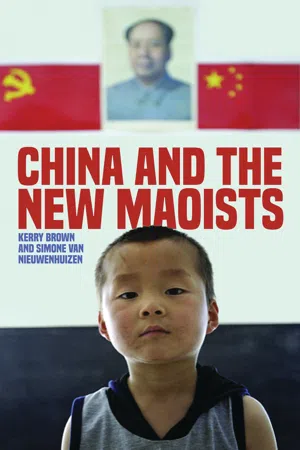 eBook - PDF
- Kerry Brown, Simone van Nieuwenhuizen(Authors)
- 2016(Publication Date)
- Zed Books(Publisher)
Not that Mao as a historic figure is unimportant. But the uses of and appeals to him are complex. The CPC in the twenty-first century is a vast body with over 86 million members. It tries to gather in its folds those with sometimes dramatically different shades of opinion. As in Europe, North America or other democracies in the Asian region, there are wide and divergent attitudes about how strong a role the central and local states should play in society, what the role of markets is, and just how much political intervention there needs to be in terms of social welfare and other key policy areas. The difference in China is, of course, that all of this debate, which is usually represented in terms of party political clashes in INTRODUCTION 17 multiparty systems, is subsumed within the single party that has a total monopoly on power at present. Just because there is one party, however, we should not be deceived into underestimating the virulence and fierceness of these internecine debates within China. The left and right wings of the Communist Party are often far apart, and the central elite Party leadership has to constantly perform a balancing act between the demands of both sides, and the myriad of positions in between. Maoism in this context becomes a label for the more extreme left, ranging from those who simply believe in greater state ownership of assets, to those who want wholesale renationalization. For this reason, Maoism and leftism in this book are almost interchangeable terms, even though all sides of the political spectrum try to appeal to some kind of link with and legitimization from the historic figure of Mao Zedong, at least in the abstract. The religion of Maoism There is a very sound reason for the constant appeal to the historic figure. eBook - ePub
Mountain of Fame
Portraits in Chinese History
- John E. Wills, Jr.(Authors)
- 2012(Publication Date)
- Princeton University Press(Publisher)
19
Mao Zedong
• • • • • •A QIN emperor breaking the mold and reshaping his society for the ages, a would-be Great Teacher, a Wang Mang promoting himself and ignoring realities, a Three Kingdoms hero rushing ahead and riding the chaos, condescending admirer of the Taipings, youthful reader of Liang Qichao, poet-politician, stroller by Su Dongpo’s dike and the lakes of Qianlong’s palaces, urging his people to always do without hesitation or selfishness what they know is right, to work as hard as Yu and sacrifice themselves as readily as Yue Fei, Mao Zedong echoes in his own experience and his exhortations to his people an amazing number of the themes of this book. To understand him and his times, we need to know a lot about Marxism-Leninism, economic development, world politics—and also a lot about a Chinese heritage that Mao found both precious and a dead weight on the forward march of his people.As seen from the beginning of this book, China was too large to be held together by force alone; the attractiveness of the ideal of the good minister of the Son of Heaven, the possibility that any talented man could become such a minister through the examination system and the carefully regulated politics of the bureaucracy, the limitation of military power and the political roles of military men, all were essential to the unity of the vast empire. But the growth of effective military power was a basic aspect of survival in the modern world, and in China this growth and the disruption of the old civilian control structures set off an uncontrolled militarization that tore the country apart. By 1920 many were groping for new ways to control the military and reunite the country. Among the pieces of a solution were discipline of troops and their indoctrination in one form or another of nationalism and public spirit; mobilization of ordinary tradespeople, farmers, and workers as active participants in politics; and new ways of disciplining and indoctrinating a civil and bureaucratic elite. These developed in various forms and combinations. The famous Christian warlord Feng Yuxiang had real success in the first, little in the others. The reorganized Kuomintang of the 1920s and 1930s achieved much in the first and third, but had an ambiguous record on mass mobilization. Mao Zedong himself was led toward interest in mass mobilization by participation in efforts to protect his native Hunan against predatory military men. The Communist party eventually produced a powerful solution to all the pieces of this problem. The Chinese people still are grappling with the consequences of that solution. In addition, the speed of the Guomindang capitulation in 1948 and 1949 left the CCP with a number of problems. The heartland of the revolution had been the guerrilla base areas of northern China and, after the Japanese surrender in 1945, the north-east. When they established the new People’s Republic in 1949, the communists lacked any real substantial support and power base in vast swathes of the country, particularly south of the Yangtze River. Furthermore, their power base in the major cities was also very weak, the urban CCP movement having been largely wiped out by the Guomindang ‘White Terror’ in the early 1930s. Governing revolutionary base areas was one thing, governing the entire country with all its complexities was another matter altogether.Overcoming these problems would be a significant challenge for any new regime. Simply restoring political control over a fragmented and impoverished nation, and rebuilding the economy from a century of neglect and devastation, would be enough to keep most leaders occupied for quite some time. But simple restoration of order was not enough for Mao. The revolution was not completed in 1949. For Mao at least, the seizure of power was only the beginning.. . .
Ruling China: Limits to Mao's Power
In many of the books and articles written about China in the 1950s and 1960s, there was a tendency to depict everything that happened as a result of Mao’s own initiatives. Such a ‘Mao-centric’ view of Chinese politics made things easier to understand. It was also excusable given the limited amount of reliable information that came out of China at the time. The CCP kept its internal disputes firmly behind closed doors, and presented an image of unity to the outside world, with Mao as the Great Helmsman and the supreme power. Furthermore, perceptions of how Stalin managed a totalitarian system in the Soviet Union provided an established framework that some scholars assumed could simply be transferred to analyses of other communist party states.We are in many ways entirely correct to talk in terms of ‘Mao’s China’ (he was the single most important figure in the country’s evolution after 1949) and to take a Mao-centric approach (he was the central figure to whom all other political actors referred in defining their own approaches and strategies). But China never was a totally totalitarian state, and Mao was never an all-powerful figure who could single-handedly shape the entire country and its destiny. There were considerable limits to Mao’s power, and the way that he tried to overcome these limits was an important determinant of the evolution of Chinese politics while he was alive. eBook - ePub
- Lowell Dittmer(Author)
- 2018(Publication Date)
- Routledge(Publisher)
87 Yet he was never publicly humiliated and was even allowed to retain a seat on the CC.Upon the elimination of residual Maoist opposition, Deng’s reform program surged forward in the early 1980s, with the generally excellent economic results noted in Chapter 1 . However Deng, like Mao, has managed to jeopardize the staying power of his legacy by some ill-considered actions during the terminal years of his reign.Deng’s Leadership Legacy
If we can say that Mao Zedong managed to synthesize the influence of traditional imperial statecraft with that of Marxist revolution, we can explore a similar synthesis in Deng’s leadership: The two figures who shaped his views more than any other were the antipodal Liu Shaoqi and Mao Zedong. From Liu Shaoqi he seems to have derived his basic theoretical premises and policy preferences, known during Mao’s heyday as “revisionist” and more recently rechristened “reform”(“revisionism” vanished from the Chinese political vocabulary in 1978). The roots of this theoretical and policy heritage were laid bare during the campaign to laud Deng Xiaoping Thought (Deng Xiaoping sixiang ) that began in the late 1980s, accelerating in preparation for the Fourteenth Party Congress in October 1992. Here we learn that “the heart of Marxism” is to “develop productive forces” and raise living standards:We advocate communism. But what does that mean? It means the principle of from each according to his ability and to each according to his needs, which calls for highly developed productive forces and overwhelming material wealth. Therefore, the fundamental task for the socialist stage is to develop the productive forces. The superiority of the socialist system is demonstrated by faster and greater development of the productive forces than under the capitalist system. … Socialism means eliminating poverty. Pauperism is not socialism, still less communism.88 eBook - ePub
Revolutionary Pairs
Marx and Engels, Lenin and Trotsky, Gandhi and Nehru, Mao and Zhou, Castro and Guevara
- Larry Ceplair(Author)
- 2020(Publication Date)
- The University Press of Kentucky(Publisher)
He equated effective leadership with effective mass mobilization. He also promoted democracy (i.e., democratic centralism) as a tool of political education: “The Red Army is like a furnace in which all captured soldiers are transmuted the moment they come over. In China not only do the workers and peasant masses need democracy; soldiers need democracy even more urgently.” 19 By early 1931, Mao dominated the Central Bureau for the Soviet Areas. But his considerable strength was continually eroded by the maneuvering of the party leadership, the Twenty-Eight Bolsheviks, who had moved to Jiangxi to better fight the “right deviation [opportunism]” there and to reform and replenish the leading bodies. They had identified Mao as the leading right deviationist, and at the November 1931 party conference they criticized Mao’s guerrilla tactics and his land policies. Nevertheless, later that month, at the First All-China Soviet Congress, Mao was elected chair of the Central Executive Committee and retained his position as chief political commissar of the First Front Red Army. 20 But the next four years would be difficult ones for Mao, not least because of Zhou Enlai’s opposition. Edgar Snow’s chapter about Zhou is titled “The Insurrectionist.” Snow, who met Zhou in 1936, described him: “Slender and of medium height, with a slight wiry frame, he was boyish in appearance despite his long black beard, and he had large, warm, deep-set eyes. A certain magnetism about him seemed to derive from a combination of personal charm and assurance of command. His English was somewhat hesitant and difficult.” Snow thought that Zhou possessed “a cool, logical, and empirical mind” and “charm.” Zhu De described Zhou as “a slender man of more than average height with gleaming eyes and a face so striking that it bordered on the beautiful. Yet it was a manly face, serious and intelligent…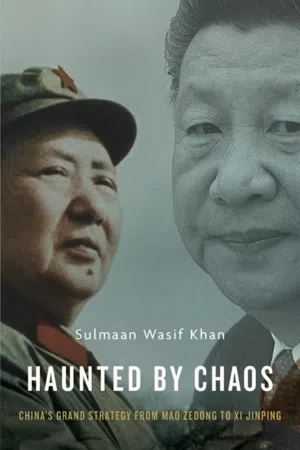 eBook - PDF
Haunted by Chaos
China’s Grand Strategy from Mao Zedong to Xi Jinping
- Sulmaan Wasif Khan(Author)
- 2018(Publication Date)
- Harvard University Press(Publisher)
He would remain a chairman of the party; he would focus on ideology. If the people and the country needed it, he could be reappointed to his former duties. 178 He had, it seemed, been efectively sidelined. And yet, for someone supposedly out of power, Mao remained astonishingly active. He met foreign leaders and issued directives. His basic foreign and do-mestic policies would remain in place (although Liu Shaoqi, notably, was a little cooler on the economic policies, admitting to foreign leaders that there had been mistakes). He would admit to error— “We have issued inappropriate directives, myself included” 179 —but he had not fallen as far as some of his comrades might have hoped. China persisted in the Great Leap Forward. It was given a reason to persist by countless cadres who reported on the Leap’s great successes. If those cadres were succeeding, as Mao wanted to believe, then the failures were obviously somehow the fault of the cadres reporting them. Zhao Ziyang, who would later gain fame as the architect of Deng Xiaoping’s economic reform and the man who stood up for the students at Tiananmen Square, provided the expla-nation Mao longed for. Zhao was serving in Leinan, Guangdong, at the time, where, he reported, the Leap was doing well. Problems had arisen only because food was being embezzled and privateered. If policy were executed properly, the problems could be fixed in ten to fifteen days. 180 It was not the system that was at fault, merely the per-sonnel charged with executing it. Adjustments to the Great Leap’s implementation would deliver on the promise. There was always a way of interpreting unfavorable evidence away, and always someone willing Mao Zedong and the Balance of Power 110 to provide such interpretation. eBook - PDF
- S. Casey, J. Wright, S. Casey, J. Wright(Authors)
- 2008(Publication Date)
- Palgrave Macmillan(Publisher)
The era’s successes have been less remarked, such as the signifi- cant modernization of China’s infrastructure, international negotiations that saw China regain tariff autonomy and a genuine transnational sym- pathy for the Nationalist project as one that was at heart progressive and modernizing. All this development was, however, swiftly destroyed with the outbreak of total war with Japan in 1937. Chiang’s government had to withdraw to the interior, relocating the capital in the southwestern city of Chongqing (Chungking). The war battered away at the regime’s capacity to govern, and although Japan was defeated in 1945, the Nation- alist government never really recovered, and by 1949, had been defeated by Mao’s Communists in the Civil War. Chiang’s government fled to Taiwan, and he continued to rule his now fictive ‘Republic of China’ until his death. His regime there was brutal and dependent on Amer- ican aid. Yet it also succeeded in dealing with some of the crises that had overwhelmed the Nationalists on the mainland. Taiwan became a successful export-oriented economy, a relatively equal society without much extreme poverty and, under Chiang Ching-kuo, Chiang’s son and successor, one of Asia’s most lively liberal democracies. 2 Mao Zedong (1893–1976) was born of a peasant family in Hunan province, where he, like Chiang, became interested in revolutionary politics from an early age. Unlike Chiang, his politics led him towards Marxism and he was a founder member of the tiny Chinese Communist Party (CCP) in 1921. Until the mid-1930s, Mao was a prominent, but not dominant member of the Party. He was caught up in its unsuccess- ful strategy to foment revolution in the cities, and was then central to the experiments in governance that marked the rural period of commu- nist rule in Jiangxi province during 1931–1935.
- Mikhail A. Molchanov, Joseph Masciulli(Authors)
- 2016(Publication Date)
- Routledge(Publisher)
1978 was the watershed year in which the promotion criteria were changed. Before that year, the top priority of the party and the state was to ensure the purity of the proletarian revolution. In order to achieve it, class struggle needed to be agitated so that class enemies would surface. Fights and imprisonments were the instruments. However, 1978 started the reform and opening up, as economic development became the top priority of the party and the state. In order to promote economic development, promoting individual initiative was necessary. In order to keep social stability, it was necessary to mitigate tensions between different groups. Tolerance and compromise became the basic instruments of doing so. These promotion criteria greatly influence the behaviour and policy orientation of the leadership, which we will discuss further below.The Changing Power Structure of Political Leadership
The power structure of Chinese political leadership has changed over time. Power was highly centralized in the top leader in the first generation. But since the second generation, there has been a tendency of consolidating collective leadership. Between 1949 and 1976, power was highly centralized in the person of Zedong Mao. Members of the politburo, of the secretariat, and of the military affairs committee were not his peer colleagues, but his mere subordinates. As one of the founders of the party, the major founder of the People’s Liberation Army, and one of the major founders of the People’s Republic, Mao built up a personal cult. His unquestionable authority was harmed to some extent in late 1950s, because of the massive number of deaths from the famine that resulted partly from the agricultural collectivization and/or the ‘Great Leap Forward’ programme, which Mao fiercely advocated. However, the personal cult of Mao did not weaken. On the contrary, the efforts of promoting his personal cult intensified in the 1960s, and reached its peak in the 1970s. Although the flight and violent death of his chosen successor, Biao Lin, in 1971 fundamentally damaged his personal cult among the party elite, his cult was still highly popular among the lower-ranking party and state officials and among ordinary people.Among the leadership of the second generation, there was no personal cult. However, Xiaoping Deng was at a higher position than any other leader. He was a charismatic leader because he was a war veteran, had important power when the first generation ruled the state, and initiated the reform and opening-up in late 1970s that brought fast economic development to the nation and rising living standards to ordinary people. When Deng took particular initiatives, the leadership had to implement them. The leadership also needed to consult with him before they reached their final conclusions over major policy issues. However, other leaders were not his mere subordinates for, as we can see from the memoirs of some of his colleagues, there were comradely discussions between other leaders and him. Deng advocated collective leadership and made efforts to establish collective leadership structures (Xiaoping Deng 1980). Though his leadership was not fully collective, his advocacy of collective leadership was materialized in the leadership of the third and fourth generations. eBook - ePub
- Mao Tse-Tung(Author)
- 2017(Publication Date)
- Verso(Publisher)
So, apropos the second violent transposition, that of Mao, it is too facile either to condemn his reinvention of Marxism as theoretically ‘inadequate’, as a regression with regard to Marx’s standards (it is easy to show that peasants lack the substanceless proletarian subjectivity), but it is no less inadequate to blur the violence of the cut and to accept Mao’s reinvention as a logical continuation or ‘application’ of Marxism (relying, as is usually the case, on the simple metaphoric expansion of class struggle: ‘today’s predominant class struggle is no longer between capitalists and proletariat in each country, it has shifted to the Third versus the First World, bourgeois versus proletarian nations’). The achievement of Mao is here tremendous: his name stands for the political mobilization of the hundreds of millions of anonymous Third World toilers whose labour provides the invisible ‘substance’, background, of historical development – the mobilization of all those whom even such a poet of ‘otherness’ as Lévinas dismissed as the ‘yellow peril’ – see, from what is arguably his weirdest text, ‘The Russo-Chinese Debate and the Dialectic’ (1960), a comment on the Soviet-Chinese conflict:The yellow peril! It is not racial, it is spiritual. It does not involve inferior values; it involves a radical strangeness, a stranger to the weight of its past, from where there does not filter any familiar voice or inflection, a lunar or Martian past.2Does this not recall Heidegger’s insistence, throughout the 1930s, that the main task of Western thought today is to defend the Greek breakthrough, the founding gesture of the ‘West’, the overcoming of the pre-philosophical, mythical, ‘Asiatic’ universe, to struggle against the renewed ‘Asiatic’ threat – the greatest antagonist of the West is ‘the mythical in general and the Asiatic in particular?’3 It is this Asiatic ‘radical strangeness’ which is mobilized, politicized, by Mao Zedong’s communist movement.In his Phenomenology of Spirit, Hegel introduces his notorious notion of womankind as ‘the everlasting irony of the community’: womankindchanges by intrigue the universal end of the government into a private end, transforms its universal activity into a work of some particular individual, and perverts the universal property of the state into a possession and ornament for the family.4In contrast to male ambition, a woman wants power in order to promote her own narrow family interests or, even worse, her personal caprice, incapable as she is of perceiving the universal dimension of state politics. How are we not to recall F. W. J. Schelling’s claim that ‘the same principle carries and holds us in its ineffectiveness which would consume and destroy us in its effectiveness’?5 A power which, when it is kept at its proper place, can be benign and pacifying, turns into its radical opposite, into the most destructive fury, the moment it intervenes at a higher level, the level which is not its own: the same eBook - PDF
The Sino-Soviet Split
Cold War in the Communist World
- Lorenz M. Lüthi(Author)
- 2010(Publication Date)
- Princeton University Press(Publisher)
As he said in July of 1962: “International and domestic [affairs] share the same set of problems, that is, whether the revolution is led by the proletariat or the bourgeoisie.” 5 The continued deterioration of rela-tions with the Soviet revisionists over Xinjiang, as related in chapter 6, was a political bonus for the Chairman. By then, he had probably already decided to counter what he perceived to be the revisionism of his fellow leaders Liu, Deng, and their constituents. Despite a dearth of evidence, it is possible to outline Mao’s political comeback at the Beidaihe work conference from July 25 to August 24. 6 While the gathering was scheduled to discuss economic issues, Mao jet-tisoned the agenda by demanding to talk about class struggle and about the revisionists in the Chinese leadership. 7 Since the Chairman knew that he lacked the political capital to push through a purge of his internal adversaries similar to the one after Lushan in 1959, he framed his attack solely in rhetorical terms. 8 He started by distributing Xinhua reports on the economic problems in revisionist Yugoslavia coupled with an ominous question: “Is the path walked by the Yugoslavs good, or is the Marxist-Leninist path good?” 9 The dichotomous phrasing of the question naturally pointed to Mao’s own conclusions. The Chairman then turned against the 2 Lieberthal, “Great Leap,” 332. Li, Private Life , 390–93. 3 Salisbury, New Emperors , 197. MacFarquhar, Origins , vol. 3, 263–67. 4 Xiao, Qiusuo , vol. 2, 933. Wu, Huiyi , 374–75. Xu, Wang , 565. 5 Zhonggong, Mao Zedong zhuan , 1235. 6 Bo, Ruogan , vol. 2, 1071. 7 Niu, “1962,” 33. 8 Li, Private Life , 394. 9 “Remarks on a Report by Xinhua News Agency regarding the Economic Situation in Yugoslavia,” 8/2/1962, JYMW , vol. 10, 129. Mao Resurgent, 1962–1963 • 221 “dark wind”—nonsocialist family farming in China.
Index pages curate the most relevant extracts from our library of academic textbooks. They’ve been created using an in-house natural language model (NLM), each adding context and meaning to key research topics.

