History

Mensheviks
The Mensheviks were a faction within the Russian Social Democratic Labour Party, advocating for a more moderate and gradual approach to achieving socialism. They opposed the Bolsheviks, who favored a more radical and revolutionary path. The Mensheviks believed in a broader coalition of social classes and a parliamentary democracy, in contrast to the Bolsheviks' emphasis on a vanguard party and dictatorship of the proletariat.
Written by Perlego with AI-assistance
Related key terms
1 of 5
12 Key excerpts on "Mensheviks"
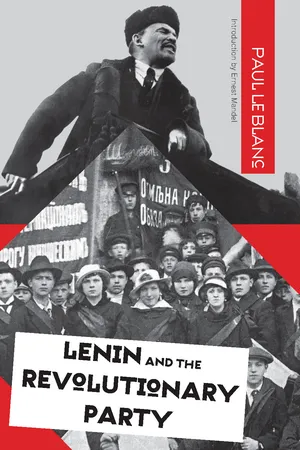 eBook - ePub
- Paul Le Blanc(Author)
- 2016(Publication Date)
- Haymarket Books(Publisher)
Another essential element helps to explain this cohesion and also helps us to understand the dynamic growth and final triumph of Bolshevism in 1917: the fact that the Bolsheviks were organized around a revolutionary program. Proletarian independence and hegemony in the struggle for democracy, as well as militant class-struggle and mass action tactics to advance the workers’ interests, were always central to this program; in April 1917 this evolved into a commitment to replace the capitalist state with a workers’ state. The Mensheviks, on the other hand, were profoundly disoriented by a fatal contradiction in the heart of their own programmatic perspective. John Basil has termed it a “clumsy strategic position” of seeing the democratic revolution as “a socialist-liberal alliance (with the liberals running up front)” while at the same time seeing the liberals as “natural enemies” because “they were the representatives of capitalism,” which the Mensheviks hoped to overthrow in the long run: “At the root of the Menshevik dilemma was the incompatibility of their liberal-socialist alliance scheme and their radical mentality encouraged by doctrinaire Marxism.” This contradiction generated a disunity of diverging standpoints—some giving greater weight to the liberal-socialist alliance, some remaining closer to the principles of what Basil terms “doctrinaire Marxism.” But all were united in the debilitating contradiction. Basil concludes: “The presence of Russian liberals was essential for the full operation and understanding of Menshevism. The Mensheviks were part of that group in the Russian socialist intelligentsia that saw the revolution against tsarist Russia as a cooperative effort [of the bourgeoisie and proletariat], even when their anti-liberal strain was playing an influential role in the day-to-day political combat. Menshevism as a viable revolutionary program ceased to exist once the Kadets were driven from Russian politics and Tseretelli, Martov and Dan were left without their foil.”67 The Bolsheviks’ programmatic orientation for the most part generated internal cohesion and political effectiveness, even with all of the tumult and diversity that characterized 1917.An important contribution to Bolshevik cohesion was, in fact, made by the vitality of inner-party democracy. Marcel Liebman points out that “all the major choices and great decisions that the Party had to take in 1917 were always subjected to discussion and a vote.” He adds: “All these votes showed that a strong minority, the numbers of which fluctuated but which was always there, existed among the Party cadres, and there was never any question of excluding this minority from theexecutiveorgans of the Party. The idea that these organs must, for reasons of efficiency, be marked by strict political homogeneity and therefore composed exclusively of members of the majority, had not yet entered into Communist practice. Whenever the Bolsheviks had to elect their leading bodies, a more or less proportional representation of the different tendencies was guaranteed. . . . This desire to associate the minority with the deciding and application of Party policy is to be seen in other ways: the presence of ‘minority’ members in the Bolshevik press organs, and the practice of providing for a ‘minority report’, giving a representative of the ‘opposition’ an opportunity of expounding the latter’s view in thorough fashion at important Party meetings.” eBook - PDF
The Russian Revolution and Civil War 1917-1921
An Annotated Bibliography
- Jonathan Smele(Author)
- 2006(Publication Date)
- Continuum(Publisher)
3875 Schapiro, L. `The Mensheviks', in E. Dahren-dorf (ed.) Russian Studies: Leonard Schapiro (introd. by H. Willets). London: Collins Harvill, 1986. pp. 253±265. A brief, sympathetic account of Menshevik history, arguing that the party's members `were the first of the many socialist victims of the illusion which dies hard among socialists: that genuine 393 The Mensheviks . 3875 cooperation is possible with communists on any terms other than complete surrender'. 3876 Volobuev, P. V. `The Mensheviks in the Fall of 1917: Decisions and Consequences', in V. N. Brovkin (ed.) The Bolsheviks in Russian Society: The Revolu-tion and the Civil Wars . New Haven, CT: Yale University Press, 1997. pp. 43±58. An unremarkable factual survey of Menshevik policies and actions from the aftermath of the Kornilov affair to the October Revolution. THE PARTY OF SOCIALISTS-REVOLUTIONARIES (SRS) Sources 3877 van Veen, H. Inventory of the Archives of the Partija Socialistov-Revoljucionerov (PSR). (1834±) 1870±1934 . Amsterdam: Stichting beheer IISG, 1994. xiv + 96 pp. A complete guide to the SR archives housed at the Institute of Social History in Amsterdam. Documents 3878 Roubanovitch, E., Soukhomline, V. and Zenzi-nof, V. Le Parti socialiste reÂvolutionnaire et la situation actuelle en Russie (fe Âvrier et mars 1919): documents . Paris: L'E Â mancipatrice, 1919. 55 pp. This rare volume contains eight SR resolutions and circulars and some extracts from the party press from February and March 1919, introduced and annotated by the editors (speaking for the Moscow and Odessa SR Bureaus), documenting their persis-tence in the `war on two fronts' against both the Bolsheviks and the Whites. 3879 [Woytinsky, W.] The Twelve Who Are to Die: The Trial of the Socialists-Revolutionists in Moscow (pref. by Karl Kautsky). Berlin: Delegation of the Party of Socialists Revolutionists, 1922.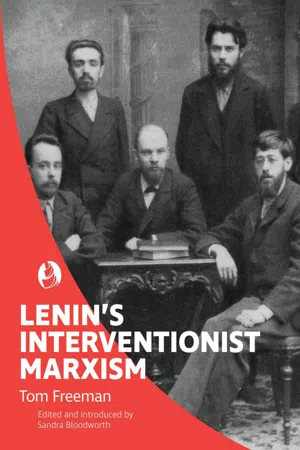 eBook - ePub
- Tom Freeman, Sandra Bloodworth(Authors)
- 2021(Publication Date)
- Interventions Inc(Publisher)
By the end of the Days of Freedom the predominant view had shifted again to support for the abolition of tsarism – though as yet this abolition was still to be achieved through indirect and decentralised tactics. The most convincing evidence for this shift was the growing dominance of the reformist leaning though very radical Menshevik faction within the Soviet. Thus the previously liberal chair Nosar declared his allegiance to the faction, and on his arrest the three-person body elected to replace him were all Mensheviks. They included the Mensheviks’ most voluble spokesperson, and editor of the faction’s paper, Trotsky. 74 The Mensheviks also dominated the contingents from the three main plants in the Nevskii district that were the initial core of the Soviet and had been the traditional heart of the activists. 75 While the predominant view within the leading worker activists did not go beyond a militant reformism, there is evidence that some, though a relatively insignificant minority, began to break from this position in the face of events. These worker activists, moving towards centralism and insurrectionism, were particularly found in those areas where the struggle had been deepest. Thus the Nevskii district, although generally dominated by the Mensheviks, still witnessed the growth of a militia to some 6,000 members as well as nightly patrols of between eight and ten workers to challenge police and members of right wing organisations. 76 Following the defeat of the eight-hour day campaign, the Menshevik leadership of the Obukhov factory were subject to bitter criticism and loss of support eBook - ePub
Russia Under Soviet Role
Twenty Years of Bolshevik Experiment
- N. de Basily(Author)
- 2017(Publication Date)
- Routledge(Publisher)
1What was the cause of this split within the Russian Social-Democratic Party? At a first glance it was due to a mere quibble. When the first article of the Party statutes was being discussed, the Mensheviks, led by Martov, suggested the following wording: “A person is regarded as a member of the Russian Workers’ Social-Democratic Party if he adheres to its programme, affords it material assistance, and gives it constant personal support under the direction of one of its organizations.” Lenin and his followers introduced, on the other hand, the following formula: “A person is regarded as a member of the Party if he adheres to its programme, affords it material assistance, and personally participates in one of its organizations.”The whole difference thus lay in the words: “personal support” and “personal participation.” This would seem to be a purely scholastic distinction. But behind this quarrel about words there existed a deep-seated conflict, a psychological clash of two types of politicians. Lenin knew what he wanted when he demanded from every Social-Democrat that they should personally participate in the party organization, and perform definite tasks within it.In creating the Russian Bolshevik Communist Party Lenin did not model it on the customary type of European political parties. He instituted, under his own leadership, a kind of militant sect whose members were convinced that they were the only depositaries of absolute truth in the wide world.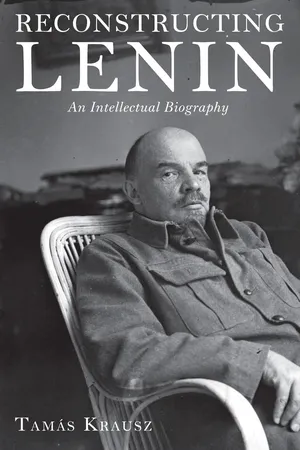 eBook - ePub
Reconstructing Lenin
An Intellectual Biography
- Tamás Krausz, Balint Bethlenfalvy(Authors)
- 2015(Publication Date)
- Monthly Review Press(Publisher)
Vperyod of August 1904 did not seem like a force that would determine the way forward in this period of the revolution, when the unity of the movement needed to be grounded. If the events of the split are to be recapitulated, indeed the point of departure must be 1904, signifying that seemingly even then the Bolsheviks were at odds among themselves in their approach to politics.Nearly a decade later Lenin summed up the organizational evolution of Russian Social Democracy, Menshevism, and Bolshevism in a short essay. He outlined the history of Bolshevism in the following way:The main practical divergences between the two trends in the autumn of 1905 were over the fact that the Bolsheviks stood for boycotting the Bulygin Duma while the Mensheviks favored participation. In the spring of 1906, the same thing happened with regard to the Witte Duma. First Duma: the Mensheviks stood for the slogan of a Duma (Kadet) Ministry; the Bolsheviks, for the slogan of a Left (Social-Democratic and Trudovik) Executive Committee that would organize the actual struggle of the masses, etc. . . . At the Stockholm Congress (1906) the Mensheviks won the upper hand, and at the London Congress (1907), the Bolsheviks. In 1908–09 the Vperyod group (Machism in philosophy and otzovism, or boycotting the Third Duma, in politics—Bogdanov, Alexinsky, Lunacharsky and others) broke away from the Bolsheviks. In 1909–11, in fighting against them,66 as well as against the liquidators (Mensheviks who denied the need for an illegal Party), Bolshevism came close to the pro-Party Mensheviks (Plekhanov and others), who had declared a resolute war on liquidationism.67The split between the two trends of Bolshevism issued from questions of a very practical nature. Bogdanov and his group condemned participation in parliamentary, “bourgeois” politics. Lenin, on the other hand, set the struggle for political power as the main task of the party. He was not occupied with creating and implanting an idea of the future of socialism; he thought of this more as a development to be expected from the period following the revolution. Instead he was preparing the organizational and political-intellectual grounds for a revolution that would be capable of overthrowing tsarism. This divergence in approach came to the fore in numerous differences in questions of tactics as well. eBook - PDF
Behind the Front Lines of the Civil War
Political Parties and Social Movements in Russia, 1918-1922
- Vladimir N. Brovkin(Author)
- 2015(Publication Date)
- Princeton University Press(Publisher)
The masses had their own fears and hopes, struggles and interests. They were not interested in the civil war against the Whites but in their bread rations and their rights. The party leaders, in this case Bolshevik and Menshevik, appeared to them as outside agitators who wanted something from them but were not offering anything but promises in return. Despite the workers’ strikes and widespread anti-Bolshevik uprisings, the Menshevik leaders decided to support the Reds even if their own worker constit uency was reluctant to do so. It was not the first time in post-October history that party policy was not in tune with the mood of the masses. Immediately after October 1917 workers had been in a euphoric pro-Bolshevik mood, and 15 Dan, ed., Oborona Revoliutsii i Sotsial Demokratiia, p. 10. 16 The Bryansk region, excerpt from the local organization’s report (November 1919), ibid. 17 Ermansky, “In Tver’,” a report of the SD delegation (October 1919), ibid. the party leadership’s critical view of the Bolsheviks was unpopular. Now the situation was reversed. It was the party leaders who were taking a pro-Bolshevik position and it was the workers who were reluctant to follow the Menshevik urging to support the Com m unists. The Right Mensheviks T he official position of the Menshevik Central Com m ittee did not of course reflect the views of all those who considered themselves to be Mensheviks. The old division of 1917 between the defensists and the internationalists which had developed into a division between Right and Left Mensheviks in 1918 contin ued in 1919 as well. In 1918 the Right Mensheviks controlled num erous provincial party organizations and competed for the leadership of the entire party. In 1919, however, after the long m onths of Red Terror, any Right Mensheviks who had escaped arrest were underground. They could no longer exist legally, let alone compete for a majority in the CC. eBook - PDF
- Leopold H. Haimson(Author)
- 1988(Publication Date)
- Cambridge University Press(Publisher)
This psycho- logical break was necessarily sharper and more dramatic among those Mensheviks who remained in Russia during these years than among those who elected or were compelled to spend most of them in the emigration, giving rise to differences in psychological orientations and political atti- tudes not fully recognized until 1917. Yet even in the more shuttered circles of the Menshevik emigration, this break - and specifically the repudiation of the ethos of the professional revolutionary - proved extremely important 10 The making of three Russian revolutionaries in the crystallization of the more stable patterns of collective life and of the intellectual and moral values that came to distinguish Menshevik political culture. The Bolsheviks too underwent a significant psychological evolution dur- ing this period - indeed, a crisis of identity in some ways even more painful and more dramatic, as Lenin and those who remained faithful to him, as well as the new followers he managed to recruit, also sought to adapt to the new conditions in Russian political life by using existing "legal" possi- bilities to mobilize a new mass revolutionary movement. They were impelled in the process to part ways with those in their own ranks who criticized them, at least initially in the name of "true" Bolshevism, for the adoption of these new tactics. Both Bolshevism and Menshevism subsequently underwent enormous changes and divisions, especially in the course of the revolution of 1917, as they became mass parties and each in turn had to shoulder the responsi- bilities of power. Yet both movements, or more precisely their inner circles, brought quite distinctive political orientations to these unprecedented prob- lems and opportunities. eBook - ePub
Workers Control and Socialist Democracy
The Soviet Experience
- Carmen Sirianni(Author)
- 2020(Publication Date)
- Verso(Publisher)
As democratic socialists who had struggled for years against the autocracy, the Menshevik and SR leaders were committed to basic democratic reforms. They vigorously supported the establishment of trade unions and the rights of labour to bargain collectively. They fought for the establishment of labour exchanges, unemployment insurance, social security, an equitable system of food rationing, and state economic controls. They likewise looked forward to an equitable distribution of the land and to an early non-annexationist peace. And they supported the establishment of a democratic republic on the basis of universal and equal suffrage. It was the Mensheviks, however, who were the ideological and practical leaders of the socialist coalition. And their conception of the current phase of the revolution at home, like their estimation of the international conditions for democratic and revolutionary development, placed them in the arduous position of mediating conflicts between the workers and the bourgeoisie, of postponing democratic and rural reforms, and of restraining and even repressing the actions of their own constituencies.As early as March, for instance, the Petrograd Soviet urged a return to work before any agreement had been reached with the Provisional Government on the basic questions of the day: peace, land, and an eight-hour day. Only direct mass action and a threatened general strike forced at least a formal commitment on this last issue. Likewise, the Soviet stood behind the government’s attempt to limit workers control to the general representation of workers interests and to cultural and educational affairs. Much effort was directed to the establishment of labour mediation boards to prevent strikes and the disruption of production. As workers and soldiers increasingly took to the streets in angry demonstrations against the government’s inability to solve the most pressing problems of the hour, the Soviet began to exercise a greater role in directly restraining them. In the April demonstrations over the publication of Foreign Minister Milyukov’s note revealing the government’s continued imperialist war aims, it was the Soviet that finally established order. From then on, the socialist leaders of the Petrograd Soviet found themselves compelled to enter the Cabinet to prop up the Provisional Government, whose continued existence had now become questionable in the eyes of the popular classes in Petrograd and elsewhere. By taking this step, however, the moderate socialist leaders simply reproduced another form of dyarchy in the heart of the legal government itself, without thereby making the latter significantly more effective. eBook - PDF
The Mensheviks after October
Socialist Opposition and the Rise of the Bolshevik Dictatorship
- Vladimir Brovkin(Author)
- 2018(Publication Date)
- Cornell University Press(Publisher)
Zasedanie men'shevistskikh fraktsii, docl,lment no. 17 in Nikolaevsky, Men'she-viki v dni Oktiabr'skogo perevorota, p. 53. The Mensheviks in October 31 policies and Bolshevik crimes. We must preserve the ideas of socialism so that when the fumes of Bolshevism disperse, the workers' movement will not perish, and so that the equation of Bolshevism with banditry does not discredit Social Democracy. Why on earth should the Social Democratic party be in the government at whatever cost? We will be the party of opposition! 50 Each of the party wings was convinced that it was the true bearer of Menshevism and that its course of action could save the Russian Revo-lution and Social Oemocracy. Faced with such impressive opposition, Dan had to demonstrate that the new conciliatory policy would be successful, for only continued success could sway the hesitating Mensheviks. Dan reminded his au-dience of the Menshevik principle that the government should be based on an alliance of all Democracy [i.e., including the dumas] and not only on the soviets. And that has already been agreed upon at Vikzhel. He then produced his trump card: The Bolsheviks are already splitting up, thanks to our tactics! ... An agreement with the healthy elements in Bolshevism is necessary! When by means of this agreement we divert the healthy elements of the proletarian masses from the Bolsheviks, then conditions will be ripe for suppression of the soldiers' mob [soldatchina] grouped around Lenin and Trotsky. 51 If the Menshevik CC policy could bring about a split in the Bolshevik CC and the isolation of Lenin and Trotsky together with their military mob, then perhaps the coalition should be given a chance. Who had a better policy? These were the obvious implications of Dan's speech. S. L. Vainshtein, of the Committee to Save the Fatherland, argued that it was useless to seek an accommodation with the Bolsheviks; the civil war was already a fact of life. No longer available |Learn more
Stalin
New Biography of a Dictator
- Oleg V. Khlevniuk(Author)
- 2020(Publication Date)
- Yale University Press(Publisher)
2 It is unlikely, however, that Stalin felt this way in 1917. The telegram reflected the prevailing intoxication with hope and freedom. In this mood, Stalin, Kamenev, and other freed revolutionaries streamed toward Petrograd.It took some time before Stalin and his fellow Bolsheviks found their bearings when they first were able to emerge from the underground and play a legitimate role in the new system. In the capital, they discovered divided political power. Russia’s parliament, the State Duma, had formed a provisional government, composed primarily of members of liberal parties that favored the creation of a Western-style parliamentary republic. Yet at the same time, the Petrograd Soviet of Workers’ and Soldiers’ Deputies, a revolutionary body whose authority came from the support of rebelling workers and, most important, soldiers of the Petrograd garrison, exercised a significant share of actual power. The soviet was run by members of socialist parties: Menshevik Social Democrats and Socialist Revolutionaries (SRs). These two parties were the most influential forces within the revolutionary camp, and they had so far outmaneuvered the other parties, including the Bolsheviks. The SRs and Mensheviks were the ones setting the revolution’s short- and long-term objectives. They considered the events of February a bourgeois revolution that would introduce a prolonged period of bourgeois-democratic development. They therefore believed that at the initial stage, a liberal bourgeois party should hold power and that it was for the Constituent Assembly to determine the shape of the new Russia. The attainment of socialism was a distant goal. Other, more developed capitalist countries—not Russia—would lead the way toward world socialism.At the same time, the Russian socialists had no intention of renouncing the power that had fallen into their laps. They were not obtuse dogmatists, incapable of deviating from doctrine, but realists and pragmatists, albeit lacking in political sophistication and decisiveness. They were well aware of the dangers confronting the country. Foremost among them was civil war and the spread of a bloody rebellion that could wreak havoc and take Russia to the brink of catastrophe and collapse, not for the first time in its history. The most eloquent symbols of this danger were the millions of war-weary and embittered armed men returning from the front. In 1917, the only responsible position a politician could take was that civil war must be avoided at all costs. Maintaining civil peace was the only way to prevent massive casualties and pave the way toward a better future. The socialists leading the soviet saw it as their duty to suppress revolutionary excesses and work with the liberals and the Provisional Government. Cooperating from a position of strength, they made reasonable use of their power and placed the highest priority on maintaining peace. The official formulation of this policy of compromise was: support for the Provisional Government so long as it advanced the cause of revolution. eBook - ePub
- Paul Le Blanc, Paul Le Blanc, Paul Le Blanc(Authors)
- 2017(Publication Date)
- Haymarket Books(Publisher)
In Petrograd, for example, the active members of all the revolutionary parties combined constituted no more than 2 percent of the total number of workers, yet they had a profoundly subversive impact. This was true both of moderates and militants, since both favored the overthrow of tsarism. Of course, not all of the different currents were doing their work in the same manner. The Menshevik moderates and their allies were concentrating their efforts in the War Industries Committees and in caucusing with elements of the bourgeois-liberal opposition. The twenty-four thousand Bolsheviks (including two thousand in Petrograd and six hundred in Moscow) were, according to one observer, “buried in a completely different kind of work, keeping the equipment of the movement in repair, forcing the pace for a decisive clash with the tsarist regime, organizing propaganda and the underground press.” 49 According to various observers, the “conscious and tempered workers educated for the most part by the party of Lenin” were not in touch with the central leadership of their organization (repression and war conditions guaranteed that), but they nonetheless played an essential role. Trotsky’s description merits attention: In every factory, in each guild, in each company, in each tavern, in the military hospital, at the transfer stations, even in the depopulated villages, the molecular work of revolutionary thought was in progress. Everywhere were to be found the interpreters of events, chiefly from among the workers, from whom one inquired, ‘What’s the news?’ and from whom one awaited the needed words. These leaders had often been left to themselves, and nourished themselves upon fragments of revolutionary generalizations arriving in their hands by various routes, had studied out by themselves between the lines of the liberal papers what they needed No longer available |Learn more
The 'Change of Signposts' in the Ukrainian Emigration
A Contribution to the History of Sovietophilism in the 1920s
- Christopher Gilley(Author)
- 2009(Publication Date)
- Ibidem Press(Publisher)
With the exception of the Bolshe-viks, all the political parties and tendencies of the revolutionary period were present: the Constitutional Democrats (Kadets), the Mensheviks, the Socialist Revolutionaries and the many different shadings of monarchist. Against the background of such political diversity, and with the wounds of the revolution and civil war still open, émigré hopes that a common ground could be found on the basis of opposition to the Bolsheviks were soon shown to be illusory. In fact, the impotence of emigration increased political fragmentation: in the course of the decade the Constitutional Democrats and the Socialist Revolu-tionaries were riven by disagreements and splits, while the monarchists ar- 36 CHRISTOPHER GILLEY gued over who was the rightful heir to the murdered tsar, and whether the fu-ture monarchy should be constitutional, absolutist or something in between. 38 Meanwhile, in Russia the Bolsheviks sought to step back, at least publicly, from some of the bloodier policies of the civil war. In March 1921, they intro-duced the New Economic Policy (NEP), which included economic measures more favourable to the peasants such as ending requisitioning and forced col-lectivisation, and allowing peasants to sell their produce. In addition, small-scale, private manufacturing was made legal, as was the activity of commer-cial middle-men. 39 In response to the failure to defeat the Bolsheviks, the impossibility of the emigration ever exercising political power and the hope that the Bolshevik re-gime would take on milder forms, a group of Russian émigrés started to ar-gue in favour of reconciliation with the Bolsheviks. The major document of this change of heart was a collection of articles, Smena vekh , or the ‘Change of Signposts’. The organiser of the collection was Iurii Kliuchnikov, a Kadet who before the revolution had taught international law at Moscow University.
Index pages curate the most relevant extracts from our library of academic textbooks. They’ve been created using an in-house natural language model (NLM), each adding context and meaning to key research topics.

