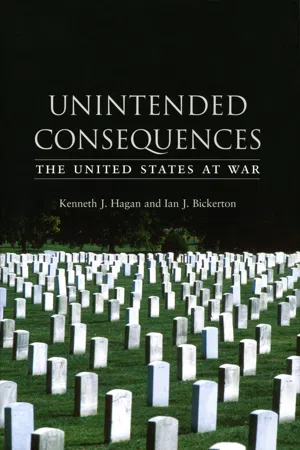
In Unintended Consequences Ian J. Bickerton and Kenneth J. Hagan describe and analyse the unintended consequences of ten major wars fought by the United States, pointing out critical turning points in the conflicts and the remarkable similarity of dilemmas that followed the conclusion of hostilities. The effect is to demonstrate that the unintended consequences of the wars not only outweighed the intended consequences in shaping subsequent events, they produced sharp and significant shifts in United States foreign, military and domestic policy. Most wars embarked upon by the United States when measured against this criterion were not only catastrophic and destructive, they were avoidable, unnecessary and unpredictable in outcome.
Once they understand this reality, Americans concerned with contemporary foreign and military policy can approach Iraq, and any prospective conflict, with greater sophistication. More importantly, policy-makers thinking of undertaking wars in the future may be made more cautious and circumspect in their planning than were those who launched the war in Iraq. It will also prove to be an invaluable corrective to the traditional views of American wars to which we are routinely exposed.
- English
- ePUB (mobile friendly)
- Available on iOS & Android
eBook - ePub
About this book
Information
ONE
THE FIRST MAJOR WAR,
1775–83
Credulity and want of Foresight, are Imperfections
in the Human Character, that no Politician can sufficiently
guard against.
in the Human Character, that no Politician can sufficiently
guard against.
John Adams to Abigail Adams, April 17761
The first major war fought by the united English colonies was against Great Britain. It was a result of the British Parliament’s persistent attempt to compel the thirteen North American colonies to bear their share of the costs for the Seven Years’ War (1756–63) and the post-war expenses of policing the colonial frontiers. In October 1774 the thirteen colonies openly defied British authority when the First Continental Congress adopted a Declaration of Rights and Grievances in protest against the impost of taxes by the British government, especially the taxes on molasses and tea, and the quartering of English troops in the colonies. In April 1775 hostilities between British troops and local Massachusetts militiamen broke out in the ‘battles’ of Lexington and Concord. Stunned and bloodied by the colonials, the British regulars retreated to Boston, where they were besieged by what soon became a regular army. On 10 May 1775, in Philadelphia, the Second Continental Congress met for the first time to form the Army of the United Colonies. For sectional balance it appointed as commander-in-chief a Virginia soldier with substantial if undistinguished combat experience in the Seven Years’ War, George Washington.
Independence was not the initial objective of the colonists. Time and again those fighting in Massachusetts stated they sought merely to guarantee themselves the historic ‘rights of Englishmen’ – particularly the right to be ruled and taxed by representatives of their own choosing and the right to govern their own internal affairs. Leaders such as John Adams, Thomas Jefferson and Benjamin Franklin claimed they were fighting against a ‘history of repeated injuries and usurpations, all having in direct object the establishment of an absolute Tyranny over these States’.2 In June 1775 George Washington told the New York Provincial Congress that his aim was ‘the re-establishment of peace and harmony between the mother country and the colonies’.3 The colonial legislatures, the militiamen and Washington were all quarrelling with the British Parliament, not the king. By January of the following year, however, Washington had come to the conclusion that the forcible expulsion of the British from the continent and complete severance of relations and independence from the mother country were the only viable outcomes of the conflict. He had been radicalized by George III’s rejection of the colonists’ final petition for redress of their grievances and by the simultaneous publication in January 1776 of the bestselling pamphlet, Common Sense, by Thomas Paine, a former British excise officer who had arrived in Philadelphia in 1774.
Six months later, in Philadelphia, Virginia delegate Richard Henry Lee introduced a resolution stating that ‘these United Colonies are and of right ought to be free and independent states’. The Second Continental Congress responded on 4 July by adopting the Declaration of Independence, which was drawn up by Jefferson, Adams and Franklin. In declaring its independence from the British Crown, the Congress claimed it was acting ‘in the Name, and by the Authority of the good People of these Colonies’. The delegates appealed ‘to the Supreme Judge of the world for the rectitude of our intentions’. Finally, the signatories mutually pledged to each other ‘our Lives, our Fortunes and our sacred Honour’.
But independence was a long way off and victories were scarce. The year 1776 was, in the words of historian David McCullough, ‘a year of all too few victories, of sustained suffering, disease, hunger, desertion, cowardice, disillusionment, defeat, terrible discouragement, and fear’.4 The Declaration of Independence was little more than a rhetorical gesture against an overwhelmingly stronger military force. Nor were the revolutionaries supported by all the colonists. Many remained loyal to Great Britain and were horrified by the idea of separating from a liberal, protective government they regarded as benevolent and beneficial. This was not a war fought against an oppressive, evil empire. According to McCullough, the colonists enjoyed a higher standard of living than their rulers – or indeed any Europeans.
The revolutionary, and initially unintended, decision to declare independence changed the nature of the armed conflict with Great Britain, giving it some aspects of an international war. The colonial revolutionaries sought to capitalize upon this situation by seeking foreign military assistance, and they actively pursued this goal with France. For two years the French monarchy gave only limited and largely clandestine aid, but the Battle of Saratoga in September–October 1777 convinced France that the colonists could achieve independence with French military and naval assistance. A treaty of military alliance was signed in February 1778, and the war became one of a Franco-American coalition against the diplomatically and militarily isolated British. This treaty was the consciously sought result of the Americans’ strategy, and it led to the culminating victory at Yorktown in September 1781. It also had far-reaching unintended consequences once the colonists won the war.
THE WAR
One man and two battles determined the nature and consequences of what became a war for independence. The man was George Washington; the battles were those at Saratoga, New York, in 1777, and at Yorktown, Virginia, in 1781. George Washington became the epicentre of the war against Britain the moment he assumed command of the Continental Army surrounding Boston on 3 July 1775. He was facing British regulars who were attempting to break through the colonial militia’s emplacements around the city. On 17 June, under the operational direction of General William Howe, a highly regarded field commander, the British had frontally attacked American militiamen holding the high ground on Breed’s Hill, immediately in front of a somewhat higher promontory named Bunker Hill. The well-drilled and disciplined British soldiers ‘went down like wheat before the scythe all along the line’.5 On the third desperate charge Howe’s men took the hill, but only because the defenders were running out of ammunition. In what became known as the Battle of Bunker Hill 50 per cent of the British force was killed or wounded. Howe never fully regained his offensive spirit, while the colonists acquired confidence in the ability of irregulars to defeat a proud professional army. This conceit fed the spirit of resistance, inclining it more and more toward outright independence, a decision formally made by the Continental Congress on 4 July 1776.
Colonial hubris following Bunker Hill also made Washington’s task of organizing a regular army more difficult, but from the outset he understood better than anyone else that only by building and preserving a national army could he ensure the success of the American cause. His army therefore became the critical Clausewitzian centre of gravity, and the British generals never fully understood this fact. As a result, they were too timid and indecisive in their efforts to engage Washington decisively in a battle of their choosing. During seven years of fighting, Washington rarely arranged his army in formation for frontal engagements; on the few occasions when he did so the outcome was not favourable to the Americans. His preference was to elude the main forces of the British army and make stinging, ungentlemanly, guerrilla-like raids, sometimes in the dead of night. In this manner he compelled the British generals to include his army’s existence in the calculations for their next offensive. So long as Washington’s regulars and militiamen remained in the central states – New Jersey and Pennsylvania – the British could only fight on the periphery; they could not enjoy interior lines of communications at the strategic level. Thus, in a real sense, Washington was a part of every battle, whether or not he was physically present. At Yorktown, where he was personally in command of a large coalition army, he won the war.
The long road to Yorktown began in Saratoga in October 1777. Lieutenant General John Burgoyne of the Royal Army had recently come from London with a plan for defeating the colonists with a two-pronged attack to split off and isolate the New England colonies, the heart of the revolution. He would descend from Canada to Lake Champlain; General Howe would head north from New York to rendezvous with him. Simplicity itself, but Howe did not comply. Orders directing him to march north were mislaid in London by the Secretary of State for the American Department, Lord George Germain. Howe in any case preferred to attack the rebels’ political centre. He thought the people of Pennsylvania were increasingly ‘disposed to peace, in which sentiment they would be confirmed by our getting possession of Philadelphia’.6 He occupied the capital on 25 September, after skirmishing with Washington, but possession proved irrelevant to a war in which the soldiers in the field were the only real American centre of gravity.
Abandoned by Howe, ‘Gentleman Johnny’ Burgoyne and 8,000 formidable troops, by whom he was ‘universally esteemed and respected’, marched south into the waiting arms of the savage, forest-smart colonials.7 The militiamen felled trees to slow his advance and cut supply lines in his rear. At Bemis Heights, on 7 October 1777, they joined the regulars commanded by Benedict Arnold, a charismatic leader possessed of ‘boundless energy and enterprise’, and Washington’s surrogate, Major General Horatio Gates, to rout much of Burgoyne’s force.8 Rather than preside over the complete wrecking of his army, Burgoyne did what a sensible and honourable eighteenth-century commander should have done: he surrendered the entire army intact. The formal surrender came at Saratoga on 17 October: 7 generals, 300 officers and 5,600 soldiers withdrew from the war. New England was saved for the Revolution as the rebels had hoped, but the monumental unintended consequence of Burgoyne’s capitulation was a war-winning military alliance between republican America and monarchical France.
News of Burgoyne’s surrender reached the American representative in Paris, Benjamin Franklin, on 4 December. Two days later, King Louis xvi approved the concept of a military alliance with the United States. The king and Franklin recognized that the magnitude of the American victory at Saratoga could transform the relationship between their two countries. Since early 1777 France had been clandestinely shipping arms and ammunition to the revolutionaries. The Catholic Bourbon monarchy was seeking revenge for Protestant England’s victory in the Seven Years’ War, and it hoped for restitution of some of the North American territories lost in that imperial war. In the words of the Comte de Vergennes, France’s foreign minister, American independence would ‘diminish the power of England and increase in proportion that of France’.9 Prior to Saratoga, however, the American military record had been mixed, and France had been cautious; now it was clear that the unorthodox combination of militiamen attacking from the sides and rear and Continental regulars standing in line could force the surrender of an intact British army. This was a previously unimaginable military catastrophe of high symbolic importance. France suddenly had the opportunity to greatly increase the American prospects for winning independence.
Vergennes and Franklin signed a treaty of military alliance on 6 February 1778. This first pact with a European power recognized the United States as a sovereign nation. It ensured the new nation of a steady supply of war materiel. Most importantly, the alliance brought French naval power into play as a check on the Royal Navy’s monopolistic sway over the coastal waters and maritime approaches to North America. The British government retaliated by going to war with France on 11 March, and within two years England was fighting alone against a coalition of Holland, Spain and France. ‘Thus, at Saratoga’, writes British historian J.F.C. Fuller, ‘the sword of Damocles fell, not only on Great Britain, but, because of the fervour of the American Revolution, upon the whole of the Western World.’10 Saratoga and the continued existence of Washington’s army presented the British with a stalemate in the northern and central colonies. Lord George Germain therefore decided on an offensive against the south, where Loyalists were in greater abundance. By capturing Georgia and the Carolinas – and continuing to occupy New York City – London hoped to frustrate the revolutionary leaders so thoroughly that they would agree to remain within a reformed imperial system. The campaign began in late 1778 and continued through 1780. Initially it went well for the British. The Americans surrendered two armies, one of them commanded by the victor of Saratoga, General Horatio Gates, who turned over his force on 16 August 1780.
Gates’s loss proved fortuitous. Under Washington’s prodding, Congress now placed Major General Nathanael Greene in command of the Southern Department. Rated as ‘one of the greatest of small war leaders’, Greene faced the perfect foil: Lord Charles Cornwallis, whose aggressiveness made him something of a rarity among British generals. By the time of Greene’s appointment, the excessive brutality of the British soldiers and their loyalist allies was turning much of the population against the Crown. Guerrilla bands, ‘the backwoodsmen of the Alleghenies’, had begun to harass the British troops, and Greene exhibited an extraordinary ability to coordinate their attacks and those of militiamen with his field army’s manoeuvres.11 Unlike Washington, who would not ‘divide the Army . . . into detachments contrary to every Military principle’, Greene broke his into segments.12 He lured the pursuing Cornwallis into doing the same with his units. In vain, ‘Cornwallis lunged after Greene in a twisting, back-country campaign that wore down British strength and patience.’13 Greene tersely described his operational strategy: ‘We fight, get beat, rise and fight again.’ He commonly ran ‘as fast forward as backward, to convince our Enemy that we were like a Crab, that could run either way’.14
By June 1781 Cornwallis had given up the chase and moved his campaign from the Carolinas to the sea coast and then north into Virginia, hoping still for a Loyalist uprising. At that point General Sir Henry Clinton, his nominal superior based in New York, ordered him to the coast so that he could send reinforcements from his army to New York, which British intelligence believed Washington and the French would soon attack. Refusing to detach soldiers from his army, Cornwallis marched his army of 7,000 men to Yorktown, Virginia. With the Marquis de Lafayette’s 5,000-man contingent of Continentals nipping at his heels, Cornwallis established a defensive position where he could communicate with the Royal Navy, which could carry him safely out of harm’s way so long as it commanded the offshore waters. In this manner, Nathanael Greene’s unorthodox warfare, intended only to expel the British from the Carolinas, had driven a British army to the brink of a disaster that would end what had become a war for American independence.
Yorktown resonates through American history as George Washington’s greatest triumph, but it was the French naval connection rather than his own calculations that drew him there instead of to the main British position in New York City. By 1780 Washington, more than any other colonial war leader, had come to understand that a conclusive military victory over the British depended on achieving at least transitory command of the seas. ‘In any operation, and under all circumstances,’ he wrote, ‘a decisive naval superiority is to be considered as a fundamental principle, and the basis upon which every hope of success must ultimately depend.’15
The rebels lacked the resources to build, equip and man a fleet of warships, so Washington turned to his allies. In early 1781 he thought that French men-of-war might establish temporary supremacy over the Royal Navy off New York City. However, French Admiral Comte de Grasse and French General Comte de Rochambeau saw Cornwallis’s army at Yorktown as the more promising target, in part because its southerly location would facilitate de Grasse’s quick return to the West Indies once the hurricane season ended in the autumn. Persuaded by his comrades-in-arms, Washington joined them in drawing up a plan to trap Cornwallis between the Franco-American armies and de Grasse’s fleet at the mouth of the Chesapeake. It was a bold stroke, and it succeeded in September and October 1781 because of allied good luck and countervailing mismanagement by the British in New York.
De Grasse, sailing from the West Indies, had the good fortune to arrive when there were no Royal Navy warships in the Chesapeake. He disembarked 3,000 men and supplies to aid Lafayette, who was barely containing Cornwallis until Rochambeau and Washington could arrive with 6,000 more soldiers. Surprised at anchor by British Admiral Graves’s small fleet, de Grasse fought them off in the inconclusive and poorly conducted Battle of the Chesapeake on 5 September. On 10 September another French fleet arrived with eight ships of the line, siege artillery and military stores. Outnumbered and outmanoeuvred, Graves sailed for New York; Cornwallis was cut off from reinforcement or escape by sea; Washington and Rochambeau, now commanding more than 16,000 men, arrived on 17 September. They began preparations to annihilate Cornwallis’s army.
A month later, on 17 October 1781, the fourth anniversary of Burgoyne’s surrender at Saratoga, Cornwallis repeated his countryman’s sad act. He sent a note to Washington proposing ‘a cessation of hostilities for twenty-four hours . . . to settle terms for the surrender’.16 Rochambeau and Washington agreed. Cornwallis had saved his army to fight another day, in another war. Except for a few military formalities and some intense diplomatic negotiations in Paris and London, the American phase of this war was finished. The men who first took up arms in 1775 now had to cope with the consequences of their successful insurrection.
UNINTENDED CONSEQUENCES
After an eight-year-long war, and the loss of around 25,000 American lives, in April 1783 Br...
Table of contents
- Front Cover
- Half Title
- Title Page
- Copyright
- CONTENTS
- Preface
- Introduction
- 1 The First Major War, 1775–83
- 2 The Second War against Great Britain, 1812–15
- 3 The War against Mexico, 1846–48
- 4 The Civil War, 1861–65
- 5 The War against Spain, 1898
- 6 The United States in World War I, 1917–18
- 7 The United States in World War II, 1941–45
- 8 The War in Korea, 1950–53
- 9 The War in Vietnam, 1964–75
- 10 The Wars against Iraq, 1991–2007
- Conclusion
- References
- Bibliography
- Acknowledgements
- Index
Trusted by 375,005 students
Access to over 1.5 million titles for a fair monthly price.
Study more efficiently using our study tools.
Frequently asked questions
Yes, you can cancel anytime from the Subscription tab in your account settings on the Perlego website. Your subscription will stay active until the end of your current billing period. Learn how to cancel your subscription
No, books cannot be downloaded as external files, such as PDFs, for use outside of Perlego. However, you can download books within the Perlego app for offline reading on mobile or tablet. Learn how to download books offline
Perlego offers two plans: Essential and Complete
- Essential is ideal for learners and professionals who enjoy exploring a wide range of subjects. Access the Essential Library with 800,000+ trusted titles and best-sellers across business, personal growth, and the humanities. Includes unlimited reading time and Standard Read Aloud voice.
- Complete: Perfect for advanced learners and researchers needing full, unrestricted access. Unlock 1.5M+ books across hundreds of subjects, including academic and specialized titles. The Complete Plan also includes advanced features like Premium Read Aloud and Research Assistant.
We are an online textbook subscription service, where you can get access to an entire online library for less than the price of a single book per month. With over 1.5 million books across 990+ topics, we’ve got you covered! Learn about our mission
Look out for the read-aloud symbol on your next book to see if you can listen to it. The read-aloud tool reads text aloud for you, highlighting the text as it is being read. You can pause it, speed it up and slow it down. Learn more about Read Aloud
Yes! You can use the Perlego app on both iOS and Android devices to read anytime, anywhere — even offline. Perfect for commutes or when you’re on the go.
Please note we cannot support devices running on iOS 13 and Android 7 or earlier. Learn more about using the app
Please note we cannot support devices running on iOS 13 and Android 7 or earlier. Learn more about using the app
Yes, you can access Unintended Consequences by Kenneth J. Hagan,Ian J. Bickerton in PDF and/or ePUB format, as well as other popular books in History & Military & Maritime History. We have over 1.5 million books available in our catalogue for you to explore.