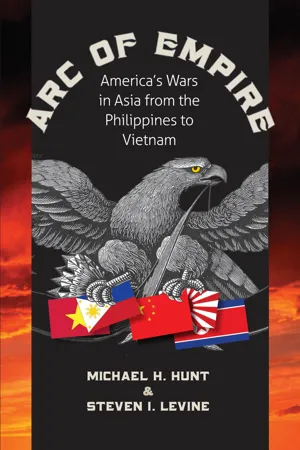
Although conventionally treated as separate, America’s four wars in Asia were actually phases in a sustained U.S. bid for regional dominance, according to Michael H. Hunt and Steven I. Levine. This effort unfolded as an imperial project in which military power and the imposition of America’s political will were crucial. Devoting equal attention to Asian and American perspectives, the authors follow the long arc of conflict across seventy-five years from the Philippines through Japan and Korea to Vietnam, tracing along the way American ambition, ascendance, and ultimate defeat. They show how these wars are etched deeply in eastern Asia’s politics and culture.
The authors encourage readers to confront the imperial pattern in U.S. history with implications for today’s Middle Eastern conflicts. They also offer a deeper understanding of China’s rise and Asia’s place in today’s world.
For instructors: An Online Instructor’s Manual is available, with teaching tips for using Arc of Empire in graduate and undergraduate courses on America’s wars in Asia. It includes lecture topics, chronologies, and sample discussion questions.
eBook - ePub
Arc of Empire
America's Wars in Asia from the Philippines to Vietnam
- 352 pages
- English
- ePUB (mobile friendly)
- Available on iOS & Android
eBook - ePub
About this book
Information
1 | The Philippines, 1899–1902
THE IMPERIAL IMPULSE UNLEASHED
In the early evening of 4 February 1899, just outside Manila, the war began that fixed formal U.S. control over the Philippines and thereby plunged the United States into a deepening involvement in eastern Asia. According to a generally accepted U.S. version, a foot patrol sent out by Company D of the First Nebraska Regiment encountered Philippine soldiers. When the advancing Filipinos failed to halt as ordered, someone on the American side—very likely Private William Grayson—made a split-second decision to fire. Grayson, a British immigrant who had left a hotel job to join the army, later claimed that he had taken several more shots at other figures and then taken stock of the situation. “Line up, fellows,” he said, “the niggers are here all through these yards.” Within minutes the trenches around the city had erupted in gun battles that continued into the next day.1
What Grayson helped unleash was a distinctly colonial struggle—from conception to execution to consequences—just as the larger U.S. enterprise in the Pacific that it inaugurated was bound up at every turn by issues of colonialism and empire. To be sure, the presiding presence, William McKinley, expressed his heartfelt belief that “no imperial designs lurk in the American mind.”2 And nothing in the biography of this strikingly reserved Ohio lawyer and Civil War veteran hinted at bold imperial impulses. He had served fourteen years in the House of Representatives and four years as governor before making his successful presidential bid under the Republican Party banner. During that time he had not ventured beyond his country’s borders or taken any interest in world affairs. Yet he conducted his presidency as though thoroughly versed in the logic of empire so prominent a feature of his age: great powers had a clear claim to colonies; native peoples had no legitimate say in their own future; and superior arms of the one could justifiably put to rest any objections from the other. Almost overnight he would bring his country in line with the prevailing practices of that imperial age. He struck at the last vestiges of Spain’s empire in the Pacific as well as in the Caribbean, fully conscious of its vulnerability. He made the case for annexation using nationalist language—invoking a cause sweeping, grand, and noble—commonplace among other eager empire builders of the time. He dispatched across the Pacific an army as practiced in putting down the “natives” as any the Europeans could field. By embracing an overtly imperial policy in the Pacific no less than in the Caribbean, he initiated the rise of the strong executive able to challenge empires as well as create and manage them.
IMPLICATED IN EMPIRE
It should come as no surprise that empire emerged as a defining feature of the U.S. push into the Pacific. The United States had emerged from and been profoundly shaped by its origins as a settler colony with a strong sense of nationalism and a pronounced feeling of cultural superiority. These were prerequisites for any imperial calling. Settlers from England had proved unusually adept at asserting control over eastern North America during the seventeenth and eighteenth centuries. They had squeezed out the Spanish, French, and Dutch and eliminated or subordinated indigenous peoples. As the United States expanded westward across the continent, political and cultural control remained in the hands of the descendants of the English and in time the Scottish and the Welsh of broadly British background. These transplants spoke glowingly if imprecisely of their new country as a great empire in embryo. The subjugation of native peoples and the enslavement of Africans were indispensable to the making of this settler colony—in the acquisition of great tracts of land and in the creation from that land of a wealth-generating plantation economy. Their nationalist self-conception incorporated a strong sense of racial superiority and entitlement justifying Anglo dominance over other, supposedly lesser peoples. Was not God, a prominent Protestant evangelist rhetorically asked in 1885, “preparing in our Anglo-Saxon civilization the die with which to stamp the peoples of the earth?”3 By ethnic background and nationalist outlook, McKinley and his circle were connected to this tradition of settler empire.
Nowhere was the U.S. settler experience more relevant to what was to come in the Philippines than the process of turning Native Americans into unwilling subjects. Informing that process at every step of the way was a sturdy settler assumption of superiority over lesser peoples that justified, even compelled, securing control of their land and lives in the name of progress and civilization. Native Americans who refused to acknowledge these claims and resisted were invariably met with coercion. Countering irregular warfare required prolonged and brutal fighting that led to de-humanization of the enemy and ample opportunity for atrocities directed at a population of “savages” in which civilians were indistinguishable from combatants. The struggle usually ended with the army’s corralling whole populations in a strategy of removal and concentration that proved effective in disrupting and undermining resistance. Bargains struck with amenable Native American leaders could hasten the end by creating divisions that isolated and demoralized the resistance. Carrying this process of conquest to the Philippines were those most intimately familiar with it: a corps of career officers steeped in small-unit Indian fighting and a strong representation of volunteer units drawn from Western states that had recently witnessed the last phase of frontier warfare. Of the thirty generals who served in the Philippines between 1898 and 1902, twenty-six (including all four commanding officers) were experienced Indian fighters, and the remainder had some other kind of connection to the American West.4
By McKinley’s day, Americans had already proved proficient at playing the imperial game on a steadily expanding stage. Growing national strength and confidence made it possible for assertive U.S. leaders to gather up great stretches of territory from France, Spain, and Russia as well as from Spain’s successor regime in Mexico. Only the imperial prizes of Cuba and Canada escaped the U.S. grasp. What Americans did not seize, they shielded from the clutches of other powers. After much of Spanish Latin America declared independence, President James Monroe proclaimed in 1823 that the European powers were to keep their hands off. By the time of McKinley’s presidency Monroe’s doctrine had become internationally respected even by Great Britain. Americans who had begun the century hemmed in by other empires had become adept at poaching on them. Guided by their “manifest destiny,” they had fastened control over a vast stretch of North America and fenced the hemisphere off from European ambitions.
By the time McKinley took office in 1897, Americans’ outlook on imperial expansion in the Pacific was still in flux, though the general tendency was telling. Acquiring Pacific Ocean frontage seemed to set the stage for a new phase in the westward advance of civilization with Americans the prime agents and China the ultimate objective. At the same time, European and Japanese ambitions across the Pacific seemed ever more threatening, not just to American dreams but also to American strategic and trade interests. New naval technology—not least steam-driven armored warships with accurate long-range guns—had made the world seem smaller and more dangerous. Territory once considered remote now mattered. American missionaries and commercial interests active in China and Hawaii were joined by big-navy advocates in promoting the notion of an American Pacific destiny and warning against European schemes that might deny Americans their proper influence in the region. U.S. naval expeditions regularly prowled the western Pacific bolstering national prestige, keeping an eye on the other powers, and beating down doors to foreign trade. The demonstration of force led by Commodore Matthew Perry against Japan in 1853-54 was the best known of these, but other naval officers tried their luck in Chinese and Korean waters with less success than Perry.
Following the Civil War, the breadth and tempo of American involvement in eastern Asia increased. Washington began acquiring maritime outposts (Midway in 1867 and Pearl Harbor in 1887), and in 1885 sharply challenged German claims in Samoa. After a narrowly averted naval clash, Washington and Berlin joined London in putting Samoa under a temporary three-way protectorate. Equally notable was the rising presence of private citizens, some hired to help with Asian modernization initiatives and others bent on saving souls. By 1889 nearly five hundred American missionaries were at work in China alone. During the following decade levels of domestic support for proselytizing reached a crescendo, and so did Chinese harassment and violence directed against an exposed network of mission stations spreading into the interior. The resulting incidents prompted missionary calls for U.S. government protection. Increasingly officials obliged.
Against this backdrop, Hawaii became the scene of the first overtly imperial U.S. exercise in the Pacific. The results were ambiguous. By 1893 American sugar plantation owners and their missionary allies had gained control of the economic and cultural life of the islands. While curbing the Hawaiian monarch, they promoted an ever tighter relationship with the United States. When this settler minority overthrew the monarchy that year and approached Washington on joining the union, the outgoing administration of Benjamin Harrison responded favorably. A takeover would foreclose any British, German, or Japanese claims on the islands. But the newly elected President Grover Cleveland regarded the coup as illegitimate; outspoken West Coast nativists wanted nothing to do with an Asia that sent hordes of cheap Chinese labor their way; and important leaders in Congress shared these reservations and added their concerns about the difficulty of defending distant island possessions. Frustrated, the settlers in Hawaii set up their own republic. They would wait for the political winds on the mainland to shift.
A confrontation with Spain over Cuba kicked up the squall that they were waiting for. It carried U.S. ambitions all the way to the Philippines, an archipelago of some seven thousand tropical islands about seven thousand miles from the U.S. mainland. McKinley took office facing a stalemated struggle between Cubans demanding independence and a Spanish ruling class clinging to the remains of a once great empire even though the treasury was empty and Spain’s armed forces were unable to pacify restive subjects. Demands for independence had flared into armed resistance in 1868, subsided following the promise of autonomy in 1878, and then erupted again in the early 1890s. By 1896 Spanish forces faced a small but stubborn guerrilla resistance, which even draconian measures failed to extinguish. While the fighting in Cuba—grinding, destructive, and cruel—failed to restore Spain’s upper hand, it did disrupt American business and investments there and generate humanitarian outrage in the United States. McKinley at first sought to resolve the conflict through diplomatic pressure. But Madrid’s half-hearted offer of autonomy was now unacceptable to Cubans, while significant concessions to Cubans collided with a strong current of opinion in Spain determined to hang on to Cuba even at the risk of war with the United States. By February 1898 McKinley was facing at home a rising chorus of jingoists demanding armed intervention and charging Madrid with not negotiating in good faith. The chorus grew louder after Spanish authorities were implicated (falsely as it turned out) in the sinking of the American battleship Maine in Havana harbor on 15 February 1898. In late April 1898, with fellow Republicans pressing for action and Congress in near revolt, McKinley asked for an authorization to go to war. Congress quickly obliged.
To this point McKinley had been conflicted and hesitant over the prospects of war with all its terrible and unknown consequences. His combat experience during the Civil War had taught him what happened once the guns began to fire. He was in addition temperamentally cautious as he had demonstrated in a political career spanning three decades. But like other Americans he was susceptible to an expansive nationalism that envisioned a great future for his country on the world stage. He also could appreciate the political advantages that accrued to a war president and the leeway it allowed him to advance the interests of the nation. The president now wheeled into action, carried along by the almost instant successes against Spanish forces and the enthusiasm that news of one victory after another produced at home.
Following the war declaration, an energized president directed U.S. forces to take Cuba and Puerto Rico and to seek out the Spanish fleet defending the Philippines. McKinley’s actions followed navy contingency plans going back to mid-1896. These plans anticipated that a successful strike at the Philippines would deprive Spain of both a base of operations and a source of revenue. In short order—on 1 May 1898—U.S. warships under the command of Commodore George Dewey scored a fateful victory in Manila Bay. By July the administration had scooped up Puerto Rico without resistance, gotten the campaign in Cuba well under way, and pushed Hawaii’s annexation through Congress. War had strengthened the argument for the importance of a Pacific stronghold to protect the West Coast and to serve as a way station for the U.S. advance into the western Pacific. The next month Manila, the last Spanish bastion in the Philippines, fell to U.S. forces, giving them a foothold in a land otherwise under the control of the Filipino forces fighting for independence. The United States was having “a splendid little war,” so observed John Hay (the man about to become McKinley’s secretary of state).5 On 12 August Madrid bowed to Washington’s cease-fire terms. The president proceeded to gather up the spoils of war. He subjected Cuba to a U.S. military occupation that would end in 1902 with the island formally independent but in fact politically and economically subordinate to the United States. He insisted that the peace treaty concluded with Spain on 10 December hand over the Philippines, Guam, and Puerto Rico. On 6 February 1899, the president won Senate approval of his handiwork.
McKinley’s transpacific push continued in 1899 and 1900, driven by rising alarm over the major powers’ carving up of China into ever more distinct spheres of influence. Trade groups warned against the prospect of restrictions against U.S. commerce in a China threatened by formal partition. In September 1899 Secretary of State Hay issued a formal warning to the powers against obstructing U.S. commercial access within their spheres of influence. In December McKinley diverted his attention from China long enough to reach an agreement with Germany to partition Samoa but then shifted back the next year as an armed popular movement, what came to be known as the Boxer Rebellion, spread like wildfire across northern China. Washington at first watched incredulous as Boxer bands took hold in the countryside, attacked foreign missionaries and their Chinese converts, and finally won the support of court officials seething over years of foreign intervention. With Boxers and sympathetic imperial forces dominating the capital and laying siege to its diplomatic quarter, McKinley decided to dispatch U.S. troops as a part of an international army assembled to pacify and punish.
McKinley wanted to make clear that the United States was a formidable Pacific power. Some four thousand American troops helped take Beijing, quell the Boxers, and bring the ruling dynasty to account. With China’s future still unsettled, Hay issued a second, more broadly drawn open-door note in September. This time he warned the powers against converting their informal spheres into a formal partition. Privately he dismissed as “mere flap-doodle” the notion that the United States was in any position to dictate.6 But in fact his call to preserve a faltering Chinese empire as a political entity gave voice to an emerging conviction that preserving American influence was essential to China’s progress and to the U.S. future as a Pacific power. While China was emerging in the closing decades of the nineteenth century as the part of eastern Asia that Americans most prized, it was also proving a difficult catch. The country was enormous, its elites were highly politicized and averse to foreign control, and other powers with their own agendas were well entrenched. The Philippines was a different story.
Of all these initiatives that began to stake out American claims in the mid- and western Pacific, the taking of the Philippines was the most surprising and unsettling. Here was a land at great remove from the U.S. mainland and with no prospect of cultural or political amalgamation through settlement. A colonial commitment was sure to plunge the administration into serious controversy. Complicating the prospects of annexation, the islands were in the grip of independence fever. The Spanish had answered reform demands with repression, finally precipitating an armed uprising in August 1896. The resistance forces had not fared well in the fighting around Manila and in nearby provinces, so the revolutionary leaders had struck a deal with the colonial authorities. They would go into exile in exchange for cash payments and the promise of reform. This deal marked a pause in the push for independence, not its death knell. Later, with the Spanish preoccupied by U.S. ambitions, armed resistance would resume, this time with greater success.
With good reason, McKinley moved toward his decision incrementally. As commander in chief, he created compelling facts on the ground. His order in April to attack the Spanish fleet defending the Philippines not only yielded a quick naval victory but also paved the way for the president’s equally quick decision to dispatch U.S. forces to secure a U.S. foothold there. At minimum he could use the islands as a pawn in any peace settlement. On 4 May he ordered the first contingent of U.S. troops to deploy, and he added more in the course of the month. By 3 June, McKinley was eyeing Manila as a commercial entrepôt and naval base along with the main island of Luzon, on which that colonial capital was located. Just as Madrid sued for peace in early August, U.S. forces secured the surrender of Manila, and McKinley insisted that the cease-fire agreement leave the future of the Philippines a matter for resolution in the final peace talks. On 16 September he told his negotiating team in Paris that he wanted all of Luzon. On 28 October he went a step further, instructing them to claim the entire Philippines.7 To soften this blow to Spain, McKinley authorized the payment of $20 million (included as a provision in the final treaty). Converted to its present-day value, his outlay came to about half a billion dollars.
McKinley supplied posterity a rough sense of the logic that guided those decisions. Taking only Manila or Luzon was impractical. Those who knew the islands had convinced him that both places were integrally tied to the rest of the archipelago. He could not return the islands to the brutal and benighted Spaniards. Independence would not work. The childlike nature of the Filipinos, according to the president’s recital, would lead them into “anarchy and misrule.” Walking away and letting the now vulnerable islands go to some other power struck McKinley as “bad business and discreditable.” The British, the leading imperial power of the day, were already dominant in the Philippine b...
Table of contents
- Cover Page
- Arc of Empire
- Copyright Page
- Dedication
- Contents
- Illustrations and Maps
- Introduction
- 1 | The Philippines, 1899–1902
- 2 | Japan, 1941–1945
- 3 | Korea, 1950–1953
- 4 | Vietnam, 1965–1973
- Conclusion
- Notes
- Guide to the Historical Literature
- Acknowledgments
- Sources of Illustrations
- Index
- Series
Trusted by 375,005 students
Access to over 1.5 million titles for a fair monthly price.
Study more efficiently using our study tools.
Frequently asked questions
Yes, you can cancel anytime from the Subscription tab in your account settings on the Perlego website. Your subscription will stay active until the end of your current billing period. Learn how to cancel your subscription
No, books cannot be downloaded as external files, such as PDFs, for use outside of Perlego. However, you can download books within the Perlego app for offline reading on mobile or tablet. Learn how to download books offline
Perlego offers two plans: Essential and Complete
- Essential is ideal for learners and professionals who enjoy exploring a wide range of subjects. Access the Essential Library with 800,000+ trusted titles and best-sellers across business, personal growth, and the humanities. Includes unlimited reading time and Standard Read Aloud voice.
- Complete: Perfect for advanced learners and researchers needing full, unrestricted access. Unlock 1.5M+ books across hundreds of subjects, including academic and specialized titles. The Complete Plan also includes advanced features like Premium Read Aloud and Research Assistant.
We are an online textbook subscription service, where you can get access to an entire online library for less than the price of a single book per month. With over 1.5 million books across 990+ topics, we’ve got you covered! Learn about our mission
Look out for the read-aloud symbol on your next book to see if you can listen to it. The read-aloud tool reads text aloud for you, highlighting the text as it is being read. You can pause it, speed it up and slow it down. Learn more about Read Aloud
Yes! You can use the Perlego app on both iOS and Android devices to read anytime, anywhere — even offline. Perfect for commutes or when you’re on the go.
Please note we cannot support devices running on iOS 13 and Android 7 or earlier. Learn more about using the app
Please note we cannot support devices running on iOS 13 and Android 7 or earlier. Learn more about using the app
Yes, you can access Arc of Empire by Michael H. Hunt,Steven Levine in PDF and/or ePUB format, as well as other popular books in History & Asian History. We have over 1.5 million books available in our catalogue for you to explore.