History

American Expeditionary Force
The American Expeditionary Force (AEF) was the United States' military force sent to Europe during World War I. Led by General John J. Pershing, the AEF played a significant role in the Allied victory and helped establish the United States as a major world power.
Written by Perlego with AI-assistance
Related key terms
1 of 5
7 Key excerpts on "American Expeditionary Force"
 eBook - PDF
An Uncertain Trumpet
The Evolution of U.S. Army Infantry Doctrine, 1919-1941
- Kenneth Finlayson(Author)
- 2001(Publication Date)
- Praeger(Publisher)
2 The American Experience in World War I So long as our general staff officers were given French Doctrines or English Doctrines, they were not sure of themselves, but when our own experience in the fighting enabled the instructors to announce the American way that had been found best, the groping was reduced to the minimum and the staff officers found themselves. Col Fay W. Brabson, 88th Inf. God is always on the side of big battalions. Henri de la Tour d'Auvergne, Marshall Turenne 2 Of the European nations that fought in World War I, the experience of Great Britain most closely mirrored that of the United States. For both countries, the beginning of the war found the army a fraction of the size of that of Germany or France. Neither Great Britain nor the United States possessed sufficient numbers of trained reserves to rapidly mobilize contingents of significant size for deployment. The British Expeditionary Force grew from 100,000 in 1914 to nearly 2 million at war's end, the largest army ever fielded by the British Empire. The American army in 1916 closely matched the size of the early BEF and grew to over 3 million by the armistice. The American Expeditionary Force (AEF) began arriving in France in June 1917. Because of the time required to deploy the forces in Europe and delays in their training, the AEF saw sustained combat only in the final five months of the war. The experience engendered by this tremendous explosion in size and the very limited exposure to combat of the American Army played a significant role in the development of tactical doctrine in the interwar period. The tactics that the AEF brought to Europe underwent little alteration in the brief period that the army saw action, but the limited combat exposure influenced subsequent doctrinal development far out of proportion to the effectiveness of the U. eBook - ePub
Unknown Soldiers
The American Expeditionary Forces in Memory and Remembrance
- Mark A. Snell(Author)
- 2008(Publication Date)
- The Kent State University Press(Publisher)
PART 3
THE AEF IN POPULAR MEMORY
 Passage contains an image
The Literature of the AEF
A Doughboy Legacy
Jack CappsHe is that fallen lance that lies as hurled, But this we know, the obstacle that checked And tripped the body, shot the spirit on Further than target ever showed or shown.ROBERT FROST , “A Soldier,” 1928Popular American remembrance of the Great War of 1914–18 relies on the literature of the American Expeditionary Forces (AEF), with the doughboy as its centerpiece.1 The eulogized Unknown Soldier immediately comes to mind, but the three literary titles most frequently recalled are a Canadian’s poem written before America entered the war, a novel of a volunteer medic’s desertion from the Italian front, and a view of the war from German youth in the opposite trenches.2 The consequential literature of the AEF, which owes its singularly American focus to General Pershing’s success in maintaining the integrity of his units as they were committed to action, began to take shape before April 1917. Volunteers and observers, who despite the nation’s professed neutrality, rallied early to the Allied cause, injected the germ of involvement by soliciting American sympathy and appealing to the national conscience. When German provocations made American entry inevitable and war was finally declared, federal agencies galvanized patriotic enthusiasm and military preparations plunged forward. What had been “their war” was suddenly “our war.” A reversed neutrality became the zealotry of the newly converted. The freewheeling enthusiasm of westward expansion and post–Civil War affluence, which by the turn of the century had been called into question, was revived as America turned toward a new frontier “over there.” Official dispatches, newspaper commentary, and letters home described the progress of troops’ training and their movements toward embarkation as an eager public awaited news of its heroes. In due time, details from participants would come. Realities of the confrontations in France, however, would radically change the complexion of the jejune idealism that charged Americans as they set sail on their mission. “For many young men the Great War was . . . an appalling experience, but it was also terribly compelling, the most profound episode of their lives, something about which they felt extremely ambivalent” and something which they would urgently communicate.3 eBook - ePub
- Allan R. Millett, Peter Maslowski(Authors)
- 2012(Publication Date)
- Free Press(Publisher)
ELEVENThe United States Fights in the “War to End All Wars,” 1917–1918
D uring the green April of 1917, as America entered the “Great War,” a United States senator cornered a General Staff officer and asked the critical strategic question of the intervention: “Good Lord! You’re not going to send soldiers over there, are you?” Some eighteen months later, the answer was clear as the American Expeditionary Forces (AEF) of over 2 million men, cooperating with the armies of France and the British Empire, bludgeoned Imperial Germany into an armistice. Supporting the AEF stood a Navy and Marine Corps of over 600,000. In the United States and in places as far separated as northern Italy, polar Russia, and Siberia, another 2 million American soldiers served the war effort and diplomacy of the Wilson administration. World War I was the debut of the United States as an international military power. Like most debuts, the war brought its share of high anticipation, major disappointment, dogged accomplishment, and exaggerated exhilaration.The American role in World War I derived its character less from strategic thinking in the United States than from the geopolitical notion that the future well-being of the United States depended upon the balance of power in Europe and the outcome of the war. Discarding the hallowed assumption that Europe’s affairs did not involve the United States and the security of the Western Hemisphere, the Wilson administration decided that the nation had a critical stake in an Allied victory. American involvement stemmed from economic self-interest as well as an emotional commitment to support “democracy” (France and Great Britain) against “autocracy” (Germany). After a brief economic dislocation when the war began in 1914, American bankers, farmers, industrialists, and producers of raw materials exploited British naval control of the Atlantic and Allied financial strength to make the war the biggest profit-making enterprise in the history of American exporting. Before American entry, the balance of trade, already favorable to the U.S., jumped by a factor of five; the Allies liquidated $2 billion of American assets and privately borrowed another $2.5 billion to pay for their purchases. In contrast, Germany secured only $45 million in American loans. eBook - ePub
Reconsidering the American Way of War
US Military Practice from the Revolution to Afghanistan
- Antulio J. EchevarriaII(Author)
- 2014(Publication Date)
- Georgetown University Press(Publisher)
The navy had a similar number to crew three hundred ships, about 10 percent of which were battleships, and the marine corps had about eleven thousand personnel under arms. 24 By August 1918, the American Expeditionary Force (AEF) listed 2 million soldiers in its ranks and had deployed over a distance of three thousand miles. It had also fought successful actions at Cantigny in May, Château-Thierry and Belleau Wood in June, and participated in the Saint-Mihiel and Meuse-Argonne offensives in September 1918. 25 The Saint-Mihiel offensive involved nine US and five French divisions supported by 3,000 guns, 270 tanks, and 1,500 aircraft, while the Meuse-Argonne offensive employed fifty-two American divisions, ten of which were assigned to French and British armies, and was supported by 2,700 guns, 200 tanks, and 1,000 planes. 26 By the armistice, the AEF had advanced approximately 34 miles, occupied 580 square miles of territory, and had suffered about 320,000 casualties (16 percent), of which over 50,000 were killed in action. 27 While these operations were successful, the AEF proved to be deficient in the areas of higher-level coordination of fire and movement; timely issuance of orders, communication, and coordination with adjacent units and higher headquarters; and logistics—in short, operational science. 28 The AEF’s lack of experience was clearly a factor in its performance, particularly at higher levels: Its headquarters had only three months’ practice maneuvering formations larger than a division by the time the armistice took effect on November 11, 1918. Consequently, its adaptations were still very much a work in progress. Although American officers lacked higher-level command experience, they were not unfamiliar with the principal ideas underpinning industrial-age warfare: use of direct and indirect firepower to facilitate forward movement and concentration of all available firepower at the decisive point to weaken the enemy before the final assault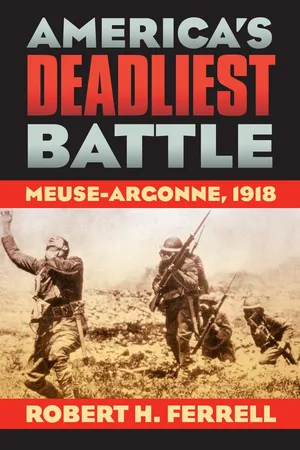 eBook - ePub
America's Deadliest Battle
Meuse-Argonne, 1918
- Robert H. Ferrell(Author)
- 2007(Publication Date)
- University Press of Kansas(Publisher)
CHAPTER TWO
The American Expeditionary Forces
In the beginning was President Wilson’s failure to organize American industry for war and Secretary Baker’s failure to supervise the War Department. Meanwhile, in 1917 the Allied armies exhausted themselves in illplanned and exceedingly costly offensives on the western front. For the French, it was the Nivelle offensive, named after its commander, General Robert Nivelle; for the British, it was a series of engagements known collectively as Passchendaele, after a Belgian town. Both these offensives became the ultimate examples of folly by Allied commanders, proof that the world war had lost any sense of purpose and was only grinding down its participants year after year. This persuaded the leaders of the German army to believe that 1918 would bring victory, that a great offensive against the Allies would defeat them and bring their governments to sue for peace.The Allies frantically appealed to the United States for assistance, which meant bringing over the cantonment divisions that had been formed in the autumn and early winter of 1917. They needed the manpower, whatever the divisions’ lack of equipment or training. The Allies, mostly the French, would provide the equipment, and Allied commanders would train the men and get them into the line. In January 1918 the British government offered shipping to bring the divisions over, and the commander in chief of the American Expeditionary Forces, General John J. Pershing, gratefully accepted.The result was the formation, by the end of the war, of a great American field army. As the divisions came over, the AEF commander began putting them into the line in a gingerly fashion because of their lack of training. He organized a large attack on the German salient at St. Mihiel that opened on September 12, 1918, and rolled up the sector almost the same day. A bare two weeks after St. Mihiel, he threw his divisions into the Meuse-Argonne.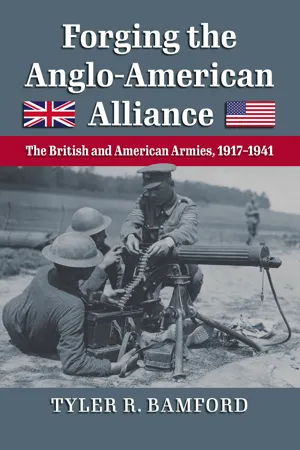 eBook - ePub
Forging the Anglo-American Alliance
The British and American Armies, 1917-1941
- Tyler R. Bamford(Author)
- 2022(Publication Date)
- University Press of Kansas(Publisher)
1
Associate Armies, 1917 –1918
The thing that is nearest my heart, as you can well imagine, is the rapprochement, the ever-closer alliance and union of British and American Armies and Nations. There is nothing else so important to win the war, and for all time to win peace for the world.1—Lieutenant Colonel Robert Bacon, US Army, April 22 , 1918On May 28 , 1917 , less than two months after the United States entered World War I on the side of the Allies, 191 US Army officers and men led by Major General John J. Pershing boarded the British ocean liner RMS Baltic and sailed for Europe.2 President Woodrow Wilson had dispatched this group as the nucleus of the American Expeditionary Forces (AEF), an army that eventually grew to more than 1 million US soldiers in Europe. Faced with the task of building and leading the largest field army in American history to that point, these handpicked officers did not pass their voyage in leisure. Also traveling on the Baltic were a number of high-ranking British Army officers with extensive experience fighting in France. Taking advantage of this opportunity, Pershing and his staff spent countless hours with their British guests, absorbing as many of their lessons as possible. Pershing later wrote that these British colleagues “kindly consented to answer questions on the subjects of organization, training, and fighting. The conferences thus held and a study of confidential reports from the British and French helped to put us more closely in touch with many details which could not have been learned other-wise except through experience.”3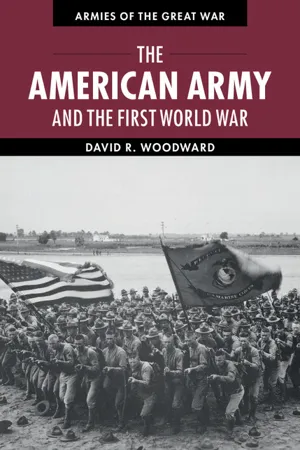 eBook - PDF
- David Woodward(Author)
- 2014(Publication Date)
- Cambridge University Press(Publisher)
4 Pershing’s Operations Staff soon followed this cable with a daunting request for “at least 3,000,000 men” along with their equipment over the next two years. 5 President Wilson, who considered alternate theaters to the killing fields of the Western Front as late as November 1917, was surely shocked by the enormity of the AEF’s requests. The expeditionary force of some 14,000 men that he had originally dispatched to France had within a few months grown to expectations by his commander-in- chief that as many as 3 million Americans would be required on European battlefields by 1919. In determining the AEF’s organization and equipment, Pershing’s Operations Section worked with a group of American officers, the Baker Mission, so named after its head, Colonel Chauncey B. Baker, which the War Department had dispatched to make its own independent report. As Harbord later noted, “it was a situation that called for extreme tact. The Mission had to be lined up and the two recommendations must agree.” 6 Baker, a friend of Pershing’s and a former West Point classmate, under- stood the delicacy of the situation and suggested that he meet with Pershing before he returned to the United States. 7 In two days of at times vigorous discussion, Pershing and his Operations Section generally prevailed. 8 Their agreement, achieved on July 11, became known as the General Organization Project. 9 The American Army’s combat divisions and their commanders in future were organized as in Table 2. Although the United States had no complete or permanent organization larger than a regiment in its prewar army, the General Organization Project now recommended creating divisions of approximately 28,000 combatants, or approximately twice as many riflemen as full-strength Allied and Organization, overseas training, and deployment 107
Index pages curate the most relevant extracts from our library of academic textbooks. They’ve been created using an in-house natural language model (NLM), each adding context and meaning to key research topics.

