History

Douglas Haig
Douglas Haig was a British senior officer during World War I, best known for his leadership of the British Expeditionary Force on the Western Front. He is a controversial figure, criticized for his tactics and the high casualty rates suffered by British forces under his command. Despite this, he played a significant role in the eventual Allied victory in the war.
Written by Perlego with AI-assistance
Related key terms
1 of 5
7 Key excerpts on "Douglas Haig"

- Todd W. Weston(Author)
- 2015(Publication Date)
- Verdun Press(Publisher)
Although operating under the constraints of economy of force, much as will future U.S. CINCs, Haig’s actions at Cambrai added a final characteristic that has relevance to the modern commander. A CINC must, then as now, understand the overall context of his activities and be willing to resist pressure (especially self-imposed as in Haig's case) to commit forces for anything other than the most compelling reason. At Cambrai, even though he was aware that he did not have sufficient forces to exploit success, Haig chose to proceed with an operation largely to salvage positive results from a disastrous year, relieve pressure on another front, and possibly in an effort to save his own job. After the unprecedented gains of the first day at Cambrai, the church bells rang in England for the first time since 1914. Two weeks later, after a successful German counter-attack the British Government was demanding a board of inquiry into Haig's conduct at Cambrai.While the U.S. military places great emphasis on ensuring a commander's intent is accurately conveyed to subordinate commanders, events as recent as Vietnam and the 1991 Gulf the art communications, may not find root in his subordinate commanders. In The General's War , War aptly demonstrate that a CINC's vision, even after extensive coordination and with state of the authors make note of the fact that “to this day Schwartzkopf blames Franks for being too slow and letting too many Iraqis escape before the cease-fire.”{3}Haig as a Commander :
Since the end of the First World War, Sir Douglas Haig, perhaps more than any other commander in the conflict, has become a symbol of the senseless carnage of the Western Front. From his arrival in France in 1914 as a corps commander for the British Expeditionary Force until the Armistice of 1918, Haig has served as a symbol to many of all that was wrong with both the British military and armed forces in general. He was ultimately portrayed by many in Britain as the executioner of the “lost generation” or, at best, as an insensitive leader who was far too casual with the lives of the soldiers entrusted to him.Today, Haig is remembered only for his campaign on the Western Front, which looks, from a contemporary perspective, as a monument to tragic ineptness. It was Haig after all, in his first major operation as the British Commander in Chief on the Western Front, who opted to continue the Somme offensive for three months after suffering 60,000 casualties on the first day of the operation. He followed this in early 1917 with a two-month battle at Arras where he accepted an average of some 4,000 casualties a day to follow up on a minimal gain.”{4}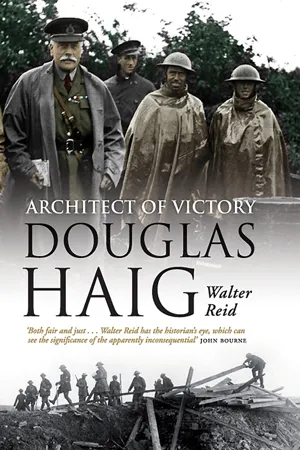 eBook - ePub
Architect of Victory
Douglas Haig
- Walter Reid(Author)
- 2011(Publication Date)
- Birlinn(Publisher)
15
HAIG’S COMMAND
The year 1916 marked an entirely new phase in Haig’s career. It is not too difficult to assess his performance as an army commander. He had done pretty well, recognising that he was involved in a new type of warfare, and making intelligent attempts to react to the circumstances in which he found himself. The remainder of his military career is much harder to assess. As Commander-in-Chief, French (now Viscount French of Ypres: he had gone quietly, taking the peerage and command of the Home Forces), had not performed adequately. He was thrown off his stride by the nature of the war he found himself fighting, he did not understand his role in the Anglo-French alliance, he lacked steadiness, and was too readily affected both by successes and failures. Crucially, he lacked the authority that was required to impose his will on his command. But, large as that command was, the forces at his disposal were of a scale comprehensible to commanders of the past. The difficulty about making a judgement on Haig is that his command was now increasing hugely, as the New Armies became available.The scale of the resources at his disposal gave Haig an obvious advantage over French, who had been asked to direct a twentieth-century total war with nineteenth-century matériel and manpower. On the other hand Haig was required to command sixty divisions on the Somme. Montgomery had eleven at Second Alamein, and Montgomery had the advantage of being able to concentrate on his role as an Army Group Commander, leaving administrative concerns to Alexander, as Theatre Commander. Haig effectively combined both roles.1 He commanded numbers of men that no British general had ever had at his disposal before, and none has had since. There is nothing against which to measure Haig. From the outset of his command he had to fight to defend his strategy, but there was no realistic alternative. The losses on the Western Front were terrible, and the conditions under which men fought the unremitting, dehumanised war of attrition remain an affront to humanity. Haig could not see how the Germans could be defeated except on the Western Front, ‘where they are’. Though his emotions repeatedly hankered after movement and dash, in principle he accepted without reservation a strategy of wearing down the enemy at a cost in his own men’s lives that would not be greatly different from the price paid by the enemy. His critics, and even his friends, did not see below the surface, and referred to his lack of imagination. An increasingly disenchanted Lloyd George (‘I never met anyone in a high position who seemed to me so utterly devoid of imagination [as Haig]’) felt that there must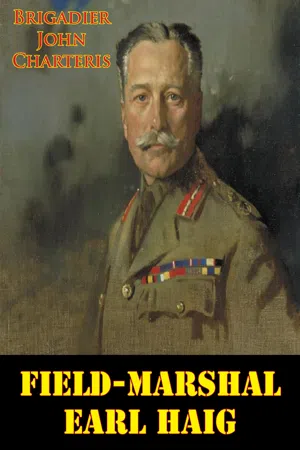 eBook - ePub
- Brigadier John Charteris(Author)
- 2015(Publication Date)
- Lucknow Books(Publisher)
With the decision between these two conflicting policies for the conduct of the war, Haig had no immediate concern. In the ‘‘Manual of Field Service Regulations,” which he had prepared in his year of work at the War Office long before the war, it had been definitely laid down that it was the duty of the Government with its responsible military advisers to decide on the task which the Army in the Field had to accomplish; and at no time was Haig the responsible military adviser of the Government in this wider field of world strategy. Nevertheless, his opinion was frequently asked, and he had no doubt in his own mind as to the correct advice for the military adviser to tender to the Government. In common with all the great soldiers of the time in British) —with the possible and spasmodic exception of Henry Wilson—he was convinced that only by direct attack on the German main armies could victory be gained, and he was also convinced that such a victory was within the power of the Allies.From the first day of the war Haig took his place as a leader of troops in the Field. No share of the responsibility for the somewhat fantastic schemes which were from time to time attempted by the Government can fairly be laid to his charge. The measure of praise or blame for them must be apportioned between the successive War Cabinets or Committees—by whatever names they were called—and their respective responsible military advisers. It can, however, be safely said that on all the main issues his views were in close accord with those of Sir William Robertson. eBook - ePub
Haig and Kitchener in Twentieth-Century Britain
Remembrance, Representation and Appropriation
- Stephen Heathorn(Author)
- 2016(Publication Date)
- Routledge(Publisher)
War Memoirs was when Lloyd George visited the Somme battlefield whilst still Minister of Munitions. His apparently naive account was anything but: it showed Haig to be totally out of his depth in comparison to himself. Lloyd George related how while conversing with Haig and Joffre at General Headquarters (GHQ) at Montreuil, he could hear squadrons of cavalry clattering towards the front lines:When I asked what they were for, Sir Douglas Haig explained that they were brought up as near the front line as possible, so as to be ready to charge through the gap which was to be made by the Guards in the coming attack. The cavalry were to exploit the anticipated success and finish the German rout … When I ventured to express to Generals Joffre and Haig my doubts as to whether cavalry could ever operate successfully on a front bristling for miles behind the enemy line with barbed wire and machine-guns, both Generals fell ecstatically on me, and Joffre in particular explained that he expected the French cavalry to ride through the broken German lines on his front the following morning.This conversation gave Lloyd George the ‘idea of the exaltation produced in brave men by a battle’ and also the belief that the generals ‘were quite incapable of looking beyond and around or even through the struggle just in front of them’.56 Lloyd George ridiculed army culture and its limited meritocracy that prevented men of real ability and vision from rising to the top. His memoirs made it quite plain that in Lloyd George’s view, Haig – the best product of this unimaginative army culture57 – was from the start fundamentally ‘incapable of planning vast campaigns on the scale demanded on so immense a battle area’ that had been entrusted to him.58 The failure to perceive the importance of the tank and how it might be used – a charge frequently repeated by Haig’s critics – was evidence enough, according to Lloyd George, of Haig’s incapacity.59 To cover his inadequacies, Haig became an obsessive ‘planomaniac’ and insisted on pursuing the agreed plan regardless of revealed obstacles or of its clear failure. Such an obsession with the GHQ plan, Lloyd George intimated, was a mark of the top generals’ own self-delusions.60 eBook - ePub
Wars Civil and Great
The American Experience in the Civil War and World War I
- David J. Silbey, Kanisorn Wongsrichanalai(Authors)
- 2024(Publication Date)
- University Press of Kansas(Publisher)
They were readily available in the older generation of British leaders and so, after an initial period of positivity, the narrative took hold that the Great War was the story of old men sending young men to die. Haig, like Grant had before him, was labeled an inept butcher, excoriated for causing the deaths of hundreds of thousands of his own men for nothing. Even the victory of 1918 was recast as simply German exhaustion, not an achievement of the British army. The historian David French later summarized this process: “Haig has passed into popular historical mythology as the archetypal ‘donkey’ who created a lost generation of British manhood by his supposedly insensitive and incompetent handling of his forces on the western front.” 29 In this narrative, World War II became the counterpoint, a war in which British generalship achieved much more than the “donkeys” of the Great War. 30 Though a revisionist school emerged that cast Haig in more positive light, he has never really escaped his role as villain. 31 A comparison between Grant, Pershing, and Haig is instructive: in each case, the generals experienced the initial popularity of victory followed by a long slide into criticism or irrelevance, if perhaps punctuated by the occasional recovery. These reputational shifts echo what happened with the American and British efforts in the wars themselves—an initial sense that the war had gone well for the respective countries, followed by much more ambivalent ideas about it. 32 The legacy of each general and each war was not concrete but fluid, shifting as each generation of historians grappled with it. It is only with Pershing that the legacy has simply settled into neglect: stability through inattention, as it were. Historians have never, on the other hand, been able to stop discussing Grant and Haig and their legacies. Like their wars, the image of those generals remains a live one, even to this day eBook - ePub
The Hall of Mirrors
War and Warfare in the Twentieth Century
- Jim Storr(Author)
- 2019(Publication Date)
- Helion and Company(Publisher)
Chapter Two , is that its outcomes weren’t obvious to the British public. A second is a confusion about the operational level of war. The Somme and Passchendaele weren’t battles. They were campaigns. The losses incurred are far more readily understood if seen in those terms. A third reason relates to Haig and, to some extent, his army commanders (men such as Rawlinson, Plumer, Horne, Byng and Birdwood). They were not butchers, nor bunglers. There were no open flanks on the Western Front. They faced an enemy whose commanders had much more experience at corps and army level. The enemy’s forces were tactically just as good as their own, and in some respects better. They had no overall numerical superiority. Campaigns fought on the Western Front were bound to be long, hard and bloody.Haig described what we now call the operational level in terms of ‘the break-in’, ‘wearing out’ and then ‘exploitation’. It wasn’t a sophisticated operational approach. It was the product of his times, his military training, and his experience. He thought, and conducted campaigns, in those terms. That was the proper role of the Commander in Chief of the BEF.Haig fought four major campaigns or operations. All were successful to some extent, the last two extremely so. On the Somme, Haig could reasonably believe that he had relieved pressure at Verdun. He had restricted the movement of forces elsewhere to a few battered divisions. He could believe that he had contributed materially to wearing the German Army out for its eventual defeat. Wars are won by attacking: at Passchendaele he commanded the only major offensive against the Germans after the failed Nivelle offensive. He could believe that had had further worn down the German Army. He had come agonisingly close to closing down the submarines at Bruges, before winter and Brest-Litovsk had forced him to close his offensive down. In the Spring Offensive he had ensured that German tactical successes were, in practice, an operational failure. Finally, in the 100 Days he broke the German Army and forced Germany to sue for peace. eBook - ePub
Haig
A Re-Appraisal 80 Years On
- Brian Bond, Nigel Cave, Brian Bond, Nigel Cave(Authors)
- 2009(Publication Date)
- Pen & Sword Military(Publisher)
The successful Hundred Days’ campaign served as a riposte to critics of his leadership during the Somme and Flanders offensives. As Haig led his forces to victory, Robertson served out the war in relative obscurity, first in the Eastern Command, and then as Commander-in-Chief, Home Forces. His pride may have kept him from a measure of vindication. When the British Fifth Army had been destroyed by the first of the great 1918 German attacks, some newspapers attacked Lloyd George and demanded Robertson’s recall. To silence his critics, Lloyd George explored sending Robertson to France to serve as Haig’s second in command. Robertson, however, wrote to Haig: ‘My job is C.I.G.S. or nothing.’ 48 After the war Haig was created an Earl and granted £100,000. A national subscription was raised to purchase Bemersyde, the ancestral home of the Haigs. Robertson got a baronetcy and £10,000. At a post-Armistice dinner given to the army commanders by Lord Milner at the Senior Service Club, Haig made a speech in which he praised Wilson and failed to mention Robertson’s role as CIGS. ‘I’ll never go farting with ‘aig again,’ 49 was Robertson’s parting response to this slight as he left the dinner.
Index pages curate the most relevant extracts from our library of academic textbooks. They’ve been created using an in-house natural language model (NLM), each adding context and meaning to key research topics.

