History

Douglas MacArthur
Douglas MacArthur was a prominent American general who played a key role in World War II and the Korean War. Known for his strategic brilliance and bold leadership, he is remembered for his famous "I shall return" promise after being forced to retreat from the Philippines during World War II. MacArthur's military career and larger-than-life persona made him a significant figure in 20th-century American history.
Written by Perlego with AI-assistance
Related key terms
1 of 5
12 Key excerpts on "Douglas MacArthur"
 eBook - PDF
- Peter Karsten(Author)
- 2005(Publication Date)
- SAGE Publications, Inc(Publisher)
MacArthur, Douglas (1880–1964) U.S. Army General One of the most celebrated and controversial military lead-ers in American history, Douglas MacArthur achieved his greatest notoriety in World War II as the U.S. commander in the Pacific theater. MacArthur best embodied the nation’s will, effort, and ultimate victory in its war against Japan; his elevation to this iconic status was assured when, in March 1942, having been forced after months of dogged resistance to abandon the Philippines to Japanese invaders, he electri-fied an American public desperate for heroes and hopeful signs in those dark days by declaring, “I shall return.” Those three words, repeatedly and reproduced ad continually over the airwaves and in print, and matched with the iron-jawed visage of the general, stoic behind aviator sunglasses and a corncob pipe, came to symbolize his and the nation’s deter-mination and certainty of eventual triumph. When, two years after his pledge, MacArthur did in fact stride victorious from a landing craft onto the beach of Leyte, in the soon-to-be-liberated Philippines, his legend was secure. Since the end of World War II, and particularly in the wake of the ignominious conclusion to his extraordinary mil-itary career in the midst of the Korean War, historians, jour-nalists, and other commentators have steadily chipped away at the exalted image of MacArthur that emerged from the Pacific campaign. Such demythologizing was inevitable: for a nation that prefers its heroes to wear their mantle with a modicum of humility and discretion, MacArthur was a too-proud tower, a target for toppling at the first opportunity. From his earliest days in the public eye, he was a flamboyant self-promoter. As a 38-year-old brigadier general in World War I (and the youngest division commander in the U.S. Army), MacArthur earned the nickname “the Dude” for his rakish, nonregulation attire—heavy muffler, bright turtle-neck sweater, floppy hat, loose field jacket, and riding crop. eBook - ePub
World War II in the Pacific
An Encyclopedia
- Stanley Sandler(Author)
- 2003(Publication Date)
- Routledge(Publisher)
MMacArthur, Douglas (1880–1964)
Douglas MacArthur comes the closest to being a mythic figure in the history of the United States and its army. Though well known, he is a difficult and complex personality to understand. MacArthur’s aloofness, coupled with his ability to lead, gave rise to many different characterizations of the general, ranging from adulators claiming military genius to detractors asserting incompetence and outright insubordination. There is truth in both portrayals. He served as a general officer over a period of thirty-three years that included three major wars (World War I, World War II, and the Korean war), during which MacArthur exhibited bravery and physical courage. As a brigadier general in World War I, he could always be found near or in no-man’s land, leading assaults or reconnoitering. During World War II and the Korean war, when he landed on the assault beaches just hours after the first troops, he often exposed himself to enemy gunfire. On the other hand, in 1942 he went to the fighting lines on Bataan only once.MacArthur was able to adapt to changing conditions of warfare, learn from his mistakes or the mistakes of others, and incorporate new doctrines or theories into his method of warfare. He came to appreciate and rely heavily upon airpower, making sure his operations were always within the range of land-based or carrier aircraft. This willingness to adopt new theories is even more significant if one takes into account that he was nearing the end of his career when World War II began. MacArthur remained in command, and even those who did not personally like him thought he fought well against the Japanese, even though he made a number of serious mistakes, particularly in the retreat to Bataan.MacArthur is also known for mastering amphibious operations, and incorporating the strategy of leapfrogging enemy strongholds, into his military repertoire. By no means did he invent this strategy; he claimed it was “as old as war itself.” He did, however, bring amphibious operations closer to perfection, relying heavily on “hitting the enemy where they ain’t.” By employing amphibious landings that bypassed strongly held enemy positions in favor of attacking more lightly defended ones, while operating under the aegis of airpower, MacArthur became very adept and successful at amphibious warfare.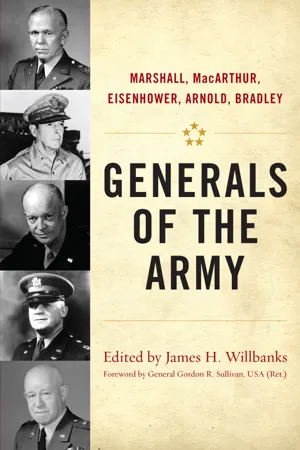 eBook - ePub
Generals of the Army
Marshall, MacArthur, Eisenhower, Arnold, Bradley
- James H. Willbanks(Author)
- 2013(Publication Date)
- The University Press of Kentucky(Publisher)
3Douglas MacArthur
Tony R. MullisDouglas MacArthur was undoubtedly the most polarizing of America’s five-star generals. General George C. Kenney, MacArthur’s World War II air commander, remarked: “Very few people really know Douglas MacArthur. Those who do, or think they do, either admire him or dislike him. They are never neutral on the subject.” General George E. Stratemeyer was an admirer. He described MacArthur as “the greatest leader, the greatest commander, the greatest hero in American history.” General Robert L. Eichelberger, MacArthur’s Eighth Army commander, was less flattering. “We have difficulty in following the satellites of MacArthur,” Eichelberger concluded, “for like those of Jupiter, we cannot see the moons on account of the brilliance of the planet…. Even the gods were alleged to have their weaknesses.”1 Regardless of how MacArthur’s subordinates, peers, and superiors saw him, his significant accomplishments over a fifty-two-year military career justify his presence in the pantheon of outstanding American military leaders and strategists.Few could equal Douglas MacArthur’s contributions to American military history. He served in key leadership positions during both world wars and the Korean War. His peacetime assignments were equally significant. As a junior officer, he was an aide to his father, General Arthur MacArthur, and to President Theodore Roosevelt. Following World War I, he returned to West Point as its superintendent. He also held key commands in the Philippines and headed the IV Corps area in Atlanta, the III Corps area in Baltimore, and the IX Corps area in San Francisco during the 1920s. He became the Army’s chief of staff in 1930. MacArthur returned to the Philippines in 1935 and retired in 1937. He became the military adviser to the Philippines and held the rank of field marshal in the Filipino military. He was recalled to active duty in 1941 as commander of the U.S. Army Forces Far East. After Japan’s surrender, he held the position of supreme commander of the Allied Powers and oversaw Japan’s occupation. When the Korean War began in 1950, MacArthur became the commander in chief of the United Nations Command. His brilliant amphibious envelopment at Inchon in September 1950 highlighted his strategic genius, but his relief for insubordination in April terminated his long and distinguished career. Despite this abrupt end, MacArthur’s contributions to American history and his legacy as an exceptional leader and strategist are without comparison. eBook - PDF
Generals of the Army
Marshall, MacArthur, Eisenhower, Arnold, Bradley
- James H. Willbanks(Author)
- 2013(Publication Date)
- The University Press of Kentucky(Publisher)
63 3 Douglas MacArthur Tony R. Mullis Douglas MacArthur was undoubtedly the most polarizing of Amer-ica’s five-star generals. General George C. Kenney, MacArthur’s World War II air commander, remarked: “Very few people really know Douglas MacArthur. Those who do, or think they do, either admire him or dislike him. They are never neutral on the subject.” General George E. Stratemeyer was an admirer. He described Mac-Arthur as “the greatest leader, the greatest commander, the greatest hero in American history.” General Robert L. Eichelberger, Mac-Arthur’s Eighth Army commander, was less flattering. “We have difficulty in following the satellites of MacArthur,” Eichelberger concluded, “for like those of Jupiter, we cannot see the moons on ac-count of the brilliance of the planet. . . . Even the gods were alleged to have their weaknesses.” 1 Regardless of how MacArthur’s subor-dinates, peers, and superiors saw him, his significant accomplish-ments over a fifty-two-year military career justify his presence in the pantheon of outstanding American military leaders and strategists. Few could equal Douglas MacArthur’s contributions to Ameri-can military history. He served in key leadership positions during both world wars and the Korean War. His peacetime assignments were equally significant. As a junior officer, he was an aide to his father, General Arthur MacArthur, and to President Theodore Roo-sevelt. Following World War I, he returned to West Point as its su-perintendent. He also held key commands in the Philippines and headed the IV Corps area in Atlanta, the III Corps area in Baltimore, and the IX Corps area in San Francisco during the 1920s. He became the Army’s chief of staff in 1930. MacArthur returned to the Philip-pines in 1935 and retired in 1937. He became the military adviser to the Philippines and held the rank of field marshal in the Filipino military. He was recalled to active duty in 1941 as commander of the U.S. eBook - ePub
We Shall Return!
MacArthur's Commanders and the Defeat of Japan, 1942-1945
- William M. Leary(Author)
- 2021(Publication Date)
- The University Press of Kentucky(Publisher)
A brave and distinguished soldier, he was at once imaginative, articulate, arrogant, theatrical, emotional, ambitious, energetic, contradictory, political, and charismatic. He combined a reckless desire for success with an unseemly paranoia, a blatant contempt for authority, and a fierce appeal for recognition and approval. His brilliant leadership and innovation on the battlefield were manifest, but they were often marred by questionable strategic judgments or unfortunate tactical decisions. Endowed with obvious courage, he wore distinctive uniforms, disdained to carry arms or protective equipment, and took extraordinary personal risks. Often his displays of valor seemed less spontaneous than staged, as if he were an actor carefully plotting each movement for effect. Gifted with an almost instinctive ability to handle the press, he enhanced his popular image or strengthened his demands on authority by skillful public appearances, dramatic interviews, and carefully worded announcements. But his fustian oratory and penchant for hyperbole frequently undermined his most impassioned arguments. His impressive military career, spanning half a century of battlefield triumphs in Europe, Mexico, and the Far East, sparkled with good fortune and grand achievements. Yet it was dominated by an almost psychological obsession with the Philippine Islands, which shaped his thoughts and deeds and in almost every sense dictated his actions in World War II. 1 Douglas MacArthur was born in 1880, the son of the successful and flamboyant General Arthur MacArthur and of a determined and domineering mother who did much to influence his life and career. Entering the U.S. Military Academy in 1899, he graduated four years later at the top of his class. He served briefly in the Philippines and elsewhere in the Far East and in Washington and participated in the 1914 Mexican expedition, distinguishing himself in action at Vera Cruz eBook - ePub
- Rutherford M. Poats(Author)
- 2020(Publication Date)
- Burtyrki Books(Publisher)
XIII — The MacArthur Controversy
AT the top level of government, the realms of the military and of politics are merged, or at least blurred. At a level just below the top, a fine line of distinction between the functions of diplomacy and of military science can usually be drawn, but not invariably. American theater commanders waging the complex campaigns of World War II, leading international forces in operations which would reshape the political destinies of millions, were constantly required to make essentially political decisions. In the post-war years, the voices of military men have played a major role in guiding American foreign policy. General MacArthur in the Far East, and General Eisenhower and others in Europe, exercised authority which could be separated from policy-making only by the most precise definition.In Japan, during a brilliantly successful occupation, General MacArthur had quickly assumed supreme power and exercised it in a manner generally applauded by both the American people and government. He was more than a subordinate in the executive branch of the American government. He was the representative of the Allied powers in Japan, and his responsibilities were political, economic, and to only a lesser extent military. To the Japanese he was Democracy’s Emperor, a demi-god of unchallenged authority. To Washington he often was a source of irritation, for he made it quite clear that he was steering his own ship and needed no help. He complied with all official orders, however, and his record of achievement was a credit to the United States Government.Following the Communist conquest of China, MacArthur became increasingly outspoken in his criticism of American policy in Asia. A procession of visitors to his Tokyo headquarters, as well as news correspondents, freely obtained and made public his program for fighting Asiatic Communism. The general expressed his views on matters outside Japan only when they were solicited, and then only in a general, positive manner, rather than in negative criticism. Nevertheless, each revelation from Tokyo amounted to an attack on the adopted policies of his nominal superior, President Truman. Official Washington was frequently reported to be angered but did little to silence its chief representative and most effective critic in the Far East.
- Fil J. Arenas, Fil Arenas(Authors)
- 2019(Publication Date)
- Routledge(Publisher)
3Military leaders
Case study 6: General Douglas MacArthur (1880–1964)
General Douglas MacArthur was characterized as a close student of Napoleon and Genghis Khan, with the extraordinary gift of relocating extremely large numbers of troops over long distances – an innovative genius, according to Mark Perry in his book The Most Dangerous Man in America: The Making of Douglas MacArthur (reviewed in Thomas, 2014). However, he also describes another side of MacArthur, as someone who was “short-tempered, abrupt, sullen, and impatient” (Thomas, 2014, para. 4). New York Governor Franklin Roosevelt was aware of MacArthur’s shortcomings, as he discussed such issues with his advisors as the new Democratic nominee for president in 1932. He described MacArthur’s heavy-handed forced retreat of the Washington Bonus Marchers (impoverished World War I veterans) in the nation’s capital. MacArthur was “the most dangerous man in America,” said Roosevelt, suggesting that MacArthur had the potential to become someone to sacrifice liberty to restore order to people in fear (Thomas, 2014).MacArthur was not the only commander with an inflated ego. Admiral Ernest King “despised” General George Patton, while Air Force General Hap Arnold “couldn’t bring himself to talk to King,” and Eisenhower thought British Field Marshal Bernard Montgomery was “conceited.” Patton held all British commanders in disdain, and General Omar Bradley “plotted ways to take advantage of Patton’s antics” (Thomas, 2014, para. 8).In April 1951, at a high point of the Korean War, President Truman fired General MacArthur. Most Americans were shocked that the president had the power to relieve a five-star general. Truman had little choice, due to the regular public complaints against his commander in chief. The main disagreement stemmed from MacArthur’s desire to expand the war against China, after entering the Korean fight in the latter part of 1950. MacArthur accused the president of restricting his control by refusing to allow the bombing of China, suggesting that he was endangering American freedom. Ignoring the complaints for a period out of respect for MacArthur, Truman held on until the criticisms began to confuse America’s allies and enemies about American policy. Truman did not want to expand war with Asia: not only would it weaken the US position in Europe, but he felt that Europe would eventually be the place to fight the Cold War, and his advisors were in agreement. The Senate’s Armed Services and Foreign Relations Committees held joint hearings where MacArthur described his disagreement with the president, claiming backing from the Joint Chiefs of Staff (JCS). However, the JCS rebutted MacArthur’s claim (Brands, 2016). General Omar Bradley, Chairman of the JCS, rejected MacArthur’s plan for a wider war. Moreover, Bradley stated: “In the opinion of the Joint Chiefs of Staff, this strategy would involve us in the wrong war, in the wrong place, at the wrong time and with the wrong enemy” (Brands, 2016, para. 5). eBook - ePub
Aftermath of War
Americans and the Remaking of Japan
- Howard B. Schonberger(Author)
- 2011(Publication Date)
- The Kent State University Press(Publisher)
The general was to require the emperor, through his representatives, to sign an instrument of surrender. From the moment of the surrender of Japanese armed forces, “the authority of the Emperor and the Japanese Government to rule the state will be subject to you …. You will exercise supreme command over all land, sea and air forces which may be allocated for enforcement in Japan of the surrender terms by the Allied Powers concerned.” MacArthur promptly acknowledged the honor of having been chosen for such a challenging position. “The entire eastern world is inexpressibly thrilled and stirred by the termination of the war,” he cabled the president. “I shall do everything possible to capitalize [upon] the situation along the magnificently constructive lines you have conceived for the peace of the world.” 2 A brief review of his career is important in understanding MacArthur’s new role as head of the Occupation of Japan. Douglas MacArthur was born in the Arsenal Barracks of Little Rock, Arkansas in early 1880. His father, Arthur MacArthur, had been a colonel in the 24th Wisconsin Volunteers during the Civil War, a captain on the Indian frontier, and the military governor of the Philippines who helped crush the insurrection against American colonial rule. Spurred by family tradition, his mother’s ambitions, and his own interest, MacArthur enrolled at West Point in 1899. After graduating first in his class he received his first military assignment in the Philippines. In 1905 the young lieutenant joined his father’s staff in Japan as aide-de-camp and accompanied him on an extensive nine-month tour of the Far East. MacArthur always believed that “the experience was without doubt the most important factor of preparation in my entire life.” That the Pacific frontier was vital to American interests now became a matter of faith to him. “Here lived almost half the population of the world, and probably more than half of the raw products to sustain future generations eBook - ePub
FDR At War
The Mantle of Command, Commander in Chief, and War and Peace
- Nigel Hamilton(Author)
- 2020(Publication Date)
- Mariner Books(Publisher)
The Baltimore Sun, for example, had recently proclaimed MacArthur a “military genius”—a general whose skills rose high above the “single field” of battle. “He has some conception of that high romance which lifts the soldiers’ calling to a level where on occasions ethereal lights play upon it,” the newspaper waxed lyrical. 2 The New York Herald Tribune, meanwhile, had run fully half a page of photographs of the general, 3 while towns across the United States were considering renaming their roads, even themselves, in his honor. The TVA’s Douglas Dam should be called “Douglas MacArthur Dam,” it was proposed in Congress; another congressman had called for MacArthur to be awarded the Congressional Medal of Honor, the nation’s highest award for bravery in battle. 4 The U.S. Senate was equally, if not more, adulatory than the House of Representatives. Senator Elbert D. Thomas of Utah, a Democrat and former professor of history, had declared: “Seldom in all history has a military leader faced such insuperable odds. Never has a commander of his troops met such a situation with greater and cooler courage, never with more resourcefulness of brilliant action.” 5 The Washington Post, for its part, had declared that MacArthur, by his “last-ditch fight in the bamboo jungles of Bataan,” had now shamed the ignorant “prophets of disaster” who had written off the Philippines as a hopeless cause. 6 The Philadelphia Record considered Bataan had proved “anew” that MacArthur “is one of the greatest fighting generals of this war or other war. This is the kind of history which your children will tell your grandchildren.” Thanks to General MacArthur, Bataan “will go down in the schoolbooks alongside Valley Forge,” the newspaper predicted, “Yorktown, Gettysburg and Chateau Thierry.” 7 The President could but shake his head eBook - ePub
General MacArthur and President Truman
The Struggle for Control of American Foreign Policy
- Richard H. Rovere(Author)
- 2022(Publication Date)
- Routledge(Publisher)
IIA General and His Legend
THE AMERICAN YEARS
The MacArthur controversy was much larger than MacArthur. Indeed, as the Senate hearings ground on into the summer of 1951, there were times when MacArthur seemed to have little part in them. There were long stretches of testimony in which his name was not mentioned; for days at a time, the discussion turned to events and issues which had no bearing on his dismissal. It was the very breadth and comprehensiveness of the controversy, of course, that made it an event of such high importance. It was part of a basic conflict in American life that would have existed even if he never had. This conflict antedated his dismissal, antedated the Korean campaign, antedated even the last great war. It will continue, in one form or another, for years certainly and perhaps decades.Nevertheless, it is perfectly clear that it was Douglas MacArthur who brought matters to a head at a particular stage of the conflict. It was MacArthur who turned the Great Debate into the Greater Debate. Now, “debate” and “controversy” and “conflict” are polite words for what was and is in reality a grim struggle for political power, a war for the American mind. The MacArthur phase of this war was a battle which took place in a congressional hearing-room partly because certain people believed that certain facts to be brought out would prove advantageous to their side, partly because the congressional investigation has become in our day one of the great theaters of political operations. But those who took part, a group of Senators on one side of a conference table and a procession of military and diplomatic leaders, led off by MacArthur, who appeared as witnesses across the table, were not engaged in a cool, dispassionate search for the truth. They were engaged, to violate the martial metaphor, in disseminating what they regarded as the truth they already possessed. Without exception, they had long since taken their stand on all of the major issues, and it is doubtful if, even on the minor issues, a single one of them was led to alter his stand in any way.* eBook - ePub
The Mantle of Command
FDR at War, 1941-1942
- Nigel Hamilton(Author)
- 2016(Publication Date)
- Biteback Publishing(Publisher)
The Baltimore Sun, for example, had recently proclaimed MacArthur a “military genius” — a general whose skills rose high above the “single field” of battle. “He has some conception of that high romance which lifts the soldiers’ calling to a level where on occasions ethereal lights play upon it,” the newspaper waxed lyrical. 2 The New York Herald Tribune, meanwhile, had run fully half a page of photographs of the general, 3 while towns across the United States were considering renaming their roads, even themselves, in his honor. The TVA’s Douglas Dam should be called “Douglas MacArthur Dam,” it was proposed in Congress; another congressman had called for MacArthur to be awarded the Congressional Medal of Honor, the nation’s highest award for bravery in battle. 4 The U.S. Senate was equally, if not more, adulatory than the House of Representatives. Senator Elbert D. Thomas of Utah, a Democrat and former professor of history, had declared: “Seldom in all history has a military leader faced such insuperable odds. Never has a commander of his troops met such a situation with greater and cooler courage, never with more resourcefulness of brilliant action.” 5 The Washington Post, for its part, had declared that MacArthur, by his “last-ditch fight in the bamboo jungles of Bataan,” had now shamed the ignorant “prophets of disaster” who had written off the Philippines as a hopeless cause. 6 The Philadelphia Record considered Bataan had proved “anew” that MacArthur “is one of the greatest fighting generals of this war or other war. This is the kind of history which your children will tell your grandchildren.” Thanks to General MacArthur, Bataan “will go down in the schoolbooks alongside Valley Forge,” the newspaper predicted, “Yorktown, Gettysburg and Chateau Thierry.” 7 The President could but shake his head eBook - ePub
Generals and Admirals, Criminals and Crooks
Dishonorable Leadership in the U.S. Military
- Jeffrey J. Matthews(Author)
- 2023(Publication Date)
- University of Notre Dame Press(Publisher)
MacArthur was intellectually and temperamentally suited for many of the herculean tasks that lay before the vanquished Japanese people. Acting as a near-proconsul, he successfully implemented the Pentagon’s postwar policies in short order, including Japan’s demilitarization and democratization. And while some early economic reforms such as breaking up oligarchic companies failed to rejuvenate the economy, MacArthur facilitated a remarkable political transformation of Japanese society, including the emancipation of women and the guarantee of civil liberties. These were historically significant triumphs.Nevertheless, MacArthur remained an ambitious and supercilious subordinate. He twice rejected invitations from the president to return home for consultations. While still on active duty in 1947–1948, MacArthur again encouraged “the movement” for the Republican presidential nomination. In October 1947, he wrote to a wealthy Republican supporter, “Should the movement become more expressive … and take on the character of popular will, I should be left no alternative but to consider it a mandate which I could not in good conscience ignore.”86 In March 1948, MacArthur issued an audacious public statement: “I would be recreant to all my concepts of good citizenship were I to shrink … from accepting any public duty to which I might be called by the American people.”87But a presidential run was not to be. MacArthur was crestfallen when he failed to win a single primary. He fell further into depression in November when “Give ’em Hell Harry” upset Republican nominee Thomas E. Dewey. Had MacArthur retired then at the age of sixty-four, he would be remembered primarily for his distinguished service in two world wars and for his transformative leadership in postwar Japan. But the general had no intention of retiring and thus his misconduct in the coming Korean War would forever exemplify his deficiencies as a flag officer.North Korean forces crossed the 38th parallel in June 1950. Seoul fell quickly, MacArthur acted without approval from Washington and provided South Korea with P-51 Mustangs, artillery, and other weaponry. The general did not expect his commander in chief to show much resolve against the communist incursion. MacArthur declared, “If Washington only will not hobble me, I can handle it with one arm tied behind my back.”88 But Truman surprised the general. He retroactively authorized MacArthur’s weapons shipment to South Korea and, to prevent “a general Asiatic war,” he ordered the Seventh Fleet to position itself between the Chinese Nationalists on Formosa (Taiwan) and the Communist Chinese mainland.89
Index pages curate the most relevant extracts from our library of academic textbooks. They’ve been created using an in-house natural language model (NLM), each adding context and meaning to key research topics.

