History

General George Washington
General George Washington was a pivotal figure in the American Revolutionary War and the first President of the United States. He is renowned for his leadership, strategic acumen, and unwavering commitment to the cause of American independence. Washington's legacy as a founding father and his contributions to shaping the early republic have solidified his place in history as an iconic figure.
Written by Perlego with AI-assistance
Related key terms
1 of 5
9 Key excerpts on "General George Washington"
 eBook - PDF
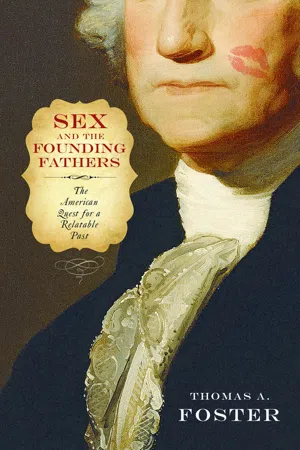
Sex and the Founding Fathers
The American Quest for a Relatable Past
- Thomas A. Foster(Author)
- 2014(Publication Date)
- Temple University Press(Publisher)
1 GEORGE WASHINGTON O F ALL THE FOUNDERS, George Washington (Figure 1.1) is at once the most familiar and the most mythologized. As the unwav-ering general of the colonial army and the first president of the Republic, he cuts a commanding figure in American memory. When we see Washington in our mind’s eye, we recall the iconography that depicts him as a gentleman, a hero, a paragon of personal and civic virtue; we see the very picture of American manhood at its best. The persistence of such too-good-to-be-true images says something about the ongoing project of national mythmaking and a common belief in the idea of an essential national char-acter. Take Emanuel Gottlieb Leutze’s painting Washington Crossing the Dela-ware (1851), for example. Washington stands tall and firm near the prow of a crowded boat in rough waters; only the tousled American flag behind him stands taller than he in the fierce wind. He is resolute and powerful, leaving no doubt about who is in charge. Small wonder, then, that this painting has been used in so many accounts of the nation’s difficult birth and Washing-Figure 1.1 ( above ). Portrait of George Washington. ( George Washington, the First Good President, 1846. Gilbert Charles Stuart. Oil on canvas, 1797.) z 12 CH APTER 1 ton’s emergence as its hero. We have seen it so many times that we sometimes fail to really see it, just as we lose sight of its mythic properties. In 2006, a Pulitzer Prize–winning account of General Washington’s early military campaign in the Revolution dazzled Americans with its heroic story. The attractive book cover, featuring a version of Leutze’s famous nineteenth-century painting Washington Crossing the Delaware (Figure 1.2) painted by one of his students, Eastman Johnson, captures in vivid color the richness of the story. 1 The central figure of the general standing at the front of a small boat illustrates the valiant image of Wash-ington that is described within the book’s pages.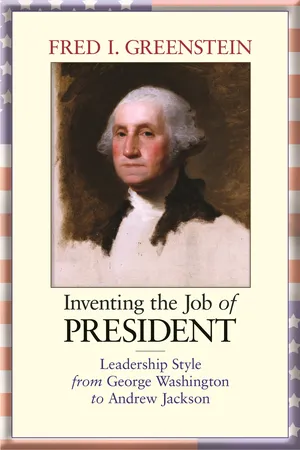 eBook - ePub
Inventing the Job of President
Leadership Style from George Washington to Andrew Jackson
- Fred I. Greenstein(Author)
- 2009(Publication Date)
- Princeton University Press(Publisher)
CHAPTER 2
The Foundational Presidencyof George Washington
If indeed he does that, he will be the greatest man in the world.—Remark attributed to George III upon being informed that Washington intended to resign his command and return to Mount Vernon after the RevolutionVery few who are not pwhilosophical Spectators can realize the difficult and delicate part which a man in my situation had to act. . . . I walk on untrodden ground. . . . There is scarcely any part of my conduct which may not hereafter be drawn into precedent.—George Washington to Catherine Macaulay Graham, January 9, 1790I consider the successful Administration of the general Government as an object of almost infinite consequence to the present and future happiness of the Citizens of the United States.—George Washington to Thomas Jefferson, January 21, 1790The powers accorded the presidency by the Constitution “would not have been so great,” one of its framers recalled, if he and his colleagues had not “cast their eyes toward General Washington as president and shaped their ideas of the powers to be given to a president by their opinions of his virtue.”1 In the aftermath of their experience with the British monarch, it went against the grain for Americans to go along with strong leaders, but they were prepared to make an exception for Washington. Two decades before a nation existed in which it was possible for him to be first in war and peace, Washington was already acclaimed throughout the British colonies for his exploits in the French and Indian War. Such was his esteem that he was unanimously elected to high positions four times—as commander in chief of the Continental Army in 1775, as president of the convention that framed the Constitution in 1787, and to his two terms as the nation’s first president in 1789 and 1792.Figure 2.1. George Washington’s well-publicized forays into the frontier and his military feats made him an admired presence in Great Britain’s North American colonies long before the United States came into being. Portraits showing what one of Washington’s associates referred to as his “commanding countenance” were widely displayed in the early republic. As president, Washington established precedents for strong executive leadership and legitimized the new political system by lending it his towering prestige.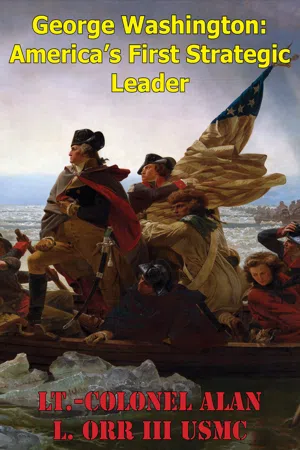
- Lt.-Colonel Alan L. Orr III USMC(Author)
- 2014(Publication Date)
- Golden Springs Publishing(Publisher)
His love of country and dedication to the cause of freedom caused the people of America to naturally gravitate towards him and rally behind the call to independence. His force of personality as a statesman made him one of the most highly regarded and revered members of Congress. His natural leadership ability, strategic vision, personal example, and adherence to discipline and moral values made him the model for all soldiers within the Continental Army to emulate. Without his example of personal sacrifice and selfless service, the march to freedom could have been without popular support of the people of the colonies. Without his genuine humility and adherence to his personal beliefs, the colonies could have easily established Washington as a monarch to rule over the newly independent colonies. Without his vision and personal ability, it is easy to see how the military could have grown to become the dominant force within the colonies. Arguably, no other person could have traveled the strategic path that George Washington blazed, because he was the personification of the link that bound the three elements of the trinity together in order to prosecute a successful war of independence. Fortunately for the nation, George Washington stepped upon history’s stage at the right time, place, and circumstance to emerge as America’s first strategic leader. Passage contains an image
REQUEST FROM THE PUBLISHER
Thank you so much for reading our book, we hope you really enjoyed it.
As you probably know, many people look at the reviews before they decide to purchase a book.
If you liked the book, could you please take a minute to leave a review with your feedback?60 seconds is all I’m asking for, and it would mean the world to us. Thank you so much, Pickle Partners Publishing Passage contains an image
{1} Don Higginbotham, George Washington and the American Military Tradition (Athens, GA: University of Georgia Press, 985), 90.{2} Burke Davis, George Washington and the American evolution (New York, NY: Random House, 1975), 8.{3} Ibid.{4} David McCullough, 1776 (New York, NY: Simon & Schuster, 2005), 43.{5} John Frederick Schroeder, Maxims of George Washington (Mount Vernon, VA: The Mount Vernon Ladies’ Association, 1989), 87.{6} Davis, 10.{7} Ibid.{8} Bruce S. Thornton and Victor Davis Hanson, “’The Western Cincinnatus’: Washington as a Farmer and Soldier,” in Patriot Sage; George Washington and the American Political Tradition, ed. Gary L. Gregg II and Matthew Spalding (Wilmington, DE: ISI Books, 1999), 50.
Passage contains an image
REQUEST FROM THE PUBLISHER
Thank you so much for reading our book, we hope you really enjoyed it.
As you probably know, many people look at the reviews before they decide to purchase a book.
If you liked the book, could you please take a minute to leave a review with your feedback?60 seconds is all I’m asking for, and it would mean the world to us. Thank you so much, Pickle Partners Publishing Passage contains an image
{1} Don Higginbotham, George Washington and the American Military Tradition (Athens, GA: University of Georgia Press, 985), 90.{2} Burke Davis, George Washington and the American evolution (New York, NY: Random House, 1975), 8.{3} Ibid.{4} David McCullough, 1776 (New York, NY: Simon & Schuster, 2005), 43.{5} John Frederick Schroeder, Maxims of George Washington (Mount Vernon, VA: The Mount Vernon Ladies’ Association, 1989), 87.{6} Davis, 10.{7} Ibid.{8} Bruce S. Thornton and Victor Davis Hanson, “’The Western Cincinnatus’: Washington as a Farmer and Soldier,” in Patriot Sage; George Washington and the American Political Tradition, ed. Gary L. Gregg II and Matthew Spalding (Wilmington, DE: ISI Books, 1999), 50. eBook - ePub
- Edward G. Lengel(Author)
- 2012(Publication Date)
- Wiley-Blackwell(Publisher)
Chapter Twenty-Two
GEORGE WASHINGTON: AMERICA’S FIRST SOLDIER
Thomas A. Rider II1. Washington’s Unique Challenge
On 31 March 1776 General George Washington, Commander-in-Chief of the Continental Army, wrote to his brother John Augustine from his headquarters in Cambridge, Massachusetts. “I believe I may, with great truth affirm,” Washington declared, “that no Man perhaps since the first Institution of Armys ever commanded one under more difficult Circumstances than I have done – to enumerate the particulars would fill a volume” (PGW,Revolution, 3:569). When he penned these lines, Washington was venting the frustrations of his first nine months in command. Beginning in July 1775 when he arrived outside Boston, through the British evacuation of that city in March 1776, Washington had struggled to create “Order, Regularity & Discipline” in a conglomeration of men who formed an army in name only (PGW,Revolution, 1:138). If bringing the Continental Army to life was not challenging enough, Washington had to figure out how to feed, arm, and equip it while simultaneously building the bureaucracy that would make these tasks possible. Moreover, Washington saw to all of these problems, and countless others, while besieging the enemy. In December 1775, just as he began to make headway, the army dissolved before his eyes as the soldiers’ terms of service expired. Washington had to start over with newly recruited formations.The Commander-in-Chief’s frustrations continued beyond his first campaign. Washington’s complaints to his brother in 1776 would have been appropriate at virtually any point during the American Revolution. Throughout the war, Washington faced a level of responsibility unique in American military history. Unlike almost any other American soldier, Washington’s duties required him to perform across what modern soldiers and scholars call the levels of war. At the strategic level Washington interacted with and supported civilian authorities. He allocated resources and disseminated information across the theaters of war. He also developed military strategy to support national war aims to include negotiating coalition strategy after France entered the war. As commander of the Main Army, Washington performed at the operational level of war. He planned campaigns, positioned his army to gain battlefield advantage, and sometimes out-maneuvered the enemy without having to fight. He hampered enemy logistics and supplied his own army. Finally, at the tactical level of war, Washington planned battles and led soldiers on the battlefield – not infrequently within range of British muskets. Washington did all of these things while simultaneously building the Continental Army. eBook - ePub
Perspectives on Presidential Leadership
An International View of the White House
- Michael Patrick Cullinane, Clare Frances Elliott(Authors)
- 2014(Publication Date)
- Routledge(Publisher)
1 The Meanings of Going First George Washington and the PresidencyFinn PollardOn both sides of the Atlantic, in surveys ranking American presidents, three figures perennially top the list: George Washington, Abraham Lincoln, and Franklin D. Roosevelt. The basic grounds for Washington’s prominence (as indeed for the other two) are easily uncovered. The office was created specifically with him in mind. Yet his eligibility to serve was placed in doubt by the hotly contested battle to ratify the Constitution in Virginia, and when he took office, a deep suspicion of such a central executive authority remained. By the time he retired, though the office’s occupancy and powers remained disputed, its existence did not. Washington was the crucial man in establishing the legitimacy of the office, a role that should assure him a top three ranking because, had he failed, he might have had no successors at all.If we move beyond legitimacy, then Washington’s presidency poses much more difficult questions. On the domestic front, historians continue to dispute how much control and indeed understanding Washington had with respect to Alexander Hamilton’s financial policies—the dominating domestic issue of his presidency. On the foreign front, although Washington has usually been judged as making the correct decision on neutrality, it was a hotly contested one that left unresolved problems for his successors. And on the political system itself, Washington could be judged on his own terms as a pretty comprehensive failure. Washington, like many of his contemporaries, abhorred political parties and sought first to smooth them away and then to stand above them. Yet, despite this attitude, parties (of a sort) developed, and, as some historians argue, Washington became, by the end of his second term, as partisan as his fellows. If presidential rankings are based on policy successes, there are grounds to wonder why Washington stands as high as he does. eBook - ePub
Revolutionary Prophecies
The Founders and America's Future
- Robert M. S. McDonald, Peter S. Onuf, Robert M. S. McDonald, Peter S. Onuf(Authors)
- 2021(Publication Date)
- University of Virginia Press(Publisher)
3George Washington’s Vision for the United States
Kenneth R. BowlingWhen Americans think of George Washington as the father of their country, they think of his practical accomplishments as commander in chief of the Continental Army, as president of the Constitutional Convention, and as president of the United States. But it is perhaps more appropriate to call him that in another sense, for, despite his inability to accept democracy or, apparently, even to write the word, Washington better than any other American revolutionary had the prescience to envision what the United States would become: an economically and religiously diverse, multiracial society that overcame its deep sectional divisions and whose enlightened federal government, seated in a large and magnificent capital, provided its citizens with cultural, scientific, and educational amenities. Washington’s concern for the survival of the union was the driving force behind this forward-looking perspective; behind that was this highly ambitious man’s fear that, if the union failed, along with it would go his historical reputation, something very dear to him.Some of my argument comes from Washington’s private and public letters, but most of it is based on his state papers and those his department heads submitted to Congress in his name, all but one of which survive. The one that does not, his magisterial, seventy-three-folio-page undelivered first inaugural address, is arguably the most important of them all, judging from its remnants. It survived in his papers until at least 1827, after which the historian and documentary editor Jared Sparks, with the implied encouragement of James Madison, who had prevented its delivery in 1789, began to cut it up and mail the ever smaller pieces to people requesting an example of the great man’s handwriting. It belongs with the 1783 Address to the States and the 1796 Farewell Address as the most extensive and detailed statements of Washington’s political views; like them, its viewpoint is centralist and stresses the necessity of supporting and maintaining the union against the forces of dissolution. Although undelivered, as president he used portions in his annual messages.1 eBook - ePub
Revolutionary Leadership
Essential Lessons from the Men and Women of the American Revolution
- Pat Williams, Jim Denney(Authors)
- 2021(Publication Date)
- Revell(Publisher)
Washington passed up the chance to become king of the United States. In October 1781, he set up headquarters in a house on the Hudson to await news from the peace conference in Paris. He kept the Continental Army in a state of readiness—just in case.In May 1782, Colonel Lewis Nicola wrote to Washington telling him that a democratic government would be unstable and that Washington should consider leading a British-style constitutional monarchy. Under Nicola’s plan, Washington would become “King George I” and Nicola and his comrades would back him as king.Washington replied with a “mixture of great surprise and astonishment” at the notion that he might become America’s first king. He added, “You could not have found a person to whom your schemes are more disagreeable.” Washington implored Nicola to “banish these thoughts from your Mind, and never communicate, as from yourself, or anyone else, a sentiment of the like Nature.”14If not for Washington’s character and humility, the American Revolution might have produced a very different result—and the American people might be living today under a king, or worse, a dictator.After commanding the Continental Army for more than eight years, Washington bade his officers farewell at Fraunces Tavern in New York on December 4, 1783. Two days before Christmas, he resigned his commission as commander in chief, refuting the predictions of his critics that he would never relinquish command. He then returned home to Mount Vernon, intending to live out his days as a gentleman farmer.But his plans of early retirement were again disrupted. In 1789, Washington was elected the first president of the United States. He took the oath of office on the balcony of Federal Hall in New York. Most of the customs we associate with the presidency bear the imprint of George Washington’s character. Congress gave him wide latitude in creating the duties, functions, and traditions of the presidency. He carefully avoided the trappings of royalty, insisting on a simple, unpretentious title: “Mr. President.”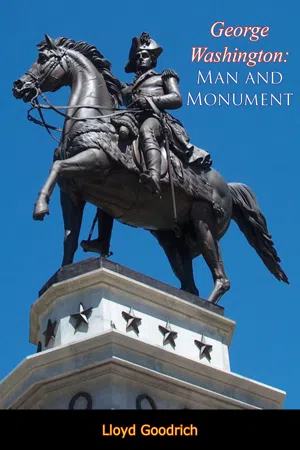 eBook - ePub
George Washington
Man and Monument
- Marcus Cunliffe(Author)
- 2017(Publication Date)
- Papamoa Press(Publisher)
Moreover, Washington was a wealthy man, if not quite as rich as rumor had it (or he himself perhaps believed). The New York delegates had been instructed beforehand:“On a General in America, fortune also should bestow her gifts, that he may rather communicate lustre to his dignities than receive it, and that his country in his property, his kindred, and connexions, may have sure pledges that he will faithfully perform the duties of his high office, and readily lay down his power when the general weal shall require it.”No one could have better fitted this description. Washington revealed himself as an aristocrat with radical leanings. At any rate, unlike some of the prominent citizens at Philadelphia, he was prepared to commit himself and his estates on the side of the colonies. His military apparel proclaimed the fact; his demeanor and his reputation preserved him from the charge of flamboyance. The first signs of the myth-making process appeared. A rumor got about in 1775 that in the previous year Colonel Washington had offered to raise and lead to Boston a regiment of a thousand Virginians, paying for them out of his own pocket. The rumor seems to be entirely without foundation, though biographers have often repeated it as true. But it shows how eagerly the men at Philadelphia cast about for evidences of greatness, for the lineaments of the altogether exceptional man. In Sam Adams and others Congress had patriots who could rouse a rabble; its imperative need was for someone who could discipline and lead a rabble, who could both look and behave like a commander on the European model and yet be a true American.There was one other important consideration. So far, the clash had been confined to New England. If the other colonies were to join in fully, the command of the proposed Continental army would have to be given—as John and Samuel Adams realized—to a soldier from outside New England. With Massachusetts, Virginia held pre-eminence in colonial power. As a Virginian, George Washington was therefore all the more eligible. In the parlance of more recent American history, he was the “available” candidate, and his subordinate major generals were appointed with due regard for the political and other factors involved: Artemas Ward to appease Massachusetts; the much-traveled Charles Lee for his military sophistication; Philip Schuyler (another delegate, a rich man and a seasoned military officer) to satisfy New York; and Israel Putnam as a favorite son and folk hero of Connecticut. Horatio Gates, British by birth and a Virginian by adoption, was appointed adjutant general. As their juniors, several brigadier generals were chosen from similarly mixed motives.
- William Alfred Bryan(Author)
- 2019(Publication Date)
- Columbia University Press(Publisher)
His features are regu-lar and placid, with all the muscles of his face under perfect control, though flexible and expressive of deep feeling when moved by emo-tions. In conversation he looks you full in the face, is deliberate, defer-ential and engaging. His voice is agreeable rather than strong. His demeanor at all times composed and dignified. His movements and ges-tures are graceful, his walk is majestic, and he is a splendid horseman. 1 'In W . S. Baker, ed., Early Sketches of George Washington . . . (Philadelphia, 1894), pp. 13-14. Baker (p. 9) compares the portrait painted by Charles Willson Peale in 1772. Shortly after Braddock's defeat Christopher Gist, a fellow soldier, wrote to Washington as Seen by His Contemporaries 25 When Washington was appointed Commander-in-Chief of the Patriot army in 1775, a Northern member of Congress wrote home that His election was unanimous, his acceptance of the high trust, modest and polite, his Character I need not enlarge on but will only say to his honor, that he is said to be as fixed and resolute in having his orders on all occasions executed, as he is cool and deliberate in giving them. 2 Benjamin Rush, physician, representative of Pennsylvania in the Second Continental Congress, and signer of the Declaration of Independence, gives us a picture of a dinner at which Washington was present shortly after his acceptance of the appointment noted above. The first toast drunk was to The Commander-in-chief of the American Armies, and Washington rose for a response. Rush describes the reaction of the group: The whole company instantly rose, and drank the toast standing. This scene, so unexpected, was a solemn one. A silence followed it as if every heart was penetrated by the awful, but great events which were to fol-low the use of the sword of liberty which had just been put into Gen-eral Washington's hands by the unanimous voice of his country.
Index pages curate the most relevant extracts from our library of academic textbooks. They’ve been created using an in-house natural language model (NLM), each adding context and meaning to key research topics.

