History

Battles of Trenton and Princeton
The Battles of Trenton and Princeton were pivotal engagements during the American Revolutionary War. In December 1776, George Washington's forces crossed the Delaware River and launched a surprise attack on Hessian troops in Trenton, achieving a crucial victory. A week later, the Americans won another significant battle at Princeton, boosting morale and bolstering support for the revolution.
Written by Perlego with AI-assistance
Related key terms
1 of 5
6 Key excerpts on "Battles of Trenton and Princeton"
 eBook - PDF
Battles that Changed History
An Encyclopedia of World Conflict
- Spencer C. Tucker(Author)
- 2010(Publication Date)
- ABC-CLIO(Publisher)
With little food or rest for 36 hours, Washington’s men needed relief, and he was thus forced to suspend operations. On December 27 the Continentals were back across the Delaware. Washington followed up Trenton by an attack against Princeton. Recrossing the Delaware on January 2, 1777, he routed 1,700 crack British troops at Princeton under Lieutenant Colonel Charles Mawhood. These two small Continental victo- ries changed the entire campaign. Washington called Trenton “A glorious day for our country,” while British minister for the colonies Lord George Germain ex- claimed, “All our hopes were blasted by the unhappy affair at Trenton.” Trenton helped end the Continentals’ fear of the Hessian troops. More importantly, the two Battles of Trenton and Princeton added immensely to Washington’s prestige, which was at a low point a month before, establishing his reputation as a general and a leader of men. The battles also restored Continental morale, which had been at its lowest point since the start of the war. In two weeks Washington had snatched vic- tory out of the jaws of death and fanned the dying embers of American indepen- dence into flame again. References Fischer, David Hackett. Washington’s Crossing. New York: Oxford University Press, 2004. Ketchum, Richard M. The Winter Soldiers: The Battles for Trenton and Princeton. New York: Anchor Books, 1975. McPhillips, Martin. The Battle of Trenton. Parsippany, NJ: Silver Burdett, 1984. Ward, Christopher. The War of the Revolution, Vol. 1. New York: Macmillan, 1952. Battles of Saratoga Date September 19, October 7, 1777 Location Saratoga in upper New York State (eastern United States) Opponents (* winner) *Americans British Commander Major General Horatio Gates Lieutenant General John Burgoyne Approx. eBook - PDF
The Revolutionary Era
Primary Documents on Events from 1776 to 1800
- Carol Sue Humphrey(Author)
- 2003(Publication Date)
- Greenwood(Publisher)
In each section, both Patriot and Loyalist views of what happened at the battle are included. And, in each case, the winners emphasize the glories of victory while the losers downplay or almost ignore the losses of defeat. 49 50 The Revolutionary Era Trenton The battle that occurred at Trenton on December 25, 1776, was really more of a skirmish than a battle. It involved 2,400 Continentals under the command of Washington. He crossed the Delaware River from Pennsylvania on Christmas Eve and attacked a force of 1,400 Hessians encamped at Tren- ton, New Jersey. It was a great victory for the Americans. The Hessians suf- fered casualties of 30 and approximately 918 taken prisoner, while the Americans had no deaths and only 3 wounded. Although a small battle in comparison to later engagements, the victory at Trenton was one of Wash- ington's greatest successes. P A T R I O T V I E W George Washington: "Official Report to Congress" George Washington attacked Trenton primarily because hefelt something needed to be done in the wake of theprecipitous retreatfrom New York. But, as he indicates in this official report, the sortie succeeded beyond his wildest dreams. Not only did his troops successfully capture the garrison at Tren- ton, but they did so under severe weather conditions and while suffering al- most no casualties. Virginia Gazette (Dixon and Hunter—Williamsburg), 10 January 1777 Sir, I have the pleasure of congratulating you upon the success of an en- terprise, which I had formed against a detachment of the enemy lying in Trenton, and which was executed yesterday morning. The evening of the 25 th , I ordered the troops intended for this service to parade back of McKenky's ferry, that they might begin to pass as soon as grew dark, imagining we should be able to throw them all over, with the necessary artillery, by 12 o'clock, and that we might easily arrive at Trenton by five in the morning, the distance being about nine miles. eBook - ePub
7 Leadership Lessons of the American Revolution
The Founding Fathers, Liberty, and the Struggle for Independence
- John Antal(Author)
- 2013(Publication Date)
- Casemate(Publisher)
Chapter 5VICTORY OR DEATH ! Washington at the Battles of Trenton and PrincetonIf every nerve is not strained to recruit the New Army with all possible Expedition I think the game is pretty near up…. No Man I believe ever had a greater choice of difficulties & less the means of extricating himself than I have-However under a full persuasion of the justice of our Cause I cannot but think the prospect will brighten.—General George Washington in a letter to his brother Samuel on December 18, 1776LEADERSHIP REQUIRES DETERMINATION.T he cause never looked more in doubt. Disaster. Defeat. Dishonor. These phantoms haunted Gen. George Washington as he rode his horse through the cold mud of a worn-out New Jersey thoroughfare and his depleted army marched to the Delaware River. He knew that some of his men doubted the capabilities of their commander and, considering the string of disasters they had endured, he couldn’t blame them.As the year 1776 came to a close, catastrophe loomed before the young American Republic. The army’s spirit was nearly broken. Morale was teetering on the edge of an abyss dug ever deeper by defeats and retreats. Casualties were high and setbacks occurred everywhere. The fervent patriotism, which had burned bright in the spring and summer, cooled under the freezing winds of adversity. In some cases it was non-existent as some turned coat, sold their freedom for security and pledged their loyalty to Britain’s King George.After the British evacuation of Boston on March 26, 1776, Washington immediately moved his forces to New York to defend that important city from British attack. He ordered his men to prepare trenches and earthworks to defend Manhattan Island. America had bravely declared independence from Great Britain on July 4, 1776. The British read the declaration and came back with a vengeance.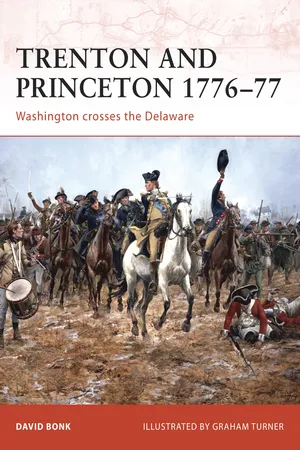 eBook - ePub
Trenton and Princeton 1776–77
Washington crosses the Delaware
- David Bonk, Graham Turner(Authors)
- 2012(Publication Date)
- Osprey Publishing(Publisher)
At his temporary headquarters on Queen Street near the Assunpink Bridge Washington convened a council with his senior staff on December 30. He updated his staff on the latest intelligence and reviewed options. Washington rejected any suggestion that the army retreat back to Pennsylvania. There was general agreement that they should offer battle at Trenton. Once again the Americans were faced with a difficult decision. The British had recovered from their paralysis more quickly than anticipated. Coupled with the delays in re-crossing the Delaware River, the continuing effort to cajole enough veterans to stay with the army, the ongoing assembly of various militia units and lack of concrete knowledge of British intentions, the overall situation was shifting dramatically.Cadwalader had sent a detachment as far as Cranbury on December 30 based on intelligence that Cornwallis had left a skeleton force of only 250 men at New Brunswick. Cadwalader’s orders were to overwhelm the New Brunswick garrison, rescue Maj. Gen. Lee and secure the £70,000 military treasury. Late on December 30 Cadwalader learned that the New Brunswick garrison totaled 1,500 and he reluctantly ordered his men back to Allentown.Operations of General Washington against the King’s Troops in New Jersey. This map shows the various movements of both American and British forces between December 25, 1776, and January 3, 1777, and the relative locations of Trenton, Princeton and Bordentown.Colonel John Cadwalader provided Washington with this map, prepared by one of Cadwalader’s spies, showing approaches to Princeton and the location of British defenses. Washington relied on this map to guide his move to Princeton on January 3, 1777.1st Continental Regiment Summer-Winter, New York-New Jersey Campaign 1776, by Don Troiani. The riflemen from the 1st Continental Regiment and similar detachments were heavily engaged during Cornwallis’s advance from Princeton to Trenton. The riflemen delayed the British advance throughout the day, allowing Washington to assemble his army behind Assunpink Creek. (Painting by Don Troiani, www.historicalimagebank.com eBook - ePub
The American Revolutionary War and The War of 1812
People, Politics, and Power
- Britannica Educational Publishing, Jeff Wallenfeldt(Authors)
- 2009(Publication Date)
- Britannica Educational Publishing(Publisher)
After the capture of Fort Washington on Manhattan Island in November 1776, the British Gen. Sir William Howe forced the Americans to retreat through New Jersey and across the Delaware River into Pennsylvania. Howe then went into winter quarters, leaving the Hessian colonel Johann Rall at Trenton with about 1,400 men.Although Gen. George Washington’s Continental Army was discouraged by the year’s disasters, its morale was not crushed, and it now numbered 6,000 effectives. Ascertaining that the Hessians were virtually unsupported, Washington determined to attempt their capture. Despite the ice floes in the Delaware, Washington crossed the river on December 25 and surprised the enemy, the next day capturing more than 900 men. Four days later he occupied Trenton. Hearing of Washington’s move, Lord Cornwallis confronted the Continentals east of the city with about 7,000 troops on Jan. 2, 1777, driving them back. Unable to find boats for an escape, Washington called a council of war that confirmed his bold plan to break camp quietly that night and take a byroad to Princeton. The maneuver succeeded, and three British regiments that met him there on January 3 were all driven back or retreated. As a result, Washington continued his march to Morristown, N.J., where he flanked British communications with New York. Cornwallis retired to New Brunswick. Besides succeeding in breaking through Howe’s lines, Washington had placed himself in an advantageous position for recruiting his army and maintaining a strong defensive in the next campaign.George Washington standing with the flags captured from the British in the Battle of Trenton . Library of Congress Prints and Photographs DivisionThe effect of these early American victories in the Battles of Trenton and Princeton, the first successes won by Washington in the open field, was marked. Following close upon a series of defeats, they put new life into the American cause and renewed confidence in Washington as commander of the Revolutionary Army.
- Charles P. Whittemore(Author)
- 2019(Publication Date)
- Columbia University Press(Publisher)
The Battle of Trenton was the first encounter during the Revolution in which Sullivan enjoyed success. He must have been jubilant and anxious for another tussle with the enemy. Washington, now back in Pennsylvania, did not disappoint him, because he shortly decided to cross the Delaware once again to beat up the rest of their Quarters bordering on and near the River. 70 He moved on December 30. This new thrust pre-sented ticklish problems, because the British were assembling a force at Princeton. Washington chose to gather his forces at Trenton in preparation for a contest. As expected, on January 2, 1777, the British and Hessians under Cornwallis advanced toward Trenton, the head of the column reaching there about LONG I S L A N D TO N E W J E R S E Y 49 4:00 P.M . Sullivan was among those Americans who harassed the enemy during their march from Maidenhead, which is now Lawrenceville. This delaying action allowed Washington's men to place themselves south of the Assunpink Creek, a risky spot because it might become a cul-de-sac. Darkness fell, and Corn-wallis showed the same indecisiveness that plagued Sir William Howe's American career. His men were tired; he would bag Washington, the fox, the next day! 71 A hasty Council held at St. Clair's headquarters determined to march at once, outflank the British, and proceed to Prince-ton. While campfires burned to delude the enemy into believing the American army remained in its position across the creek, the tired men during the early hours of January 3 moved in silence. If Cornwallis knew the Americans were leaving, he did nothing about it. 72 It was a motley group that marched—half-starved, half-frozen, feeble, worn out men, with old fowling pieces for muskets, and half of them without bayonets.
Index pages curate the most relevant extracts from our library of academic textbooks. They’ve been created using an in-house natural language model (NLM), each adding context and meaning to key research topics.

