History

John Adams
John Adams was the second President of the United States, serving from 1797 to 1801. He played a key role in the American Revolution and was a leading advocate for independence. Adams was also a key figure in the drafting of the Declaration of Independence and the establishment of the United States as a sovereign nation.
Written by Perlego with AI-assistance
Related key terms
1 of 5
8 Key excerpts on "John Adams"
 eBook - PDF
The Presidency of John Adams
The Collapse of Federalism, 1795-18
- Stephen G. Kurtz(Author)
- 2017(Publication Date)
Though he clearly recognized that a large segment of the population did not think in such terms, his party had attracted most of the men who did. There was also a sense in which a republic still led by the men who had directed its independence movement owed the highest public trust to the few who remained in the front ranks of national politics. Adams believed that he was ex--pected to play a major role in public life and spoke of the many claims upon himself to do so. Adams may have been vain, but he was neither insincere nor unintelligent. Amer-icans chose to celebrate the announcement of the Declara-tion of Independence rather than the acceptance of the Con-stitution as a memorial day; and Washington, Adams, and Jefferson alone remained national figures from that group which had led the independence movement. Patrick Henry still stirred memories, but he was old and chose obscurity rather than publicity. The outstanding services that Adams had rendered in 1775 and 1776 when he had teamed up with Sam Adams and Richard Henry Lee to push and persuade wavering men into an open break with England were not easily forgotten; no one had been a more powerful debator, orator, or strategist than the John Adams of 1776. 1 He had represented the Confederation during and just after the Revo-lution at Paris, London, and The Hague. His championship of New England fishing rights on the treaty commission had not been forgotten in Massachusetts, and his successful negotia-tion of a Dutch loan at a time when the Continental Con-gress had reached the end of its resources was a contribution of large proportions to the survival of independence. 2 1 Catherine Drinker Bowen has done full justice to the work of Adams in relation to the declaration of American independence. John Adams and the American Revolution (Boston, 1950), 488-599. eBook - PDF
Origins of Legislative Sovereignty and the Legislative State
Volume Six, American Traditions and Innovation with Contemporary Import and Foreground, Book I: Foundations, (to Early 19th Century)
- A. London Fell(Author)
- 2004(Publication Date)
- Praeger(Publisher)
In later years, Adams let it be known that he had had a greater hand in the committee's revised text than people realized. Jefferson steadfastly replied that he (and not Adams) was indeed the author, as he also later indicated in his inscription for his Monticello tombstone. 1 While accepting Jefferson's account and his criticism of Adams' lapses of memory, one is nevertheless struck by Adams' potential influence on Jefferson's great interest at that time in matters of legislative sover- eignty, viewed by both men through historical thought and contempo- rary events. Like Jefferson, Adams compiled during his long life a huge private library. Though not as large and diverse as Jefferson's, Adams' collec- tion included a vast array of historical books on politics and law, similar to those discussed above in the case of Jefferson. Among them were works by Locke, Sidney, and others deeply indebted to Bodinian tradi- 101 102 I Founding Fathers tions on legislative sovereignty. Especially noteworthy is Adams' posses- sion of two editions of Bodin's Republic—the 1606 Knolles translation in English and an 18th-century abridgement in French. 2 Adams' library also included his own voluminous writings on political and constitutional history and theory, which point up his interests in legislation, sover- eignty, and the state. Adams' intellectual interests were greatly shaped by his student days at Harvard College, by his many years as a practicing lawyer in Massachusetts, and by his public career in the service of the new emer- gent nation. In 1774 Adams was elected a Massachusetts delegate to the Continental Congress at Philadelphia. In 1777 he was elected joint com- missioner to France to negotiate a treaty of alliance, and in May 1778 he was presented at Versailles to King Louis XVI. In August 1779 Adams returned home and was chosen to write the Massachusetts con- stitution, which was soon submitted and adopted. eBook - ePub
The American Story
Conversations with Master Historians
- David M. Rubenstein(Author)
- 2019(Publication Date)
- Simon & Schuster(Publisher)
Nothing happened on July 4. That’s the date on the document. And all those people weren’t assembled to sign it. They signed it when they were in town, as it were. Some of them signed in the fall, some were signing all the way up to Christmas. And the furniture in the painting is wrong. The room, the decorations of the room are wrong.The only thing that’s right, and it’s what’s most important, are the faces. They were all representative of individual Americans—free, independent Americans—who are stating their political faith and who are accountable. In other words, they can’t hide anymore. There they are. Proudly, but not without courage to do that.Adams wrote that day or the next day: “The 2nd day of July, 1776, will be the most memorable epoch in the history of America. I am apt to believe that it will be celebrated, by succeeding generations, as the great anniversary festival. It ought to be commemorated as a day of deliverance by solemn acts of devotion to God almighty. It ought to be solemnized with pomp and parade, with shows, games, sports, guns, bells, bonfires, and illuminations from one end of this continent to the other, from this time forward forevermore.”“Just the thing for a Child to have!” Commemorative 1850s broadside of Adams’s passionate letter, July 5, 1776, about the importance of the Declaration of Independence.Think about it for a minute. He’s saying, “From one end of the continent to the other.” The country at that point didn’t even reach the Allegheny Mountains. And he’s seeing this dream, this ambition. Like John F. Kennedy saying, “We will go to the moon.” This is an American moment, and it is more than just legally interesting or legally important, profound, and unprecedented, which it was. And Adams had that capacity.Adams was short, and he was not very handsome, and he comes right after the presidency of the tallest, most glamorous, important figure in the world then, George Washington, and before the glamorous Thomas Jefferson. And to me, it’s very interesting that it’s the same situation with Harry Truman. He comes after Franklin Roosevelt and is succeeded by Dwight Eisenhower, two of the most luminous figures of that day. But you have to wait for the dust to settle, and you begin to see who really did matter.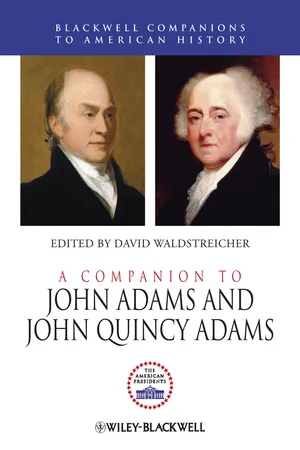 eBook - ePub
- David Waldstreicher(Author)
- 2013(Publication Date)
- Wiley-Blackwell(Publisher)
and realism in his politics was then demonstrated by the side he took in the slavery controversy. The slave power had, indeed, gotten out of hand and was trampling on the constitution and the Declaration of Independence; the meaning of America was at stake (Lipsky, 1950: 121–127, 212, 278, 316–317).Lipsky helped solidify the “foundations” upon which Bemis would complete his monument to John Quincy Adams and the Union in 1956. The emphasis here was on Adams’sspectacular Second Career: as Minority President with visions of a consolidated Union of Liberty with Power, then in Congress as a crusader in crescendo for human rights against the expansion of slavery – abolitionist at heart but constitutionalist in practice – until he fell at the climax of his life a dying gladiator on the floor of the House of Representatives. (Bemis, 1956: ix)Looking forward, Bemis now found himself fully able to assimilate the seemingly failed presidency to a larger second-career story. In 1824 no one was better qualified for the presidency, as Adams rightly realized. He kept quiet on slavery; his discretion on this issue and on the tariff helped him get elected by the House of Representatives in “an implicit but certainly not corrupt bargain.” The union had to be preserved and expanded before anything could be done about slavery (Bemis, 1956: 11, 58, 63).But the election itself, and Adams’s policies, changed things. The opposition to him was sectional. His plan for a great national government was a threat to slavery, and understood as such by Southern leaders like John Randolph (1956: 70–71, 88, 90–91). This shaped his presidency and his defeat. In a passage that seems to be ignored by recent historians of the election of 1828 (Parsons, 2008; Cole, 2009), and even in recent scholarship on the politics of slavery, Bemis insisted that “The most significant issue on the Presidential campaign of 1828 was the hidden issue … the issue of slavery.” While neither candidate said anything about it for fear of antagonizing real or potential supporters, “the hidden issue silently transformed the Presidential Question of 1828 into an underlying sectional contest.” Van Buren successfully courted “the vested interests of the slavery capitalists” and created the Jacksonian cross-sectional coalition (Bemis, 1956: 150, 152).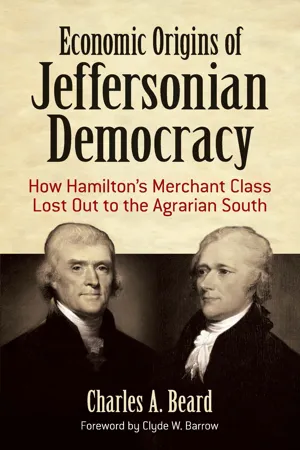 eBook - ePub
Economic Origins of Jeffersonian Democracy
How Hamilton's Merchant Class Lost Out to the Agrarian South
- Charles A. Beard(Author)
- 2017(Publication Date)
- Dover Publications(Publisher)
CHAPTER XI THE POLITICAL ECONOMY OF John Adams 1 D URING the election of Washington’s successor it became apparent that the country was sharply divided and that the dissatisfaction with Federalist policies was deep and fervent. It is true, a sturdy Federalist, John Adams, carried the day, but his victory over Jefferson was won by a margin of three electoral votes — a fact which stung him like a nettle. Moreover, he knew that many who voted for him, including no less an important person than Hamilton, had accepted his candidature with reluctance as a lesser evil. Yet, un-propitious as were the signs, the election of 1796 was a victory for the party that had framed the Constitution and carried it into effect. Whatever may have been the objections brought against Adams on personal grounds, it could not be said that his system of politics was unknown to those who had occasion to vote for presidential electors in the autumn of 1796. On the contrary, Adams, unlike Jefferson and Washington, had published a large work in which he had elaborated with great pains and with copious details his theories of government, politics, economics, and democracy: A Defence of the Constitutions of Government of the United States of America against the attack of M. Turgot in His Letter to Dr. Price, first issued in 1786. 2 This work, although too laborious and too prolix for popular interest; was nevertheless widely read and still more widely commented upon in American newspapers. Large sections, particularly those considered in this chapter, had been reprinted in full in several papers and had been the subject of friendly and adverse criticism by those interested in politics No longer available |Learn more
New England Forefathers´ Day Orations, 1770–1865
An Annotated Edition of Selected Plymouth Anniversary Addresses
- Udo J. Hebel(Author)
- 2016(Publication Date)
- Universitätsverlag Winter(Publisher)
John Quincy Adams grew up in one of the leading families in New England and the nation at large . He graduated from Harvard College in 1790 to practice law and accompanied his father on travels to Europe before he himself became minister to the Netherlands (1793) and to Prussia (1797) . In 1802, after his resignation from his diplomatic posts in the wake of the election of Thomas Jefferson to the presidency and shortly before his Plymouth oration, he was elected to the United States Senate on a Federalist ticket . Soon thereafter, Adams began to steer a political course between strict party lines . In the further course of his eminent career, he held the newly established Chair of Rhetoric and Oratory at Harvard, was appointed minister to Russia and Britain, and served as secretary of state under President Monroe from 1817 to 1825 . In 1824, he was elected president of the United States and served for one term through early 1829 . Until his death, he remained a member of the U .S . House of Representatives for the Plymouth dis-trict and became one of the most outspoken opponents of slavery in the increasingly heated controversies of the 1830s and 1840s . On 23 February 1848, he died of a stroke suffered during a congressional debate in the Speaker’s Room of the Capitol . John Quincy Adams’s 1802 Forefathers’ Day oration illustrates the shift from a pre-dominantly homiletic to a more secular anniversary rhetoric at the turn from the eigh-teenth to the nineteenth century . eBook - PDF
American Statesmen
Secretaries of State from John Jay to Colin Powell
- Edward Mihalkanin(Author)
- 2004(Publication Date)
- Greenwood(Publisher)
JOHN QUINCY ADAMS (1767-1848) Served 1817-1825 Appointed by President James Monroe Democratic-Republican Scholars seem to agree that John Quincy Adams was the most accomplished diplo- mat and statesman in the country's history. Behind his unsurpassed career was a totally unique upbringing and exposure to learning. As the son of John and Abigail Adams, he lived in a universe of high expectations, devotion to duty, Christian faith, and classical virtue. He spent much of his youth abroad in the company of American and European leaders of distinction and renown. Born on July 11, 1767, he was scarcely 10 years old when he accompanied his father on a brief diplomatic mission to Paris. When John Adams returned to Paris as minister plenipotentiary in 1779 to negotiate a peace with England, Abigail insisted that John Quincy again accompany his father. "In all human probability," she wrote, "it will do more for your education to go back to France with your father than to prepare for college at Andover." John Quincy's next six years comprised a phenomenal learning experience. For six months he studied at Passy, transferred to the Latin School in Amsterdam, and then pursued classical studies at the University of Leyden. Already he had read many classics in history, politics, and philosophy. His father had recommended Thucydides's History of the Peloponnesian War for his enlightenment on war and diplomacy. Adams's apprenticeship in diplomacy began in July 1791 when, at 14, he became private secretary to Francis Dana, the newly appointed U.S. representative to the court of Catherine the Great of Russia. Finding Russian education hopeless, he turned to English and European history. In 1782-1783, having returned to his father's residence at The Hague, Adams embarked on a seven-month trip through Sweden, Denmark, and Germany. eBook - ePub
Historian in Chief
How Presidents Interpret the Past to Shape the Future
- Seth Cotlar, Richard J. Ellis, Seth Cotlar, Richard J. Ellis(Authors)
- 2019(Publication Date)
- University of Virginia Press(Publisher)
Just as John Adams remains the first source of quotes on the nature of the American Revolution, so John Quincy Adams’s diary has reemerged as the locus classicus for understanding the politics of slavery in the early republic, no less than for events like the Treaty of Ghent and the Monroe Doctrine. The leading synthesis of the period 1815–48 is dedicated to Adams, and the leading rival quotes him almost as often even while relying on a curiously inverted interpretation of him as politically naive if not craven until he suddenly became a sage and a hero. 35 We would like to separate his careers into successes and failures, or into politics and good intentions, or into doing and writing, and so did he; but he also knew better. Moreover, both his historical interpretation of a proslavery Republic and his consequently anguished, revisionist search to square nation-building and empire with America’s inspiring opposition to tyranny resonate strongly today, leading to what can only be called an Adams revival. Did the Revolution, or the Constitution, make a nation? Did the Revolution or the Constitution undermine, or advance, slavery? What is the relationship between the answers to those questions? We have not revised perhaps as much as returned to our founding revisionist, the president whose very loyalty to the regime of the father first suppressed, and then enabled, an antislavery nationalism. Notes 1. For the significance of Washington’s lack of a biological son, which made it easier for him to serve as consensual father to all, see Francois Furstenberg, In the Name of the Father: George Washington, Slavery, and the Making of the Nation (New York: Penguin, 2006). 2. Stephen Skowronek, The Politics Presidents Made: Leadership from John Adams to George Bush (Cambridge, MA: Harvard University Press, 1993), 33, 110–27. 3. See the classic analysis of “getting right with Lincoln” in David Donald, Lincoln Reconsidered, 2nd ed
Index pages curate the most relevant extracts from our library of academic textbooks. They’ve been created using an in-house natural language model (NLM), each adding context and meaning to key research topics.

