History

John Quincy Adams
John Quincy Adams was the sixth president of the United States, serving from 1825 to 1829. He was known for his role in shaping American foreign policy and for his efforts to promote national infrastructure and education. Adams also played a key role in negotiating the Treaty of Ghent, which ended the War of 1812.
Written by Perlego with AI-assistance
Related key terms
1 of 5
10 Key excerpts on "John Quincy Adams"
 eBook - PDF
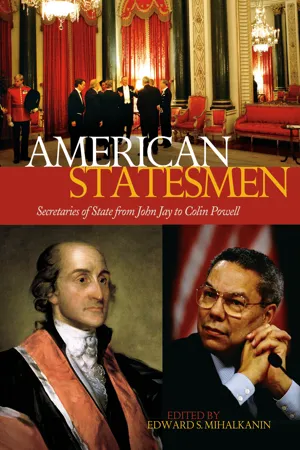
American Statesmen
Secretaries of State from John Jay to Colin Powell
- Edward Mihalkanin(Author)
- 2004(Publication Date)
- Greenwood(Publisher)
John Quincy Adams (1767-1848) Served 1817-1825 Appointed by President James Monroe Democratic-Republican Scholars seem to agree that John Quincy Adams was the most accomplished diplo- mat and statesman in the country's history. Behind his unsurpassed career was a totally unique upbringing and exposure to learning. As the son of John and Abigail Adams, he lived in a universe of high expectations, devotion to duty, Christian faith, and classical virtue. He spent much of his youth abroad in the company of American and European leaders of distinction and renown. Born on July 11, 1767, he was scarcely 10 years old when he accompanied his father on a brief diplomatic mission to Paris. When John Adams returned to Paris as minister plenipotentiary in 1779 to negotiate a peace with England, Abigail insisted that John Quincy again accompany his father. "In all human probability," she wrote, "it will do more for your education to go back to France with your father than to prepare for college at Andover." John Quincy's next six years comprised a phenomenal learning experience. For six months he studied at Passy, transferred to the Latin School in Amsterdam, and then pursued classical studies at the University of Leyden. Already he had read many classics in history, politics, and philosophy. His father had recommended Thucydides's History of the Peloponnesian War for his enlightenment on war and diplomacy. Adams's apprenticeship in diplomacy began in July 1791 when, at 14, he became private secretary to Francis Dana, the newly appointed U.S. representative to the court of Catherine the Great of Russia. Finding Russian education hopeless, he turned to English and European history. In 1782-1783, having returned to his father's residence at The Hague, Adams embarked on a seven-month trip through Sweden, Denmark, and Germany. No longer available |Learn more
New England Forefathers´ Day Orations, 1770–1865
An Annotated Edition of Selected Plymouth Anniversary Addresses
- Udo J. Hebel(Author)
- 2016(Publication Date)
- Universitätsverlag Winter(Publisher)
John Quincy Adams grew up in one of the leading families in New England and the nation at large . He graduated from Harvard College in 1790 to practice law and accompanied his father on travels to Europe before he himself became minister to the Netherlands (1793) and to Prussia (1797) . In 1802, after his resignation from his diplomatic posts in the wake of the election of Thomas Jefferson to the presidency and shortly before his Plymouth oration, he was elected to the United States Senate on a Federalist ticket . Soon thereafter, Adams began to steer a political course between strict party lines . In the further course of his eminent career, he held the newly established Chair of Rhetoric and Oratory at Harvard, was appointed minister to Russia and Britain, and served as secretary of state under President Monroe from 1817 to 1825 . In 1824, he was elected president of the United States and served for one term through early 1829 . Until his death, he remained a member of the U .S . House of Representatives for the Plymouth dis-trict and became one of the most outspoken opponents of slavery in the increasingly heated controversies of the 1830s and 1840s . On 23 February 1848, he died of a stroke suffered during a congressional debate in the Speaker’s Room of the Capitol . John Quincy Adams’s 1802 Forefathers’ Day oration illustrates the shift from a pre-dominantly homiletic to a more secular anniversary rhetoric at the turn from the eigh-teenth to the nineteenth century . eBook - ePub
- James D. (James Daniel) Richardson, (Authors)
- 2004(Publication Date)
- Perlego(Publisher)
John Quincy Adams
March 4, 1828, to March 4, 1829John Quincy Adams
John Quincy Adams, sixth President of the United States, eldest son of John Adams, second President, was born at Braintree, Mass., July 11, 1767. He enjoyed peculiar and rare advantages for education. In childhood he was instructed by his mother, a granddaughter of Colonel John Quincy, and a woman of superior talents. In 1778, when only 11 years old, he accompanied his father to France; attended a school in Paris, and returned home in August, 1779. Having been taken again to Europe by his father in 1780, he pursued his studies at the University of Leyden, where he learned Latin and Greek. In July, 1781, at the age of 14, he was appointed private secretary to Francis Dana, minister to Russia. He remained at St. Petersburg until October, 1782, after which he resumed his studies at The Hague. Was present at the signing of the definitive treaty of peace in Paris, September 3, 1783. He passed some months with his father in London, and returned to the United States to complete his education, entering Harvard College in 1786 and graduating in 1788. He studied law with the celebrated Theophilus Parsons, of Newburyport; was admitted to the bar in 1791, and began to practice in Boston. In 1791 he published in the Boston Centinel, under the signature of "Publicola," a series of able essays, in which he exposed the fallacies and vagaries of the French political reformers. These papers attracted much attention in Europe and the United States. Under the signature of "Marcellus" he wrote, in 1793, several articles, in which he argued that the United States should observe strict neutrality in the war between the French and the British. These writings commended him to the favor of Washington, and he was appointed minister to Holland in May, 1794. In July, 1797, he married Louisa Catherine Johnson, a daughter of Joshua Johnson, of Maryland, who was then American consul at London. In a letter dated February 20, 1797, Washington commended him highly to the elder Adams, and advised the President elect not to withhold promotion from him because he was his son. He was accordingly appointed minister to Berlin in 1797. He negotiated a treaty of amity and commerce with the Prussian Government, and was recalled about February, 1801. He was elected a Senator of the United States by the Federalists of Massachusetts for the term beginning March, 1803. In 1805 he was appointed professor of rhetoric and belles-lettres at Harvard College, and accepted on condition that he should be permitted to attend to his Senatorial duties. He offended the Federalists by supporting Jefferson's embargo act, which was passed in December, 1807, and thus became connected with the Democratic party. He resigned his seat in the Senate in March, 1808, declining to serve for the remainder of the term rather than obey the instructions of the Federalists. In March, 1809, he was appointed by President Madison minister to Russia. During his residence in that country he was nominated to be an associate justice of the Supreme Court of the United States, and confirmed February, 1811; but he declined the appointment. In 1813 Adams, Bayard, Clay, Russell, and Gallatin were appointed commissioners to negotiate a treaty of peace with Great Britain. They met the British diplomatists at Ghent, and after a protracted negotiation of six months signed a treaty of peace December 24, 1814. In the spring of 1815 he was appointed minister to the Court of St. James, remaining there until he was appointed by Mr. Monroe Secretary of State in 1817. In 1824 Adams, Jackson, Crawford, and Clay were candidates for the Presidency. Neither of the candidates having received a majority in the electoral colleges, the election devolved on the House of Representatives. Aided by the influence of Henry Clay, Mr. Adams received the votes of thirteen States, and was elected. He was defeated for reelection in 1828 by General Andrew Jackson. On the 4th of March, 1829, he retired to his estate at Quincy. In 1830 he was elected to Congress, and took his seat in December, 1831. He continued to represent his native district for seventeen years, during which time he was constantly at his post. On the 21st of February, 1848, while in his seat at the Capitol, he was stricken with paralysis, and died on the 23d of that month. He was buried at Quincy, Mass.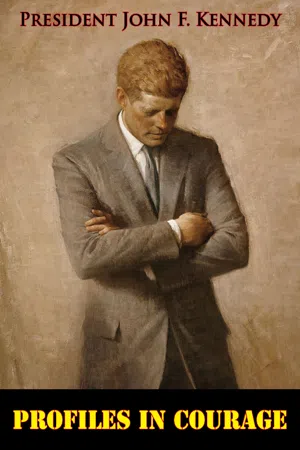 eBook - ePub
- President John F. Kennedy(Author)
- 2015(Publication Date)
- Golden Springs Publishing(Publisher)
“I am forty-five years old. Two-thirds of a long life have passed, and I have done nothing to distinguish it by usefulness to my country and to mankind....Passions, indolence, weakness and infirmities have sometimes made me swerve from my better knowledge of right and almost constantly paralyzed my efforts of good.”And finally, at age seventy, having distinguished himself as a brilliant Secretary of State, an independent President and an eloquent member of Congress, he was to record somberly that his “whole life has been a succession of disappointments. I can scarcely recollect a single instance of success in anything that I ever undertook.”Yet the lifetime which was so bitterly deprecated by its own principal has never been paralleled in American history. John Quincy Adams—until his death at eighty in the Capitol—held more important offices and participated in more important events than anyone in the history of our nation, as Minister to the Hague, Emissary to England, Minister to Prussia, State Senator, United States Senator, Minister to Russia, Head of the American Mission to negotiate peace with England, Minister to England, Secretary of State, President of the United States and member of the House of Representatives. He figured, in one capacity or another, in the American Revolution, die War of 1812 and the prelude to the Civil War. Among the acquaintances and colleagues who march across the pages of his diary are Sam Adams (a kinsman), John Hancock, Washington, Jefferson, Franklin, Lafayette, John Jay, James Madison, James Monroe, John Marshall, Henry Clay, Andrew Jackson, Thomas Hart Benton, John Tyler, John C. Calhoun, Daniel Webster, Lincoln, James Buchanan, William Lloyd Garrison, Andrew Johnson, Jefferson Davis and many others.Though one of the most talented men ever to serve his nation, he had few of the personal characteristics which ordinarily give color and charm to the personality. But there is a fascination and nobility in this picture of a man unbending, narrow and intractable, judging himself more severely than his most bitter enemies judged him, possessing an integrity unsurpassed among the major political figures of our history, and constantly driven onward by his conscience and his deeply felt obligation to be worthy of his parents, their example and their precepts.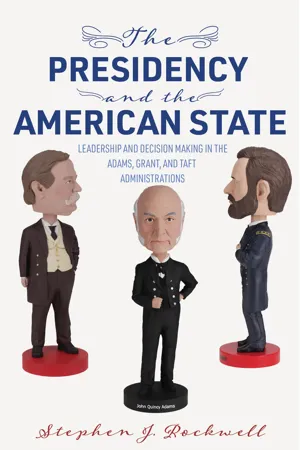 eBook - ePub
The Presidency and the American State
Leadership and Decision Making in the Adams, Grant, and Taft Administrations
- Stephen J. Rockwell(Author)
- 2023(Publication Date)
- University of Virginia Press(Publisher)
12Adams’s effectiveness as president is important to recognize. Adams may have had trouble exciting people, especially later historians, about his vision, but in the long run much of his appeal to order, process, law, and tradition effectively bridged the gap from the founding generation to the next. Adams’s presidency is a lynchpin of the United States before the Civil War, as he protected the processes that governed westward expansion, laid the foundation for fighting slavery through administrative and procedural maneuvers, and married traditional values and understandings of the federal government’s appropriate scope to a set of procedures and specific policy proposals aimed at actively improving the people’s welfare. The words he wrote to his father, when John Adams had been defeated in the 1800 election by Thomas Jefferson, as easily apply to the legacy of President John Quincy Adams: “In your retirement you will have not only the consolation . . . that you have discharged all the duties of a virtuous citizen, but the genuine pleasure of reflecting that by the wisdom and firmness of your administration you left . . . [the] country in safe and honorable peace.”13 Adams, whose entire life operated within state activity at the national and international levels, was the center of the intersection of the presidency and the state during his administration.The President and Domestic Affairs
The idea of active national government had been established long before the start of Adams’s presidency. Decades before Adams took office, the national government was involved in managing key sectors of the national economy like land, furs, and trade; it was a key player in the development of infrastructure like canals, harbors, and the National Road; and it had developed social initiatives in areas as diverse as marine hospitals, vaccination programs, education, and veterans’ benefits. Once we recognize the scope of federal governance in the eighteenth and nineteenth centuries, and its connection to active governance to promote the people’s welfare, it becomes inescapably apparent that Adams and his presidential decision making touched on a host of areas. eBook - ePub
John Quincy Adams
American Statesmen Series
- Morse, John T., Jr. (John Torrey)(Authors)
- 2006(Publication Date)
- Perlego(Publisher)
JOHN T. MORSE, JR. July, 1898.CONTENTS
CHAPTER I. Youth and Diplomacy CHAPTER II. Secretary of State and President CHAPTER III. In the House of Representatives IndexILLUSTRATIONS
John Quincy Adams From the original painting by John Singleton Copley, in the Museum of Fine Arts, Boston. Autograph from the Chamberlain collection, Boston Public Library.The vignette of Mr. Adams's home in Quincy is from a photograph.William H. Crawford From the painting by Henry Ulke, in the Treasury Department at Washington. Autograph from the Chamberlain collection, Boston Public Library.Stratford Canning After a drawing (1853) by George Richmond. Autograph from "Life of Stratford Canning."Henry A. Wise From a photograph by Brady, in the Library of the State Department at Washington. Autograph from the Chamberlain collection, Boston Public Library.John Quincy Adams
CHAPTER I
YOUTH AND DIPLOMACY
On July 11, 1767, in the North Parish of Braintree, since set off as the town of Quincy, in Massachusetts, was born John Quincy Adams. Two streams of as good blood as flowed in the colony mingled in the veins of the infant. If heredity counts for anything he began life with an excellent chance of becoming famous—non sine dîs animosus infans. He was called after his great-grandfather on the mother's side, John Quincy, a man of local note who had borne in his day a distinguished part in provincial affairs. Such a naming was a simple and natural occurrence enough, but Mr. Adams afterward moralized upon it in his characteristic way:—"The incident which gave rise to this circumstance is not without its moral to my heart. He was dying when I was baptized; and his daughter, my grandmother, present at my birth, requested that I might receive his name. The fact, recorded by my father at the time, has connected with that portion of my name a charm of mingled sensibility and devotion. It was filial tenderness that gave the name. It was the name of one passing from earth to immortality. These have been among the strongest links of my attachment to the name of Quincy, and have been to me through life a perpetual admonition to do nothing unworthy of it." No longer available |Learn more
The American President
A Complete History
- Kathryn Moore, Kathryn Moore(Authors)
- 2018(Publication Date)
- Union Square & Co.(Publisher)
J OHN Q UINCY A DAMS ★ ★ ★ SIXTH PRESIDENT ★ ★ ★LIFE SPAN • Born: July 11, 1767, in Braintree (now Quincy), Massachusetts • Died: February 23, 1848, in Washington, D.C. RELIGION • Unitarian HIGHER EDUCATION • Harvard, 1787 PROFESSION • Lawyer MILITARY SERVICE • None FAMILY• Father: John Adams (1735–1826)• Mother: Abigail Smith Adams (1744–1818)• Wife: Louisa Catherine Johnson Adams (1775–1852); wed July 26, 1797, in London, England• Children: George Washington Adams (1801–1829); John Adams II (1803–1834); Charles Francis Adams (1807–1886); Louisa Catherine (1811–1812)POLITICAL LIFE • Minister to the Netherlands (1794–1797) • Minister to Prussia (1797–1801) • Massachusetts state senator (1802) • US senator (1803–1808) • Minister to Russia (1809–1814) • Head negotiator of Treaty of Ghent (1814) • Minister to Great Britain (1815–1817) • Secretary of state (1817–1825) PRESIDENCY • One term: March 4, 1825–March 4, 1829 • Democratic-Republican• Reason for leaving office: lost election to Andrew Jackson in 1828• Vice president: John C. Calhoun (1825–1829)ELECTION OF 1824• Electoral vote: Jackson 99; Adams 84; William Crawford 4; Henry Clay 37• Popular vote: Jackson 153,544; Adams 108,740; Crawford 46,618; Clay 47,136• Due to lack of a majority, election decided by House of Representatives, who voted for AdamsThe first American political dynasty was that of John and John Quincy Adams. Both men became president, but to their chagrin, each only served one term. Father and son were close and shared a similar temperament, and in later years, John Quincy Adams described himself: “I never was and never shall be what is commonly termed a popular man . . . . I have no powers of fascination; none of the honey which the profligate proverb says is the true fly-catcher.”1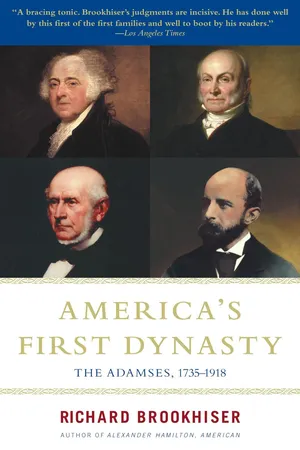 eBook - ePub
America's First Dynasty
The Adamses, 1735-1918
- Richard Brookhiser(Author)
- 2002(Publication Date)
- Free Press(Publisher)
13 Unable to be so frank, John Quincy dissembled whenever the subject loomed, or said nothing at all. His elevation to the Senate was not automatic, for his father's old enemy, Timothy Pickering, also wanted to go to Washington, and pro- and anti-Adams factions in the Federalist party had to strike a bargain that gave John Quincy the senior seat and Pickering the junior one. But John Quincy's diary is silent on these maneuvers—the first of several such omissions.Another feature of his political career seemed to recall his father. John Adams had been a man above parties. Republicans and Federalists, he said of his blighted term, each had a party, “but the commonwealth had none.” In his own mind, John Adams supplied the lack. John Quincy entered politics proclaiming the same doctrine. “A politician in this country,” he wrote his brother Thomas, “must be a man of a party.” But “I would fain be the man of my whole country.”14The party situation in the country at the start of the new century was both confused and acrid. The Federalists, who had defined themselves as the friends of government when Washington and John Adams ran it, had to decide how to conduct themselves now that they were out of power. Federalism in the south and middle states, except for a few pockets, withered away, leaving a New England base. The party wanted a strong military establishment, and the taxes necessary to pay for it, and it continued to fear the ambitions of France. These were real. Though Napoleon Bonaparte had declared that the Revolution was complete, he was extending France's power farther than his radical predecessors. The most alarming example of his reach, to Americans, was his acquisition of Louisiana—the inner third of the continent, including New Orleans at the mouth of the Mississippi River, its economic spigot. The nation's rejection of the policies and fears of the Federalists filled them with gloom. America, wrote one, was “infamous and contented.”15The leading Federalist in New England became Timothy Pickering, the former secretary of state whom John Adams had fired. Pickering's rise to national power had been a function of the reluctance of better men to hold office: He had been Washington's seventh choice as secretary of state. Nevertheless, there were many in New England who admired him for his upright manner and firm principle. When he was an old man, sharing a stagecoach to Washington with Elbridge Gerry, he loaned Gerry his cloak. “The mantle of Timothy the prophet hath fallen upon me,” Gerry joked. “The mantle of charity, rather,” Pickering replied, “‘for charity shall cover the multitude of sins.’ ”16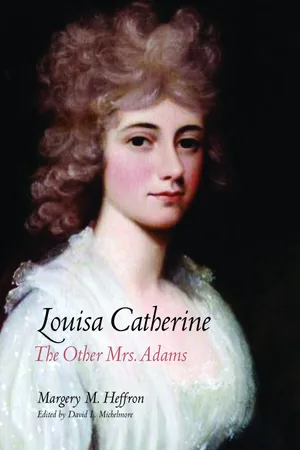 eBook - PDF
Louisa Catherine
The Other Mrs. Adams
- Margery M. Heffron, David L. Michelmore(Authors)
- 2014(Publication Date)
- Yale University Press(Publisher)
45 3 DESTINED FOR GREATNESS I devoted him to the Publick. — abigail adams At first sight, the prince more nearly resembled a frog. During dinner, John Quincy “was in high spirits” and “conversed most agreeably,” but when he left to go to his hotel in the Adelphi buildings, off London’s Strand, the Johnson sisters, recalling the details of his unfashionable costume, were convulsed with laughter. “His dress did not impress us agreeably as it made his person appear to very great disadvantage,” Louisa recalled long afterward. 1 Their daughters could giggle, but Joshua and Catherine would have recog-nized at once that John Quincy was, in reality, American royalty. His father was now completing a second term as vice president of the United States. At only twenty-eight, the younger Adams had already served for more than a year as minister to Holland—an important commercial and diplomatic post in the late eighteenth century—and had spent more time in European court circles than any American of his generation. At only eleven years old, he had begun to observe at first hand the arts of statecraft and diplomacy. John and Abigail Adams had raised their eldest son to play a preeminent role in the new American nation. From an early age he had been inculcated with the belief that public service trumped all other needs and desires and that he, perhaps above all others, was destined for greatness. His ill-fitting Dutch-made waistcoat and trousers to the contrary, John Quincy was an urbane, well-educated bachelor and, as the American vice president’s son, a minor celebrity on both sides of the Atlantic. On that November evening in 1795 George Washington had not yet announced his precedent-making decision to retire from public life after two terms as president. Public opinion at home and abroad could justifiably have Destined for Greatness 46 assumed that America’s great hero, in the manner of kings and emperors, would continue to lead the new nation until his death. eBook - ePub
Life and Public Services of John Quincy Adams
Sixth President of the Unied States; With the Eulogy Delivered Before the Legislature of New York
- William Henry Seward(Author)
- 2006(Publication Date)
- Perlego(Publisher)
The kindly feelings expressed by the King, were, however, comparatively, only the language of ceremony, for the British Ministry, and the British people, did not regard the new republic with favor. But they could not withhold the exhibition of reluctant respect.It was at such a time as this, and in such circumstances, that John Quincy Adams surveyed, from a new position, the colossal structure of British power, and the workings of its combined systems of conservative aristocracy, and progressive democracy. It was here that he imbibed new veneration for Russell, Sidney, Hampden, and Milton, its republican patriots; for Shakspeare, Dryden, and Pope, its immortal poets; and for Addison and Johnson, its moralists; here he learned from Wilberforce the principles of political philanthropy, as well as the patience and perseverance to defend them, and studied eloquence by the living models of Pitt, Fox, Erskine, Burke, and Sheridan.This, indeed, was a fitting conclusion to a precocious education by the patriots and philosophers of his own country, with practical observations in the courts of Spain and the Netherlands, of the weak but amiable Louis XVI., and the accomplished, but depraved, Catharine II.John Quincy Adams now became fearful that the duties of manhood would devolve upon him without his having completed the necessary academic studies. He therefore obtained leave to return home in 1785, at the age of eighteen years, and entered Cambridge University, at an advanced standing, in 1786. He graduated in 1788 with deserved honors.CHAPTER II.
John Quincy Adams STUDIES LAW—HIS PRACTICE—ENGAGES IN PUBLIC LIFE—APPOINTED MINISTER TO THE HAGUE.
After leaving the University, young Adams entered the office of Theophilus Parsons, who was then in the practice of law at Newburyport, and who afterwards for so many years filled with dignity and ability the office of Chief Justice of Massachusetts.Adams completed the usual term of professional study, and then commenced the practice of the law in Boston. It may encourage some who are oppressed by the difficulties attending initiation in the profession, to know, that during the first and only four years of John Quincy Adams' practice, he had occasion for despondency.
Index pages curate the most relevant extracts from our library of academic textbooks. They’ve been created using an in-house natural language model (NLM), each adding context and meaning to key research topics.

