History

Dardanelles Campaign
The Dardanelles Campaign, also known as the Gallipoli Campaign, was a World War I military operation in 1915. It aimed to secure a sea route to Russia and knock the Ottoman Empire out of the war. However, the campaign resulted in heavy casualties for the Allied forces and ultimately ended in failure, leading to the evacuation of troops.
Written by Perlego with AI-assistance
Related key terms
1 of 5
11 Key excerpts on "Dardanelles Campaign"
 eBook - ePub
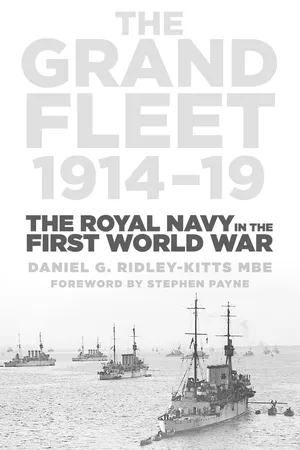
The Grand Fleet 1914-19
The Royal Navy in the First World War
- Daniel George Ridley-Kitts, Daniel G. Ridley-Kitts MBE(Authors)
- 2013(Publication Date)
- The History Press(Publisher)
13THE DARDANELLES OPERATION
From classical times at the eastern end of the Mediterranean, the Dardanelles, which lead through the Sea of Marmara to the Bosporus to what, at that time, was the Turkish capital Constantinople, have been the crossroads between Asia and Europe. Invading armies and ideas have crossed this narrow stretch of water, determining the fate of nations from ancient times. The area has always had great strategic importance, as it controls the only entrance into the Black Sea. From the time when the fabled city of Troy was built on its southern shore over three millennia ago, to Allied attempts to force the straits in the First World War, the Dardanelles have been constantly fought over.In August 1914 the two German cruisers Goeben and Breslau, eluding the pursuit of Admiral Troubridge’s squadron, found sanctuary in the Dardanelles, where the Turkish Government allowed them free, unchallenged passage through the Sea of Marmara to Constantinople.At this stage of the war Turkey was uncommitted and neutral and, under the existing international agreements concerning the passage of war vessels between the Black Sea and the Mediterranean, they should have refused them entry. Instead, the Turkish Government, in the shape of two soldiers of fortune Enver Pasha and Talaat Bey, had decided to throw in their lot with the German Empire and arranged the purchase of the two cruisers.Germany had for some years been establishing a relationship with the Ottoman Empire, supplying military advisors and weapons, as they saw the Turks as a possible future ally against Russian expansion. Turkey had for years been considered the sick man of Europe and was to all intents and purposes bankrupt, so the purchase was worth no more than the paper it was written on.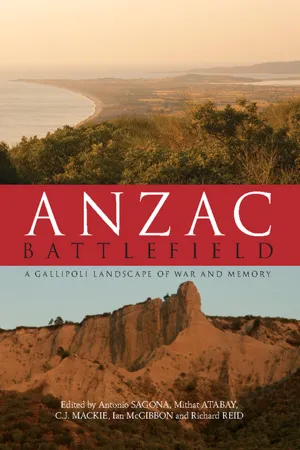 eBook - PDF
Anzac Battlefield
A Gallipoli Landscape of War and Memory
- Antonio Sagona, Mithat Atabay, C. J. Mackie, Ian McGibbon, Richard Reid(Authors)
- 2016(Publication Date)
- Cambridge University Press(Publisher)
Of the campaigns fought in that battle, which took the lives of more than 125 000 Turkish and Allied soldiers, three are Boundary and divide The antiquity of the Dardanelles C.J. MACKIE, MITHAT ATABAY, REYHAN KÖRPE AND ANTONIO SAGONA Boundary and divide 5 deeply embedded in the psyche of the contemporary nation states of Turkey, Australia and New Zealand: 18 March, when the Ottoman fortresses and batteries successfully fought off the second attempt by the British Royal Navy and the French Navy to break through the Straits; 25 April, the dawn landing of the Australian and New Zealand Army Corps (ANZAC), which launched the land offensive; and 10 August, when the Ottoman forces drove the Allied soldiers back down the slopes of Chunuk Bair, thus effectively thwarting their August offensive. Yet the Gallipoli Peninsula, encompassing an area of 33 000ha (330km 2 ), has a much deeper history, stretching back to remote prehistory. Washed by the waters of the Aegean to the west, and defined by the Dardanelles to the east, this thin slice of land (5km wide at its narrowest point) has acted as a bridgehead, a barrier and a meeting place for millennia. 1 This predicament of ‘bridge and barrier’, together with the human impulse to control the Straits – a 70km natural channel that connects the Aegean Sea and the Sea of Marmara, and thence Istanbul – have defined its dramatic and turbulent history, even in antiquity. Yet, despite this, there is little consciousness of the peninsula’s rich cultural history among many Australians. A mature understand- ing of Gallipoli in 1915 requires some awareness of the significance of the peninsula in a broader cultural and historical context. There are many detailed histories of the Dardanelles region through time, and this introduction will not try to emulate them. 2 But we can at least focus briefly on some of the moments in time that have caught the imagination of poets and historians and myth-makers. eBook - ePub
- James Brian McNabb(Author)
- 2017(Publication Date)
- Praeger(Publisher)
Successful operations in the Dardanelles and into the Black Sea also offered the potential for convincing neutral Balkan states such as Bulgaria and Romania in joining the Triple Entente. With several promising associated benefits from a Dardanelles operation, the one potential and perhaps most strategically decisive outcome in terms of the war itself in “forcing the Straits” during a successful naval campaign operations would be in taking control of Istanbul and forcing the Ottomans out of the war. Even if that eventuality did not lead immediately to the end of hostilities, it would position the Allies to resupply Russia and control Anatolia, the Middle East, and the Black Sea. Given success in a Dardanelles Campaign, in addition to forcing Turkey from the war would also provide substantial leverage in any future war termination negotiations with the remaining Central Powers.Thus, Churchill and his allies at the British Admiralty, including those within the government, argued that while the upside of such a campaign would bring significant strategic benefits, the downside effects would be minimal, as the campaign planners would use older warships and, should they not meet with success in “forcing the Straits” they would indeed, given British and French control of the Mediterranean, be in a position to simply withdraw. The ships, in the worst scenario where many may be lost, were simply not critical for British naval operations. From Churchill’s perspective, given the enormous level of benefits success would generate, and contrasted with the limited deleterious effects of failure, the decision to conduct the Dardanelles naval campaign at the beginning of 1915 was seen as prudent and rational as it was bold.However, while the basic logic of the proposition was sensible enough, empirical reality in conditions of war soon served in altering the argument’s original soundness. A study in Britain in 1907 had discussed the various difficulties in “forcing the Straits” as any naval operation would have to be supported by a ground force in order to consolidate any gains that a naval bombardment might bring. In short, the forts, the guns, and the firing positions would have to be placed under Allied control, lest Ottoman and German troop reinforcements and artillery be sent in as replacements. Additionally, mobile artillery and mortars were proving to be difficult in targeting for naval bombardment, and their effect on naval operations had proven worrisome. Given this, ground units would be useful in neutralizing the threat, both to the fleet and to merchant shipping. Further still, the presence of land forces would be necessary in obtaining needed supplies from the shore, without which the naval force would have to withdraw to home waters or, at the minimum, friendly waters in order to refuel and restock. eBook - ePub
The Last Century of Sea Power, Volume 1
From Port Arthur to Chanak, 1894–1922
- H. P. Willmott(Author)
- 2009(Publication Date)
- Indiana University Press(Publisher)
The Dardanelles venture emerged after some two decades of unprecedented study of history within the Royal Navy, but much of that effort was effort wasted because of the inadequacy of its scholarship and the mendaciousness of the navy’s purpose. The baleful influence of such individuals as Sir Julian Corbett (1854–1922) and Richmond was critically important, specifically in seeking to explain British operational success and failure in terms of personality at the expense of any real examination of the problems that attended joint operations and by their espousal of various myths that surrounded civil-military relations with respect to certain specific episodes (and not just in 1739–1740). The Dardanelles initiative came after the navy had lost the critical “roles-and-mission” argument with the army but when the navy nevertheless remained committed to a maritime as opposed to a continental strategy. After the Committee of Imperial Defence meetings of July 1912 the navy still aspired to a major role in the Mediterranean in no small reason because of its own institutional requirements. The real truth of the situation was that British history is largely a story of trying to run the maritime and continental in tandem and as complements to one another, not as either/or. The point of present-day relevance, of course, is that the Dardanelles venture must be seen against a background of a decade of furious argument between the services, and a most deliberate manipulation of historical argument and peddling of self-justifying mythology by the navy in its attempt to secure its own perceived raison d’être.As it was, the Dardanelles operation serves notice of the truth of one Nelsonian dictum: only a fool attacks forts. There were forts on Gallipoli, but the real point is that the peninsula itself was a fortress, and the campaign showed the danger of attacking so powerfully invested a defensive position. With this fact comes another, that fleets are at their most vulnerable when operating in direct support of the army ashore. The most obvious danger is when armies are moving backward, in retreat, but perhaps even more dangerous is the position that is seldom recognized—when armies are not moving at all, witness the Guadalcanal campaign. And it is perhaps recalling that at Gallipoli there was no air problem with which to contend.In seeking to explain the Dardanelles operation in terms of present-day doctrine one would note four matters. The preliminary attacks—by the navy either alone or in conjunction with minor landing operations—were anticipatory, and most certainly had they been pushed through to a successful conclusion would have taken the British within the Turkish decision-making cycle. These attacks were also directed against weakness: the general unpreparedness of Turkey for war and specifically the unpreparedness of Turkish forces and positions on the Gallipoli peninsula in the period November 1914–March 1915 bordered upon the chronic, and were much more severe than could have been anticipated on the part of a major power. The fragmented operations of this period were the very opposite of what modern doctrine demands, and the fluid battle, characterized by devolved command, initiative, and the avoidance of synchronization and set-piece action, was perhaps observed though not exactly in the manner that was intended but on account of the breakdown of command and the pattern imposed by a hostile terrain. In reality, the British offensive at the Dardanelles was to founder for a number of self-evident and well known reasons that need no elaboration at this point. The fact remains that even if the plan of campaign had been faultless in concept and detail, if all the means needed to carry the operation through to success had been present and if everything had unfolded quite contrary to what von Moltke believed, there is no good reason to believe that the Allied effort would have been successful. No longer available |Learn more
- Various(Author)
- 2015(Publication Date)
- Otbebookpublishing(Publisher)
Halil Bey's prediction of the reestablishment of communications with the Central Powers was not long in being fulfilled. Within two weeks the Germano-Austrian drive from the Danube had penetrated to Bulgarian territory opposite the Rumanian frontier, and within another fortnight it had linked up with the Bulgarian columns in the south operating against Nish. For all practical purposes Serbia was in their hands, and the powerful economic group heralded by Halil Bey was in the process of completion.There is no doubt that the forging of this strong link with Berlin was one of the main considerations in inducing the Allies to abandon the Dardanelles Campaign. There were two immensely important reasons why this should have radically changed conditions in the Gallipoli Peninsula.In the first place, there was the question of supplies. There are three ways in which modern wars on a big scale can be won: by direct military pressure, by financial pressure, or by economic stress. In the case of the Allies' offensive against Turkey, after the first disappointment of the naval military operations, it was confidently predicted that economic stress would accomplish what military pressure had failed to do. It was known that Turkey had but meager means of making good the enormous expenditure of heavy-gun ammunition necessary in modern battles. Indeed, as early as the big naval attempt to force the Dardanelles, rumors were heard of a shortage of ammunition in the Turkish forts, and in this connection it is interesting to print a report that gained currency at the time of the abandonment of the Anzac and Suvla Bay bases.Had the allied fleet returned to its attack upon the Dardanelles batteries on the day following the great bombardment of March 19, 1915, the waterway to Constantinople would surely have been forced, in the opinion of several artillery officers of the defense works near Tchanak-Kalessi expressed to the Associated Press correspondent, who had just reached Vienna.One of the principal batteries, it appeared, had for three of its large caliber guns just four armor-piercing shells each when night ended the tremendous efforts of the British and French fleet.For the fourth gun five shells were left, making for the entire battery a total of seventeen projectiles of the sort which the aggressors had to fear. What this meant is best understood when it is considered that the battery in question was the one which had to be given the widest berth by the allied fleet.
- Allen L. Churchill, Francis Trevelyan Miller(Authors)
- 2016(Publication Date)
- Last Post Press(Publisher)
Halil Bey’s prediction of the reestablishment of communications with the Central Powers was not long in being fulfilled. Within two weeks the Germano-Austrian drive from the Danube had penetrated to Bulgarian territory opposite the Rumanian frontier, and within another fortnight it had linked up with the Bulgarian columns in the south operating against Nish. For all practical purposes Serbia was in their hands, and the powerful economic group heralded by Halil Bey was in the process of completion.There is no doubt that the forging of this strong link with Berlin was one of the main considerations in inducing the Allies to abandon the Dardanelles Campaign. There were two immensely important reasons why this should have radically changed conditions in the Gallipoli Peninsula.In the first place, there was the question of supplies. There are three ways in which modern wars on a big scale can be won: by direct military pressure, by financial pressure, or by economic stress. In the case of the Allies’ offensive against Turkey, after the first disappointment of the naval military operations, it was confidently predicted that economic stress would accomplish what military pressure had failed to do. It was known that Turkey had but meager means of making good the enormous expenditure of heavy-gun ammunition necessary in modern battles. Indeed, as early as the big naval attempt to force the Dardanelles, rumors were heard of a shortage of ammunition in the Turkish forts, and in this connection it is interesting to print a report that gained currency at the time of the abandonment of the Anzac and Suvla Bay bases.Had the allied fleet returned to its attack upon the Dardanelles batteries on the day following the great bombardment of March 19, 1915, the waterway to Constantinople would surely have been forced, in the opinion of several artillery officers of the defense works near Tchanak-Kalessi expressed to the Associated Press correspondent, who had just reached Vienna.One of the principal batteries, it appeared, had for three of its large caliber guns just four armor-piercing shells each when night ended the tremendous efforts of the British and French fleet.For the fourth gun five shells were left, making for the entire battery a total of seventeen projectiles of the sort which the aggressors had to fear. What this meant is best understood when it is considered that the battery in question was the one which had to be given the widest berth by the allied fleet. eBook - ePub
Defending Gallipoli
The Turkish Story
- Harvey Broadbent(Author)
- 2015(Publication Date)
- Melbourne University Press Digital(Publisher)
1
DRIFTING TO THE DARDANELLES
I n November 1914 the First World War turned truly global. Great Britain, France and Russia had been fighting Germany and Austria-Hungary on the Western and Eastern fronts, respectively, since August. On 2 November 1914, as the convoy carrying the Australian Imperial Force (AIF) sent to join them was just one day out from Albany on the Indian Ocean, Russia declared war on the Turkish Ottoman Empire. The Ottoman Sultan and Caliph of Islam, Mehmed V, reciprocated by declaring war on Russia and her allies on 11 November and on 13 November, pronouncing it a jihad for all Moslems. Its text ran in part:When the enemy attacks Islam, and attempts to invade and raid the country of Islam, and capture the people of Islam, if the Sultan of Islam orders mobilization for a war, should it not be an obligation for all the Muslims, young and old, to be ready to fight, as infantry and cavalry, with all their assets and lives pursuant to the Verse of the Koran which says, ‘Set off, light and heavy, and fight on the path of God with your assets and lives. If you only knew that this is more beneficial for you?’The answer: It would be ‘God knows best’, written by Hayri Bin Avnî El-Ürgûbî.Response in Moslem countries such as Egypt, India, Yemen and Saudi-Arabia was meagre, but the crumbling Ottoman Empire found itself committed to war on four fronts—Eastern Anatolia and the Caucasus, Iraq, Syria and Palestine and the Dardanelles Strait. It was the defence of the latter, with its sea route to the Ottoman capital, Istanbul (Constantinople), that was to lead to the Gallipoli Campaign and the Ottoman ultimate victory there in 1915.The Ottoman Empire
The origins of the six hundred-year-old Turkish Ottoman Empire, one of the world’s greatest-known empires, dated back to the early fourteenth century. It led Islam with its Sultan as Caliph from 1516, and as the new guardian of the holy places of Mecca and Medina. The empire reached its zenith under Suleyman the Magnificent (1520–66) and his immediate successors. A slow decline over two hundred years, as territory was lost, followed. By the 1890s the Ottomans, endeavouring to modernise and threatened by Russian expansionist ambitions, sought German assistance. The newly powerful, unified and ambitious Germany emerged and strutted upon the Ottoman stage. Major Colmar von der Goltz headed a German military mission to the Empire in 1885, replacing British and French contractors. Then in 1889 and 1898, Kaiser Wilhelm II visited Istanbul to strengthen financial and military relations. eBook - ePub
The Naval War in the Mediterranean
1914-1918
- Paul G. Halpern(Author)
- 2015(Publication Date)
- Routledge(Publisher)
79 Any serious Russian action therefore involved a big if – that the Allies would succeed at the Dardanelles. The Russian navy, however important and successful its struggle for command of the Black Sea, would have, at best, only indirect effects on the Mediterranean.The Dardanelles were not the only Allied concern in the Mediterranean. The Suez Canal was an obvious objective for the Turkish army once Turkey entered the war and its capture would have had enormous consequences for the Allies. The long-anticipated Turkish offensive came at the end of January. The defence of the canal was largely in the hands of Indian troops assisted by a handful of British and French warships under Vice-Admiral Peirse. Fortunately for the Allies the Turkish attack, made with inadequate forces and preparation, was never close to success. After a few days’ fighting in early February the Turkish forces were in full retreat and by the 11th the canal had been reopened for night traffic.80There were various British plans for naval operations against the seaward flank of the Turkish army but these ran into obstacles that were as much political as military. The French ambassador in London objected to one Admiralty proposal to land 5,000 men at Jaffa to seize leading Turkish authorities and German representatives as hostages on the obvious grounds that, in addition to being of little military value, it would expose the numerous French nationals and protégés in Syria to reprisals.81 Captain Richmond was another frequent advocate of harrying the Syrian coast to keep Turkish garrisons employed and favoured a landing in Syria together with the attack on the Dardanelles. He wrote to Hankey after the Turks had retreated from the canal and ‘implored him to try & get someone to seize the psychological moment & sling the Egyptian troops into Alexandretta as well as feints and raids at other ports from Aleppo to Acre’. Richmond complained, ‘It is damnable to see everyone sitting doing nothing’.82 Fisher also favoured the capture of Alexandretta because of its value as an outlet for the Mesopotamian oil fields.83 eBook - ePub
- C.R.M.F. Cruttwell(Author)
- 2019(Publication Date)
- Academy Chicago Publishers(Publisher)
From the junction at Aleppo in northern Syria ran two lines, one east, one south. The former was feeling its way across the desert to Baghdad. A gap of some 500 miles separated it from the Mesopotamian limb, which was being slowly extended up the Tigris. One branch of the latter ended at Nablus, in Palestine north of Jerusalem; the other crawled precariously as a single line down the deserts of Arabia to the holy places of Medina and Mecca. It is quite evident that Turkey was scarcely knit together at all in a modern sense. No abundance of good roads compensated for the absence of railways; no abundance of motor vehicles was available for such roads as did exist. One of the principal theatres of war, the Caucasus, was actually 500 miles from Konia, its nearest rail-head. Four campaigns were in progress against the Turk in 1915; one of the Russians in the Caucasus, three of the British in Egypt, Mesopotamia, and Gallipoli. The first three of these were to continue with varying intensity until the end of the war; the last, the most dramatic and potentially decisive, was alone complete from beginning to end within the year. It will therefore be first taken into consideration here. II The Dardanelles Campaign, as we have seen, developed out of a request by the Russians that we should help their hard-beset forces in the Caucasus by a diversion (January 2,1915). At that very moment the need had passed, for thewidelyscattered Turkish forces were being overthrown in the snowy mountains at Sari Kamish. Yet out of this grain of mustard seed developed a tall tree. As the British Ministers could not make up their minds whether they would or would not have troops available, it was decided to try what could be effected by naval action alone. The inducement was twofold. First the Admiralty had at its disposal a large number of battleships and cruisers often years of age and upwards eBook - PDF
Roads to Glory
Late Imperial Russia and the Turkish Straits
- Ronald P. Bobroff(Author)
- 2006(Publication Date)
- I.B. Tauris(Publisher)
104 For the next few weeks, Sazonov indicated that Russia could allow the participation of Greek forces at the Dardanelles, but they could not remain there permanently. He said that Grey’s suggestion that compensation would be found for Greece along the coast of Asia Minor around Smyrna was for Great Britain and France to decide, but the Straits and Constantinople were off-limits. 105 Once the allied fleet began operations off of the Dardanelles, the Russians decided to demand more extensive and concrete concessions and to refuse Greece any participation in the attack, which in late February and early March seemed very likely to succeed. Regardless of a Greek assurance in January recognizing Russia’s predominant interest in the region, by late February, A. P. Demidov, the Russian ambassador at Athens, was reporting that the Greeks were captivated by the allied attempt to break through the Dardanelles and saw participation as a means to fulfill their own historic aspirations. 106 This last point was exactly what worried Sazonov, and he replied to Demidov that “under no circumstances can we allow Greek forces to participate in the attack of allied forces upon Constantinople.” His attitude had sharpened in parallel with the escalation of Russian demands and frustrated his allies. Grey insisted to Benckendorff on 4 March that Greek forces could play an important role in naval operations against Turkey and reminded the ambassador of the great effect a victory at the Dardanelles could have on the rest of the neutral states. 107 Delcassé, claiming ignorance of British opinion, stressed on 4 March that Greece could contribute to the overall war effort and should not be discouraged. 108 On 6 March, better informed, he agreed that Greek help in the Dardanelles Campaign would be useful and should not be refused. eBook - ePub
- J. H. (John Henry) Patterson(Author)
- 2012(Publication Date)
- Perlego(Publisher)
Of course, whoever is to blame for the Bedlamite policy of the first disastrous attempts by the Navy alone bears a heavy responsibility. Beyond knocking the entrance forts to pieces, all that this premature attack by the Fleet effected was to give the Turks ample warning of our intentions, of which they took full advantage by making the Gallipoli Peninsula an almost impregnable fortress and the Dardanelles a network of mines.But even this grave initial blunder could have been rectified, if only sound strategy had been adopted in the combined naval and military attack on the Dardanelles.The problem before the strategists was, of course, to get through to Constantinople with the Fleet, and this could only be done by forcing the Narrows, a strip of the Dardanelles heavily fortified and only a mile wide. It was therefore necessary to reduce the forts guarding the Narrows, and with an army to hold the heights on Gallipoli dominating the Dardanelles, so as to ensure the safety of the Fleet.
Index pages curate the most relevant extracts from our library of academic textbooks. They’ve been created using an in-house natural language model (NLM), each adding context and meaning to key research topics.

