History

Operation Torch
Operation Torch was the code name for the Allied invasion of North Africa during World War II. Launched on November 8, 1942, it marked the first major offensive by the Western Allies against the Axis powers. The operation aimed to secure the region and create a second front against the Axis forces.
Written by Perlego with AI-assistance
Related key terms
1 of 5
10 Key excerpts on "Operation Torch"
 eBook - PDF
War of Words
Britain, France and Discourses of Empire during the Second World War
- Rachel Chin(Author)
- 2022(Publication Date)
- Cambridge University Press(Publisher)
172 6 Operation Torch American Influence and the Battle for French North Africa 1 See, for instance, Arthur Layton Funk, The Politics of Torch: The Allied Landings and the Algiers Putsch 1942 (Lawrence, Kansas: The University Press of Kansas, 1974). Keith Sainsbury, The North African Landings 1942: A Strategic Decision (London: Davis- Poynter, 1976). Peter Mangold, Britain and the Defeated French: From Occupation to Liberation, 1940–1944 (London: I. B. Tauris, 2012), Chapter 11. In the early morning hours of 8 November 1942, Anglo-American forces moved into action. Their goal was to consolidate Allied power in French North Africa, which remained loyal to the Vichy government. Opera- tion Torch was a turning point in the Allied struggle. For the first time, American forces took the lead in a military operation. But American predominance was not solely a question of material resources. It was also a strategy designed to persuade Vichy troops to decamp to the Allies. American President Franklin Delano Roosevelt and the Combined Chiefs of Staff (CCS) hoped that by promoting Torch as an opportu- nity for Franco-American cooperation, they would avoid the resistance associated with British ventures and notions of Franco-British rivalry. America’s entry into the war in December 1941 gave the Allies a much- needed injection of men and materials. It also shifted the wartime nar- rative. Some of these narratives, such as the promise of victory, held firm. Others, including expectations for post-war reconstruction and the future of empire began to change. Previous studies have analysed in great detail the broader political, military and logistical aspects of these opera- tions. 1 However, Torch was much more than a military endeavour. It showcased the dominance of American power. This shift in the balance of power also altered (in subtle and more obvious ways) the rhetoric of the conflict. eBook - ePub
Patton's Tactician
The War Diary of Lieutenant General Geoffrey Keyes
- Geoffrey Keyes, James W. HolsingerJr., James W. Holsinger Jr.(Authors)
- 2024(Publication Date)
- The University Press of Kentucky(Publisher)
Major Generals Dwight D. Eisenhower and Mark Clark arrived in Great Britain at the end of June 1942. On June 25, General Eisenhower assumed command of the European Theater of Operations US Army (ETOUSA).5 The plan for Operation Torch consisted of Allied amphibious landings stretching from Casablanca, Morocco, to Algiers, Algeria. The attacking force comprised approximately 65,000 men divided into three groups. The Western Task Force of American troops, under the command of Major General George S. Patton Jr., with Major General Geoffrey Keyes as his deputy,6 landed in and around Casablanca and included the 3rd and 9th Infantry Divisions, the 2nd Armored Division, and various armored and support units. The Center Task Force, consisting of the US II Corps, commanded by Major General Lloyd Fredendall, landed at Oran, Algeria, and was composed of the 1st Infantry Division, Combat Command B, 1st Armored Division, 1st Ranger Battalion, and one battalion of the 509th Parachute Infantry Regiment. The Eastern Task Force, with the American 34th Infantry Division and the British 78th Division, under the command of Major General Charles Ryder, landed at Algiers.7 The Eastern Task Force was originally commanded by the Americans due to the animosity between Great Britain and Vichy France that resulted from the destruction of the French naval forces in harbor at Mers-el-Kebir on July 3, 1940, in order to keep the fleet from falling into the hands of the Germans.8 Once the landing was complete, command of the Allied force passed to the British under General Kenneth Anderson and was designated the British First Army.A major issue facing the Americans and British in effecting Operation Torch concerned the reaction of the Vichy French forces garrisoning French North Africa. Since the United States maintained diplomatic relations with Vichy, it was hoped that the French would not resist the Allied landings. “In the diplomatic dance that ensued, the Americans stumbled repeatedly. Their first effort was to convince the French that Torch was an American operation even though nearly half the troops and virtually all the ships were British, although the overall commander was American. Vichy refused, and an effort was made to find an amenable French leader who could induce the French forces not to oppose the landings. Eventually, a Nazi sympathizer, Admiral François Darlan, at last arranged a general cease-fire, bringing opposition to the landings to a halt. eBook - ePub
More Lives Than a Ship's Cat
The Most Highly Decorated Midshipman 1939–1945
- G A (Mick) Stoke, Jeremy Stoke, G.A. Stoke(Authors)
- 2022(Publication Date)
- Pen and Sword Maritime(Publisher)
Chapter 10
Operation Torch, the Retaking of North Africa
Decorated again
A dmiral Cunningham was in overall command of the naval side of Operation Torch but had only recently returned from his posting in Washington, and the detailed naval plan had not yet been fully written. So it was not until the middle of October 1942 that he was able to really get down to the detailed arrangements for the Allied landings in North Africa. Time was very short. He wrote:I augmented my team with a fourth, from my Mediterranean staff, Commander Power,* who had written many a plan for us and was a master of clear and concise exposition. Our Orders involved the sailing, routing, exact timing and arrival at their respective landing places inside the Mediterranean at Oran and Algiers of two advance convoys of some forty-five ships, to be followed by a main body of more than two hundred vessels with a hundred escorts carrying some 38,500 British and American troops.Over and above this, the orders laid down the movements and duties of all the naval forces inside the Mediterranean, which, apart from more than a hundred vessels at Gibraltar, meant another one hundred and seventy-six vessels of all types from battleships and aircraft carriers to submarines, sloops, corvettes and motor launches. To ensure the passage of more than four hundred vessels through the eight-mile wide Gibraltar Straits undetected, within a limited period of time, was the problem upon which all else depended.Additionally, the French Navy manned most of the coastal defences in North Africa. It was highly important that the harbour installations and shipping in the ports of Algiers and Oran should not be destroyed before our forces gained control of them.In view of the huge number of small craft involved, Cunningham applied for and secured the services of Captain Geoffrey Oliver, whom he had known for years and in whose outstanding ability and personality he had good reason to have complete confidence. Oliver arrived in Gibraltar promoted to Commodore. eBook - ePub
True to My God and Country
How Jewish Americans Fought in World War II
- Françoise S. Ouzan(Author)
- 2024(Publication Date)
- Indiana University Press(Publisher)
In his memoirs, General Eisenhower explained that it was of the utmost importance that the landings succeed in the capital of Algeria, Algiers. To secure victory, the Allied landings must not meet with any harsh opposition. In his papers, Eisenhower underlined the importance of the French Resistance in standing against the Vichy regime established in French North Africa. 1 Resistance fighters cooperated with the Allied forces in what came to be known as Operation Torch in November 1942, a secret operation that began on the night of November 7 to November 8 under the American general’s command. An expeditionary corps of one hundred thousand men landed on the French North African coast at Casablanca, Algiers, and Oran. Map 5.1 Operation Torch landings in North Africa, November 8, 1942, and the pursuit to Tunisia (November 1942–February 1943). Courtesy of United States Military Academy Department of History. Public domain. General Eisenhower recorded the main goal of the campaign in his memoir: “The minimum objective of the North African invasion was to seize the main ports between Casablanca and Algiers, denying their use to the Axis as bases for submarines, and from them to operate eastward toward the British desert forces.” 2 As early as autumn 1940, a paramilitary organization was established in Algiers under the guise of a sports club. Led by a twenty-year-old Jewish medical student named José Aboulker, non-Jewish officers joined the group and were involved in establishing contact with Anglo-American military command. 3 To what extent did Jewish members of resistance groups in Algeria participate as Jews? Most Jews in Algeria cherished French patriotic values out of gratitude to France, which had granted their ancestors French citizenship in 1870 eBook - PDF
- D. Pike(Author)
- 2008(Publication Date)
- Palgrave Macmillan(Publisher)
84 7 Fortunes Reversed: Operation Torch and Italian Capitulation (November 1942–September 1943) The Anglo-American landings on 8 November 1942 at various points in French North Africa (French Morocco and Algeria) came to the Axis as a total surprise. Maintaining the secrecy of this Operation Torch was a remarkable achievement of Allied security, 1 especially in light of the preparations that were visible in Gibraltar, but German intelligence in Madrid clearly failed in its task of interception. Charles Halstead, work- ing in the US archives, found that Count Jordana was sufficiently aware of the plan in order to do everything he could to prevent it from being carried out. On one occasion the new Spanish foreign minister ( Jordana) bluffed the American ambassador (Weddell) to the point of hinting (as Serrano Súñer had previously done to the same ambassador) that Spain would declare war. 2 To the French ambassador, François Piétri, Jordana said that Spain expected Vichy to resist the Allies, and that if Vichy failed to do so Spain would consider the Spanish zone of Morocco to be under threat. 3 Admiral François Darlan, who hap- pened to be in Algiers at that moment, indeed ordered French forces to resist the Allies, and his naval forces (if not his army and air force units) obeyed the order. The action was brief but fierce, and the land- ings resulted in Vichy breaking its diplomatic relations with the United States. In the wake of Operation Torch, a situation report sent to Berlin on 10 November 1942 by the German naval attaché in Madrid described the prevailing mood in Spain as ‘very nervous’. There was good reason for this. Thanks to Gibraltar, British and American troops were now present in number on the Iberian Peninsula, and Grand Admiral Raeder warned the Führer on 19 November that control of the Peninsula offered attractive rewards to the Allies, who could thus eBook - PDF
The War in North Africa, 1940-1943
A Selected Bibliography
- Colin F. Baxter(Author)
- 1996(Publication Date)
- Greenwood(Publisher)
No French soldier had paid the sUghest attention to General Henri Giraud, the anti-Vichy general whom the Allies had brought to North Africa for the purpose of rallying his countrymen to the Allied cause. On November 10, Vichy Admiral Jean Darlan finally ordered a cease-fire. Writer of popular miUtary history, William B. Breuer authored the 1986 account, Operation Torch: The Allied Gamble to Invade North Africa [59]. Highly suitable for general readership, the book is a compelling, journalistic narrative of the Allied invasion that offers a wealth of detail; Other sources on Torch include Blumenson's, The Patton Papters: 1940-1945 [48]; Edward Ellsberg, No Banners, No Bugles [146]; Monroe MacCloskey, Torch and the Twelth Air Force [303]; Brahim Haroun doctoral dissertation, "How the Anglo-American invasion of North Africa in November 1942 was Prepared and Realised," [203]; and Jack Coggins's, The Campaign for North Africa [103], which contains maps, diagrams, and drawings of the weapons and equipment used by both sides in Africa. The story of American correspondents present at the Torch landings is found in M.L. Stein's work, Under Fire: The Story ofAmerican War Correspondents [442]. THE DARLAN AFFAIR Hopes for Torch were only partly realized. The AlUes had anticipated that the French in North Africa would quickly turn from Vichy and join the Allied effort against the Axis. Roosevelt's optimism is revealed in Churchill and Roosevelt: The Complete Correspondence [262] edited by Warren F. Kimball. The President wro to Churchill in September: "An American expedition led in all three phases by American officers wiU meet little resistancefromthe French Army in Africa." The American Consul General in Algiers, Robert Murphy, played a key role in America's first offensive in World War II. An indispensable personal account, Murphy's memoir, A Diplomat Among Warriors [347], is candid and entertaining. eBook - ePub
U-Boats in the Mediterranean
1941–1944
- Lawrence Paterson(Author)
- 2019(Publication Date)
- Skyhorse(Publisher)
Afrika Korps, the cowing of Spain to prevent it being persuaded to enter the war on the Axis side, to provoke antagonism between Vichy France and Germany as German forces were predicted to invade Vichy, to expose Italy to the threat of direct attack from an Allied-controlled North Africa and, of course, securing of Allied convoy routes across the Mediterranean. Both the military and diplomatic groundwork for ‘Torch’ had taken months of careful planning, as United States and British forces were working in true cooperation against French units of indeterminate loyalties. Stalin in Moscow also had to be convinced of its rationale, pressing as he was for a more direct assault against German-held Europe and the opening of a ‘Second Front’ to take pressure off the Soviet Union which was soon to be embroiled in the rubble of Stalingrad.In overall command was the relatively inexperienced General Dwight D Eisenhower, though what he lacked in combat experience he more than compensated for with acute political acumen, vital for the often rocky relationships between various Allied nations. During April 1942 Admiral Andrew Cunningham had been appointed to head the Royal Naval Staff Mission to Washington and proved an ideal opposite number to the equally blunt American, Admiral Ernest King. It was therefore Cunningham who was given command of the Allied Expeditionary Force for the invasion of North Africa and he would direct the ‘Torch’ landings from his headquarters in Gibraltar, beginning a long and successful friendship with Eisenhower.German forces had unwittingly already bumped into the large convoy traffic assembled for Operation ‘Torch’, both U-boats and Condor reconnaissance aircraft sighting large groups of shipping at sea. However, although they regarded an attack in the Mediterranean as highly possible, they had no idea where the blow might actually fall. Hitler believed that the Allies would not risk inciting anger in France by attacking Vichy French possessions in North Africa, and therefore reasoned the most logical area was near Tripoli or Benghazi in Libya, attacking at Rommel’s rear as the ‘Desert Fox’ retreated from El Alamein. Therefore on 4 November Dönitz was asked by OKM to redirect seven Atlantic Type VIICs into the Mediterranean. Dönitz in turn hurriedly formed the ‘Delphin’ group from six boats already at sea – U-407, U-617, U-259, U-596, U-755 and U-380 – reinforced by U-595 out of Brest.1 eBook - ePub
Spitfire Saga
Rodney Scrase DFC
- Angus Mansfield(Author)
- 2019(Publication Date)
- The History Press(Publisher)
CHAPTER SIX
OPERATION TORCH – NORTH AFRICA, 72 SQUADRON
Very soon after the US had entered the war, Winston Churchill met President Roosevelt in Washington in December 1941. Churchill’s plans were to continue to aid Russia, to drive the Axis forces out of Cyrenaica and Libya, and to invade Morocco, Algeria and Tunisia.This would require a combined Anglo-American occupation of French North Africa and enable the Allies to clear the whole of the African coast of the Mediterranean and give the Allies control of the coast from Tunis to Dakar and in due course open up the Mediterranean Sea from Gibraltar to Alexandria. At the planning stage there were differences of opinion as to where and when the landings would take place but eventually it was decided to make the landings on 8 November. At Casablanca on Morocco’s Atlantic coast 24,000 American troops were put ashore and at Oran in Western Algeria a further 18,000 American troops were landed. The landings in Algiers, a little further east and closer to the Axis forces, were mainly British and another 18,000 troops were put ashore. The landings in Morocco were the responsibility of the US Navy while those at Oran and Algiers were the responsibility of the Royal Navy. In total the Allied Forces totalled parts of seven divisions, five American and two British, and came under the overall command of an American commander, General Dwight D. Eisenhower.The air plan for Operation Torch as it became known included two separate geographical commands, the Eastern Air Command (EAC) and the Western Air Command (WAC) both of which would be directly responsible to the Supreme Commander. The EAC was made up almost entirely of RAF squadrons and the WAC was made up almost entirely of the US XII Air Force, some of whom had flown with the RAF in Britain after the US had entered the war the previous December. In the EAC and under the command of 242 Group, there would be several RAF wings.322 WING – COMMANDED BY GP CAPT C. APPLETON AND LED BY WING CDR PETE ‘DUTCH’ HUGO
 eBook - ePub
Operations in North Africa and the Middle East, 1942–1944
El Alamein, Tunisia, Algeria and Operation Torch
- John Grehan, Martin Mace(Authors)
- 2015(Publication Date)
- Pen & Sword Military(Publisher)
2ADMIRAL SIR ANDREW CUNNINGHAM’S DESPATCH ON OPERATION TORCH, THE LANDINGS IN NORTH AFRICA 22 OCTOBER TO 17 NOVEMBER 1942THE LANDINGS IN NORTH AFRICAThe following Despatch was submitted to the Commander-in-Chief, Allied Forces on the 30th March, 1943, by Admiral of the Fleet Sir ANDREW B. CUNNINGHAM, G.C.B., D.S.O., Commander-in-Chief, Mediterranean.Office of the Commander-in-Chief,Mediterranean,Algiers.30th March, 1943.OPERATION “TORCH” – REPORT OF PROCEEDINGS.I have the honour to render the following report on Operation “Torch” covering the period 22nd October to 17th November, 1942, from the sailings of the assault convoy from the United Kingdom until the occupation of Bone. This report deals mainly with the British naval assaults, since the naval operations of the Western Naval Task Force have already been reported in the Commander, Task Force 34’s letter of 28th November, 1942 to the Commander-in-Chief, United States Atlantic Fleet.12. The early stages of the operation prior to D day were remarkable for lack of incident. This was indeed fortunate since, in the course of this vast and complex movement, delays caused by casualties or stress of weather would have rendered the timely delivery of the assaults improbable.3. The movement of the assault convoys and Force “H”2 through the Straits of Gibraltar on the 5th/6th November and the continuous entry and departure of all classes of ships for fuelling placed a heavy strain on the resources and organisation of Gibraltar. The manner in which this strain was withstood reflects credit on the Vice-Admiral, Gibraltar and Commodore Superintendent, Gibraltar and their staffs.4. It is also a tribute to the skill and seamanship of individual Commanding Officers that this continuous flow of movements and berthing in a congested harbour and anchorage in the dark was accomplished with but a single minor collision.5. The only major incident inside the Mediterranean before the assaults was the torpedoing of United States Ship THOMAS STONE at 0535 on 7th November. A notably courageous decision was taken by Captain O.R. Bennehoff, United States Navy to send on his escort and boats to the assault, leaving his ship defenceless; tenacity and seamanship was displayed by His Majesty’s Ship WISH-ART (Commander H.G. Scott, Royal Navy) in towing United States Ship THOMAS STONE to Algiers.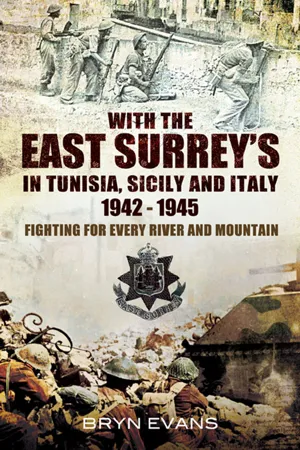 eBook - ePub
With the East Surrey's in Tunisia, Sicily and Italy, 1942–1945
Fighting for Every River and Mountain
- Bryn Evans(Author)
- 2012(Publication Date)
- Pen & Sword Military(Publisher)
In the Allies’ first thrust into Tunisia in the vicinity of Bizerta and Tunis, an assault by paratroopers and seaborne commandos, sought the shock of surprise to gain control of the ports and airfields. Without sufficient numbers, little or no armour or air support, it came to naught.At the same time Operation Torch gambled on a land spearhead, that in the main comprised only 11 and 36 Brigades, some light tank units of Blade Force, and an American field artillery battalion. The 1st Surreys, and two other battalions, 2nd Lancashire Fusiliers and 5th Northamptons, made up 11 Brigade, part of the 78th, or Battleaxe, Division of the British First Army. When writing the Surreys’ official history, David Scott Daniell described 78th Division as the British Army’s cutting edge to rush forward to occupy Tunis.5The strategy of Operation Torch was first to quickly gain control of the main port of Tunis. The decision not to land at Tunis itself, or even the closest Algerian port of Bone, was driven by a fear of German air attack. Luftwaffe bombers based in Sicily could easily reach both Bone and Tunis with fighter escorts, whereas the British and American air forces could offer little support to any landings there. Even after air bases were established at Algiers, Allied aircraft would be at the extremity of their range to reach Tunis, which would allow little time over the battlefield to support ground forces.At the moment of the landings, there were no garrison troops there in Tunis, and the German and Italian High Commands were taken completely by surprise. But Axis reaction was swift, and effectively assisted by the conduct of Admiral Esteva, the French Resident-General. The first German troops arrived by air at El Aouaina airfield, near Tunis, on 9 November, only a day after the Allied landings.They seized the key points of the cities; they executed or imprisoned the known and suspected Allied sympathizers; they took over the ports of Sousse, Sfax and Gabes and the inland town of Kairouan. Within a week there were 5,000 front-line troops in and around Tunis and Bizerte; they had tanks; and they were still flying in Messerschmitt and Focke Wulf fighters.6
Index pages curate the most relevant extracts from our library of academic textbooks. They’ve been created using an in-house natural language model (NLM), each adding context and meaning to key research topics.

