History

Gallipoli Campaign
The Gallipoli Campaign was a World War I military campaign in 1915 that aimed to secure a sea route to Russia and knock the Ottoman Empire out of the war. Allied forces, primarily from Australia and New Zealand, landed on the Gallipoli Peninsula in modern-day Turkey but faced fierce resistance from Ottoman troops. The campaign ultimately ended in failure and heavy casualties on both sides.
Written by Perlego with AI-assistance
Related key terms
1 of 5
11 Key excerpts on "Gallipoli Campaign"
 eBook - PDF
The Royal Newfoundland Regiment in the Great War
A Guide to the Battlefields and Memorials of France, Belgium, and Gallipoli
- Frank Gogos(Author)
- 2015(Publication Date)
- Flanker Press(Publisher)
41 The Gallipoli Peninsula is the site of extensive WWI battlefields and memorials. It contains commemorative sites for the British, Australian, New Zealand, French, and Turkish forces who fought and died there. The Gallipoli Campaign was a joint British and French operation to secure a land route with the intent to capture the city of Istanbul and secure a passageway to Russia and the Black Sea through the Ottoman Empire– controlled Dardanelles. The land invasion was launched on April 25, 1915, after a previous prolonged naval assault from February 1915 to March 18, 1915, proved futile, and lasted until the withdrawal of Allied troops from Cape Helles on January 9, 1916. The Gallipoli Campaign was very costly to both sides. It resonated deeply with all those involved. It was the defining moment in the building of three nations: Australia, New Zealand, and the secular Republic of Turkey. For the French and British it was a campaign that they would sooner forget. Newfoundlanders have never forgotten the role of the Newfoundland Regiment in Gallipoli despite failing to place a monument in Suvla Bay. After the war, the Newfoundland Government had allotted a budget to place a memorial equal to what they hoped to place in France and Belgium. However, the situation in occupied Turkey was volatile. The same man who had become the hero of Gallipoli, General Mustafa Kemal, was now in a struggle for the control of Turkey from the occupying forces of France and Britain. Frequent attacks on the Imperial War Graves Commission (IWGC) in charge of reburials on the Gallipoli Peninsula led to their withdrawal. In 1923, a negotiated treaty with the new government under Kemal allowed the IWGC to return to finish their work. By this time the budget for the memorial had decreased and Padre Thomas Nangle’s Gallipoli, Turkey 2 eBook - ePub
Ottoman Army Effectiveness in World War I
A Comparative Study
- Edward J. Erickson(Author)
- 2007(Publication Date)
- Routledge(Publisher)
2 Gallipoli, 1915The English officers were brave but inexperienced, and did not seem to know how to command or lead their soldiers in battle.(Turkish officers to Capt. R.H.Willliams, USA, Gallipoli, 6 November 19151 )The Gallipoli Campaign continues to exert a seductive lure for historians and ordinary persons alike.2 Unique among World War I battles, it combined modern amphibious operations with a sweeping strategic plan on a landscape pockmarked with classical and romantic sites and memories. The name Gallipoli itself evokes controversy and the campaign is, perhaps, the greatest ‘what if of the Great War. For the Turks, Australians and New Zealanders the campaign symbolised a coming of age as these peoples entered the mainstream of the twentieth century.The campaign and its subset of battles have been well documented from the allied side over the past eighty years.3 The most commonly held notion about the Ottoman victory is that the Turks stubbornly held on long enough for a series of allied mistakes to disable the allied plan.4 At the tactical level, a 2001 history blames British command failures, friction between the army and navy, and inexperienced troops and commanders as reasons for failure.5 At the operational level, a 1995 history noted that ‘the Turks always managed to concentrate more troops at the crucial points for the simple reason that they had more troops readily available on the peninsula’.6 At the strategic level, a third history published in 2003, found that the campaign itself was ill conceived and incompetently executed.7 The older histories contain variants of these themes. Finally, every history noted includes the notion that the Turks won because of the generalship of Liman von Sanders and Mustafa Kemal and because their fighting men were incredibly tough soldiers.8 eBook - ePub
Letters from Gallipoli
New Zealand Soldiers Write Home
- Glyn Harper(Author)
- 2013(Publication Date)
- Auckland University Press(Publisher)
INTRODUCTION THE GALLIPOLI CAMPAIGN MUDDLE , MYTH AND MEANINGIt is an extraordinary country to look across – range after range of high hills, precipice and gully, the despair of Generals, the grave and oblivion of soldiers .1THE FIGHTING THAT OCCURRED at Gallipoli for most of 1915 holds a particular fascination for Australians and New Zealanders. This is especially true in Australia where Gallipoli has been described as ‘surely the most overworked subject in Australian military history’; so much so, that Australian historian Robin Prior once suggested that historians should be awarded grants for not writing books on Gallipoli.2 Interestingly, since making this remark, Professor Prior has added a Gallipoli book to his impressive list of publications. The primary reason for this intense focus is that the campaign was the first significant military engagement on the world stage for both nations and has assumed a cultural significance out of all proportion to the military realities of the time, overshadowing other military engagements of equal or even greater importance.This peculiar fascination with Gallipoli has seen it develop unique characteristics. For a start, it is most unusual for nations to associate one of their most defining moments with a severe military defeat, one that was marked from its very beginning with poor planning, muddle and confusion. More than any other battle or campaign, the Gallipoli experience sustains several powerful and persistent myths, some of which are addressed in this introduction. Such myth-making was probably inevitable given the meaning that both Australia and New Zealand have invested in this campaign. It is part of what Australian historian Peter Stanley has called ‘the cocoon of myth and exaggeration which so often envelops the high points of a nation’s war history’.3 eBook - PDF
Anzac Battlefield
A Gallipoli Landscape of War and Memory
- Antonio Sagona, Mithat Atabay, C. J. Mackie, Ian McGibbon, Richard Reid(Authors)
- 2016(Publication Date)
- Cambridge University Press(Publisher)
Even after Ross’s arrival, most news of the campaign published in New Zealand was not written by a New Zealander. See also Oosterman, ‘Covering Gal- lipoli’, especially pp. 3–4. Sir Ian Hamilton’s despatches and post-war writing and speeches were also influential; see especially his diaries, which were published in two volumes: Hamilton, Gallipoli Diary . 36 Fussell, The Great War and Modern Memory , pp. 96–7. 37 Todman, The Great War , pp. 151–2. 38 Miller, ‘Rupert Brooke and the growth of commercial patriotism in Great Britain, 1914–1918’, pp. 156–7. 39 Age, 1 February 1916. 40 On Anzac Day, its origins and importance, see McKenna, ‘Anzac Day’, pp. 110–34. On the co- alescence of personal grief and national pride in the first Anzac Day commemorations, see Ziino, A Distant Grief , pp. 45–6. 41 Howard, ‘War and the making of nations’, p. 153. 42 For an argument that war commemoration dominates Australian historical memory, see Lake, ‘Monu- ments of manhood and colonial dependence’, pp. 56–7. 43 Aslan & Atabay, ‘Atatürk in Troy’, p. 155. The Gallipoli Campaign 33 have taken revenge for Hector.’ 44 Atatürk continued to emphasise the importance of the Trojan War to the Turkish nation throughout his life. In the early 1930s he wrote: ‘In the history of ancient Asia Minor, the Trojan War was one of the most important events. The allied tribes of Asia Minor and Anatolia long defended Troy against Greek invaders.’ 45 He went on to remark on the fact that the Trojan War was won by the invading forces, which pointedly highlighted the difference between the outcomes of the Trojan War and the Gallipoli Campaign. The designs of the British and their Allies had failed to defeat the Ottoman Empire on their own soil, and this, the only unquestionable Ottoman victory of the First World War, came to hold a special place in the hearts and minds of the citizens of the new Turkish republic. eBook - ePub
Grasping Gallipoli
Terrain, Maps and Failure at the Dardanelles, 1915
- Peter Chasseaud, Peter Doyle(Authors)
- 2015(Publication Date)
- Spellmount(Publisher)
CHAPTER 2
Genesis of the Gallipoli Campaign
The Dardanelles, that strategic waterway connecting the Aegean Sea and Mediterranean with the Sea of Marmara and ultimately, connecting through the Bosphorus, the Black Sea, has been a point of interest to military minds for centuries. Constantinople, the modern city of Istanbul, sits astride the Bosphorus and guards the entrance to the Black Sea thereby controlling entry to the winter ports of Russia. Because of this and a myriad of other reasons, Constantinople, the seat of the Sublime Porte , the name commonly used for the Ottoman Court and the Turkish Government, has long been coveted, particularly by Greece and Russia.At the other end of the Marmara lies the Dardanelles, a narrow passageway between European and Asian Turkey, a tightly constrained waterway created by geological faulting over millennia. In European Turkey, the shores of the Dardanelles are guarded by the Gallipoli Peninsula, a narrow finger of land named after its principal settlement. Opposing this is the Asiatic Shore, the Aegean expression of the great Anatolian Peninsula, the greater part of modern Turkey, and the heart of the ailing Ottoman Empire in 1915. Fortified for centuries, the idea of squeezing a fleet of ships between the beetling brows of the shores of the Dardanelles has continually exercised the mind of the military of many nations, particularly so in the complex diplomacies of two centuries before the Gallipoli landings of 1915.It is not possible to examine the relationship between operational planning on the one hand, and geographical intelligence on the other, without taking account of the political decision-making process, and of the extent to which the military and naval authorities were admitted to this decision-making in wartime. It is therefore necessary to look at the prolonged period during which Britain’s strategic gaze, not to mention that of other European nations, was drawn to ‘The Sick Man of Europe’, and during which the consequent ‘Eastern Question’ was one of the dominant issues of political and public debate. Conflict with Russia over her approach towards India, or with Turkey over Egypt and the Suez Canal, inexorably raised the question of operations in the Dardanelles on several occasions, and on each of these occasions led to surveys, reconnaissances and intelligence-gathering initiatives which added to the data bank of available information. eBook - PDF
The Dardanelles Campaign, 1915
Historiography and Annotated Bibliography
- Fred R. van Hartesveldt(Author)
- 1997(Publication Date)
- Greenwood(Publisher)
1 Introduction and Tactical Overview of the Campaign The passage of time has not slowed the production of books and articles about World War I. The two World War I volumes so far published in the Battles and Leaders series (of which the current volume will be a part), The Battle of Jutland by Eugene L. Rasor and The Battles of the Somme, 1916 by Fred R. van Hartesveldt, have together almost 1,400 entries, with relatively little overlap. A.J.P. Taylor's Illustrated History of the First World War [No. 688], written more than thirty years ago, has never been out of print. In the last three years several major scholarly works about the war have been prominent in general-interest bookstores. These include Lyn Macdonald's 1915: The Death of Innocence [No. 452], Martin Gilbert's The First World War: A Complete History [No. 272], and Paul Halpern's A Naval History of World War I [No. 306]. In that same time period, there were two major studies of the campaign that is the subject of the bibliography that follows: Nigel Steel and Peter Hart, Defeat at Gallipoli [No. 674] and Michael Hickey, Gallipoli [No. 330]. Popular interest is also strong. In the decade following the war, the campaign drew attention and comment [Nos. 342, 566], and such interest in the war and the Dardanelles continued into the current period. The 1962 movie Lawrence of Arabia was a blockbuster, and the B.B.C.'s twenty-six part series on World War I in 1964 caused much discussion. Concerning the Dardanelles, there was a successful Australian film, Gallipoli [68] starring Mel Gibson and directed by Peter Weir in 1981 and a documentary Gallipoli: The Fatal Shore in 1988. Joan Baez's 1995 album, Ring Them Bells, includes Eric Bogle's song "And the Band Played Waltzing Matilda," written in the early 1970s, lamenting the suffering of Australian soldiers at Gallipoli. As Baez's performance makes clear, the agonies of eighty years ago can still bring tears. eBook - ePub
The Gallipoli Campaign
The Turkish Perspective
- Metin Gürcan, Robert Johnson(Authors)
- 2016(Publication Date)
- Routledge(Publisher)
2 It is clear that the British naval commanders were aware of this situation, but the fact that the Ottoman Army was defeated so easily by the newly founded weak Balkan States, Greece, Bulgaria and Serbia, meant that everyone believed that the Ottoman Empire was not only ‘the sick man of Europe’ but practically a corpse waiting for post-mortem. Thus they expected little resistance from the Ottoman armed forces. After failing to get through in a purely naval operation in March 1915, the Allies decided to execute a land campaign in order to enable their fleets to pass through the Çanakkale Strait. Yet, because of the failed attempt by the French and British navies, the Allies lost the effect of surprise for their amphibious offensive, and the Ottoman Army had sufficient time for defensive preparations.The land campaign took place primarily on the Gallipoli Peninsula on the European side with some operations on the Biga Peninsula on the Asiatic side, but the decisive struggles were waged on a very narrow strip in the southern part of Gallipoli. The objective of the land campaign was not to occupy any particular place, but merely to enable the fleets to pass through the strait. They wanted to take control of Kilitbahir Plateau, located at the narrowest part of Çanakkale, destroy artillery positions both on the Asian and European sides, and finally prepare favourable conditions for the fleets to reach the Marmara Sea. To achieve their objectives the Allies preferred the shortest route. With the main landings at Helles (Seddülbahir) and Gabatepe (Kabatepe), they wanted to take control of the Kilitbahir Plateau as quickly as possible. The distance to their objective was about 20km from Helles (Seddülbahir), and eight kilometres from Gabatepe. Landing in the Seddülbahir and Gabatepe areas offered several advantages, such as naval fire support from three sides of the peninsula, shorter distances to the objective, the ability to deploy smaller forces and fewer means of transportation, and the proximity of their main logistics base on Limnos Island. On the other hand, the terrain is more suited to defence.3 eBook - ePub
Loyal to Empire
The Life of General Sir Charles Monro, 1860-1929
- Patrick Crowley(Author)
- 2016(Publication Date)
- The History Press(Publisher)
By the time Monro arrived, the Allied troops – British, French, Australians and New Zealanders (Anzacs) – had been on the ground at Gallipoli for over six months with little to show for it. The over-ambitious campaign had been instigated by the Russian Tsar’s request in January 1915 for an Allied demonstration to relieve pressure on the Russian front, but the landings had become more than a demonstration. In an attempt to help knock Turkey out of the war, threaten the German flank and support Russia’s war efforts there had been unsuccessful Allied naval bombardments between February and March, then landings at Kum Kale by the French and Anzac Bay and Cape Helles by the British on 25 April. Unfortunately, these assaults achieved no surprise and, as in Mesopotamia, the Turkish capability and reaction were underestimated.After various attacks and counter-attacks by both sides, the Allies launched a second wave of landings in order to break the deadlock, by outflanking the Turkish lines at Suvla Bay in August, simultaneous with further assaults. However, hopes following initial success were short-lived. By then, seven British divisions had been committed to the campaign – 410,000 troops from the British Empire were involved, sustaining just under 200,000 casualties; the French lost nearly 50,000 killed and wounded out of 79,000; and the Turks had around 195,000 casualties, of which 87,000 were killed.4Gallipoli. (Birdwood)Sixty-two-year-old General Sir Ian Hamilton had been the C-in-C since March 1915, supported by the brave and confident naval commander, Admiral John de Robeck. Hamilton was a highly respected and extremely experienced infantry officer who was very charismatic and popular with both officers and men, despite some disloyalty within his Gallipoli headquarters, making Monro’s position as his successor even more difficult, even though Hamilton had failed to break the deadlock on the peninsula. Initially, Hamilton had had only forty days to prepare and improvise the Gallipoli landings with one, untrained, regular division – the 29th Division. Without the vital element of surprise, the Allies had failed to reach 3 miles inland because of excellent Turkish leadership and the combination of enemy wire, machine guns and well-prepared dug-in positions. eBook - PDF
Britain Before Brexit
Historical Essays on Britain and Europe
- Bernard Porter(Author)
- 2021(Publication Date)
- Bloomsbury Academic(Publisher)
* Churchill should have known. From the time of the Crusades onwards, Western military interventions in the Near and Middle East have nearly all been disastrous, in the long run obviously (look at today), but usually short-term too. The Gallipoli adventure (1915) was no exception. The reason for it was Turkey’s siding with Germany in the Great War – Turkey, of course, is a European as well World War I: Gallipoli 99 as an Asian power geographically – and Churchill’s cunning plan to cut through the ghastly stalemate of the Western front with a morale-boosting attack where Germany expected it least. Force the Straits between the Aegean and the Sea of Marmara, get to Constantinople, detach the Turks from the Germans, bolster the Russians, and it could shorten the war by two years. In retrospect, it has been suggested that it might even have forestalled the Bolshevik Revolution. Ottoman oil may also have played a small part. Wasn’t all that worth a gamble? In the end it failed miserably, with appalling losses on both sides, and the Allied forces evacuating the peninsular in December, leaving much of their materiel behind. Churchill attracted most of the obloquy for this – ‘what about the Dardanelles?’ they used to shout at him whenever he got up in Parliament – though that may have been unfair to him: most of the rest of the government and the high command, including Kitchener, were behind him at the start. Kitchener’s reputation ended up pretty battered too, though he was drowned before it came to matter so much. In historical retrospect it has become established as one of those heroic cock-ups that the British seemed almost to revel in, and even to gain strength from. But obviously it would have been better if it had worked. The historical verdict today seems to be that it could never have done.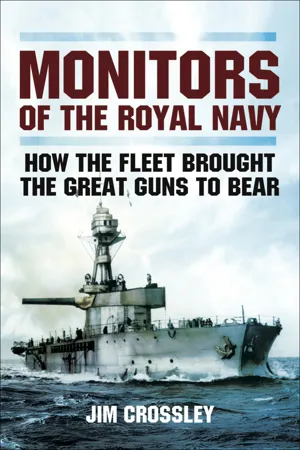 eBook - ePub
Monitors of the Royal Navy
How the Fleet Brought the Great Guns to Bear
- Jim Crossley(Author)
- 2013(Publication Date)
- Pen & Sword(Publisher)
Chapter 4
The Gallipoli Campaign
W hile the first two monitors were active on the coast of Africa events of far greater importance were taking place in the Dardanelles. It was to prove one of the most disastrous actions ever undertaken by British arms. After Troubridge had been sent home in disgrace for letting Goeben escape, Admiral, Sir Sackville Carden, was placed in command of the force which was to find her, if she dared to emerge from her Turkish lair, and sink her and her consort. His task was not an easy one (see map 3).The Narrows, the passage leading from the Aegean to the Sea of Marmora was protected by powerful forts on Cape Helles and Kum Kale and by further batteries of heavy guns at Kephez and Chanak points. Even more dangerous than these was a dense minefield consisting of almost 400 moored mines in the channel which was less than 1 mile wide.A quick look at chart 3 will show the nature of the task which the navy faced. The Straits are dominated by hilly, broken country and are only about 5 miles wide at their widest point. Ships in the Straits are liable to shelling from the forts at the entrance and from others established at strategic points along the shoreline. The forts themselves were venerable structures, but around them had been built, with German advice and help, modern well designed earthworks concealing heavy guns which could survive anything short of a direct hit on the gun itself. In the hillsides looking down on the Straits were concealed mobile batteries of field guns and howitzers. These were not big enough to damage heavily armoured ships much, but they could be fatal to unarmoured vessels such as trawlers or destroyers. There were also powerful mobile searchlights to spot for the guns at night. Through the Straits runs a current of anything from 2 to 4 knots, constantly running out into the Mediterranean. This current runs strongly in the centre, but is weak or nonexistent near the shores, especially the southern (Asiatic) shore. There could scarcely be a more suitable stretch of water for defensive mining.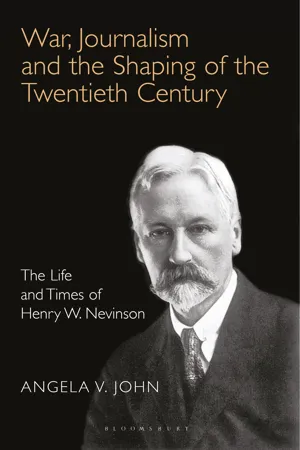 eBook - PDF
War, Journalism and the Shaping of the Twentieth Century
The Life and Times of Henry W. Nevinson
- Angela V. John(Author)
- 2006(Publication Date)
- I.B. Tauris(Publisher)
His conception of the campaign was linked to his love of Greek history and legends. For Henry, the Dardanelles spelt the ancient Helles-pont. From the cliff above Cape Helles he could look across to the windy Trojan plain. With Byronic musing, he conjured up ancient scenes. Near the fortified promontory of Kum Kale, briefly occupied in April by the French, was a white, sandy shore where, for ten long years, the fleet of the invading Greeks had rested, that famous force of over a thousand. Influenced by tales of Achilles and Hector, Henry relished living vicariously and enjoyed telling readers that the straits were the site of Trojan war. Homer and heroes occupied his thoughts alongside the modern army. Henry’s story was laced with tragedy, ancient and modern. His book is dedicated to ‘Those Who Fell On The Gallipoli Peninsula’. But two quotations follow from Thucydides (Pericles’ funeral speech) and Aeschylus’ Agamemnon : ‘Beside the ruins of Troy they lie buried, these men so beautiful; there they have their burial-place, hidden in an enemy’s land.’ Churchill, the first British minister to focus on Gallipoli, had initially conceived of a Greek army seizing the peninsula so that a British fleet could reach the Sea of Marmara. 16 The doomed sacrificial hero in Henry’s tragic tale was Sir Ian Hamil-ton. He fulfilled Henry’s personal criteria for bravery and admiration but was eventually recalled from the Dardanelles. He never again had a Gallipoli and the Western Front 147 senior appointment. 17 At first sight he might seem an unlikely subject for Henry’s admiration. Part of the ruling class with a military back-ground and maternal links to the Anglo-Irish gentry, he appears neither radical nor underprivileged. Yet Henry saw him as a scapegoat for the failings of the British government. There were also many traits in his personality and career that appealed to him. They had first met in South Africa where both disliked Sir Redvers Buller.
Index pages curate the most relevant extracts from our library of academic textbooks. They’ve been created using an in-house natural language model (NLM), each adding context and meaning to key research topics.

