History

War of Attrition
The War of Attrition is a military strategy that aims to wear down the enemy's strength through sustained and continuous warfare, rather than achieving a decisive victory. It involves prolonged battles and high casualty rates, with the goal of exhausting the opponent's resources and will to fight. This strategy has been employed in various historical conflicts, including World War I and the Vietnam War.
Written by Perlego with AI-assistance
Related key terms
1 of 5
8 Key excerpts on "War of Attrition"
 eBook - ePub
The Greater War
Other Combatants and Other Fronts, 1914-1918
- Jonathan Kraus(Author)
- 2014(Publication Date)
- Palgrave Macmillan(Publisher)
Essentially, victory in a War of Attrition necessitated both outlasting and outfighting the enemy. This entailed commitment to ‘a gradual and piecemeal process of destroying an enemy’s military capability’, 17 and acceptance that with the enemy applying the same strategic logic a reciprocal sacrifice was inevitable. Attrition has deeper levels of complexity. An effective attritional strategy also involved applying resources efficiently to degrade those of the enemy, as well as the integration of ‘positive’ elements – the mobilisation of national and Allied resources: men (and women), industrial and financial capacity, and hearts and minds – with ‘negative’ aspects – attacking and destroying adversaries’ manpower, materiel, economic stability and morale. Inevitably there was great scope for Clausewitzian friction in such an all-encompassing strategy, but, at the same time, the more closely a national or alliance war effort could approach the ‘absolute’, or ‘total’, the greater was the potential for final victory. This entailed a policy of ‘all or nothing’, in this instance fighting ‘until the military domination of Prussia is wholly and finally destroyed’, as William Robertson, Britain’s Chief of the Imperial General Staff in November 1916, defined it, 18 rather than a ‘limited’ war approach predicated on winning battles for political ends or to secure a favourable peace, which seemed to be Lloyd George’s unshakeable conception of proper strategy. Resilience, as demonstrated by armies and societies in 1914, was the third factor in attrition. Defined by Robertson as ‘the staying power in men’, 19 resilience also involved the staying power in economic and social strength, as well as patriotic commitment to the war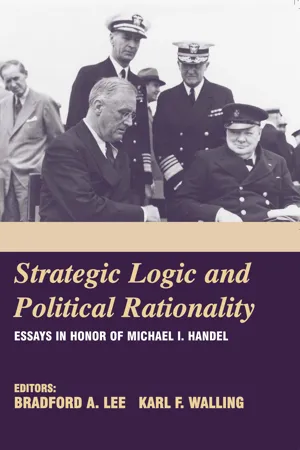 eBook - ePub
Strategic Logic and Political Rationality
Essays in Honor of Michael I. Handel
- Bradford A. Lee, Karl F. Walling(Authors)
- 2004(Publication Date)
- Routledge(Publisher)
Attrition need not be initiated deliberately by one of the sides. A war that had been intended to conform to an entirely different pattern may, on its own, deteriorate into a War of Attrition. This is not a paradox, as there are logical explanations for this phenomenon. These explanations basically stress (a) the creation of a state of symmetry in capabilities between the parties, as a result of operational, technological, or doctrinal factors; (b) a state of asymmetry in capabilities balanced by asymmetry in cost tolerance of the respective societies; or (c) the existence of political constraints limiting the freedom of action of the military.Symmetry in capabilitiesOperational factorsAttrition can develop as a result of a phenomenon that Clausewitz, though not applying it specifically to attrition, defined as ‘the diminishing strength of the attack’; that is, the tendency of an offensive to expend itself and lose its effectiveness. This can occur as a result of a drawing-out of the lines along which the attacker is operating, a lengthening of his logistical lines, or a weakening in the resolve of his forces to continue fighting as they move increasingly further from their homes, as well as in consequence of a parallel strengthening of the defender for precisely opposite reasons.42 The less negotiable the territory—whether because of natural obstacles, such as mountains, water (e.g., the swamps in the Iran-Iraq War), forests (e.g., the 1939–40 Winter War between the Finns and the Soviets), jungles (e.g., Vietnam), and the like, or because of artificial obstacles—the greater the likelihood the attack will soon reach its culminating point. From the point of time at which each offensive loses its impetus, the confrontation begins to assume the characteristics of wars of attrition. Classic examples of attrition that developed out of a diminution in the strength of the attack are Napoleon’s Russian campaign in 1812 and Nazi Germany’s Russian campaign during World War II. A more recent example is the 1980–88 Iran—Iraq War. The offensive of the Iraqis in late 1980 expended itself and lost its effectiveness. Two years later, in the summer of 1982, Iran launched a large-scale counterattack on the Iraqi forces near the city of Basra, which diminished after a few weeks, owing to the Iraqi advantage in force ratios, strong Iraqi defenses, and the muddy terrain. In late 1986/early 1987, Iran managed to transfer the war to Iraqi territory, but failed to translate it into battlefield decision. The pattern of attrition continued to dominate the Iran-Iraq War.43 eBook - ePub
Israel's Wars of Attrition
Attrition Challenges to Democratic States
- Avi Kober(Author)
- 2009(Publication Date)
- Routledge(Publisher)
93Waging and winning wars of attrition
The management of wars of attrition is affected by their protracted nature, and achievements in such wars are characterized by a difficulty to translate military achievements into political gains. Battlefield decision is usually restricted to the tactical level, and it is usually outside the actual battlefield, at the grand-strategic level, where wars of attrition are won.The prolongation of conflict and the impact on its management
Due to their protracted nature, in wars of attrition it is often possible to learn lessons, not only once the conflict is over, but, rather, during its course, adapting to changing challenges and correcting failures by applying improved, sometimes new strategies, tactics, and even doctrines and force structure. For example, the Soviets in Afghanistan changed their force structure, creating a greater balance between armor and infantry, and to be more effective against the mujahedeen , made some doctrinal and technological adaptations which included indirect approach, guerrilla- like counter- insurgency tactics, and the use of helicopters.94 The Americans tried various strategies during the war in Vietnam. For example, unlike the sustained strategic bombing campaign against North Vietnam, which had been inaugurated in March 1965, they later on adopted a search and destroy strategy, which was more suited for counterguerrilla warfare, and was based on inserting ground forces into hostile territory in order to target enemy forces and withdraw immediately afterwards. During the 1969–70 Egyptian–Israeli War of Attrition, the IDF turned to in- depth grand-strategic bombing, after having failed to compel the Egyptians to stop the war as long as its operations were restricted to the Suez Canal zone. Once the Soviets intervened in that war, however, Israel had to lower the profile of its operations in Egypt and eventually agree to ceasefire. During the first Palestinian Intifada Israel realized that popular uprising could not be dealt with merely by employing military means in one go, but rather via a cumulative process of economic and psychological exhaustion.95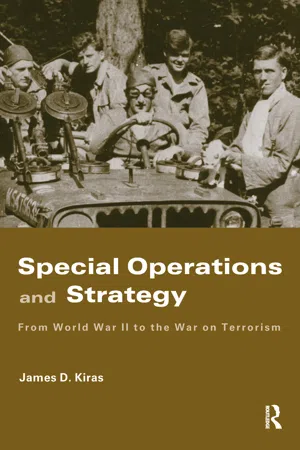 eBook - ePub
Special Operations and Strategy
From World War II to the War on Terrorism
- James D. Kiras(Author)
- 2006(Publication Date)
- Routledge(Publisher)
3 A few, however, have attempted to articulate more comprehensive theories of strategy and its relationship to warfare. A common trait shared by authors such as Carl von Clausewitz, Hans Delbrück, and Robert Osgood, to name but a few, has been the development of typologies to distinguish between forms of war and relative levels of effort. These forms of war include limited war, total war, absolute war, war in reality, war of annihilation, and War of Attrition.Much like special operations in practice, attrition in theory arguably was one of the most misunderstood strategic concepts of the twentieth century.4 Some of the confusion can be ascribed to difficulties associated with translating texts. For example, Carl von Clausewitz’s term “verzehrender krieg ,” which has been rendered into English as “War of Attrition,” is more accurately translated as “war of consumption.”5 Adding to the confusion are different translations of term “Ermattungsstrategie ” by Hans Delbrück. Some scholars, including Walter Renfroe, suggest that it should be rendered “strategy of attrition” whereas others suggest that “strategy of exhaustion” is more accurate.6 Finally, a handful of influential theorists, writing in the wake of the First World War, ascribed a pejorative value to the term attrition that continues to influence perceptions today.7 Advocating strategic attrition, or strategies of attrition, has become the intellectual equivalent of inflexibly advocating the slaughter practiced by British general officer “butchers and bunglers” during the First World War.8Understanding the relationship between attrition and strategy is further complicated by the different connotations the term “attrition” has to various military and civilian defense professionals. Functionally the term has a specific and quantifiable meaning. Logisticians and those who program military simulations, for example, find the term useful in their attempts to measure the combat effectiveness of forces in the field.9 In addition, attrition as a functional concept is linked with retention rates of Service personnel.10 eBook - PDF
- Carter Malkasian(Author)
- 2002(Publication Date)
- Praeger(Publisher)
Protracted warfare in pursuit of moderate gains was difficult for nations to justify. Attrition often seemed to drag on indefinitely for very little purpose. This often caused increasing public, political, and military opposition to attrition and limited war. Geostrategically, attrition diverted resources from other strategic interests, such as defending Europe. On the battlefield, military commanders disliked the lack of a decisive victory. And the public often grew frustrated as war persisted with steady casu- alties and no sign of victory. People questioned the very point of fighting a war for an aim less than total victory: "Why die for a tie?" If attrition involved heavy casualties to one's own forces, such as during the Tet Offensive, these Attrition as an Operational Strategy 217 difficulties were multiplied. In most cases, the effectiveness of attrition over- came these new difficulties in the Cold War. However, when attrition was ap- plied too broadly and in an unsustainable fashion, as in Vietnam, its costs could become overwhelming and result in crippling public opposition. Spanning the gap between the period of total war and the Cold War, air power was increasingly emphasized from 1939 to 1973 as a means of causing attrition, one of the rare examples of continuity in the strategic thought behind attrition. Although air-to-air combat was often important in wearing down an enemy's air strength, air power was primarily applied through bombing cam- paigns. The ability to strike directly at an enemy's lines of communication or industrial capability was a new and enticing means of causing attrition. It seemed to promise to break an enemy's military capability without the costs of ground combat. Indeed, by the end of the Korean and Vietnam Wars, air op- erations were the primary US instrument of attrition. Like that of other forms of attrition in the Cold War, the goal of air operations was usually to compel an enemy to concede in negotiations. eBook - PDF
- R. Harkavy, S. Neuman(Authors)
- 2016(Publication Date)
- Palgrave Macmillan(Publisher)
That’s just the way it played out! Many wars, as we shall see, are not so easily described at one or another end of this spectrum, may involve mixes or an overall status in between or wholly dis- tinct places or theaters of operations where both types of warfare are in evi- dence. Attrition war is one described by the use of brute force, with Luttwak refer- ring to it as “a war waged by industrial methods.” 44 The side that has superior firepower and material strength—note our previous data for comparative power—uses its advantage to wear down the other side, where there can be no cheap victory and where roughly symmetrical but heavy losses will favor the side that, in a quantitative sense, can best afford to take the losses. Grant before Richmond can be added to the above examples. With relational maneuver, instead of trying to destroy the enemy physically, wearing him down, the goal is to “incapacitate by systemic disruption.” 45 One avoids the enemy’s strength, and attempts to achieve selective superiority against the enemy’s weakness, be it physical or psychological, technical or organizational. It is the strategy of the weak, numerically speaking, but when there is qualitative or intellectual superi- ority, perhaps only a temporary or surprise strategy. It is also a high-risk strategy that, if it fails, can be catastrophic, whereas attrition warfare is said to be “full cost but of low risk,” a blunt instrument. We shall later attempt to apply this duality to our recent Third World wars. But one caution intrudes. The duality is easy to explicate, particularly at the extremes, that is, with obvious cases such as World War I versus Israel’s classic vic- tories of 1956 or 1967. In many cases, however, defining a policy or a war itself according to the duality of attrition or relational maneuver is not so simple a matter. It must be viewed from both sides, from the offensive and defensive ends, to the extent that is consistent in a given war. eBook - PDF
Selected Works of Mao Tse-Tung
Volume 2
- Mao Tse-Tung(Author)
- 2014(Publication Date)
- Pergamon(Publisher)
These two forms of warfare will afford full play to the art of directing war and to the active role of man — what a piece of good fortune out of our misfortune! War of Attrition A N D WAR OF ANNIHILATION 97. As we have said before, the essence, or the object, of war is to preserve oneself and destroy the enemy. Since there are three forms of warfare, mobile, positional and guerrilla, for achieving this object, and since they differ in degrees of effectiveness, there arises the broad distinction between War of Attrition and war of annihilation. 98. To begin with, we may say that the anti-Japanese war is at once a War of Attrition and a war of annihilation. Why? Because the enemy is still exploiting his strength and retains strategic superiority and strategic initiative, and therefore, unless we fight campaigns and ON PROTRACTED WAR 175 battles of annihilation, we cannot effectively and speedily reduce his strength and break his superiority and initiative. We still have our weakness and have not yet rid ourselves of strategic inferiority and passivity; therefore, unless we fight campaigns and battles of annihila-tion, we cannot win time to improve our internal and international situation and alter our unfavourable position. Hence campaigns of annihilation are the means of attaining the objective of strategic attrition. In this sense war of annihilation is War of Attrition. It is chiefly by using the method of attrition through annihilation that China can wage protracted war. 99. But the objective of strategic attrition may also be achieved by campaigns of attrition. Generally speaking, mobile warfare per-forms the task of annihilation, positional warfare performs the task of attrition, and guerrilla warfare performs both simultaneously; the three forms of warfare are thus distinguished from one another. In this sense war of annihilation is different from War of Attrition. Cam-paigns of attrition are supplementary but necessary in protracted war. eBook - PDF
Pyrrhic Victory
French Strategy and Operations in the Great War
- Robert A. Doughty, Robert A. DOUGHTY(Authors)
- 2009(Publication Date)
- Belknap Press(Publisher)
pyrrhic victory A Strategy of Attrition, 1916 A Strategy of Attrition 1916 250 c h a p t e r 6 D uring the may–june 1915 offensive in Artois, Joffre began using the word “attrition.” In a letter to the minister of war on May 27, he mentioned the “struggle of attrition . . . we are already waging.” 1 A month later in a message to Grand Duke Nicholas he said that France and Rus-sia should work together to “drain the enemy and attrit him.” 2 Despite his recognition that the war had become one of attrition, in September– October 1915 he launched his huge offensive in Artois and Champagne and attempted to rupture the enemy’s defenses. As his offensive faltered, he warned the minister of war on October 3, 1915, that his attacks would not get through the enemy’s second band of defenses. He could launch a new offensive, he said, only after the arrival of fresh troops and the recon-stitution of units and thus had no choice but to suspend offensive actions “momentarily” after the last assault in Champagne. Yet France could not remain completely passive, for, as he later explained, “if we ourselves do not attack, we will be attacked.” 3 To provide time for France to rebuild its forces, Joffre wanted Great Britain to bear the main burden of future at-tacks on the Western Front. He wrote on October 7, “Since the begin-ning of the campaign, France has borne the heaviest burden of the war. It has given without reservations the best of its blood for the triumph of the common cause . . . . It is the allies, who still have considerable forces at
Index pages curate the most relevant extracts from our library of academic textbooks. They’ve been created using an in-house natural language model (NLM), each adding context and meaning to key research topics.

