History

Stalemate WW1
Stalemate in WW1 refers to the prolonged period of trench warfare on the Western Front, where neither side was able to make significant gains. This was due to the development of new technologies such as machine guns and artillery, which made it difficult for troops to advance. The stalemate lasted for several years until the introduction of new tactics and weapons broke the deadlock.
Written by Perlego with AI-assistance
Related key terms
1 of 5
7 Key excerpts on "Stalemate WW1"
 eBook - ePub
The Great War
Western Front and Home Front
- Hunt Tooley(Author)
- 2015(Publication Date)
- Bloomsbury Academic(Publisher)
3 Stalemate and Mobilization, 1915/1916The metaphor of “stalemate” is apt to mislead us as much as enlighten us if we apply it too literally to the Western Front. It was a potent concept of the era, which influenced the actions of participants, decision-makers, and bystanders, and in large measure, the history of the Western Front has been envisioned in terms of stalemate.1 Since the 1980s, on the other hand, historians have begun to emphasize change and development rather than stasis. Yet even in light of new material emphasizing the extent to which the battle front itself changed during the four years of war, the idea of stalemate is still a useful analytical tool for thinking about the course of the war, both on the battle front and on the home front. It is necessary first, of course, to comprehend the nature of this stalemate, and we make a good start by understanding that individuals and armies in 1915 were not inactive, hamstrung, or otherwise unable to introduce new ideas and adopt clear courses of action. Indeed, in some ways, the military behaviors of the Western Front powers in the period from November 1914 to the crucial year 1916 represented sometimes frantic, sometimes fatalistic, plans in reaction to or even in fear of stalemate itself.The generation of stalemateAlthough the Western Front can seem a monotonous parade of failed and self-destructive offensives, some of the individuals most engaged in the actual conduct of the war – not necessarily the commanding generals – were also engaged in the design of new methods and techniques of warfare at a rate far exceeding various phases of earlier military change dubbed “revolutionary” by historians. A host of special weapons and tactics emerged during this period, from new artillery techniques to the use of gas and flamethrowers to the astounding development of military aviation almost from scratch. Nearly all of these innovations related to the problems of fighting a war of entrenched positions, without flanks, across a 400-mile front – in a word, a war of stalemate. eBook - ePub
World War I
A Short History
- Tammy M. Proctor(Author)
- 2017(Publication Date)
- Wiley-Blackwell(Publisher)
For anyone taking a survey of the battlefronts in early 1915, the war looked static (see Map 3.1). Most of the offensives had stalled, winter had set in, and serious trench networks had emerged on both the Eastern and Western Fronts. Military and civil leaders alike began to consider the problem of “stalemate,” which was a term borrowed from the game of chess. In its original meaning, a player cannot move any pieces without going into check. This seemed a perfect description of the situation of the war by early 1915—no one could move without catastrophic losses, and normal strategies appeared illogical. Not only was stalemate a conundrum in terms of accomplishing any strategic goals, but it cost a lot of money to keep millions of soldiers in the field waiting for something to happen. Governments who were draining their treasuries began borrowing and taxing to finance the war. Action was needed, but the question of what action seemed an open one. Generals knew that outflanking maneuvers were impossible in most of the entrenched battlefronts of the war, so they faced either frontal assaults with great casualties or some other creative approach. Planners had several ideas for how to address the stalemate, and each in turn made an appearance in 1915. Every plan depended on the idea of a big breakthrough that would knock the enemy out of contention, and this concept remained a constant throughout the rest of the war. This led to experimentation in terms of military tactics and technologies.1915 and the Problem of Stalemate
A popular notion about how to deal with stalemate was to develop technology that would enable the big breakthrough that would crush enemy forces. Armies experimented with handheld weapons such as flamethrowers and brass knuckles, but they also sought to create defensive equipment such as body armor that would provide an advantage. When battlefield advances did not provide a breakthrough capacity, planners turned to a broader field of vision in their search for new technologies. One such advance was the widening of the air war to include aerial bombing of civilian and military targets by zeppelins and planes in order to break morale and destroy resources. Another was an expansion of unrestricted submarine warfare by the Germans, especially in the Atlantic, which culminated in the sinking of the passenger liner, RMS Lusitania eBook - PDF
Discovering the Western Past
A Look at the Evidence, Volume II: Since 1500
- Merry E. Wiesner-Hanks, Andrew Evans, William Bruce Wheeler, Julius Ruff(Authors)
- 2014(Publication Date)
- Cengage Learning EMEA(Publisher)
The prewar alliance system meant that, for the first time in a century, all the great powers were at war, making the scope of the hostilities greater than in any recent fighting. Moreover, the conflict quickly became a world war as the belligerents fought one another outside Europe and as non-European Copyright 201 Cengage Learning. All Rights Reserved. May not be copied, scanned, or duplicated, in whole or in part. Due to electronic rights, some third party content may be suppressed from the eBook and/or eChapter(s). Editorial review has deemed that any suppressed content does not materially affect the overall learning experience. Cengage Learning reserves the right to remove additional content at any time if subsequent rights restrictions require it. [299] The Problem Especially in western Europe, such losses resulted in increased reliance on what has been called the “infan-tryman’s best friend,” the shovel. To avoid the firepower of the new mod-ern weaponry, opposing armies dug into the earth, and by Christmas 1914 they opposed each other in 466 miles of trenches stretching through France from the English Channel to the bor-der of Switzerland. These trenches represented stalemate. They were separated by “No Man’s Land,” the open space an attacker had to cross to reach the enemy. Swept with machine gun and artillery fire and blocked by barbed wire and other obstacles, “No Man’s Land” was an area that an at-tacking force could cross only with great losses. In such circumstances, neither side could achieve the tradi-tional decisive break through into the enemy’s lines. Field Marshal Horatio Kitchener, an experienced commander of the old school of warfare and British secretary for war until 1916, ex-pressed the frustration of many about such combat: “I don’t know what is to be done—this isn’t war.” In their efforts to achieve victory, generals and statesmen sought to break the stalemate in a number of ways that extended the impact of World War I. eBook - ePub
The Illustrated History of World War I
The Battles, Personalities, Events and Key Weapons From All Fronts In The First World War 1914-18
- Andrew Wiest(Author)
- 0(Publication Date)
- Amber Books Ltd(Publisher)
HAPTER 4Stalemate in the Trenches
THE WORLD OF THE TRENCHES WAS ONE OF SQUALOR AND HARDSHIP AS DEPICTED BY THESE BRITISH SOLDIERS RESTING AMIDST THE LITTER OF WAR . AT ANY MOMENT THE TRENCH COULD BE SHELLED BY THE GERMAN GUNS , SENDING THE SOLDIERS SCURRYING TO THEIR DUG -OUTS .At the centre of the strategic debate was the advent of an unexpected new, attritional style of modern warfare. World War I had settled down into something that resembled a gigantic siege, a siege that many felt threatened to destroy the old world.STRATEGIC DEBATE
A fter failing to achieve victory at First Ypres, Falkenhayn had to attempt to come to terms with a two-front war. After much study, he concluded that the war in the west was a stalemate, and that in the east the Russians could give ground for an almost indeterminate length of time, denying German forces a meaningful victory. The German commander realised then that the war had degenerated into a war of attrition. Hindenburg and Ludendorff, the heroes of Tannenberg, did not agree. They argued that decisive victory beckoned in the east, if only Falkenhayn would transfer to them much-needed reinforcements. In the end, Falkenhayn agreed. The German offensive efforts of 1915 — with one notable exception — would be directed against Russia.GENERAL ERICH VON FALKENHAYN , THE ARCHITECT OF GERMAN STRATEGY IN 1915, WHO SAW THE WAR AS ONE OF ATTRITION .The Allies, too, had similar strategic problems. The French, led by Joffre, were quite certain that any Allied attack had to be made on the Western Front in order to expel the German Army from France. The British were not so certain. Several key British policy-makers, including Winston Churchill, the First Lord of the Admiralty, and David Lloyd George, sought to circumvent the stalemated Western Front and attack elsewhere in Europe against less stalwart enemies. Thus dawned the ‘Easterner-Westerner’ debate that would haunt Allied planning for the rest of the war. Suggestions for an eastern alternative included landing British troops on the North German Plain as a direct threat to Berlin, landing troops in Greece to aid the Serbs, and landing troops at Gallipoli in an effort to defeat the newest German ally: Turkey. Most of the British military, including French and Haig, were vehemently opposed to any eastern strategy. They contended that Germany was the main enemy, and that striking Turkey would do little to help defeat the Germans. Though the debate in Britain raged on, in 1915 France remained the senior alliance partner. As the French were bearing the main burden of the war, they retained a firm control over Allied planning. As a result, the main Allied efforts of 1915 came on the Western Front. The only victory for the Easterners was in a seemingly rather minor naval assault on the Dardanelles. eBook - PDF
When Men Lost Faith in Reason
Reflections on War and Society in the Twentieth Century
- H. P. Willmott(Author)
- 2002(Publication Date)
- Praeger(Publisher)
divisions on the battlefield. The Allied conduct of operations in the second half of 1918 conformed to the Methodical Battlefield idea, but their success at that stage probably had less to do with this concept of operations than with a series of other considerations, specifically German exhaustion. If the majority of military historians and commentators identify such factors as the imbalance of firepower and mobility, the problems of ground, lack of surprise, and the absence of an open flank as the cause of tactical deadlock on the Western Front during the First World War, these other factors seldom command much atten- tion. The changing nature of the defense, specifically the increased depth of defense in these years, is often acknowledged, but the capacity of states to wage war by generating resources on an unprecedented scale is The First World War: Deadlock and Hatred 43 very seldom defined in such terms. Refuge is taken in the notion that wars between great industrialized powers are necessarily protracted and attritional and hence cannot produce decisive campaigns or battles. But the problem with all of these explanations of deadlock on the Western Front is that they are not explanations. Whether singly or together, they describe the battlefield rather than explain the indecisiveness of battle. * * * If one wishes to understand deadlock on the Western Front after November 1914, one needs to look beyond conventional wisdom; per- haps the best explanation is provided in an often-quoted passage from Tender Is the Night by F. Scott Fitzgerald, in a conversation between American tourists looking over the Somme battlefield in the 1920s: "This land here cost twenty lives a foot that summer .... See that little stream—we could walk to it in two minutes. It took the British a month to walk to it—a whole empire walking very slowly, dying in front and pushing for- ward behind.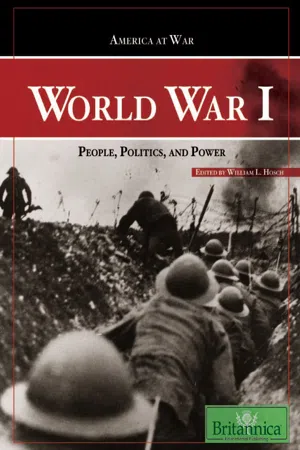 eBook - ePub
World War I
People, Politics, and Power
- Britannica Educational Publishing, William Hosch(Authors)
- 2009(Publication Date)
- Britannica Educational Publishing(Publisher)
CHAPTER 4 THE STALEMATE YEARS BEGINB y late 1914 the state of deadlock on the Western Front of the first World War had become clear to the governments of the opposing countries and even to many members of their general staffs. As each side sought a solution to this deadlock, the solutions varied in form and manner.MAJOR DEVELOPMENTS IN 1915
DARDANELLES CAMPAIGN
Erich von Falkenhayn had succeeded the dispirited Moltke as chief of the German general staff in September 1914. By the end of 1914 Falkenhayn seems to have concluded that although the final decision would be reached in the West, Germany had no immediate prospect of success there. Therefore, the only practicable theatre of operations in the near future was the Eastern Front, however inconclusive those operations might be. Falkenhayn was convinced of the strength of the Allied trench barrier in France, so he took the momentous decision to stand on the defensive in the West.Falkenhayn saw that a long war was now inevitable and set to work to develop Germany’s resources for such a warfare of attrition. Thus, the technique of field entrenchment was carried to a higher pitch by the Germans than by any other country. Germany’s military railways were expanded for the lateral movement of reserves. Furthermore, the problem of the supply of munitions and of the raw materials for their manufacture was tackled so energetically and comprehensively that an ample flow was ensured from the spring of 1915 onward—a time when the British were only awakening to the problem. Here were laid the foundations of that economic organization and utilization of resources that was to be the secret of Germany’s power to resist the pressure of the British blockade.The western Allies were divided into two camps about strategy during its stalemate with the Central Powers. General Joseph Joffre and most of the French general staff, backed by the British field marshal Sir John French, argued for continuing assaults on the Germans’ entrenched line in France, despite the continued attrition of French forces that this strategy entailed. Apart from this, the French high command was singularly lacking in ideas to break the deadlock of trench warfare. While desire to hold on to territorial gains governed the German strategy, the desire to recover lost territory dominated the French.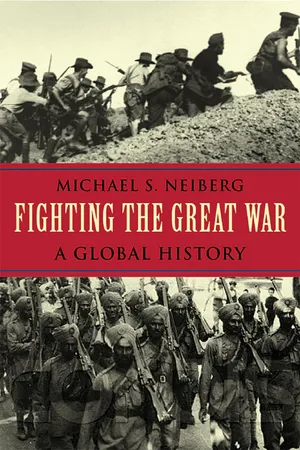 eBook - PDF
Fighting the Great War
A Global History
- Michael S. Neiberg, Michael S. NEIBERG(Authors)
- 2009(Publication Date)
- Harvard University Press(Publisher)
[ 3 ] THE COUNTRY OF DEATH Stalemate on the Western Front The result of the fighting here [in Artois] is to show that the Germans can be driven back at the cost of an enormous effort, but that the thing is possible . . . . People in England must be prepared for a long war and I am afraid there are no brilliant or sudden victories to be ex-pected—the best stayers will win in the end. —Letter from British General Sir Charles Grant to his father-in-law, April 15, 1915 A s 1914 ended, the problem facing the Allied armies was at once deceptively simple and immensely complicated. The simple part lay in the obvious need to push the Germans out of those parts of France and Belgium that they occupied. The British, French, and Belgians all agreed on this war aim, unifying them at least on this one level. The complication came from the immense operational and tactical challenges posed by the new style of war. By the end of the year, a solid line of German defenses reached from the North Sea to the impassable terrain of the Alps. There were no longer any flanks to turn; consequently, strategic envelopments, like the one the Germans had so daringly executed at Tannenberg, were virtually impossible. To make the problem even more com-plicated, in 1914 and 1915 the Allies could not count on any sig-nificant superiority in manpower, nor did they have access to any weapons that the Germans did not also possess. The Germans had decided to conduct their main offensive for 1915 in the east and therefore determined to fortify their defensive positions in the west. They connected and improved the haphaz-ard system of field entrenchments that had developed during the 67 Race to the Sea and protected them with thick tangles of barbed wire. They added concrete in places and buried telephone and telegraph lines to protect them from enemy artillery fire.
Index pages curate the most relevant extracts from our library of academic textbooks. They’ve been created using an in-house natural language model (NLM), each adding context and meaning to key research topics.

