History

Modern Warfare
"Modern Warfare" refers to the use of advanced technology, tactics, and strategies in armed conflict, particularly after the Industrial Revolution. It encompasses the use of firearms, artillery, aircraft, and other modern military technologies. Modern warfare has significantly impacted global politics, economics, and society, and has led to the development of international laws and treaties governing armed conflict.
Written by Perlego with AI-assistance
Related key terms
1 of 5

3 Key excerpts on "Modern Warfare"
 eBook - PDF
- Matthew Hughes, W. Philpott(Authors)
- 2006(Publication Date)
- Palgrave Macmillan(Publisher)
This last study is particularly important because it demonstrates how politics, economics, market structures and technology changed the conduct of war from the Middle Ages to the twentieth century. In addition, it is one of the few books on the development of war that looks beyond the European experience. Charles Townshend's The Oxford History of Modern War (Oxford, 2000) also provides a broad survey of the evolution of war from the early modern period to the present and contains essays written by experts in each of the main periods of war. The single best survey of land warfare is presented in Hans Delbriick's four-volume study: The History of the Art of War Within the Framework of Political History (Westport CT, 1975-82). This massive study covers warfare from the period of antiquity until the end of the Napoleonic Wars. Delbriick demonstrates a mastery of the subject and his analysis of the evolution and conduct of war is unsurpassed. Particularly impressive is his methodology and the extreme effort made to develop a theory of war based on solid and meticulous research. Michael Howard's War in European History (Oxford, 2001) is small, but actually provides a superb analysis of the major influences on warfare from the Dark Ages through to the twentieth century and emphasizes the relationship between war and society. More limited in scope, but still very useful is Hew Strachan's European Armies and the Conduct of War (London, 1983). This provides a concise, but insightful, overview of the chief influences on warfare in Europe from the time of Marlborough until the Second World War. Russell Weigley's study, The Age of Battles: The Quest for Decisive Warfare from Breitenfeld to Waterloo (Bloomington IL, 1991) demonstrates that advances in tactics, organization and the size of armies resulted in battles that were less decisive and more attritional in character.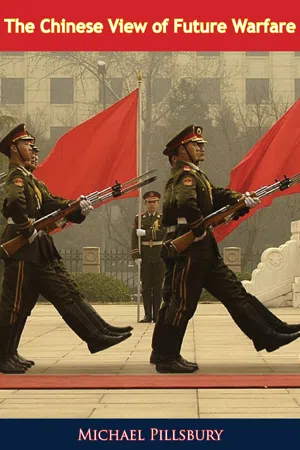 eBook - ePub
- Michael Pillsbury(Author)
- 2021(Publication Date)
- Barakaldo Books(Publisher)
The Science of Strategy• People usually refer to strategy, battle methods, and tactics as the art of war. Its highest level is grand strategy, which is the art and science of utilizing and strengthening the comprehensive power of a nation to realize long-term political goals. The philosophical thinking of the art of war is military dialectics, or military philosophy. Its keys are the theory of knowledge and methodology in military affairs. Only when military dialectics have been mastered can practical experience be raised to the level of ideology and theoretical treasure. And only when this tool of understanding has been mastered can the areas of practice and guidance, be consciously entered and current military strategic problems be studied and solved. Military science has strong application in guiding practice. We must adhere to the ideological line of seeking truth from facts and discover in the objective military field regular patterns and raise them to the level of theory and not use ideology to cut objective reality and discover laws. We should not be separated from the basis of military practical experience, but we should also be ahead of the practice. Otherwise, the country might be inflicted with disasters. That is the seriousness of military science.The science of strategy is not satisfied by one particular historical pattern of war or by the result and viewpoint of one particular war. It constantly uses new war experiences, new war models, new technical equipment’s effect on war to study and guide warfare. The Gulf War, for example, symbolizes the beginning of a new phase. The domination of the battlefield by cold weapons, hot weapons, and nuclear weapons has been changed into domination by high-tech weaponry. That is to say, the emergence of the new character of local war or military conflict a few years ago has now gradually become the leading factor on the battlefield. It will cause change in the patterns of war, and this is the rule. For instance, the use of rifles caused the change in the formation of combat teams, creating dispersed formations. Trench warfare appeared after machine guns and wire netting. When the infantry could not make a breakthrough, they expanded into two flanks. Protracted flanks appeared in the First World War, and fronts were long and unbroken. After the introduction of tanks, machine guns and wire netting were of no use, thus mobile warfare appeared. During World War I, tanks were the new weapons but not the dominant ones. During World War II, planes and tanks became the dominant weapons on the west front of the battlefield, and great depth of attack and high speed in the form of combat occurred. The United States used more than 80 high-tech weapons in the Gulf War, and these new weapons are beginning to play the dominant role on the battlefield. This form of high-tech warfare has just emerged, and its rules and regular patterns are not completely revealed yet. However, we must realize that the domination of the battlefield by these high-tech weapons will cause a series of changes in the patterns of war, forms of combat, combat command, or even in the strategic control. eBook - ePub
War of Time
Managing Time and Temporality in Operational Art
- Jan Hanska(Author)
- 2020(Publication Date)
- Palgrave Macmillan(Publisher)
2006 , p. 319–322). The most sophisticated cyber weapon is useless if the enemy lacks computers. Furthermore, there have been numerous occasions when one or all proponents have reverted during the course of a given war to ways and means of warfare of the past that may have seemed barbaric at the time.Ardant du Picq (1987 , p. 130) argued that “The study of the past alone can give us a true perception of practical methods, and enable us to see how the soldier will inevitably fight tomorrow.” Even during the course of a single war warfare may change drastically. There is a continuous evolution of weapons and methods alike, but in a prolonged war high-technology weapons and other resources may be depleted and this affects the outlook of the war. Reading the famous military thinkers, one notices that many of them considered themselves as witnesses of revolutionary turning points. An example is Giulio Douhet’s (1999 , p. 383) claim that “in the period of history through which we are passing, war is undergoing a profound and radical change in character and forms, as I shall show; so that the war of the future will be very different from all wars of the past.” For the authors their eras were separated from the past.The fascinating thing about all turning points of history is that people at the time rarely recognize the importance of the moment. Warfare has its own turning points that shape the outlook of future war s. For Douhet (1999 , p. 279), “the form of any war—and it is the form which is of primary interest to men of war—depends upon the technical means of war available.” We might or might not today live in a time that could in the future be characterized as a turning point—maybe the dawn of robotic and autonomous systems’ warfare. Or something completely different. Progress keeps speeding up and we need to keep up with the pace of “mechanical progress, whereby the latest product of to-day is obsolete to-morrow. (…) if we are to await mechanical finality we shall wait for all eternity” (Liddell Hart 1927 , p. 13). Development will never stop as long as civilization
Index pages curate the most relevant extracts from our library of academic textbooks. They’ve been created using an in-house natural language model (NLM), each adding context and meaning to key research topics.

