Literature

Hypermodernism
Hypermodernism in literature refers to a movement characterized by a self-aware, reflexive approach to storytelling that challenges traditional narrative structures and conventions. It often incorporates elements of postmodernism while pushing boundaries further, embracing new technologies, and exploring the impact of globalization and digital culture on the human experience. Hypermodernist literature reflects a heightened awareness of the complexities of contemporary society.
Written by Perlego with AI-assistance
Related key terms
1 of 5

4 Key excerpts on "Hypermodernism"
 eBook - PDF
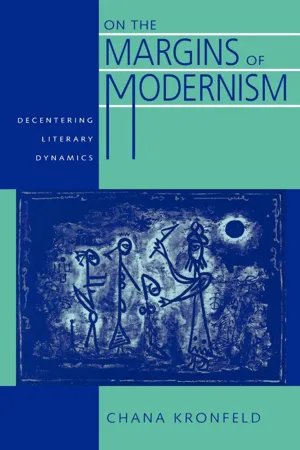
On the Margins of Modernism
Decentering Literary Dynamics
- Chana Kronfeld(Author)
- 2023(Publication Date)
- University of California Press(Publisher)
C H A P T E R 1 Modernism through the Margins From Definitions to Prototypes The term "modernism," though highly equivocal, com- monly refers to a cluster of international movements and trends in literature and the arts. Beyond this rudimentary labeling, however, there is little agreement about the term's meaning and scope. In some cultural centers one talks of modernism as early as the 1880s; in oth- ers, as late as the 1950s. Although there seems to be some consensus that modernism's "high points"—itself a charged and problematic description—were reached during the first thirty years of this cen- tury, critical opinions are as divergent about the meaning of modern- ism now as they were fifty years ago, despite the massive literature devoted to the subject in recent years. Three logically distinct sets of difficulties seem to have led to this impasse, each at a different level of discourse: the sense of the term itself, the nature of the category modernism constitutes, and the gen- eral conceptual map of literary groupings of which it is part. Distin- guishing among these three levels of discussion is only a preliminary methodological gesture but—it seems to me—quite a necessary one given the conceptual fog in which the debate over modernism is often conducted. (a) The term. "Modernism" remains a complex and contradictory literary label which, in the very process of naming, provokes some fundamental questions: Is modernism by any other name ("moder- nity," "avant-garde") still the same? How does the meaning of the label change when it is applied across media (literature, art, architec- ture, music); across genres within the same medium; and, still more 21 eBook - PDF
Stranger at the Door
Writers and the Act of Writing
- Kristjana Gunnars(Author)
- 2006(Publication Date)
- Wilfrid Laurier University Press(Publisher)
Notes to chapter 5 are on p. 112. 55 5 Theory and Fiction The Mixed Bag of Postmodern Writing In the 15 March 1998 issue of the New York Times Book Review, Laura Miller, an editor at Salon, wrote a rebuttal to a debate she says had been going on for five or six years, about the durability of the novel in relation to a new mutation of the genre called hyperfiction. In hyper-fiction, a story is told as if it were also literary criticism, and reader participation is involved. No chronology or structure is necessary in hyperfiction, and readers will finally be “liberated” from “linear narrative and the author” (43). These assertions, Miller argues, are claptrap. The novel in its traditional form is not now and never will be dead. “What the laboratory of hyperfiction demonstrates,” writes Miller, “is how alienated academic literary criticism is from actual readers and their desires.” She further says that the academic reader is “the creature of a world where books are assigned, not chosen. To the academic, a book is often a stony monument from which the relatively insignificant scholar must wring some drop of fresh commentary” (43). 1 Here the author of that week’s “Bookend” essay is voicing what is commonly heard in the debate between the populace and the ivory tower “elite,” or between the academic and the so-called real reader. The enemy, in what could be seen as a backlash movement against poststructuralism, is literary theory. One of the understandable arguments in the apparent backlash to post-structuralist writing, which also goes for postmodern “classical” music, is the sense of elitism and exclusion these new modes of art convey. The idea that you have to be an expert in the area before you can enjoy it is unpalatable to many. The sense of exclusion is not only based in ideas but also in language. The populist protest is against what is pejoratively called “jargon,” but which is simply the vocabu-lary of the field for academics. eBook - PDF
- Jeremy Hawthorn(Author)
- 2022(Publication Date)
- Bloomsbury Academic(Publisher)
In contrast, the infant mode of hypertext fiction reflects more accurately the world in which we live, and the ways in which we live in the world. In very general terms such a view can be said to be sociological in essence. It argues a broad similarity between the dominant characteristics of an age (both how the age ‘works’ and how people living at that time perceive reality) and the dominant characteristics of fiction. The argument goes something like this. In the nineteenth century the fiction produced in developed countries was realist because it reflected the way people made sense of the world (a shared sense of what was real, explanatory narratives based on strict rules of cause and effect, unitary characters with an understanding of themselves and their identities, and a commitment to ‘grand narratives’ that were ‘teleological’, that is, that were moving towards a predetermined and meaning-conferring goal). In the modern age (i.e. for the first three-quarters of the twentieth century), in contrast, people yearned to live in this same world but could not, and thus modernist fiction contrasts the tragic gap between the need for a REALISM, MODERNISM, POSTMODERNISM 73 comprehensive system of belief that explained the individual’s place in the world and the recognition that actual experience is meaningless, personality is fragmented and communication between human beings is at best partial. Then, in the postmodern world of the late twentieth century, an acceptance that meaning can be at best local, and that the movement from experience to experience is largely or completely random and fortuitous, finds expression in postmodernist fiction. And finally, in the present day, postmodernist fiction is able to be most completely itself when granted the resources of the electronic media, resources that at last allow it to shrug off the fetters of the single linear plot, the fixed text and the passive reader.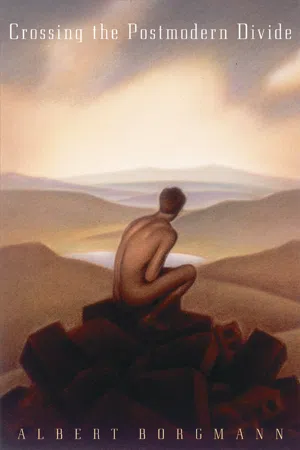 eBook - ePub
- Albert Borgmann(Author)
- 2013(Publication Date)
- University of Chicago Press(Publisher)
Postmodernism must become, for better or worse, something other than modernism. In its inchoate phase, it already exhibits two distinct tendencies. The first is to refine technology. Here postmodernism shares with modernism an unreserved allegiance to technology, but it differs from modernism in giving technology a hyperfine and hypercomplex design. This tendency I call Hypermodernism. The alternative tendency is to outgrow technology as a way of life and to put it in the service of reality, of the things that command our respect and grace our life. This I call postmodern realism.Hypermodernism tends to produce hypertrophic versions of the three developments that are distinctive of the postmodern economy—information processing, flexible specialization, and informed cooperation. Of course, hypermodern tendencies are also visible in the intellectual debate and in architecture, but the former is not constructive enough and the latter is too solid to exhibit Hypermodernism clearly. Once we recognize the hypermodern design in the economy, we can discover its spell among the intellectuals and architects, too.Information processing attains its hypermodern exaggeration to the extent that it overcomes and displaces tangible reality. Even in its hypertrophic state, it continues to be patterned by technology and preserves the division of the realm of labor from the realm of leisure. The hypermodern modification of the former constitutes at first a painful and disorienting process. Workers who are accustomed to a tangible, audible, pungent, and spacious setting find it hard to gain entry, by way of monitor and keyboard, into the unreal world of computerized information. Zuboff has us listen to the anguished testimony of a pulp mill operator.“With computerization I am further away from my job than I have ever been before. I used to listen to the sounds the boiler makes and know just how it was running. I could look at the fire in the furnace and tell by its color how it was burning. I knew what kinds of adjustments were needed by the shades of color I saw. A lot of the men also said that there were smells that told you different things about how it was running. I feel uncomfortable being away from these sights and smells. Now I only have numbers to go by. I am scared of that boiler, and I feel that I should be closer to it in order to control it.”5
Index pages curate the most relevant extracts from our library of academic textbooks. They’ve been created using an in-house natural language model (NLM), each adding context and meaning to key research topics.

