Literature

Futurism
Futurism was an early 20th-century artistic and literary movement that emphasized the dynamism, speed, and energy of modern life. It rejected traditional forms and embraced technology, urbanism, and the industrial age. Futurist literature often featured unconventional typography, fragmented syntax, and a focus on the machine age, reflecting the movement's celebration of progress and innovation.
Written by Perlego with AI-assistance
Related key terms
1 of 5

7 Key excerpts on "Futurism"
![Book cover image for: Literature and Revolution [First Edition]](https://img.perlego.com/book-covers/3018827/9781787209732_300_450.webp) eBook - ePub
eBook - ePub- Leon Trotsky, Rose Strunsky(Authors)
- 2018(Publication Date)
- Muriwai Books(Publisher)
CHAPTER FOUR—Futurism
Futurism is a European phenomenon, and it is interesting because, in spite of the teachings of the Russian Formalist school, it did not shut itself in within the confines of art, but from the first, especially in Italy, it connected itself with political and social events.Futurism reflected in art the historic development which began in the middle of the 1890s, and which became merged in the World War. Capitalist society passed through two decades of unparalleled economic prosperity which destroyed the old concepts of wealth and power, and elaborated new standards, new criteria of the possible and of the impossible, and urged people towards new exploits.At the same time, the social movement lived on officially in the automatism of yesterday. The armed peace, with its patches of diplomacy, the hollow parliamentary systems, the external and internal politics based on the system of safety valves and brakes, all this weighed heavily on poetry at a time when the air, charged with accumulated electricity, gave sign of impending great explosions. Futurism was the “foreboding” of all this in art.A phenomenon was observed which has been repeated in history more than once, namely, that the backward countries which were without any special degree of spiritual culture, reflected in their ideology the achievements of the advanced countries more brilliantly and strongly. In this way, German thought of the Eighteenth and Nineteenth Centuries reflected the economic achievements of England and the political achievements of France. In the same way, Futurism obtained its most brilliant expression, not in America and not in Germany, but in Italy and in Russia.With the exception of architecture, art is based on technique only in its last analysis, that is, only to the extent to which technique is the basis of all cultural superstructures. The practical dependence of art, especially of the art of words, upon material technique is insignificant. A poem which sings the skyscrapers, the dirigibles, and the submarines can be written in a faraway corner of some Russian province on yellow paper and with a broken stub of a pencil. In order to inflame the bright imagination of that province, it is quite enough if the skyscrapers, the dirigibles, and the submarines are in America. The human word is the most portable of all materials. eBook - ePub
Technoculture and Critical Theory
In the Service of the Machine?
- Simon Cooper(Author)
- 2003(Publication Date)
- Routledge(Publisher)
4 Futurism and the politics of a technological being in the world It is clear that the Italian Futurist movement was concerned with and shaped by the developing technology of the time. From the manner in which media technology assisted the creation of Futurism as a cultural movement to the love of speed, the machine, and the technology of warfare, Futurism directly engaged and embraced the increasing technologisation of the world, both in theory and in practice. Marinetti was an expert manipulator of the media. By placing the first manifesto of Futurism on the front page of Le Figaro, Europe’s premier newspaper in 1909, he cleverly used the technology of the time to create a new cultural movement that reached a mass audience virtually instantly. Futurism was as skilful in using new technology as it was in theorising its possibilities or worshipping its beauty. However, I want to argue that the Futurist relationship to technology is much broader than the simple valorisation of this or that weapon or machine. The technological aspect of Futurism went beyond mere ‘automobilecentrism’, as Wyndham Lewis derisively characterised it. 1 The love of the machine is representative of a more general desire, on the part of the Futurists, to transcend the socio-cultural framework of the period. In this respect, the love of technological speed, the call for the abolition of syntax, the project for the destruction of the ‘I’ in literature, the repeated desire in Futurist writings to transcend gendered and bourgeois forms of identity, and the call to embrace war, all form part of a generalised sensibility that finds liberation through a more abstracted mode of being in the world. The Futurists envisage a form of social and cultural transcendence enabled by the more abstract reconfiguration of social life that I have argued characterises the dominant framework through which technology impinges upon our worldly activities eBook - ePub
- Paul Miliukov(Author)
- 2020(Publication Date)
- Hesperides Press(Publisher)
The Fellow Travelers lacked even the degree of unity that was present in the Serapion Brothers. In this new group the former Serapions, V. Ivanov, Fedin, Kaverin, and Tikhonov, were associated with such individual writers as Pilniak (b. 1894), Babel (b. 1894), Seifulina (b. 1889), Leonov (b. 1899), A. Malyshkin (b. 1890), S. Semenov (b. 1893), and Budantsev (b. 1896). Later they were joined by A. Tolstoy (b. 1882), I. Ehrenburg (b. 1891), V. Veresaev (b. 1867), M. Prishvin (b. 1873), and V. Lidin (b. 1894), all authors whose works had been known prior to the revolution. Eventually, to be a member of a group in a measure recognized by the authorities, partially guaranteed their safety. The list of the Fellow Travelers included the names of the most eminent writers who had given the literature of the Soviet period not only a national but also a European reputation. What talent there was in this literature during the years 1922–25 came from the Fellow Travelers. We shall return to some of these writers, but in the meantime it must be pointed out that their advent and their literary work aroused approbation and support along with an acute animosity from the opposite camp of proletarian writers. This struggle was conducted like a literary debate until the authorities finally interfered, and it ended in a compromise, the terms of which were dictated by the resolution of the conference called in May 1924 by the Press Department, and the subsequent decisions of the Thirteenth Congress and the Political Bureau of the Central Committee of the Party.Simultaneously an evolution was taking place in the opposite literary camp of proletarian writers. Of the three unsuccessful claimants to power in literature, the Futurists who led the way were the first to be defeated. They were reluctant to leave the stage without establishing an original literature or at least a literary school. But there already existed a school very like the Futurists—the Formalists, who back in 1916 had formed a Society for the Study of Poetical Language, with the object of directing the new “literary science” towards an exclusive study of literary forms while practically ignoring the content. A literary work was to be approached as a technical production, and every explanation founded on the biography of the author, his social surroundings, the public spirit of his time, etc., was to be eliminated. Perhaps the passion for this manifestly one-sided view could also be regarded as a shield against the intrusion of contemporary reality into the realm of artistic activity, or as a veiled defense of “pure” art. But Professor Pereverzev, the leader of the school, who successfully gathered together a group of disciples, attempted to link this stand for the autonomy of art with a simplified Marxist interpretation. Accepting the principle that thought is conditioned by existence, he argued that by directly studying the form of a literary work it was possible to base one’s conclusion as to the social group in which the author belonged, and what economic interest he represented.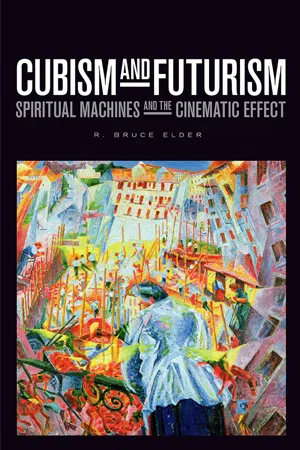 eBook - PDF
Cubism and Futurism
Spiritual Machines and the Cinematic Effect
- R. Bruce Elder(Author)
- 2018(Publication Date)
- Wilfrid Laurier University Press(Publisher)
For example, Ezra Pound, writing to James Joyce in September 1915, counselled him to avoid “reading the Young Italians, who seem all tarred with the Futuristic taint, i.e., spliced cinematography in painting and diarrhoea in writing.” 117 Wyndham Lewis, that same year, and by now a fierce critic of Joyce, defined Vorticism by high-lighting its differences from Futurism: “By Vorticism we mean . . . ESSENTIAL MOVEMENT AND ACTIVITY . . . as opposed to the imitative cinematogra-phy, the fuss and the hysterics of the Futurists.” 118 Futurist art was widely understood as having a cinematic character. None-theless, its cinematicness was not of the sort that repudiated Bergson’s critique of the Newtonian conception of experience. In an article published in 1981, Edward Aiken commented on the frequency with which Futurist painting had been understood as displaying cinematic qualities and reviewed many instances of commentators suggesting that Futurism had been influenced by the cinema. 119 He notes that in 1911 the French critic and poet Roger Allard (1885–1961) opined that the Futurist painters must have “a cinematograph in their bellies,” and that in 1912, Allard characterized Futurism as “cinematism” (if one key argument of this book—that the cinema played a central role in shaping Futurism—is true, then this remark implies that within two years of the movement’s birth Allard had discerned the inner truth of Futurism). 120 Robert Delaunay, a highly accomplished thinker, made a similar remark in his notebooks, when he wrote of the Futurists, “Your Art has Speed for its expression and film for its means.” 121 Horace B.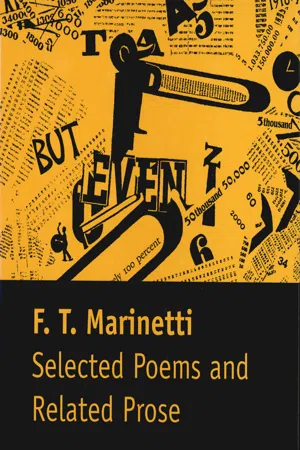 eBook - PDF
- R. Po-chia Hsia(Author)
- 2011(Publication Date)
- Yale University Press(Publisher)
Futurist Words in Freedom (1919) Futurism, born in Milan eleven years ago, has in-fluenced the entire universe through thousands of ex-hibitions, meetings, and concerts, and has created in-numerable different Futurisms in response to the needs of different circles. Every circle has its own kind of passéism, an oppressive,pernicious passéism that must be destroyed. Futurism has been understood in all the European and American capitals and has become the springboard for important spiritual revolutions every-where. In Italy it has long been slandered and hounded by reactionary, clerical, moralistic, pedantic, and con-servative forces. It is emerging from this battle more powerful than ever. The Futurist movement first exercised an artistic effect while at the same time indirectly influencing Italian politics through its propaganda of revolution-ary,anticlerical patriotism that was directed against the Triple Alliance and that prepared us for our war against Austria. Italian Futurism, prophet and architect of our war, disseminator and coach of courage and freedom, opened its first artistic meeting at the Lirico Theater in Milan eleven years ago with the cry Down with Austria! From that day on, those words became the inces-sant cry of all our stormy gatherings. The Italian Futurists are proud of having orga-nized the first two mass demonstrations against Austria on 15 September 1914 in Milan, in the face of Italian neutrality. These two demonstrations were relentless and resounding: eight Austrian flags were burned in the riot by the Futurists, who were thrown into jail at San Vittore. The Futurists, always first in the streets to fight for the declaration of war on Austria, were also first on the battlefield, with a large number of dead,wounded,and decorated. During the war the Futurists founded the Futurist political party, whose organ is the paper Roma Futurista. eBook - PDF
The Promise of History
Essays in Political Philosophy
- Athanasios Moulakis(Author)
- 2019(Publication Date)
- De Gruyter(Publisher)
The famous eleven laws of Futurist art that follow are the direct consequence of its 'life-style': 1. We intend to sing the love of danger, the habit of energy and fearlessness. 2. Courage, audacity, and revolt will be the essential elements of our poetry. 3. Up to now literature has exalted a pensive immobility, ecstasy, and sleep. We intend to exalt aggressive action, a feverish insomnia, the racer's stride, the mortal leap, the punch and the slap. 186 Manfred Hinz 4. We say, that the world's magnificence has been enriched by a new beauty; the beauty of speed. A racing car whose hood is adorned with great pipes, like serpents of explosive breath — a roaring car that seems to ride on grapeshot — is more beautiful than the 'Victory of Samothrace'. 5. We want to hymn the man at the wheel, who hurls the lance of his spirit across the Earth, along the circle of its orbit. 6. The poet must spend himself with ardor, splendor, and generosity, to swell the enthu-siastic fervor of the primordial elements. 7. Except in struggle, there is no more beauty. No work without an aggressive character can be a masterpiece. Poetry must be conceived as a violent attack on unknown forces to reduce and prostrate them before man. 55 This is the Futurist replacement of the old sublime by a new one. This art has no autonomy over action, it is entirely integrated with it, becomes part of the 'élan', and it is impossible to distinguish whether this art compensates aggres-sion in the aesthetic sphere, or whether it is the spark which makes it explode in real action. Yet, aggression, which in reality demands motives and limits, is 'liberated' by these quasi-aesthetics from any similar necessities. It would be a misinterpretation to conceive Futurism, following Benjamin's theory, as de-ritualisation or profanisation of art. The new sublime, the auto-mobile, is more beautiful, more overwhelming, than the 'Victory of Samo-thrace', the exemplar of the old. eBook - ePub
European Literary History
An Introduction
- Maarten De Pourcq, Sophie Levie, Maarten De Pourcq, Sophie Levie(Authors)
- 2018(Publication Date)
- Routledge(Publisher)
10Modernism
Unlike the avant-gardists, who all worked in groups, provoked their audiences with their anti-bourgeois behaviour and openly took political stances, the more moderate authors did not manifest themselves as a movement and never drew up a joint literary programme. Writers like Virginia Woolf, T.S. Eliot, James Joyce, Thomas Mann, Marcel Proust and Italo Svevo did not disseminate their ideas about literary innovation* through manifestoes, but instead worked individually on their novels, short stories and essays. Like the avant-gardists, they were dissatisfied with the representation of reality in the work of their predecessors and searched for new ways to capture a changing world. In their writings, they exploit the unreliability of linguistic communication while at the same time exploring the depth of human consciousness, the passing of time and the subconscious impulses that move every individual. Also like the avant-gardists, they were influenced by the theories of Nietzsche, Freud, Einstein and Bergson, and the technological and scientific advances of the late nineteenth century. Any efforts on their part to form a separate group of their own, however, would have been obstructed by the fact that these writers not only came from different national traditions but also wrote in their own mother tongues. This is not to say that they did not keep up with the latest literary developments, both national and international. A lively exchange sprung up in newspapers and magazines, publishing both critical and original work by the new authors. The little magazines* especially played an important role as a platform for the dissemination of and discussion on the new style in prose and poetry. T.S. Eliot’s correspondence – as well as the letters, diaries and critical writings of Virginia Woolf, Rainer Maria Rilke and Thomas Mann, to name but a few examples – show the rapidly increasing internationalisation of literature during the interbellum and the way in which authors influenced each other across national boundaries. Poets and writers such as Eliot and Woolf did more than just correspond; they also reviewed each other’s works and published their writings in German and French magazines. Through his writings on his British and Italian contemporaries, the French author Valery Larbaud kept fellow authors and the French public informed. Eliot, an American by birth, worked as British literary correspondent for La Nouvelle Revue Française, a magazine founded in 1909 by André Gide, among others. The German-language poet and novelist Rilke, whose extensive travels across Europe brought him into contact with like-minded authors from Scandinavia to Spain, visited Paris several times before and after World War I. The city and his many contacts in the French literary world became a source of inspiration for his work. In turn, André Gide translated selected passages from Rilke’s modernist novel Malte Laurids Brigge (1910) and published them in the NRF
Index pages curate the most relevant extracts from our library of academic textbooks. They’ve been created using an in-house natural language model (NLM), each adding context and meaning to key research topics.

