Literature

Neo-Realism
Neo-realism is a literary movement that emerged in the aftermath of World War II, characterized by a focus on the everyday lives of ordinary people and a rejection of romanticism and idealism. It sought to depict the harsh realities of post-war society with a sense of objectivity and social consciousness, often emphasizing themes of poverty, class struggle, and the human condition.
Written by Perlego with AI-assistance
Related key terms
1 of 5
11 Key excerpts on "Neo-Realism"
 eBook - PDF
Art, Politics and Society
Social Realism in Italian and Turkish Cinemas
- Asli Daldal(Author)
- 2010(Publication Date)
- Gorgias Press(Publisher)
Neo-Realism is a type of critical realism but under the high artistic influence of naturalism. For the Christian Democrat Rossellini, the basis of Neo-Realism is the depiction of everyday life through a technique of faithful reportage, in line with the typical contemporary interest of the modern man in statistical and scientific results 2 . This positivistic approach is erroneously generalized by some critics to the whole of the movement, and Zola's naturalism is shown as the literary counterpart of Neo-Realism. 3 In fact Neo-Realism is a hybrid style, embodying elements from both perspectives. Thus, Rossellini is closer to Zola, whereas Visconti is, no doubt, a follower of Stendhal. The difference of Neo-Realism from naturalism is that the former is always interested in capturing the essential behind the surface appearance of things. But unlike orthodox realist works, this essential is never treated in terms of causal relationships. The neo-realist directors are often satisfied with showing the consequences of deep social conflicts, and the socio-economic analyses of these conflicts are generally absent from their works. Apart from the idea of collective strength and solidarity, they do not offer any solutions to the problems (i.e. poverty, the black market, unemployment, prostitution, exploitation of peasants...) they depict. Zavattini says that, it is enough for the artist to make the need urgently felt 4 . As Lawton points out: ... From the critical realists and the naturalists, the neo-realists inherited the depiction of everyday life and the perception that the interests of the different social classes do not necessarily coincide. But while naturalism's sympathy for the worker offered no solution, often Neo-Realism emulated socialist realism. eBook - ePub
- Raymond Williams(Author)
- 2013(Publication Date)
- Parthian Books(Publisher)
7 Realism and the Contemporary NovelThe centenary of ‘realism’ as an English critical term occurred but was not celebrated in 1956. Its history, in this hundred years, has been so vast, so complicated and so bitter that any celebration would in fact have turned into a brawl. Yet realism is not an object, to be identified, pinned down and appropriated. It is, rather, a way of describing certain methods and attitudes, and the descriptions, quite naturally, have varied, in the ordinary exchange and development of experience. Recently, I have been reconsidering these descriptions, as a possible way of defining and generalising certain personal observations on the methods and substance of contemporary fiction. I now propose to set down: first, the existing variations in ‘realism’ as a descriptive term; second, my own view of the ways in which the modern novel has developed; third, a possible new meaning of realism.There has, from the beginning, been a simple technical use of ‘realism’, to describe the precision and vividness of a rendering in art of some observed detail. In fact, as we shall see, this apparently simple use involves all the later complexities, but it seemed, initially, sufficiently accurate to distinguish one technique from others: realism as opposed to idealisation or caricature. But, also from the beginning, this technical sense was flanked by a reference to content: certain kinds of subject were seen as realism, again by contrast with different kinds. The most ordinary definition was in terms of an ordinary, contemporary, everyday reality, as opposed to traditionally heroic, romantic or legendary subjects. In the period since the Renaissance, the advocacy and support of this ‘ordinary, everyday, contemporary reality’ have been normally associated with the rising middle class, the bourgeoisie. Such material was called ‘domestic’ and ‘bourgeois’ before it was called ‘realistic’, and the connexions are clear. In literature the domestic drama and, above all, the novel, both developing in early eighteenth-century England with the rise of an independent middle class, have been the main vehicles of this new consciousness. Yet, when the ‘realist’ description arrived, a further development was taking place, both in content and in attitudes to it. A common adjective used with ‘realism’ was ‘startling’, and, within the mainstream of ‘ordinary, contemporary, everyday reality’ a particular current of attention to the unpleasant, the exposed, the sordid could be distinguished. Realism thus appeared as in part a revolt against the ordinary bourgeois view of the world; the realists were making a further selection of ordinary material which the majority of bourgeois artists preferred to ignore. Thus ‘realism’, as a watchword, passed over to the progressive and revolutionary movements. eBook - ePub
Miraculous Realism
The French-Walloon Cinéma du Nord
- Niels Niessen(Author)
- 2020(Publication Date)
- SUNY Press(Publisher)
My second objection against Delorme and Lavin is that their juxtaposition of realism and its revival in young French, and more broadly francophone-European, cinema, on the one hand, and a radical modernism that links Bresson to New Wave and post–New Wave directors including Godard and Eustache, on the other, oversimplifies the triangular relationship between Italian neorealism, the French New Wave, and the long tradition of “Bazinian” realism: from Vigo and Renoir, via Bresson and Pialat, to Dumont and the Dardennes. That triangle is the focus of this chapter, which explores the revival of a socially critical and often humanist realism in the wake of modern critiques of realism and representation in francophone-European film and philosophy. Building on Beugnet’s definition cited earlier, I understand new realism as an ethics and aesthetics of filmmaking that 1) reinvents earlier practices, and in particular the Italian neorealist practice, of depicting the everyday lives of ordinary people for the globalized age, and 2) revives a belief in cinema’s promise to capture reality, however defined, while showing the influence of television and mobilizing the haptic potentials of new digital image and sound technology. New realism is a cinema of life, so I agree with Lavin and Delorme, “life” understood as both the biological body-mind and its sociocultural trajectory from cradle to grave. In its most compelling forms new realism integrates both notions of life. It does so when it renders intelligible and sensible the question: “How does the transition from a strong industrial to a more precarious and diversified, postindustrial economy affect the social fabric, down to the structures of people’s quotidian existence?”First and foremost, new realism addresses this question by telling stories. It’s a storytelling cinema, and as such it moves away from what Gilles Deleuze has theorized as the “modern cinema” and its deconstruction of stories. In Deleuze’s terminology, one could consider new realism as a renewed cinema of the “action image,” by which Deleuze in his Cinema books refers to the type of plot-driven image that became dominant under cinema’s classical paradigm (e.g., Classical Hollywood, the French cinéma du papa). At the same time, new realism, in its most interesting forms, also transforms the “action image” into what I call the acting/acted image eBook - PDF
How to Make Believe
The Fictional Truths of the Representational Arts
- J. Alexander Bareis, Lene Nordrum, J. Alexander Bareis, Lene Nordrum(Authors)
- 2015(Publication Date)
- De Gruyter(Publisher)
But the term is useful in distinguishing between those forms which tend to efface their own textu-ality, their existence and discourse, and those which explicitly draw their attention to it. Realism offers itself as transparent. The rejection of the concept of a literary form which reflects the world, however, has led some post-Saussurean critical theorists to use the phrase ‘classic realism’ to designate literature which creates an effect or illusion of reality. This is not just another gratuitous piece of jargon. ‘Classic realism’ makes it possible to unite categories which have been divided by the empiricist assumption that the text re-flects the world. (Belsey [1980, 51]) The Concept of Literary Realism | 21 But if one needs to invent a new term to refer to such works as have been called simply realist, then the question does arise whether the concept of realism itself is not losing its usefulness as a critical instrument. Indeed, this kind of criticism in effect denies the existence of realist literature. If no literary work can be real-ist in the sense that it ‘truthfully/objectively represents reality’, then the con-cept of realism becomes a concept with a null extension and only an ideological function. 3 There are various ways to respond to ‘The rejection of the concept of a literary form which reflects the world’. An immediate and direct response was simply to reject the rejection and insist that literary realism is a form of truth-telling. Real-ist works of literature are interesting and valuable because they do tell the truth about human existence: War and Peace is interesting not only as an account of a particular campaign and of the manners and morals of a certain group of people in a certain place and time. It is great be-cause it has much to say about war and peace at other places and other times. The reality described in a great fiction stands metonymically for a larger reality, or for a whole, infi-nite class of realities. eBook - PDF
- James Acheson, S. Ross, James Acheson, S. Ross(Authors)
- 2019(Publication Date)
- Palgrave Macmillan(Publisher)
PART I Realism and other -isms 1 Realism, Dreams and the Unconscious in the Novels of Kazuo Ishiguro Frederick M. Holmes A critical consensus has emerged about the themes, modes, narrative tech- niques and interrelationships of the five novels that Ishiguro has published to date. The first three - A Pale View of Hills (1982), An Artist of the Floating World (1986) and The Remains of the Day (1989) - have been cel- ebrated for their historically grounded realism, achieved through the limpid, masterfully controlled prose styles of their first-person narrators, all of whom depend upon memory as they look back over their troubled lives and times. Realism in fiction is a vexed concept, but it can be defined as the attempt to use linguistic and narrative conventions to create a fictional illu- sion of social and psychological reality that seems plausible to ordinary readers. Writers of realist fiction, David Lodge comments, assume that 'there is a common phenomenal world that may be reliably described by the methods of empirical history'; however, he adds that 'to the later writers in the [ realist] tradition what this world means is much more problematical'.1 In other words, although the novelists of the eighteenth and nineteenth cen- turies had a shared view of the nature of reality, those of the twentieth and twenty-first centuries are generally aware that what constitutes reality is a matter for speculation and debate. Neither is contemporary realism usually premised on the belief that the language used to describe what Lodge calls the 'common phenomenal world' is a transparent medium that creates a perfect correspondence between its symbols and an objective reality exter- nal to it. On the contrary, most realists recognise that language does not so much mirror reality as use conventions to construct simulacra of what some readers can accept as reality. No longer available |Learn more
Neorealist Film Culture, 1945-1954
Rome, Open Cinema
- Francesco Pitassio(Author)
- 2019(Publication Date)
- Amsterdam University Press(Publisher)
On the contrary, I believe that, in a certain given period—i.e. the post-war era, and namely in the years 1945-1949 and more occasionally in the following f ive years—numer-ous Italian artworks appeared that aimed to represent, reflect, and change national, and sometimes international, reality. For the sum of these reasons, I agree with scholars such as Gian Piero Brunetta, Alberto Farassino, or Bruno Falcetto 29 who, rather than using expressions such as movement, school, or aesthetics, prefer to talk about the ‘neorealist epoch’ or ‘f ield of tensions’. Such a conception does away with any intentionality or planned action in the phenomenon itself, 30 particularly when it comes to the relationship of cultural products with reality; conversely, it emphasises the unpredictable manner in which artworks, declarations, appraisals, or rejections followed one after the other at a given historical conjuncture. Nonetheless, within this epoch and f ield, some mottos, slogans, and implied constellations of meanings and practices did recur, as already discussed by many scholars. 31 Words such as engagement, document, chronicle, everydayness, people, humankind, and/or man come back in statements and declarations or echo in novels, tales, and films. They all exhibit a willingness to face reality, to report authentic experiences, and to advocate general human values beyond political ideologies and allegiances, in an allegedly distanced mode, as chronicles usually do, and in a direct way, beyond art. Right after the war, novelist Cesare Pavese proclaimed: We are not aiming at the people. Since we are already people, and eve-rything else does not exist. If anything, we shall aim at the man. […] The new legend, the new style is all there. 32 The war’s aftermath created unprecedented circumstances for artists, who now felt (or believed) they were part of a larger community—their audience. eBook - PDF
- Carlos Reis(Author)
- 2020(Publication Date)
- De Gruyter Mouton(Publisher)
It is also the case that this so-called critical Realism (although incapable, according to Lukacs, of describing the man of the future) has merit as an artistic tendency that, by raising all that is important (positive or negative) in the bourgeois life to a level of typical signification, in that way managed to present the meaning of that life and make it comprehensible. 10 None of what has been said prevents us from disagreeing with the negative terms in which Lukacs describes the artistic avant-gardes which are situated at the opposite extreme of realist literature . n 1.3. In another sphere, it is also possible to see how narrative reveals special aptitudes for fulfilling realist representation's aesthetic and socio-cultural designs: we are referring to the formulation, normally in prose, of narrative discourse. In this case, we are dealing with a problem that includes a number of collateral issues, from the question of literary genres (including the common confusion between narrative and prose) to the historical consolidation of a discursive formulation whose aesthetic pres-tige is more recent than that of verse. Whatever the case may be, we are concerned to approach this matter in terms of the domain of functionality, connecting it closely not only to narrative's basic characteristics 12 but also to its metonymic proclivity already commented upon: it is worthwhile to recall, in this regard, that Jakobson explicitly states that it is the predominance of the metonymic which rules and effectively defines Realism. On the basis of relationships Marxism and realism 127 of contiguity, the realist author elaborates métonymie digressions from the plot to the environment, and from the characters to the spatio-temporal setting. eBook - PDF
- Michael J. Hoffman, Patrick D. Murphy, Michael J. Hoffman, Patrick D. Murphy(Authors)
- 2005(Publication Date)
- Duke University Press Books(Publisher)
ultimate unfolding of the possibilities latent in them, in extreme presentation of their extremes, rendering concrete the peaks and limits of men and epochs. True great realism thus depicts man and society as complete entities, instead of showing merely one or the other of their aspects. Measured by this criterion, artistic trends determined by either exclusive introspection or exclusive extraversion equally impoverish and distort reality. Thus realism means a three-dimensionality, an all-roundness, that endows with indepen-dent life characters and human relationships. It by no means involves a rejection of the emotional and intellectual dynamism which necessarily develops together with the modern world. All it opposes is the destruction of the completeness of the human personality and of the objective typicality of men and situations through an excessive cult of the momentary mood. The struggle against such tendencies acquired a decisive importance in the realist literature of the nineteenth century. Long before such tendencies 104 ] georg lukács appeared in the practice of literature, Balzac had already prophetically fore-seen and outlined the entire problem in his tragicomic story Le chef d’oeuvre inconnu. Here, experiment on the part of a painter to create a new classic three-dimensionality by means of an ecstasy of emotion and colour quite in the spirit of modern impressionism, leads to complete chaos. Fraunhofer, the tragic hero, paints a picture which is a tangled chaos of colours out of which a perfectly modeled female leg and foot protrude as an almost for-tuitous fragment. Today a considerable section of modern artists has given up the Fraunhofer-like struggle and is content with finding, by means of new aesthetic theories, a justification for the emotional chaos of their works. The central aesthetic problem of realism is the adequate presentation of the complete human personality.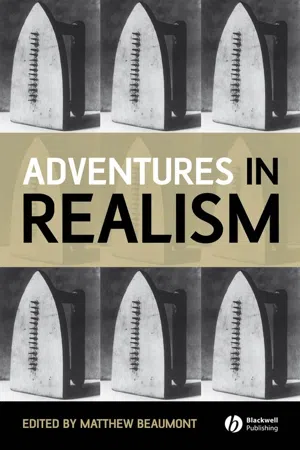 eBook - PDF
- Matthew Beaumont(Author)
- 2008(Publication Date)
- Wiley-Blackwell(Publisher)
Realism stood for an exact and unedited representation of nature, for truth and contemporaneity. It represented a materialist approach to the world, to some even a pictorial equivalent to positivism. Crucially, it represented a rejection of the ideal, so central to the value system of academic theory, and a corresponding valorization of the mundane and ugly (Weinberg 1937: 97–114). It was this privileging of the common-place and low that made realism seem democratic at a time when the exten-sion of bourgeois democratic rights was still a revolutionary proposition in France, as elsewhere. However, in that context it was at most tepidly socialistic, and even the novels of social propaganda produced in con-siderable number under the July Monarchy in France did no more than seek to prompt sympathy for the sufferings of the poor and to disseminate progressive ideas. If realism stood for an approach to the painting of the contemporary world that treated ordinary experience (rather than the doings of the rich and great) as the proper realm of art, then there were clearly abundant inherited materials from which such an art could be made. The emer-gence and growing importance of the independent genres of portrait, landscape, still-life, and genre painting itself (small scenes of everyday life), in both northern and southern Europe, between the fifteenth and eigh-teenth centuries, was one sign of the fact that painting, like the other arts, increasingly served secular functions. When Champfleury defended Gustave Courbet’s first major work, After Dinner at Ornans (1848–9) at the Salon of 1849, he described it famously as “a genre painting of natural size”; and he would associate both it and its yet more ambitious successor, Burial at Ornans (1849–50) with seventeenth-century Dutch and Flemish genre paintings, with life-size figures of beggars and cripples by Velázquez and Murillo, and with group portraits by Van der Helst and Rembrandt (Champfleury 1973: 154, 163). eBook - PDF
War, Peace, and International Political Realism
Perspectives from The Review of Politics
- Keir A. Lieber(Author)
- 2009(Publication Date)
- University of Notre Dame Press(Publisher)
Be- hind all the claims of neorealism’s methodological and epistemological supe- riority, all of which may or may not be true, lies a more basic explanation for the rise and popularity of neorealism among American scholars. We cannot fully understand the popularity of neorealism in the United States without ex- amining it and classical realism in the context of the American liberal tradi- tion. Theoretical perspectives, particularly in the social sciences, thrive not merely because of their scientific superiority, but also because they are conso- nant with a society’s prevailing values and beliefs. I. Classical Realism in the United States A good place to begin this discussion is to examine how most people think of realism today in the context of general debates over international relations theory, because as one does so it becomes clear that there are some problems. Two of the most recent and widely used surveys of the field are K. J. Holsti’s The Dividing Discipline and Kauppi and Viotti’s International Relations Theory. 5 Holsti identifies three contending paradigms—the classical tradition, theories of global society, and neo-Marxist approaches. Kauppi and Viotti also present three schools of thought—realism, pluralism, and globalism. It is clear from reading these overviews that the different categorizations are basically the same (i.e., realism is the classical paradigm, pluralism is theories of global society, and globalism is the same as neo-Marxist approaches). The analysis and citations in both volumes also makes it clear that the authors see the clas- sical paradigm (Holsti) or realism (Kauppi and Viotti) as the dominant frame- work for understanding international relations in the United States. Even the most cursory examination of the literature suggests that this judgment is correct. The problems emerge when different labels are employed and when we look at the specific issue of international conflict. eBook - PDF
- Jens Elze(Author)
- 2022(Publication Date)
- Bloomsbury Academic(Publisher)
While eco-critical perspectives have thrived on experimental poetry and dystopian fiction as modes that are trying to wrestle us from complacency, Levine argues that realism is actually the most suitable mode of envisioning sustainability. This nexus between realism and sustainability does not assume a simplistic representational understanding of realism or the perpetuation of the belief that realism naturalizes social forms and relations. Quite the opposite, Levine draws on a quality of realism 20 REALISM that is often muted by its detractors and that becomes even more vital to realism’s politics in the Anthropocene: defamiliarization. Levine looks at a range of historical and contemporary texts and TV series, from Dickens’s Bleak House over the BBC’s Call the Midwife (2012-) to Chimamanda Ngozi Adichie’s Americanah (2013) to explore how they deploy a realist aesthetics of defamiliarization in order to restore to our awareness those social tasks, infrastructures, and routines that are vital to maintain and imagine socially and ecologically sustainable forms of communal life. Dirk Wiemann’s contribution theorizes realism’s ambiguous relation to politics in the context of globalization, by attending to the relation between network realism, capitalist realism, and the “world novel.” Global capitalism is often understood as a mode of production that generates a networked world, in which the most distant locations and live-worlds are connected through the abstract workings of capital. In this vein, Wiemann reads the fragmented and loosely entangled form of recent “world novels,” like David Mitchell’s Cloud Atlas, as symptoms of a world networked by capital, as a form of network/capitalist realism.
Index pages curate the most relevant extracts from our library of academic textbooks. They’ve been created using an in-house natural language model (NLM), each adding context and meaning to key research topics.

