Literature

Social realism (1930s-1980s)
Social realism in literature from the 1930s to the 1980s was a movement that aimed to depict the everyday lives of ordinary people, often focusing on social and political issues. Writers sought to provide a realistic portrayal of society, addressing topics such as poverty, inequality, and the struggles of the working class. This literary movement emphasized the importance of social consciousness and the need for social change.
Written by Perlego with AI-assistance
Related key terms
1 of 5
12 Key excerpts on "Social realism (1930s-1980s)"
 eBook - PDF
- Carlos Reis(Author)
- 2020(Publication Date)
- De Gruyter Mouton(Publisher)
Above all, what Socialist Realism represents is an historical example of literary representation's adaptation to the concrete historical demands of a particular period. In an era marked by politico-social events of great 130 Narrative and realist representation importance (the consolidation of the Soviet revolution and of Stalinism, the economic crisis of the 30's, the birth of the People's Front in France, the establishment of totalitarian regimes in Italy, Germany and Portugal, the political origins of the 2nd World War, etc., etc.) it is not surprising to find partial and ideologically proselytizing expositions of Realism; this is precisely the case with Jean Cassou when he states, in 1936: ... In art I cannot express all of reality and nobody can oblige me to express all of reality. I can only express that with which I feel a deep solidarity. 19 On to these models, to some extent justified by an era filled with tension, Socialist Realism further superimposed an orientation originating in a peculiar political situation: the radical and incontrovertible assertion of the literary work's social content, the systematic rejection of formalist deviations, the postulation of the writer as an engineer of souls engaged in propelling society towards Socialism, the shaping of positive heroes as irreproachable interpreters of Socialist ideals, the concentration of the writer's attention on the phenomena of his time as the initial stage of bringing into perspective the society and the man of the future. All this was dominated by two basic principles: that which defended a preem-inently didactic viewofthe functionsof artand that which saw realist repre-sentation (ideologically informed by Dialectical Materialism) as a process of representation concerned with the social truth of its contents, rather than with artistic verisimilitude or with the appropriateness of technico-literary procedures. eBook - PDF
- Matthew Beaumont(Author)
- 2008(Publication Date)
- Wiley-Blackwell(Publisher)
And it took further debate in the art and literature journals before the term was defined in contrast to the principles of Western modernism and most world literature, at the first All-Union Congress of Soviet Writers in August 1934. In hindsight it is remarkable that Socialist Realism first emerged as a method applicable to the literary arts. This priority can be SOCIALIST REALISM 143 taken as reflecting an older tradition of nineteenth-century Russian clas-sic writers of the order of Tolstoy, Turgenev, and Chekhov, combined with a utilitarian strain in nineteenth-century critical writing from such revolutionary democrats as Belinsky, Dobrolyubov, and Chernyshevsky. Indeed, when Andrei Zhdanov, Secretary of the Central Committee of the Communist Party, addressed the 1934 Congress with his notorious speech “Soviet Literature – The Richest in Ideas, the Most Advanced Literature,” he was able to associate what he believed was the pessimism, nihilism, and disjointedness of literature in the capitalist countries with the crisis of capitalism itself, especially its failure to resist the darkest cul-tural consequence of capitalism, namely fascism. The Socialist Realist work of literature, Zhdanov announced, is by contrast optimistic – not in a subjective way but “because it is the literature of the rising class of the proletariat, the only progressive and advanced class.” Soviet literature is already strong “because it is serving a new cause, that of socialist con-struction.” Hence the Socialist Realist writer or artist was able to depict not merely “objective reality” (that was being done, said Karl Radek later in the Congress, by the likes of James Joyce) but “to depict reality in its revolutionary development” (Gorky et al. 1977: 20–1). eBook - PDF
- Jeremy Hawthorn(Author)
- 2016(Publication Date)
- Bloomsbury Academic(Publisher)
In contrast, if a novel presents us with a world that seems extremely unusual, it may encourage us to ask to what extent our familiar world perhaps really is like this, in ways we have not previously considered. The term “realism” very often implies that the artist (and not just the literary artist) has tried to include a wider and more representative coverage of social life in his or her work, and in particular that he or she has extended the coverage of the work to include “low life” and the experiences of those deemed unworthy of artistic portrayal by other artists. The apparent realism of the early novel was intimately related in the public mind to the fact that it often concerned itself with the lives of the sort of human being who would not only never have been portrayed by the romance but whose depiction was clearly out of bounds too for the genteel eighteenth-century poet. Fielding’s Joseph Andrews, Defoe’s Moll Flanders, Smollett’s Humphry Clinker—none of these characters or their real-life equivalents could have entered into the polite world of Alexander Pope except in certain forms of satire or burlesque. This is one of the reasons why Joseph Andrews (1742), Moll Flanders (1722), and Humphry Clinker (1771) are generally taken to be more realistic works than Pope’s mock-heroic poem The Rape of the Lock (1711). “Realism” also has a specific reference to a particular literary movement which started in France in the early nineteenth century, and flourished in the latter part of the century. The novelists most associated with this movement are Balzac, Stendhal, and Flaubert. These writers made enormous efforts to ensure that “factual details” in their works were “correct”—that is to say, capable of being checked against an external reality by empirical investigations. They achieved this accuracy by lengthy and painstaking research. eBook - PDF
- Jens Elze(Author)
- 2022(Publication Date)
- Bloomsbury Academic(Publisher)
It may precisely be due to this confusion or, as has been formulated in more polite terms, to its “exceptional elasticity” that the term “realism” today looks back on an impressive, albeit somewhat doubtful, success story. 20 Historically rooted, as we have seen, above all in the 1850s in France, it has rather unhistorically deployed its impact forward and backward in the sense that, prospectively, it even today still looks as if it were addressing an important—if not the important—aspect or feature of what is widely, and almost always epigonally, identified with, or commonly taken for, “literature,” while at the same time, it is also used retrospectively to— anachronistically but, perhaps, to some extent also appropriately—describe, for example, eighteenth-century or even seventeenth-century prose or is taken as an epithet referring to the “novel” in general, going back to works like Cervantes’s Don Quixote or even Homer’s Odyssey. 21 Considering this, one can say that the term today seems to have split into basically two complementary, if not contradictory, uses: (1) “realism” as a historical term referring to the literature of a certain distinct period, that is to say, (roughly) to the genre of the novel in the second half of the nineteenth century, and (2) “realism” as a typological (or systematic) term referring to a certain mode of re/presenting a text’s contents in a way so as to make the process of transmission as self-denying or unobtrusive or direct or objective or transparent or consumable as possible. 22 In the first case, “realism” is used as a term referring to a specific period in time comparable to other periods such as “classicism,” “romanticism,” “modernism,” “postmodernism,” etc.; in the second, it is used as a term identifying a specific style or mode, a way of expressing things, presupposing some existence of what is being expressed and, more often than not, appearing rather in the adjectival form “realistic” than in its nominal equivalent.
- Noriko Mizuta Lippit(Author)
- 2017(Publication Date)
- Routledge(Publisher)
Politics and Literature: The Debate Over Socialist Realism 9 During the 1920s and 1930s, writers and artists in Japan actively debated the proper relationship between politics and literature, between social values and artistic values. The dispute over socialist realism appeared as the culmination of this debate. For the Japan Communist Party (JCP) and those writers committed to socialist revolution, these issues and the question of socialist realism were naturally of central concern. The question of the relation of art and literature to society or of world view to literary creation, however, was of great concern to nonproletarian writers as well, particularly to those humanist and modernist writers who, discontent with the dissociation of art from society in the decadent literature and autobiographical I-novels then dominant, were trying to make art once again vitally relevant to social reality and the modern human condition. 1 The question of literary realism had been a major subject of debate from the time of Tsubouchi Shōyō's essay "The Essence of the Novel" in 1885, 2 and with the development of the I-novel as a distinct genre in the twentieth century, the debate often took the form of critiques of the I-novel. An outgrowth of naturalism, the I-novel had become the predominant novelistic genre in the "modernization" of Japanese literature from the turn of the century. Narrowing their concerns to the exploration and unveiling of their own internal worlds, the writers of the I-novels had lost vital touch with the reality outside of themselves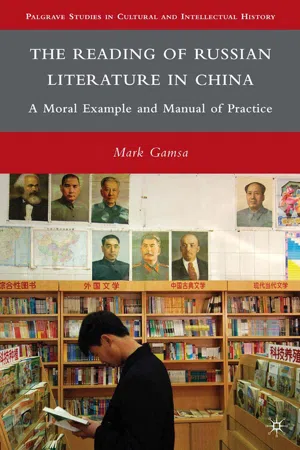 eBook - PDF
The Reading of Russian Literature in China
A Moral Example and Manual of Practice
- M. Gamsa(Author)
- 2010(Publication Date)
- Palgrave Macmillan(Publisher)
Already in 1933 an enthusiastic article by Zhou Yang brought socialist realism to China and presented it as the most recent development in the theory of literature and art. 35 Condemning the “mistakes” of RAPP, Soviet socialist realism was extended retrospectively to include the key works of the first revolution- ary decade, though it proved necessary to reach as far back as 1907 in order to establish that the first novel of socialist realism avant la lettre had been Gorky’s Mother. The favourite of many revolutionaries (includ- ing Lenin), Nikolai Chernyshevskii’s What Is to Be Done? (1863) could not formally enter the annals of the genre but was considered another prec- edent and an argument in support of the continuity of Russian “progres- sive” thought. In a formulation that became notorious for its ambiguity, in the Writers’ Congress of 1934 Stalin’s commissar of education Andrei Zhdanov instructed Soviet writers to “depict reality in its revolutionary development”. The corresponding requirements from writers in China were, prior to the adoption of the Soviet term in 1953, gathered under the heading of “proletarian realism”; it was this last term that Mao had employed in the original version of his Yan’an Talks in 1942. As championed by Zhdanov’s counterpart Zhou Yang and made into holy writ by Mao, the Chinese interpretation did not differ greatly from the Soviet model: it too defined the correct standpoint of the writer as that of the proletarian class (compare with the Soviet demand for klassovost’ , the “class character” of literature) and the purpose of writing as serving the masses of “workers, peasants and soldiers” (compare with narodnost’ , “national character”), and it underlined T HE READING OF RUSSIAN LITERATURE IN CHINA 104 the absolute precedence of political over creative considerations (the Soviet partiinost’ , “Party spirit”). The slogan of “socialist realism” was reaffirmed after the Communist victory in 1949.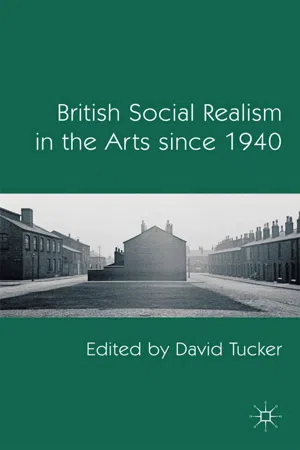
- D. Tucker(Author)
- 2011(Publication Date)
- Palgrave Macmillan(Publisher)
Social Realism and Visual Art 155 Studio International in 1976 provided a snapshot of some of the socially and politically engaged work going on in Britain at the time. 47 Steve Willats wrote about ‘Art Work as a Social Model’, a theme he pursued through the 1970s as he explored the realities of living in high-rise urban housing through text, photography and diagrams. Walker doc- umented the important Artists Placement Group, the project set up by John and Barbara Latham, Jeffrey Shaw and Barry Flanagan a decade ear- lier, which created artists’ residencies in industrial settings: placements included John Latham with the National Coal Board as well as in the Intensive Care Unit of Clare Hall Hospital, Stuart Brisley at Hillie Co Ltd, Leonard Hessing working with ICI Fibres Ltd, and Lois Price with the Milton Keynes Development Corporation. 48 In the same issue, Victor Burgin, typically crossing the boundaries of theory and practice, contributed a theoretical critique on ‘Socialist For- malism’ and a two page photo-essay warning against the illusions of capital, urging As we move into this characteristic contemporary world, we can see the supposed new phenomenon of classlessness as simply a failure of consciousness. Class consciousness Think about it (Burgin 1976, pp. 146–7) Later that year, Burgin reprinted his now well-known poster, Possession, originally produced in connection with an exhibition in Edinburgh, and flyposted 500 copies of it across Newcastle upon Tyne. Created to look like an advertisement, it aimed to engage the public in a political dialogue about consumption under capitalism. All these activities and practices exemplified art’s purposeful engage- ment with social and political contexts but, in particular, specific photographic practices in the 1970s and 80s offer a richer resource for considering a social realist aesthetic. eBook - PDF
Exploring Visual Culture
Definitions, Concepts, Contexts
- Matthew Rampley(Author)
- 2019(Publication Date)
- Edinburgh University Press(Publisher)
In this sense his work is closely related to the late nineteenth-century European Realist project of mapping contemporary culture and social mores, par-ticularly those that relate to urbanism and consumerism. As in late nineteenth-century Europe, there is a political project here. Murakami and followers of his superflat doctrine stress the insurgence of consumer-driven subcultures, equating generational Japanese rebelliousness with voyeuristic passive aggression, sexual fetishism and compositional dynamism. Superflat is a cultural oxymoron, a ritualis-tic form of resistance against the perceived oppressiveness of the ritualistic behaviour that dominates Japanese daily life. 6 The Politics of Representation In the twentieth century, what was representationally permissible (and therefore ‘real’) was often subject to coercive acts of censorship in Fascist and Communist dictatorships, as well as in purportedly liberal democracies. The Soviet concept of Socialist Realism, rigorously pursued during the Stalinist era, is a good example of ‘realism’ being used to describe a set of representational conventions. Socialist Realism was designed to show the Communist government and state in a favourable light, depicting happy collective farm workers, industrial labourers and soldiers striving eagerly for a better future. What Socialist Realism depicted were the ideo-logical ideals of the Party, rather than the day-to-day lives of ordinary Soviet citi-zens. 7 The seemingly simple act of drawing, in this context, clearly has a political outcome. Official art functioned purely in relation to socially established medians. Any challenge to these medians was ruthlessly suppressed. Drawings produced by REPRESENTATION AND THE IDEA OF REALISM 123 starving political dissidents held in Soviet gulags attest to a brutal undesirable present hidden by the framing sensibility of state-endorsed realism. eBook - PDF
- Bertolt Brecht(Author)
- 2015(Publication Date)
- Methuen Drama(Publisher)
Realism and Formalism 1938-1940 Word that this magazine wanted to assign too narrow a space to realism in literature. It may be that, in a few discussions, the realist mode of writing was characterised in far too formal terms, and that many a reader therefore came away with the idea that what is being proposed is that a book is written in a realist way if it is 'written in the same way as the bourgeois realist novels of the last century'. Of course that is not being proposed. Realist writing can only be distinguished from non-realist writing by being confronted with the very reality it deals with. There are no special formalities that have to be observed. It may be a good idea to introduce to the reader at this point a writer from the past, who wrote differendy from bourgeois novelists and yet must still be called a great realist: the great revolutionary English poet P. B. Shelley. If it were the case that his great ballad The Mask of Anarchy written immediately after the bourgeoisie's bloody suppression of riots in Manchester (1819), did not fit the usual descriptions of a realist mode of writing, then we would need to make sure that the description of the realist mode of writing is indeed changed, broadened and completed. Shelley describes how a terrible procession makes its way from Manchester to London: I met Murder on the way -He had a mask like Castlereagh, Very smooth he looked, yet grim; Seven bloodhounds followed him: All were fat; and well they might Be in admirable plight, For one by one, and two by two, He tossed them human hearts to chew Which from his wide cloak he drew. Next came Fraud, and he had on, Like Eldon, an ermined gown; His big tears, for he wept well, Turned to mill-stones as they fell, 221 BRECHT ON ART AND POLITICS And the little children who Round his feet played to and fro, Thinking every tear a gem, Had their brains knocked out by them.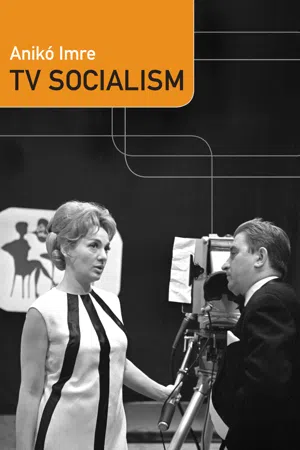 eBook - PDF
- Anikó Imre(Author)
- 2016(Publication Date)
- Duke University Press Books(Publisher)
This is because any notion of realism, whether it is a project of verisimilitude or of reference to the real, is based on a normative construction of “the real,” whose existence is “disputable independently of any media representation.” 3 FROM SOCIALIST REALISM TO EMOTIONAL REALISM • 31 Marxism presumed the existence of material reality and assigned representation a mirroring, rather than performative, re-presenting role. Idealist philosophies, while not banned, were taught to be simply wrong. The system’s great seduction lay precisely in holding out the promise that it possessed historical truth and placed everyone on the road to its ful-fillment, the perfect society. However, life under socialism was a far cry from this eventual good life. By the 1960s, as the grand promise appeared to be further and further delayed and as communist parties continually redirected and adjusted their truth-seeking ideologies to match the real-ity of economic lag and deficit of political trust, the gap between public Marxist rhetoric and its private translations grew increasingly wide. This is the gap in which television quietly performed its work of ideological fermentation. By the mid-1960s, socialist parties began to grab onto the new mass medium as a vehicle around which to consolidate their dwin-dling legitimacy. Because of its ability to link the private and the public spheres, television became an experimental kitchen in which to adjust the recipe for making an ideal, then an adequate, then at least a livable socialist society. The economic contours of this society resembled capital-ism more and more with each reform, while holding on to the social pro-tections and nationalistic cultural leanings typical of Western European socialist democracies. Realism became a flexible ideological and aesthetic instrument in the course of these adjustments. eBook - PDF
- Daniel Tyler(Author)
- 2021(Publication Date)
- Cambridge University Press(Publisher)
Third, if the novel interrogates itself so comprehensively every twenty or thirty years, then it follows that realism cannot be as monolithi- cally complacent as it is accused – as it accuses itself, indeed – of being. In fact, far from seeing realism as smoothly and oppressively “classic,” it would be more historically sensitive to see the great realists as multifarious, precarious, and radical – the creators not of instant classics but of instant experiments. Since the word realism is problematic anyway – because it can refer to a movement in literature and art (first used in connection with Courbet’s paintings, and then transferred to Flaubert); to a broader approach to the writing of fiction in the syntax of verisimilitude; or simply to a worldview that prizes unillusioned veracity – we would do better to talk of realisms, or of a particular author’s realism. 24 Jane Austen’s realism, which possesses almost no density of detail, describes no furniture or clothes or even faces, could not be further from Balzac’s or Flaubert’s detail-infested noticing. Leo Tolstoy’s realism, often called Homeric, is rich in denotation and is of course full of the events of the world, but it has none of the pressurized anxiety, the careful formalism, of Flaubert’s. (When Flaubert first read War and Peace, he admired its great power but was shocked by how the Russian master repeated himself, and how wantonly he “philoso- phized.” 25 Henry James, Flaubert’s disciple in this respect, thought the Russian epic an affront to formalist realism, a “loose, baggy monster.”) 26 Theodor Fontane is rightly regarded as the greatest German realist of the nineteenth century, but his great novel Effi Briest (1895), which on the surface tells yet another “classic” story of an adulterous heroine, ripples with symbolism, allegorical patterning, ghost tales, gothic atmospheres, and fragments of other texts about adulterous women.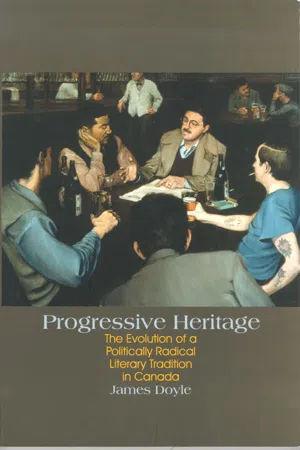 eBook - PDF
Progressive Heritage
The Evolution of a Politically Radical Literary Tradition in Canada
- James Doyle(Author)
- 2006(Publication Date)
- Wilfrid Laurier University Press(Publisher)
But the short stories published in Masses reveal as much uncertainty and disagreement among Communist creative writers as among the critics and theorizers about what socialist realism should achieve and how it should achieve its ends. Lunacharsky's insistence that the new litera-ture of the proletariat should deal with the victorious principle of the forces of the socialist revolution proved difficult to reconcile with the tendency to associate literary realism with the sordid and oppressive aspects of human experience. According to the tenets of socialist realism, to write only about the suffering of poverty-stricken workers provided an incomplete view of reality; yet even converts to The 1930s: Socialist and Other Realisms 97 Marxist-Leninist historical optimism found it hard to break away from dominant realist literary models. The first short story in Masses, published in the second (June 1932) issue, illustrates the difficulties. Written by M. Granite-pos-sibly a pseudonym for Oscar Ryan, who also wrote as Martin Stone-Fellow Workers describes a demonstration of the unem-ployed, and focuses on one demonstrator, who is arrested, beaten, and at the end of the story, thrown in jail. The author's basic method is documentary—much of the narrative reads almost like a news story—with impressionistic glimpses of the appearance and feelings of the participants. In its narrow and literal focus on the class strug-gle, the story certainly satisfies Stanley Ryerson's leftist definition of proletarian art. In fact, the story comes close in conception and nar-rative method to a theory of fiction advocated in Russia by the Left Front of Art (LEF), in opposition to the socialist realism of the IURW. According to the LEF formulation, creative literature was to be totally rational and concentrate on facts. The writer was to be seen as an arti-san (Murphy 32).
Index pages curate the most relevant extracts from our library of academic textbooks. They’ve been created using an in-house natural language model (NLM), each adding context and meaning to key research topics.

