History

War on the Sea
The "War on the Sea" refers to naval warfare and battles fought on the world's oceans and seas. Throughout history, nations have engaged in conflicts at sea to gain control of trade routes, protect their territories, and project power. Naval warfare has played a crucial role in shaping the outcomes of many historical conflicts and continues to be a significant aspect of modern military strategy.
Written by Perlego with AI-assistance
Related key terms
1 of 5
9 Key excerpts on "War on the Sea"
 eBook - PDF
- Anne Curry(Author)
- 2019(Publication Date)
- Bloomsbury Academic(Publisher)
13 In presenting a new interpretation of the maritime dimension of the war, we shall assess the reasons for, and implications of, these and other distinctive features of the war at sea, and consider how, in terms of naval activity, the three broad phases of the war – 1337–60, 1369–89, 1415–53 – differed from each other and why. Our investigation is driven by three key questions. To what extent and in what ways were strategy and naval operations of England and France, whether logistical or ‘fighting’ in nature, shaped by environmental constraints and geopolitical considerations, and how far by the maritime resources that were available for deployment? How effective were these operations in fulfilling the protagonists’ strategic aims? What were the relative merits of the various types of naval resource that could be drawn upon? THE WAR AT SEA: STRATEGY AND OPERATIONS The Maritime Environment and Naval Warfare It is something of a commonplace that the stretch of sea separating England from mainland Europe is at once a barrier and a highway. Shipping an army intended for a large-scale land campaign posed a formidable logistical chal-lenge. Army size was constrained by the carrying capacity of the fleet of avail-able transport vessels, and much depended on the vagaries of the weather. While assembling the hundreds of vessels required to transport the men, horses, equipment and supplies that an army of 5,000 men needed, com-manders were ever conscious that contrary winds might cause delays or even cancellation, and that once at sea a fleet could be scattered by storms. Edward III’s personal role in the war ended anticlimactically in October 1372 when a fleet carrying 6,000 men-at-arms and archers, having failed to make progress against headwinds, was forced to return to port. 14 Yet the relative rapidity and efficiency with which, in favourable conditions, a seaborne force eBook - PDF
Brown-, Green- and Blue-Water Fleets
The Influence of Geography on Naval Warfare, 1861 to the Present
- Michael Lindberg, Daniel Todd(Authors)
- 2001(Publication Date)
- Praeger(Publisher)
5 Naval Warfare on the High Seas When people think of the long historical tradition of naval warfare, they generally conjure up images of ships-of-the-line battling it out in line-ahead formations or lines of battleships attempting to "cross the T," or perhaps, more recently, carrier task groups ranging far and wide across great ocean expanses seeking one another in order that their groups of winged warriors could swoop down and dispatch these flattops with lightning strikes. Truth be told, however, much of what has constituted naval warfare over the past 150 years bears little resemblance to these romantic images. Apart from the Battle of Jutland in World War I and a handful of fleet actions in the Pacific during World War II, such fleet engagements have been the exception in naval warfare, not the rule, and while carrier-to-carrier battles raged throughout the Pacific during the latter conflict, the last 50 years have seen no such engagements on the high seas. So why do these images, however isolated in history, dominate our perception and study of naval warfare? Perhaps, apart from their obvious appeal for naval enthusiasts, it is because they represent the personification of naval power. In these fleet-to-fleet engagements navies seem to have their greatest impact upon one another. This may be true, but navies do not exist solely to impact one another. Instead, they are part of a larger picture, a greater cause. To be sure, naval warfare is not conducted in a vacuum. It is not separate from larger strategic considerations that are always centered on land and involve, ultimately, military campaigns on land. Almost never have naval operations been conducted independently of, and without regard to, land operations or objectives. Even those operations that take place entirely at sea, and involve only naval forces are still being waged in connection with some land-oriented objective. eBook - PDF
- Matthew Hughes, W. Philpott(Authors)
- 2006(Publication Date)
- Palgrave Macmillan(Publisher)
9 naval warfare andrew lambert Conventionally naval warfare has been treated as a distinct subject, set apart by specialist knowledge and essentially concerned with fighting between navies. This reflects the origins of academic naval history in the naval educational needs of an age of profound technological transformation without conflict (1865-95), rather than its connection with the newly professional discipline of history. 1 The influence of navies on their history has favoured the production of highly detailed narratives which rarely extend their scope beyond the maritime dimension. This history of naval warfare is filled with inconclusive engagements between fleets of essentially identical configuration, technological advantage being perhaps the most transitory of all advantages, rarely lasting long enough to decide a war, even if the initial impact was significant. The famous Monitor-Virginia action of 1862 is typical. While most accounts focus on the fighting the real impact was the effect this drawn action had on Union General George McClellan's Peninsula Campaign. This example suggests the important questions for naval history address the balance between land and sea power, and the ability of navies to influence the result of conflicts. In 1911 the brilliant maritime strategist Sir Julian Corbett (1854-1922) wrote: Since men live upon the land and not upon the sea, great issues between nations at war have always been decided- except in the rarest cases- either by what your army can do against your enemy's territory and national life, or else by what the fear of the fleet makes it possible for your army to do. 2 172 naval warfare 173 His argument was directed at those who followed a simplified version of the case advanced by Alfred T. Mahan (1840-1914) that securing command of the sea would ensure victory in war.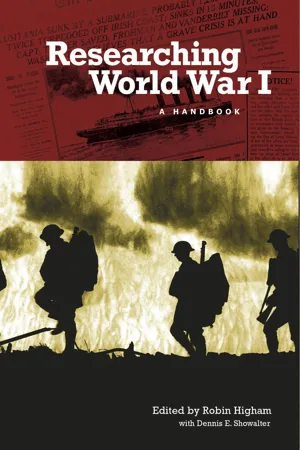 eBook - PDF
Researching World War I
A Handbook
- Robin Higham, Dennis Showalter, Robin Higham, Dennis Showalter, Dennis E. Showalter, Robin Higham, Dennis E. Showalter(Authors)
- 2003(Publication Date)
- Greenwood(Publisher)
15 The War at Sea Eugene L. Rasor INTRODUCTION The important historical literature and conflicts of interpretation among histori- ans of the war at sea before and during World War I will be reviewed. For the first time in history naval warfare in three dimensions, surface, sub- surface, and aerial, was demonstrated on a major scale. The submarine, mines, torpedoes, and the aircraft, with versions of lighter- and heavier-than-air, were introduced in an already unprecedented pace of technological change in surface naval warfare. This precipitated changes in the concepts of sea power, naval strategy and tactics. There had been relative peace during the long nineteenth century while extraordinary advances in science, industry, and technology had progressed unabated. Other innovations included the development of a system of alliances based on a series of stated contingencies, restructuring of military and naval organizations based on elaborate war planning and readiness for mobilization; on strategic and tactical reorientations, such as how a blockade was conducted; and on an unprecedented international arms race, especially involving new super-battleships, the Dreadnought, and a cheaper, faster, but more vulnerable, battle cruiser. Invasion scares, naval panics, and accusations of encirclement resulted as inevitable consequences. For some, war came as a relief. Despite warning signs, such as were evident from the American Civil War and the Sino-Japanese and Russo-Japanese Wars of the late nineteenth and early twentieth centuries, the predictions were that a future war would be short and much glory would be attained. When war finally came, at sea, participants, in order of importance and appearance, were Great Britain, Germany, France, Russia, Italy, Austria- 316 RESEARCHING WORLD WAR I Hungary, Turkey, Japan, and the United States. eBook - PDF
From Valmy to Waterloo
France at War, 1792-1815
- M. Thoral(Author)
- 2010(Publication Date)
- Palgrave Macmillan(Publisher)
While cruising on the three-master the Cerf in Malaysian waters in 1793, Guillaume-Marie Angenard took part in the capture of six large proas (multihull sailing vessels) carrying cargoes from Europe and China. Angenard was among the crew members who went in boats to board the proas and ferry their cargo back to the privateer, in the course of which, he admits, he stole a small part of the booty for himself, like the other seamen: ‘I did what I saw others doing. I pock- eted various gold objects and a nice little pearl necklace that I sold in Mauritius.’ 81 The War at Sea 71 IV. Conclusion The maritime war of the revolutionary and Napoleonic era – less glori- ous and less successful for France than the war on land – had direct and far-reaching implications for French society and made a deep impres- sion on public opinion. The war on land was spectacular in scale and extent, encompassing practically the whole of continental Europe, from southern Spain to the Russian steppes and from Italy to the Baltic. But the maritime war was a truly world war in the literal sense of the term: it extended over several seas and oceans and posed a threat to long-established trading relations in an increasingly integrated or ‘global’ world economic system, most notably in the colonial and Mediterranean markets. War at sea, like war on land, moved closer to being ‘total’ in this period. Naval combat reached new levels of intensity and violence, a trend reinforced by the new practice of refusing surrender and taking the enemy in pursuit. Secondly, it required quantities and concentra- tions of men, ships, and materials on a massive scale. Finally, the war at sea now involved civilians, either through choice, as corsairs, or invol- untarily, through exposure to the effects of the war on maritime trade.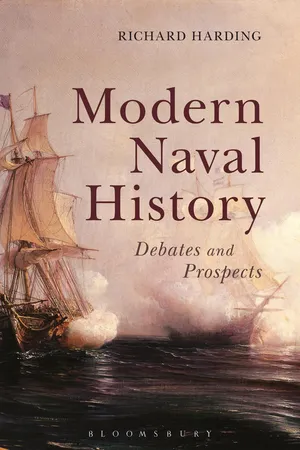 eBook - PDF
Modern Naval History
Debates and Prospects
- Richard Harding(Author)
- 2015(Publication Date)
- Bloomsbury Academic(Publisher)
It was an aspect of the war that was central to British naval planning, and, lacking the dramatic narrative of decisive sea battles, it was a story that could be presented to the public as a shining example of how sea power worked constantly to preserve British supplies of food and raw materials while slowly, but decisively, strangling the enemy. In recent years, historians have revised interpretations of both the defensive and offensive policies, demonstrating that the British were less sure footed than the immediate post-war narratives claimed. The defence of British trade was precarious until the middle of 1917 as the British sought a means to counter the German U-boats. It was not until the adoption of convoys after the crisis of April 1917 that the threat was overcome. 148 The offensive, founded on an aggressive plan of economic warfare, rapidly collapsed under US and domestic pressures. It struggled on as a series of improvisations, and its ultimate effectiveness owed as much to German agrarian inefficiencies as to a tight maritime grip on a major industrial economy. 149 A range of minor themes (in terms of historical attention given to them) have also had some good work done on them in recent years. Paul Halpern has covered the naval war in the Mediterranean. 150 The war in the air at sea has had some attention, particularly its significance for the control of the English Channel. 151 The Gallipoli campaign has its own large literature, SEA POWER AND INTERNATIONAL RELATIONS 45 but after the abortive attempt to force the Straits on 18 March 1915, these histories focus mostly on the army’s campaign on the Peninsula. Aside from participants, such as Churchill, Keyes and Wemyss, writing after the war, the naval contribution to the overall campaign has not attracted a great deal of attention. 152 Combined operations generally in the war still need modern studies. 153 The war ended without a decisive naval victory that the public could applaud. eBook - PDF
- G. Mortimer(Author)
- 2004(Publication Date)
- Palgrave Macmillan(Publisher)
177 10 Sea Power: The Struggle for Dominance, 1650–1815 Richard Harding Sea power in early modern history By 1650 war at sea had many of the characteristics that were to be familiar for the next 160 years. Warships had assumed the basic form and design that developed into the classic line-of-battle ship and frigate (Lavery, 1983; Gardiner, 1992). The purpose of navies was generally agreed. States put fleets to sea with the intention of fighting their enemies, destroying their trade and invading their territory, as well as defending their own lands and trade. The warship was also a symbol of state power for domestic and diplomatic purposes. The size and decoration of ships such as the English Sovereign of the Seas (1637) and the French Soleil Royal (1669) were self-conscious expressions of royal power. These warships were extremely expensive and complex, and the need for basic administrative systems to support large-scale state navies was recognized and, in some states, in place. With so much progress already made, it is tempting to see the developments of the next 150 years as simply a working out or perfecting of well-established principles of naval warfare under sail. Warships got bigger, became better armed, and sail plans improved. It was possible to keep warships at sea longer and send them further. With greater control, reach and duration the benefits of sea power became more attainable and desirable. From this perspective Great Britain was the prime example of the sea power. From Cromwell to George III there was a conscious incremental development of the state’s navy that steadily outpaced its rivals. By the mid-eighteenth century Britain achieved an ascendancy over its rivals that was never fully eclipsed. With the exception of the years 1778–81 and 1796–98 British ships dominated the world’s oceans.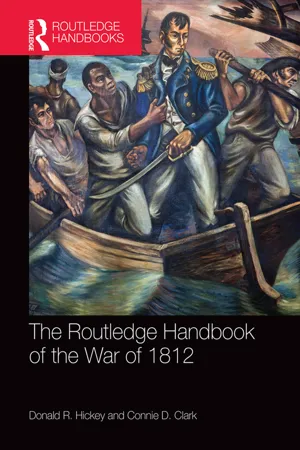 eBook - ePub
- Donald R. Hickey, Connie D. Clark(Authors)
- 2015(Publication Date)
- Routledge(Publisher)
4The War on the High SeasAndrew LambertWhile the Naval War of 1812 is a familiar subject, it has suffered from a fractured historiography. The basic American treatment, created by wartime and early postwar Democratic-Republican politicians and publicists, claimed the United States won the war, with the Navy playing a significant part in that victory. This literature focused on surface detail: combat, heroism, and ocean voyages. It addressed the pressing need of the governing party to win the upcoming presidential election, rather than the outcome of the conflict. Yet it was so successful that within two decades President Andrew Jackson brandished his “victorious” navy as a weapon in diplomatic relations with Britain and France, whose navies could have demolished the American fleet and imposed a crippling economic blockade.A very different assessment of the naval war was produced by British lawyer-historian William James. Having collated and analyzed the evidence, James concluded the American victories in single-ship actions, the core of the boasted naval “victory,” were, in all cases, the product of a substantial American superiority in size, manpower, and firepower. More importantly, as Alfred Thayer Mahan argued more than a century ago, it mattered very little who won the occasional frigate battle, so long as British floating commerce continued to move without serious hindrance across the world ocean, enabling the British to fund their war effort. America simply lacked the power to stop British trade. Mahan recognized the overriding importance of economic warfare, the offensive weapon of British sea power against American land power. Blockading ports, seizing commercial shipping at sea, and destroying commercial assets onshore dovetailed perfectly with the defense of British floating trade against American warships and privateers. American cruisers were blockaded or destroyed in port, while the convoy system and cruiser patrols at key landfalls obliged any predators that did get to sea to fight for their prizes. Having waged total economic war against republican and imperial France for almost 20 years, the British simply applied the same strategy to America, extending blockades, convoys, and other countermeasures to address the new threat. The British victory was absolute; by November 1814 the United States was bankrupt: literally unable to pay sailors, shipyard workers, and bondholders. British limited war strategy prevailed. eBook - PDF
Blue Water Patriots
The American Revolution Afloat
- James M. Volo(Author)
- 2006(Publication Date)
- Praeger(Publisher)
4 The Art of War at Sea [We will] put to hazard the fortunes of war in America. —John Montagu, Lord Admiral Sandwich AMERICAN STRATEGY Strategy and tactics are related, but they are not equivalent. Strategy is done in a planning room by heads of state, commanders of military forces, or Lords of the Admiralty (usually on maps), while tactics are applied by the on-site commanders at the point of contact with the enemy. In most cases where opposing warships came into contact, the deployment of specific tactics was left to the judgment of the admiral in charge of a fleet or the captain in charge of an individual ship. Although none of its prominent members were specifically trained in nautical matters, Congress supplied the overall naval strategy for America. This was generally limited to defending the deep-water ports and major coastal towns from insult by the Royal Navy. In September 1775 Josiah Quincy proposed the construction of coastal fortifications ‘‘placed to command the channels’’ so that British warships ‘‘could be driven out by [their] fire’’ or kept out by the deployment of armed barges. ‘‘Row gallies must be our first mode of defense by sea,’’ he noted. 1 Naval scholar Alfred Thayer Mahan noted that a strategic reliance on the defense alone harbored an intrinsic inadequacy for any nation with many ports scattered over an extended coastline compelling it ‘‘to distribute [its] force so as to be strong enough to stop the enemy on any line of attack that [they might] adopt.’’ 2 It is not clear that the members of Congress understood the consequences of this limitation of their strategy at the time. The British attack on Charleston, South Carolina, in 1776 was remark- able for the depth of its failure, and it presented a number of strategic les- sons from which the Americans might learn in defending other port cities. Unfortunately, the Patriots were never again so successful in defending a port city from naval attack as they were in repulsing Gen.
Index pages curate the most relevant extracts from our library of academic textbooks. They’ve been created using an in-house natural language model (NLM), each adding context and meaning to key research topics.

