History

US Navy
The US Navy is the naval warfare service branch of the United States Armed Forces. It was established in 1775 and has played a significant role in shaping American history through its involvement in conflicts and operations around the world. The Navy's capabilities include power projection, strategic deterrence, and maritime security.
Written by Perlego with AI-assistance
Related key terms
1 of 5
6 Key excerpts on "US Navy"

- Daniel R. Lake(Author)
- 2019(Publication Date)
- Palgrave Macmillan(Publisher)
© The Author(s) 2019 Daniel R. Lake The Pursuit of Technological Superiority and the Shrinking American Military https://doi.org/10.1057/978-1-349-78681-7_5Begin Abstract5. The Navy and Technology
End AbstractDaniel R. Lake1(1) State University of New York College at Plattsburgh, Plattsburgh, NY, USAThe Navy is the second oldest American armed service, established by the Second Continental Congress in 1775. During the Revolution, it experienced some success at commerce raiding but was disbanded after independence due to a lack of funds (Carrison 1968 ; Howarth 1991 ; Love 1992 ; Morris 1984 ). After being reconstituted, for most of its first century the Navy was relatively small and insignificant by the standards of the day. Its main mission during its early years was protecting US merchant ships from predators like the Barbary pirates and French privateers, though it also started to develop a proud wartime tradition with victories against the British during the War of 1812. During the nineteenth century, the Navy played an important role in achieving victory in the Mexican-American and Civil Wars by blockading ports, supporting ground troops, and carrying out the amphibious landing at Veracruz. By mid-century the Navy was also increasingly engaged in gunboat diplomacy, such as Commodore Perry’s expedition to Japan. While the Navy grew quite large during the Civil War, it was not until the 1880s that the United States began to build a modern Navy commensurate with its status as a rising great power. This was used to demonstrate American power and might, defeating the Spanish Navy in 1898 and circumnavigating the globe as the “Great White Fleet.” The Navy was relegated to an important supporting role in World War I, protecting convoys from German U-boats, and during the interwar years the Navy started to experiment with aircraft carriers. World War II was a transformative experience for the Navy, both because of the central role it played in Allied victory and in the rise of the aviation and submarine communities within the Navy (Mahnken 2008 eBook - ePub
Securing The Seas
The Soviet Naval Challenge And Western Alliance Options
- Paul H Nitze(Author)
- 2019(Publication Date)
- Routledge(Publisher)
7Evolution of the U.S. NavyEarly History
Until the last decade of the nineteenth century, the United States was concerned primarily with coastal defense, and most of its ships were constructed for that specific purpose. Although the U.S. Navy had a significant mission of maintaining a presence overseas and took action against Caribbean and Barbary pirates, its major concern was the protection of coastal cities and shipping. Throughout most of that century, U.S. naval objectives remained limited. The combination of remoteness of location, the protection afforded by British naval supremacy, and limited international objectives hardly demanded a massive navy that could stand up to European fleets on the open seas.From about 1890 to 1910, U.S. naval objectives were entirely revised. Crises with England, Germany, Chile, and finally with Spain brought U.S. foreign relations impressively to the fore. The need to supply protection for U.S. citizens in South America and China, the threat of European penetrations in Central and South America, and the growing interest in the Pacific and in the acquisition of overseas possessions all forced a reevaluation of U.S. naval objectives. Under the influence of Alfred Mahan and the leadership of Theodore Roosevelt, the purely defensive navy gave way to the concept of the fighting fleet.The Battleship Navy
The nineteenth century had seen a revolution in naval ship construction. The advent of steam propulsion, screw propellers, shell ammunition, rifled ordnance, and armor plate all contributed to a great change in naval warfare. Many of these innovations were of American origin.The Russo-Japanese War established the supremacy of the battleship. The early 1900s witnessed major debates over the optimum displacement of that vessel (similar to present-day arguments over aircraft carrier size). The United States emphasized big guns and heavy broadsides rather than speed. Its aim was to acquire an oceangoing battleship navy of second rank, with the heaviest and most powerful units in the world. At this time, aircraft were in their infancy, and their military potential had not been foreseen. eBook - ePub
Contemporary Military Culture and Strategic Studies
US and UK Armed Forces in the 21st Century
- Alastair Finlan(Author)
- 2013(Publication Date)
- Routledge(Publisher)
Monitor, revealed an institution, albeit fractured, that had adopted state-of-the-art technologies such as armour, shell-firing guns and steam propulsion and now provided other navies with an example of future warfare. The roots of the modern US Navy and Marine Corps can be clearly linked to the rapid growth and prosperity of the United States from the mid-nineteenth century onwards, as its newfound strength in world affairs required its naval forces to support and, in some cases, enforce its political will on the world stage. The conquest of the US continent by the end of the nineteenth century, with the extinguishing of the internal threat from native North Americans, meant the first line of defence was now located in the Atlantic and the Pacific Oceans, which demanded powerful naval forces. The shift in priorities was quite apparent with US involvement in World Wars I and II, in which naval forces provided the only sustainable means of supporting large-scale armies abroad and protecting the mainland from potential invasions. It was this period that witnessed the origination of the modern US Navy and Marine Corps whose identities are so strong today.Transformative EventsFor the US Navy and Marine Corps, World War II represents one of the most important transformative events in their collective history. It generated a massive expansion across the board, with the two services accounting for a high of nearly 3.5 million personnel during the war.10 At an ideational level, World War II also had a significant impact on the self-image of both institutions due to their sheer success on the battlefield. The US Navy fought several great and decisive sea battles that finally brought them out of the shadow of the Royal Navy – a service with a history of famous battles at sea. World War II not only demonstrated that Nelson’s mantle had now passed to the US Navy, it was also unquestionably the most powerful naval force in existence – a position it still holds in the twenty-first century. It also revealed that the service had mastered the new age of naval warfare, in which the aircraft carrier, not the battleship, was the capital ship. In this respect, the US Navy was fortunate at the start of its war (1941 rather than 1939) that the surprise Japanese attack on Pearl Harbor on 7 December effectively neutralised its battleships for a significant period of time, so that inevitably much greater emphasis was placed on carrier air power, allowing it operational space to give a practical exhibition of its true value. This is not to argue that the US Navy’s awareness of the importance of aircraft carriers was not apparent before the war, because it was;11 eBook - ePub
War and Society Volume 2
A Yearbook of Military History
- Brian Bond, Ian Roy(Authors)
- 2015(Publication Date)
- Routledge(Publisher)
All of these uses of naval power were consistent with the basic American outlook and were directly related in every case to foreign policy considerations. Of course, foreign policy may not be the sole reason for which a navy exists. Certainly in the present case, the existence of a viable national defence was crucial to the very unity of the federal republic. But even with such an additional factor, the uses of the American Navy in this period were significantly different from those which Mahan outlined for great powers, even though the basic naval elements involved were very similar. There was proper geographic position, overseas bases, maritime commerce, deployed squadrons, but the ‘distant, storm-beaten ships’ of the American Navy sought neither commercial nor political dominion. There was no thought given to command of the sea.No body of naval theory has been written which will help us to understand fully why a small nation might wish to build a navy. In the American case, however, it seems apparent that the navy was used to secure a national identity amongst other nations as well as to assert, protect and defend those particular elements which were necessary to maintain that identity.One may take as the refrain to the history of the American Navy in the years of its birth, the words of advice which Benjamin Stoddart gave to Congress in 1798: The wisest, cheapest, and most reasonable means for obtaining the end we aim at, will be prompt and vigorous measures for the creation of a navy sufficient for defence, but not for conquest. Bibliography This essay is based on the following sources:R.G. Albion, Sea Lanes in Wartime (1968).G. Allen, Naval History of the American Revolution (1913).American State Papers: Naval Affairs, Foreign Affairs (1832).B. Bailyn, The Ideological Origins of the American Revolution (1967).S.F. Bemis, The Diplomacy of the American Revolution (1935).E. B. Billingsley, In Defense of Neutral Rights (1967). A. De Conde, The Quasi-War (1966).J. A. Field, America and the Mediterranean World, 1776-1882 (1969).J.C. Fitzpatrick (ed.), Writings of George Washington (1931-44).R. Glover, The French Fleet 1807-14: Britain’s Problem and Mr Madison’s Opportunity’, Journal of Modern History, 39 (1967), 233-52.G.S. Graham, The Empire of the North Atlantic (1958).F. H. Hayes, ‘John Adams and American Sea Power’, American Neptune, 25 (1965), 35-45.D. W. Knox, History of the United States Navy (1936).——, The Naval Genius of George Washington (1932).C. L. Lewis, Admiral Grasse and American Independence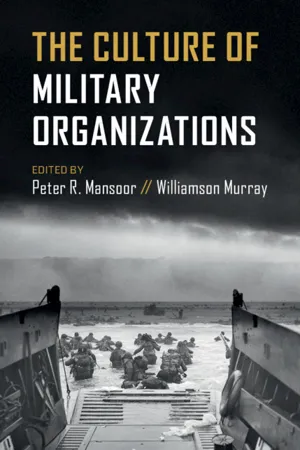 eBook - PDF
- Peter R. Mansoor, Williamson Murray(Authors)
- 2019(Publication Date)
- Cambridge University Press(Publisher)
The author joined the navy in 1981, specifically its naval aviation clan, and has experienced and observed all the cultural changes since. He continues a close relationship with the US naval officers who attend the US Army Command and General Staff College. 2 This chapter follows the construct presented in Chapter 2, although the US Navy might alter- natively be categorized as an institutional culture; see fn. 4 later in this chapter. 351 established, something scientists call initial conditions. 3 Moreover, service cultures of long duration are more stable, or more paradigmatic, to use Thomas Kuhn’ s phrasing. They encompass a much larger set of norms and rules, with a much broader mandate of functions, roles, missions, and capabil- ities for the larger societies that they ostensibly serve. 4 However, in the modern age, few societal organizations exist that are made from whole cloth. Most have their precedents, the government of the United States, for example, having the republics from classical antiquity, as templates from which they emerge. 5 The US Navy sprang from the traditions of navies going back to the days of Themistocles, but especially from the traditions of the reigning navy for most of the American history until after World War I, Britain’ s Royal Navy. This cultural substrate remains today in the odd language that American sailors still employ: scuttlebutt, grog, goat locker, gun deck, and so on. 6 Unlike other human organizations, navies, especially their physical manifestation as fleets of warships, are shaped profoundly by the environment in which they operate – the sea. Foremost they are shaped by the lonely separateness that sea service confers. Ships exist to go from point A to point B, whether that point is along a coast or at sea. To accomplish this, they risk the dangers of storms, tides, currents, winds, and all that the “cruel sea” throws at them. eBook - ePub
- Bradley A. (Bradley Allen) Fiske(Author)
- 2006(Publication Date)
- Perlego(Publisher)
Fortunately, Admiral Luce and a very few other officers had learned the salient lessons of war during the Rebellion, and sturdily stood up against the decadent tendency of the times. Against much opposition, Luce succeeded in founding the Naval War College at Newport, where the study of war as an art in itself was to be prosecuted, and in enlisting Captain Mahan in the work. In a few years Mahan gave to the world that epochal book, "The Influence of Sea Power upon History" (embodying his lectures before the War College), which stirred the nations of Europe to such a realization of the significance of naval history, and such a comprehension of the efficacy of naval power, that they entered upon a determined competition for acquiring naval power, which continues to this day.Meanwhile, a little before 1880, the people became aroused to the fact that though the country was growing richer, their navy was becoming weaker, while the navies of certain European countries were becoming stronger. So they began in 1880 the construction of what was then called "the new navy." The construction of the new ships was undertaken upon the lines of the ships then building abroad, which were in startling contrast with the useless old-fashioned American ships which then were flying our flag.The construction of the material of the navy has progressed since then, but spasmodically. At every session of Congress tremendous efforts have been made by people desiring an adequate navy, and tremendous resistance has been made by people who believed that we required no navy, or at least only a little navy. The country at large has taken a bystander's interest in the contest, not knowing much about the pros and cons, but feeling in an indolent fashion that we needed some navy, though not much. The result has been, not a reasonable policy, but a succession of unreasonable compromises between the aims of the extremists on both sides.Great Britain, on the other hand, has always regarded the navy question as one of the most difficult and important before the country, and has adopted, and for centuries has maintained, a definite naval policy. This does not mean that she has followed a rigid naval policy; for a naval policy, to be efficient, must be able to accommodate itself quickly to rapid changes in international situations, and to meet sudden dangers from even unexpected quarters—as the comparatively recent experience of Great Britain shows. At the beginning of this century the British navy was at the height of its splendor and self-confidence. Britannia ruled the waves, and Britannia's ships and squadrons enforced Britannia's policies in every sea. The next most powerful navy was that of France; but it was not nearly so large, and seemed to be no more efficient, in proportion to its size. Owing to Britain's wise and continuing policy, and the excellence of the British sailor and his ships, the British navy proudly and almost tranquilly held virtual command of all the seas.

